
I took care of my eighty-five-year-old neighbor for her inheritance, but she left me nothing.The next morning, her lawyer knocked and said, “Actually, she left you one thing.” I spent my whole childhood in the system.
My mother abandoned me right after I was born, and my father was rotting in prison before I learned how to spell my own name. I had no one. Not in the sweet, dramatic way people say it when they mean they feel lonely.
I mean no one. No mother at school plays. No father teaching me how to shave. No grandmother saving birthday cards. No uncle who showed up when things got bad.
I belonged to case files, borrowed bedrooms, and people who were paid to use words like placement and transition.
By the time I was eighteen, the system finally spit me out with two black trash bags of clothes, a bus voucher, and a handshake from a woman who told me to “make good choices.”
I wanted to laugh in her face. Good choices were easier when someone taught you what they looked like. I drifted for a while after that. A warehouse job in Ohio.
A motel cleaning job in Indiana. A dishwashing job behind a bar where the cook drank more than the customers. Eventually, I ended up in a small town called Bellweather, a place so quiet you could hear people judging you through their curtains.
I rented the cheapest apartment I could find.
It was above a closed flower shop with cracked windows, bad heating, and stairs that groaned like they were offended by my weight.
I took whatever work I could get.
Unloading trucks.
Fixing fences.
Mowing lawns.
Cleaning gutters.
Anything that paid cash and did not ask too many questions.
That was when Mrs. Rhode first noticed me.
Her house sat across the alley from my apartment building.
It was small, white, and stubborn-looking, with blue shutters, a crooked porch swing, and rosebushes that had clearly survived more winters than I had survived people.
Mrs. Rhode was eighty-five, thin as a broom handle, and sharper than broken glass.
She wore cardigans even in July, kept her gray hair pinned tight at the back of her head, and carried herself like old age had insulted her personally.
The first time she spoke to me, I was hauling a rusted washing machine from the flower shop basement for the landlord.
“You there,” she called from her porch.
I looked around.
There was nobody else.
“Me?”
“No, the mayor,” she snapped. “Yes, you.”
I set down the dolly.
“What?”
Her eyes narrowed.
“You always answer old women like that?”
“I answer everyone like that.”
She stared at me for a moment.
Then she smiled.
Not warmly.
More like she had found something interesting under a rock.
“Son, if you want to make decent money, come help me,” she said. “We’ll agree on a price.”
I almost kept walking.
I did not like favors.
I did not like old people who acted helpless and then complained about everything.
But I liked being hungry even less.
So the next morning, I went to her house.
She made tea, though I did not ask for it.
She placed one cup in front of me and sat across the kitchen table.
The kitchen smelled like lemon polish, old wood, and peppermint.
Everything was clean.
Not rich.
Not fancy.
Just cared for.
“My name is Eleanor Rhode,” she said.
“I know.”
“Because the mailbox says Rhode?”
“Yes.”
“And you are?”
“James.”
“James what?”
I hesitated.
Names had always felt temporary to me.
Different homes.
Different schools.
Different adults using my name like it was a problem written on paper.
“James Carter,” I said.
She nodded.
“Well, James Carter, I am dying.”
I stared at her.
She lifted her tea like she had just told me it might rain.
“Cancer,” she said. “It has spread. The doctors have become very gentle with me, which means the news is very bad.”
“I’m sorry.”
“No, you’re not. You don’t know me.”
I blinked.
She was not wrong.
“But you may be sorry later,” she continued. “Depending on how annoying I become.”
I did not know what to say.
Mrs. Rhode leaned back in her chair.
“I have no children. My husband has been dead for twenty-two years. My friends are either gone, in nursing homes, or too proud to admit they cannot drive after dark. I need help. Groceries. Pills. Small repairs. Rides to appointments. Someone to make sure I don’t die on the kitchen floor and get found by the mailman three days later.”
“That’s a lot.”
“I will pay you.”
“How much?”
She named a number.
It was more than fair.
I tried not to look surprised.
“And,” she added, watching my face, “if you take proper care of me until the end, I will leave you everything I have.”
Everything.
The word landed in my chest like a match.
I looked around the kitchen.
The house was old, but it was hers.
There was probably savings somewhere.
Maybe jewelry.
Maybe more than I had ever seen in one place.
I knew what some people would think of me.
They would say I was greedy.
They would say only a bad person hears an old woman say she is dying and thinks about inheritance.
But people who have never been poor love to romanticize poverty.
They think hunger makes you noble.
It does not.
It makes you practical.
“Deal,” I said.
Mrs. Rhode studied me for a long moment.
“You are very honest about being self-interested.”
“Would you rather I lie?”
“No,” she said. “I am too old to waste time with polite lies.”
So that was how it began.
At first, I treated it exactly like work.
Every morning before my other jobs, I stopped by her house.
I brought groceries from the market.
Eggs.
Milk.
Bread.
Tea.
Canned soup.
Those chalky vanilla nutrition drinks she hated but drank anyway because her doctor insisted.
I changed light bulbs.
Took out trash.
Fixed the wobbly stair railing.
Cleaned leaves from the gutters.
Drove her to appointments where nurses called her sweetheart and she looked like she wanted to bite them.
On Sundays, I sorted her pills into that plastic Monday-through-Sunday box.
She watched me like a prison guard.
“Blue one at night,” she said.
“I know.”
“White one with food.”
“I know.”
“Half the yellow one, not the whole yellow one.”
“I know, Mrs. Rhode.”
“You say that like people don’t make mistakes.”
“I’m not people.”
She smiled faintly.
“No. I suppose you’re not.”
She paid me every Friday.
Cash in an envelope.
She always wrote my name on it in careful handwriting.
JAMES.
As if someone might steal my envelope from the table.
As if I had anyone else around who would.
For the first few weeks, I kept my distance.
I did the work.
Took the money.
Went home.
But Mrs. Rhode had a way of dragging words out of silence.
“Why do you limp when it rains?”
“Old injury.”
“What kind?”
“Bad kind.”
“Who taught you to fix things?”
“Nobody.”
“That explains the crooked cabinet handle.”
“It works.”
“So does a mule. Doesn’t mean I want it in my kitchen.”
She was impossible.
Nosy.
Critical.
Too observant.
The kind of person who saw through you because she had no interest in pretending she could not.
Then one evening in December, she knitted me a pair of ugly green socks.
I had come in from shoveling her walkway.
My shoes were soaked, my hands were numb, and I was trying not to shake in front of her.
She held out the socks like she was offering me a royal medal.
“For you,” she said. “So your feet don’t freeze.”
They were hideous.
Thick.
Lumpy.
A green somewhere between split pea soup and mold.
I stared at them.
“I don’t wear stuff like that.”
“You wear wet socks?”
“I manage.”
“That was not my question.”
I took them because arguing with Mrs. Rhode was like punching fog.
She won by exhausting you.
“Thanks,” I muttered.
She looked pleased.
“Try them on.”
“Now?”
“No, at your wedding.”
I changed into them in the bathroom.
They were too warm.
Too soft.
Too much like something someone made while thinking about me.
When I came out, Mrs. Rhode pretended not to notice my expression.
“Well?” she asked.
“They’re ugly.”
“They are practical.”
“They’re very ugly.”
“Then no one will steal them.”
That was the first time she made me laugh.
After that, things changed slowly.
Not all at once.
Life almost never changes all at once.
It changes in small betrayals of what you thought you were.
I started staying for tea.
Then dinner.
Then old movies I claimed I hated but watched anyway.
Mrs. Rhode liked black-and-white mysteries, game shows, and complaining about news anchors.
She told me stories about her husband, Thomas.
He had been a mechanic with big hands and a terrible singing voice.
“He proposed to me with a ring he bought from a pawnshop,” she said one night. “I said yes before he finished the sentence because I was afraid he would change his mind.”
“Did he?”
“Never once.”
Her voice softened when she spoke about him.
Not weak.
Just lit from somewhere old.
Sometimes she showed me photographs.
Thomas standing beside a pickup truck.
Mrs. Rhode as a young woman in a yellow dress.
A baby in a knitted hat.
That one she put away quickly.
I noticed.
I always noticed things people tried to hide.
“Who’s that?” I asked.
“Nobody.”
“Nobody wore a hat?”
She glared.
I let it go.
A week later, she told me.
“We had a daughter,” she said while I fixed the loose hinge on her pantry door.
My hand stopped.
“Had?”
“Her name was Lydia.”
I did not turn around.
Sometimes people told secrets more easily if you did not look at them.
“She died when she was four,” Mrs. Rhode said. “Pneumonia. One week she was chasing butterflies. The next she was gone.”
“I’m sorry.”
This time, I meant it.
Mrs. Rhode nodded.
“Thomas wanted another child. I couldn’t. Or maybe I wouldn’t. Hard to tell the difference after a grief like that.”
I tightened the screw.
“My mother gave me away.”
The words came out before I planned them.
Mrs. Rhode said nothing.
So I kept talking.
“Or abandoned me. Depends on which social worker you ask. My father was in prison. I got moved around a lot.”
“How many homes?”
“Twelve.”
She breathed in sharply.
I hated that sound.
Pity.
I closed the pantry door harder than necessary.
“Doesn’t matter.”
“Yes,” she said quietly. “It does.”
I wanted to tell her she was wrong.
I wanted to say the past was done and I had survived it.
But there was something about Mrs. Rhode that made lies feel childish.
So instead I said nothing.
Almost every evening after that, we ended up talking.
She told me about Lydia.
About Thomas.
About working thirty years at the town library.
About the niece who only called near Christmas and sounded disappointed when Mrs. Rhode did not mention money.
I told her about group homes.
About sleeping with shoes on because things disappeared if you left them by the bed.
About the foster father who locked the pantry.
About learning to read people before they spoke because sometimes tone was warning enough.
For once in twenty years, I felt like someone actually gave a damn whether I came home or not.
I hated that feeling at first.
Caring made people dangerous.
When nobody mattered, nobody could leave a hole.
But Mrs. Rhode mattered anyway.
By spring, she was thinner.
Her hands shook when she lifted teacups.
She needed help getting in and out of the car.
Sometimes she forgot words and became furious with herself.
“Do not look at me like that,” she snapped one afternoon when I caught her gripping the counter to steady herself.
“Like what?”
“Like I am already gone.”
I looked away.
“I don’t.”
“You do.”
“Fine. I’ll look at you like you’re annoying.”
“That is better.”
In May, the doctor recommended hospice.
Mrs. Rhode refused at first.
Then accepted once the nurse promised not to call her dear.
Her world grew smaller.
Bedroom.
Kitchen.
Armchair.
Porch.
Still, she insisted on sitting outside every evening when the weather was warm.
I carried a blanket out for her.
She pretended she did not need it.
I tucked it around her knees anyway.
“You fuss worse than Thomas,” she said.
“Good.”
“He was better-looking.”
“Everyone says that.”
She smiled.
That summer, I stopped thinking about the inheritance.
Not completely.
I was not a saint.
I still knew there was a house.
I still knew she had promised.
But the thought stopped being the reason I showed up.
One night, she woke me with a phone call at 2:13 a.m.
“James,” she whispered.
I was across the alley in bed.
I sat up instantly.
“What happened?”
“I cannot breathe right.”
I ran across the alley barefoot in those ugly green socks.
I called the hospice nurse.
Sat beside her bed.
Held her hand while her lungs dragged air in and out like torn paper.
She was afraid that night.
Mrs. Rhode, who mocked doctors and bullied pharmacists and treated death like an appointment she planned to reschedule, was afraid.
“Don’t leave,” she whispered.
“I won’t.”
“Promise.”
“I promise.”
She squeezed my fingers with what little strength she had.
“Good boy.”
No one had called me that since I was too young to remember whether it was true.
I turned my face away so she would not see my eyes.
After that night, she changed.
Not kinder exactly.
Mrs. Rhode never became soft in the way stories make dying women soft.
She still complained.
She still corrected my coffee.
She still told the hospice nurse that her shoes were inappropriate for someone in medicine.
But she started watching me with a sadness I did not understand.
Once, I caught her looking at me while I washed dishes.
“What?” I asked.
“Nothing.”
“Your nothing face looks guilty.”
“My nothing face is my face.”
“Sure.”
She looked down at her hands.
“I have made arrangements.”
I dried a plate.
“What kind?”
“The necessary kind.”
The inheritance.
There it was again, between us.
I did not know why it suddenly made me uncomfortable.
“Okay,” I said.
She looked annoyed.
“That is all you have to say?”
“What do you want me to say?”
“Ask questions. Everyone asks questions when money is involved.”
“I don’t want to talk about it.”
Her eyes narrowed.
“Why?”
“Because you’re not dead.”
She looked at me for a long time.
Then she said softly, “No. Not yet.”
In September, she stopped walking without help.
In October, she stopped eating much.
By November, her voice had become thinner, but her mind stayed sharp.
One cold morning, I found her in the living room staring at the old photograph of the baby in the knitted hat.
Lydia.
I sat beside her.
“She looks like you.”
“She looked like Thomas when she was angry.”
“Was she angry often?”
“For a four-year-old? Constantly. She once told the pastor she did not like his sermon because it needed more horses.”
I laughed.
Mrs. Rhode smiled, then her eyes filled with tears.
It was the first time I had seen her cry.
“I wanted to be a mother longer,” she whispered.
I did not know what to do with that kind of pain.
So I just sat there.
After a while, she reached for my hand.
“You deserved a mother longer too.”
My throat closed.
I stared at the floor.
“Don’t.”
“James.”
“I said don’t.”
She squeezed my hand.
“I know you came for what I promised.”
Shame burned my face.
I tried to pull away, but she held on.
“I know,” she repeated. “And I know when that changed.”
I swallowed hard.
“It didn’t.”
“Liar.”
I laughed once, but it came out broken.
She smiled.
“My favorite kind of man. Useful and dishonest only when emotional.”
A week later, she asked me to bring her the dented metal lunchbox from the top shelf of her closet.
It was red once, maybe, but time had scratched most of the color away.
There was a faded sticker on the side shaped like a rocket ship.
“What’s this?”
“Private things.”
“Want me to put it somewhere?”
She nodded.
“Give it to Mr. Bell.”
“Your lawyer?”
“Yes.”
“Why?”
“Because I said so.”
That was Mrs. Rhode’s favorite legal argument.
I drove the lunchbox to Mr. Bell’s office that afternoon.
He was a small man with silver eyebrows and a careful voice.
He accepted the lunchbox like it weighed more than metal.
“Mrs. Rhode said you would bring this.”
“What is it?”
He looked at me over his glasses.
“Instructions.”
“For what?”
“For later.”
I hated that word.
Later.
It meant death was standing nearby, checking its watch.
On the last evening I saw Mrs. Rhode alive, it snowed.
Not heavy snow.
Just a thin white dusting over the porch railing and roses.
I made soup she barely touched.
Then I helped her into her armchair.
The old game show played on TV.
She liked the noise.
I sat on the couch with a blanket over my knees.
The ugly green socks were on my feet.
She noticed.
“You wear them often now.”
“They’re warm.”
“They are ugly.”
“That too.”
She closed her eyes.
For a while, I thought she had fallen asleep.
Then she said, “James?”
“Yeah?”
“When you are angry with me, do not stay angry forever.”
I frowned.
“Why would I be angry?”
“Because you are still young enough to think fairness means getting what was promised.”
I sat up.
“What does that mean?”
She opened her eyes.
They were watery but clear.
“It means I have done what I believe is right.”
“Mrs. Rhode—”
“Eleanor,” she said.
I froze.
She had never asked me to call her that.
“What?”
“My name is Eleanor.”
I stared at her.
She looked smaller than ever in that chair.
“Okay,” I said quietly. “Eleanor.”
Her lips trembled into a smile.
“Good boy.”
The next morning, I found Mrs. Rhode in her favorite armchair.
The TV was still mumbling through some old game show.
Her head rested slightly to one side.
Her hands were folded in her lap.
She had died in her sleep.
For a moment, I stood in the doorway and waited for her to insult me.
Tell me my face looked gloomy.
Tell me the tea was too strong.
Tell me to stop standing there letting cold air in.
But she said nothing.
The house was quiet.
Not peaceful.
Empty.
I walked over and touched her hand.
It was already cool.
I called hospice.
Then Mr. Bell.
Then I sat on the floor beside her chair and cried like something had been ripped out of me by the roots.
The funeral was small.
Too small.
A few church ladies.
Mr. Bell.
The hospice nurse.
The pharmacist Mrs. Rhode had tormented for years, who cried into a tissue and said, “She was my favorite difficult customer.”
Her niece came late wearing black sunglasses and irritation.
She looked at me once and dismissed me immediately.
I recognized that look.
I had seen it on foster parents, bosses, teachers, landlords.
The look that said temporary.
Unimportant.
Not family.
At the will reading, I sat in Mr. Bell’s office with damp palms and a hollow chest.
I hated myself for caring about the inheritance.
But I did.
Of course I did.
Mrs. Rhode had promised.
For the first time in my life, I thought maybe I would have a foundation.
A house.
A little money.
Something that made the world less sharp.
Mr. Bell read calmly.
Her house went to a local charity that provided shelter for women and children.
Her savings went to her church.
Her jewelry went to a niece who had not visited in six years.
I got nothing.
Not even a note.
The niece smiled when the jewelry was mentioned.
The church representative wiped her eyes.
The charity director looked stunned and grateful.
I sat there feeling like an idiot.
A greedy, stupid idiot who had let himself believe a dying woman meant what she said.
After the reading, Mr. Bell approached me.
“James—”
I stood up.
“No.”
“Please let me explain.”
“No,” I said again.
My voice was calm, which was worse.
“If she wanted me to have nothing, then I have nothing. Explanation won’t make it less nothing.”
He looked genuinely sad.
But I did not care.
I walked out before he could say another word.
The next day, I slept through morning and afternoon.
I did not go to work.
I did not answer my phone.
I did not open the curtains.
The ugly green socks lay on the floor where I had thrown them.
I hated them.
I hated the house across the alley.
I hated the charity.
The church.
The niece.
The stupid game show that probably kept playing after she died.
Most of all, I hated myself for missing her.
Then came the knocking.
At first, I ignored it.
The knocking continued.
Firm.
Patient.
Like the person on the other side had nowhere better to be.
I dragged myself out of bed and opened the door.
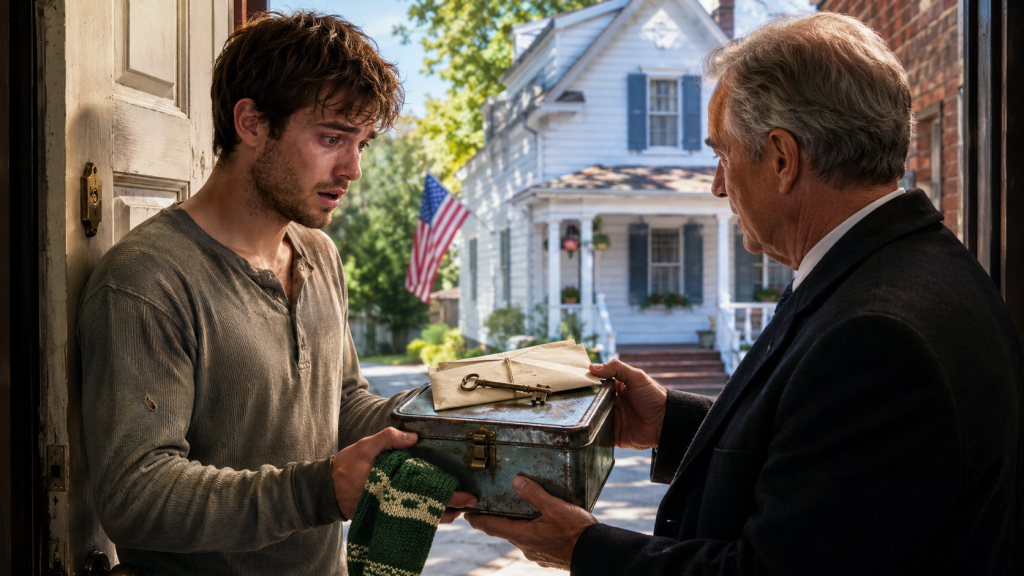
Mr. Bell stood on my porch, wearing an overcoat and holding the dented metal lunchbox.
His silver eyebrows were dusted with snow.
“James,” he said.
I almost shut the door.
He lifted the lunchbox slightly.
“Mrs. Rhode left instructions.”
I stared at it.
“Looks like she left everything except instructions.”
His face did not change.
“Actually, she left you one thing.”
The anger came back fast.
I laughed bitterly.
“What? A sandwich?”
“No,” he said. “A key.”
That stopped me.
Mr. Bell stepped inside when I moved aside.
My apartment was a mess.
I did not care.
He placed the lunchbox on my small kitchen table.
The metal made a dull sound.
“Mrs. Rhode instructed me to deliver this to you the morning after the will reading,” he said. “Not before.”
“Why?”
“She said you needed one night to be honest about what you felt.”
“That sounds like her.”
“Yes,” he said softly. “It does.”
He opened the lunchbox.
Inside were a brass key and an envelope with my name written in Mrs. Rhode’s shaky handwriting.
JAMES.
My throat tightened before I could stop it.
I picked up the envelope.
The first line read:
James, you are probably angry that I left you nothing.
My hands clenched around the paper.
The next line blurred.
But believe me, what I prepared for you will change your life.
My knees hit the floor before I reached the second paragraph.
Mr. Bell moved toward me, but I shook my head.
I sat there on the floor and read.
Dear James,
You came to me for money.
Do not feel ashamed. I offered it. I knew what I was doing.
You were hungry, tired, angry, and alone. I recognized all of that because grief makes a person look very similar.
At first, you helped me because you wanted my house. Then one day, without noticing, you started helping me because you cared whether I had eaten.
That is when my plan changed.
If I left you the house outright, you would have sold it or hidden inside it until loneliness swallowed you whole.
If I left you money outright, you would have spent some, saved some, and trusted no one with the rest.
You needed more than property.
You needed proof that you could belong somewhere.
So I left the house to the Bellweather Home Trust, a charity I created before my death.
You will find the key in this box.
It opens the old library building on Mason Street.
I bought it fifteen years ago after the town closed it.
I never knew what to do with it until you.
Mr. Bell will explain the rest.
By then, I was crying so hard I could barely read.
But I forced myself to continue.
The building is yours to run, not to sell.
The trust will fund repairs, utilities, taxes, and your salary for five years.
Its purpose is simple.
A place for boys and young men leaving foster care with nowhere to go.
A place with beds, meals, job training, warm socks, and someone who gives a damn whether they come home.
I named it Lydia House, because I could not be a mother as long as I wanted.
But I think perhaps you can become the kind of man who opens a door for someone else.
You once told me no one taught you what good choices looked like.
Now you will.
You are not getting my house, James.
You are getting a reason to build one.
Do not waste it.
And do not pretend those green socks are ugly.
They are magnificent.
With love,
Eleanor
I pressed the letter to my chest and bent forward until my forehead touched the floor.
For a long time, I could not speak.
Mr. Bell waited.
When I finally looked up, he handed me a handkerchief.
I took it without making a sarcastic comment.
That alone would have made Mrs. Rhode suspicious.
“She did all this?” I asked.
“Yes.”
“The old library?”
“Yes.”
“It’s mine?”
“Not personally,” Mr. Bell said. “It belongs to the trust. But you are the founding director, if you accept. You will have a salary, housing in the upstairs apartment after renovation, and full authority to build the program with oversight from the board.”
I laughed through tears.
“The board?”
“Three people. Myself, Reverend Anna Price from her church, and Dr. Samuel Ortiz, who runs the youth outreach clinic. Mrs. Rhode chose people she believed would challenge you without controlling you.”
“That sounds terrible.”
“It may be very good for you.”
I looked at the key.
It was old and heavy.
Nothing like the cheap apartment key on my ring.
“What if I fail?”
Mr. Bell’s expression softened.
“She said you would ask that.”
Of course she did.
“And?”
He reached into his coat and pulled out a second folded note.
I almost laughed.
“She left notes for my reactions?”
“She was a thorough woman.”
I opened it.
James,
If you are asking what if I fail, good.
That means you understand this matters.
Failing is allowed.
Quitting because you are afraid is not.
Start by opening the door.
E.
I wiped my face with my sleeve.
Then I stood.
“Okay,” I said.
Mr. Bell raised his eyebrows.
“Okay?”
“Let’s open the door.”
The old library on Mason Street stood near the edge of downtown.
I had passed it hundreds of times without noticing it properly.
Red brick.
Boarded windows.
A cracked stone lion beside the steps.
The sign above the entrance still read BELLWEATHER PUBLIC LIBRARY, though half the letters had faded.
Snow gathered along the doorway.
The key stuck at first.
I had to shoulder the door gently while turning it.
Then it opened with a groan that sounded like something waking up.
Dust filled the air.
The lobby smelled like old paper, cold wood, and possibility.
Sunlight pushed through dirty windows.
Rows of empty shelves stood like ribs.
There was a front desk.
A reading room.
A staircase leading to the second floor.
A children’s mural on one wall, faded but still visible.
A painted moon.
A yellow star.
A small rocket ship.
The same kind as the sticker on the lunchbox.
I looked at Mr. Bell.
“She planned this for years?”
“Some part of it, yes. The rest after she met you.”
I walked deeper inside.
My footsteps echoed.
I imagined beds along one wall.
A kitchen.
A common room.
A workshop in the back.
A place where boys with trash bags of clothes could walk in and not feel like a problem.
My chest hurt.
Not with grief this time.
With something heavier.
Responsibility.
I spent the next few months learning how hard dreams are when they become paperwork.
Permits.
Insurance.
Inspections.
Budgets.
Contractors.
Meetings.
Grant applications.
Furniture donations.
Fire code.
Staffing plans.
Background checks.
Some days, I wanted to throw the key into the river.
Mrs. Rhode had made “open a home” sound like turning a doorknob.
It was not.
It was forms and arguments and people asking for credentials I did not have.
At the first board meeting, Reverend Anna Price looked me straight in the eye and said, “James, caring is not the same as being ready.”
I bristled.
Dr. Ortiz nodded.
“She’s right. You need training.”
“I grew up in the system,” I snapped. “I know what these kids need.”
Mr. Bell folded his hands.
“You know what you needed. That is a beginning, not a complete program.”
I hated them for being right.
But Mrs. Rhode had chosen them for a reason.
So I took classes.
Trauma-informed care.
Conflict de-escalation.
Youth mentoring.
Basic nonprofit management.
I sat in rooms with people who used phrases I did not understand and forced myself to learn instead of walking out.
At night, I went back to my apartment and read Mrs. Rhode’s letter again.
You are getting a reason to build one.
Do not waste it.
The town started noticing.
At first, people were suspicious.
They remembered me as the quiet guy who fixed gutters and avoided conversation.
Now I was asking for donations, attending council meetings, and standing in front of church groups explaining why boys aging out of care needed more than a pamphlet and a bus voucher.
Some people gave money.
Some gave furniture.
Some gave advice I did not ask for.
The pharmacist donated first-aid supplies.
Carlos from the hardware store donated tools.
A retired teacher named Miss June brought boxes of books and cried when she saw the old reading room.
“She used to work here,” Miss June said, touching one of the shelves.
“Mrs. Rhode?”
“Oh, yes. She loved this place. Said libraries were the closest thing to miracles because anyone could walk in poor and leave with something.”
That sounded like Eleanor.
By spring, Lydia House had walls painted warm yellow, eight bedrooms upstairs, a kitchen with secondhand appliances, a common room full of mismatched furniture, and a basket near the front door filled with socks.
Not all green.
I had limits.
Opening day came in April.
A small crowd gathered outside.
Reverend Anna said a prayer.
Mr. Bell gave a short speech.
Dr. Ortiz talked about community responsibility.
I stood there in a clean shirt, palms sweating, trying not to run.
Then Mr. Bell nodded toward me.
“My turn?”
“Your turn,” he said.
I looked at the people waiting.
Town council members.
Church ladies.
Workers.
Neighbors.
People who had once looked through me and now looked at me like I might say something worth hearing.
I unfolded a piece of paper.
Then folded it again.
“I was going to give a speech,” I said. “But Mrs. Rhode would say speeches are where honesty goes to suffocate.”
A few people laughed.
I took a breath.
“So I’ll just say this. I came to this town with nothing. I met an old woman who offered me money to take care of her. I said yes for the money. Then she gave me socks, criticized my repair work, forced me to drink tea, and somehow tricked me into becoming a person who cared.”
My voice shook.
I did not hide it.
“She promised me everything she had. When she died, I thought she broke that promise. But she didn’t. She just understood better than I did what everything meant.”
I turned toward the building.
“This is Lydia House. It is for young men leaving foster care who need a place to land. It is not charity in the way people use that word to feel above someone. It is a door. It is a meal. It is a bed. It is someone saying, ‘Did you get home safe?’ and meaning it.”
I reached into my pocket and pulled out the ugly green socks.
The crowd laughed softly.
“These were the first thing Mrs. Rhode gave me that I didn’t earn. I pretended I hated them. I still pretend sometimes. But they taught me something. Warmth feels strange when you’ve been cold too long.”
By the end, I was crying.
So were half the church ladies.
The first resident arrived two weeks later.
His name was Marcus.
Nineteen years old.
Two trash bags of clothes.
A scar over one eyebrow.
Eyes like locked doors.
I recognized him immediately.
Not personally.
Spiritually.
He stood in the lobby and looked around like he expected a trap.
“This some religious thing?” he asked.
“No.”
“Do I gotta pay?”
“No.”
“Why?”
I almost said because an old woman died.
Instead I said, “Because someone did it for me.”
He looked unconvinced.
Good.
Trust should not come too easily.
I showed him his room.
The bed.
The dresser.
The clean towel.
The small lamp.
He touched the blanket like it might vanish.
“Rules?” he asked.
“Yes. No drugs in the house. No stealing. No violence. Chores rotate. Curfew unless you’re working. Meetings twice a week. If you mess up, we talk before we throw you away.”
His eyes flicked to mine.
“You mean that?”
“Yes.”
“People always say stuff like that.”
“I know.”
That night, I sat in the office downstairs listening to the old building settle.
At 11:47 p.m., footsteps moved down the stairs.
Marcus appeared in the doorway.
“You got food?”
“In the kitchen.”
He hesitated.
“Can I make eggs?”
“Yes.”
“You want some?”
I looked up.
The question was casual.
Small.
But I knew what it cost.
“Sure,” I said.
He burned them.
Badly.
Mrs. Rhode would have called them criminal.
I ate them anyway.
More residents came.
Andre.
Luis.
Peter.
Shawn.
Some stayed.
Some left.
Some came back.
Some broke rules.
Some broke my heart.
I learned quickly that caring did not save everyone.
That was the hardest lesson.
I wanted every boy to walk through the door and become proof that pain could be transformed.
But people are not projects.
Healing is not obedience.
Sometimes the best you can do is keep the porch light on and hope they remember the way back.
On the first anniversary of Mrs. Rhode’s death, I went to her grave.
The cemetery was quiet, damp, and gray.
I brought no flowers.
She hated cut flowers.
“Dead things pretending to decorate death,” she once said.
So I brought a thermos of tea and sat beside her headstone.
ELEANOR RHODE
BELOVED WIFE, MOTHER, FRIEND
I poured tea into the cap.
“I’m still mad at you,” I said.
The wind moved through the trees.
“I know. You’d say that means I’m paying attention.”
I told her about Marcus getting a job at the auto shop.
About Andre enrolling in community college.
About Luis stealing peanut butter and then confessing before I noticed.
About the washing machine flooding the basement.
About Reverend Anna terrifying everyone into attending budget meetings.
Then I told her the truth.
“I miss you.”
The words came out small.
“I miss you more than I miss the idea of your money. That was your trick, wasn’t it?”
A crow landed on a nearby stone.
I laughed.
“Yeah. You’d like that.”
Before I left, I placed something on her grave.
The ugly green socks.
Not the originals.
Those I still wore.
This was a new pair I had tried to knit myself.
They were terrible.
Uneven.
One was larger than the other.
A shade of green so offensive it deserved legal consequences.
Mrs. Rhode would have loved them.
Or pretended not to.
Years passed.
Lydia House grew.
The first five years of funding became ten after new donors joined.
The upstairs apartment became mine.
The old reading room became a classroom.
The basement became a workshop.
The faded children’s mural was restored by a local artist.
The rocket ship looked new again.
Every winter, we held a sock drive.
People donated normal socks.
I always added one ugly green pair to the basket.
No one knew why at first.
Then the story spread.
The boys started calling them Rhode Socks.
The first resident who got his own apartment received a pair.
The first who finished a degree received a pair.
The first who became a father received a pair for his baby, though his wife said absolutely not.
One evening, almost seven years after Mrs. Rhode died, Marcus came back to visit.
He was twenty-six then.
Clean work boots.
Strong shoulders.
A steady gaze.
He had become a mechanic.
Thomas would have approved.
He stood in the doorway of my office holding a paper bag.
“You busy?”
“Always.”
“So no?”
“Come in.”
He set the bag on my desk.
Inside was a pair of socks.
Ugly.
Green.
Hand-knitted.
Better than mine, though not by much.
“My wife made them,” he said. “For the next kid who comes in looking like he wants to punch the world.”
I looked down at the socks.
My throat tightened.
Marcus shifted uncomfortably.
“Don’t get weird.”
“I’m not.”
“You look weird.”
“I always look like this.”
“No, you look emotional. It’s disturbing.”
I laughed.
Mrs. Rhode would have liked him.
Maybe she already did, in whatever way the dead keep track of the living.
That night, after Marcus left, I opened the dented lunchbox.
I kept it in my desk drawer.
Inside were Mrs. Rhode’s letters, the original key, the first envelope she ever paid me with, and a photograph Miss June had found of her standing in front of the old library in 1978.
Young Eleanor.
Dark hair.
Sharp eyes.
The same look that said she would tolerate nonsense only long enough to destroy it.
I unfolded her first letter again.
You are not getting my house, James.
You are getting a reason to build one.
For years, I thought inheritance meant ownership.
A deed.
A bank account.
Something with your name on it that proved life owed you a little less pain.
But Mrs. Rhode understood what I did not.
A house can be sold.
Money can disappear.
Jewelry can go to a niece who does not deserve it.
But purpose?
Purpose roots itself in you.
It changes how you stand.
How you speak.
How you open doors.
Mrs. Rhode did leave me one thing.
Not the white house with blue shutters.
Not her savings.
Not her jewelry.
She left me the key to a building.
The key to a future.
The key to becoming the person I needed when I was eighteen and scared and pretending I was not.
And every time a boy walks through the doors of Lydia House carrying his life in a trash bag, I understand her promise all over again.
She did leave me everything she had.
She left me love disguised as responsibility.
Trust disguised as work.
Family disguised as a mission.
And one dented metal lunchbox that still smells faintly of dust, peppermint, and the old woman who saw me clearly enough to know I needed more than money.
I needed a reason to stay.
So I stayed.
And I opened the door.
💬THE END! THANK YOU FOR READING! ❤