
On Thanksgiving, my son took his wife and children on a luxury trip to Hawaii and left me alone at home with nothing but a note on the kitchen counter. I didn’t cry.
I called a moving company. Five days later, my phone would not stop ringing. “We left for Hawaii. Don’t worry, Mrs. Margaret. At your age, you’re better off resting at home.”
That was what the note said, stuck to the refrigerator with a turkey-shaped magnet. Margaret Collins read it three times, standing in the silent kitchen of her son Daniel’s house in Scottsdale, Arizona.
Thanksgiving morning had always smelled like cinnamon, coffee, and butter. But that Thursday smelled like nothing at all.
There were no voices.
No cartoons playing on the television.
No footsteps from her grandchildren running down the hallway.
No Rebecca calling from the laundry room, asking where the good serving plates were. No Daniel asking if she had remembered to thaw the turkey. Nothing. Only the hum of the refrigerator and the slow ticking of the clock above the stove.
“Emily,” Margaret called first.
Her voice sounded too small in the big kitchen.
Nothing.
“Jack?”
Silence.
She slowly climbed the stairs to the second floor, holding the railing with one hand.
The house was beautiful, but it had never felt warm unless the children were in it.
Emily’s room was neat, her purple blanket folded at the foot of the bed.
Jack’s dinosaur pajamas were gone from the chair.
Their backpacks were missing.
Their jackets were gone.
In the master bedroom, Daniel and Rebecca’s suitcases were missing too.
Margaret stood there for a long moment, staring at the empty closet space where Rebecca’s expensive resort dresses usually hung.
Then she walked back downstairs with a strange sense of calm.
The kind of calm that comes when pain still has not found where to sink its claws.
The SUV was gone from the garage.
So was Rebecca’s car.
Only Margaret remained.
And the note.
She read it again.
“We decided to spend Thanksgiving in Hawaii this year. We didn’t tell you beforehand because we knew you’d insist on coming. The flight is long, and you get tired so easily now. We’ll be back in a week. There’s soup in the freezer.”
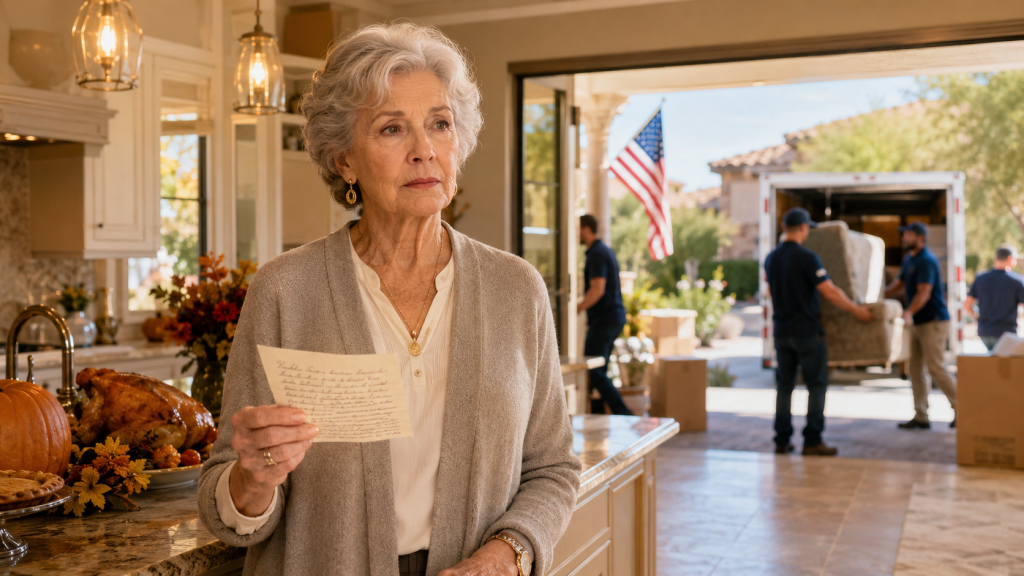
Margaret set the note down on the table.
She was seventy-three years old, but she was not a child.
She did not need anyone deciding whether she was capable of getting on a plane, walking through an airport, or sitting by the ocean.
What hurt the most was not that they had left.
It was that they had left her behind the way someone waters a houseplant before going on vacation.
Four years earlier, when Arthur passed away, Daniel had sat beside her on the edge of her bed in Oak Park, Illinois, and held both her hands.
“Mom,” he had said, his eyes red from the funeral, “come live with us. I don’t want you to be alone.”
Margaret remembered looking around the apartment she had shared with Arthur for thirty-six years.
The faded blue sofa.
The bookshelf Arthur had built himself.
The small balcony where she grew basil and tomatoes every summer.
Her life was there.
Her memories were there.
Arthur’s slippers were still beside the bed.
“I don’t know, Danny,” she had whispered.
“It would be good for the kids to have you close,” he said. “Emily adores you. Jack needs his grandma. And honestly, Mom, I’d sleep better knowing you weren’t alone.”
Those words had undone her.
I’d sleep better knowing you weren’t alone.
So Margaret sold her small apartment.
She packed forty years of marriage into cardboard boxes.
She donated half her furniture because Rebecca said their Arizona home had “a cleaner design style.”
Then she moved to Scottsdale.
Daniel and Rebecca had chosen the house before she arrived.
A wide, elegant place with cream stucco walls, arched windows, a three-car garage, and a backyard pool.
“It’s perfect,” Rebecca had said brightly. “Plenty of room for everyone.”
What Rebecca had not said was that they could not afford the down payment alone.
Margaret used part of the money from selling her apartment to help them.
Daniel had looked ashamed when he asked.
Rebecca had not.
“It’s not really help,” Rebecca said at the time. “You’ll live here too. It’s basically your house as well.”
Margaret had believed her.
She bought the refrigerator.
The living room furniture.
The washing machine.
The dryer.
The curtains.
The dining room set.
The guest beds.
The television in the family room.
The patio furniture beside the pool.
The Italian coffee maker Rebecca loved showing off to her friends.
Margaret even paid for the new dishwasher after Rebecca said, “A beautiful house can’t have old appliances.”
At first, they called her a blessing.
“Mom, you saved us,” Daniel said more than once.
Rebecca told everyone, “We’re so lucky to have Margaret here.”
Emily and Jack climbed into Margaret’s bed on Saturday mornings and begged for pancakes shaped like hearts.
Those early months almost felt like family.
Almost.
Little by little, that blessing became an obligation.
If Margaret wanted to go downtown with a friend from church, Rebecca would purse her lips.
“And who’s going to pick up the kids from swim practice?”
If Margaret said her back hurt, Daniel would sigh.
“Mom, we’re only asking you to help with dinner. It’s not that much.”
If she bought something for herself, Rebecca would remark, “Well, it’s nice that you can still afford things, because expenses around here are really tight.”
Margaret began paying for groceries.
At first, it was only once in a while.
Then it was every week.
She paid for school shoes.
Birthday gifts.
Soccer registration.
A new laptop for Emily.
Dental bills.
Pool repairs.
Daniel always promised to pay her back.
He never did.
Rebecca stopped saying thank you.
The children still loved her, but they were children.
They did not see the way adults rearranged the world around convenience.
Margaret saw.
She saw everything.
She saw how Daniel stopped asking if she wanted to join family outings.
She saw how Rebecca corrected her in front of guests.
She saw how her room became “Grandma’s room” instead of “Mom’s room,” as if she were an accessory attached to the house.
The sentence that finally broke something inside Margaret had come six months earlier.
Rebecca had been talking on the phone on the patio, thinking no one could hear her.
Margaret had gone outside to water the basil plants.
Then she heard Rebecca laugh softly.
“We can’t ask her to leave. She watches the kids, pays for things, and even buys groceries. It’s not her we’re keeping. It’s her money that’s saving us.”
Margaret stood behind the sliding glass door, her hand still on the handle.
Rebecca kept talking.
“No, Daniel feels guilty, of course. But guilt is cheaper than hiring a nanny.”
Margaret did not move.
She did not drop the watering can.
She did not confront Rebecca.
She simply turned around, walked back to her bedroom, and sat on the edge of the bed.
On the dresser was a framed photograph of Arthur.
He was standing beside a lake, wearing his old green sweater and smiling like the world had never disappointed him.
“What would you do?” Margaret whispered.
Of course, Arthur did not answer.
But she imagined what he would have said.
Maggie, don’t let anyone turn your kindness into their property.
Margaret had not said a word then.
She tucked that pain away inside her chest the way someone hides a needle in a fold of clothing.
But Thanksgiving morning, with the house empty and the note lying on the table, she finally understood everything.
They had not invited her to live with them out of love.
They had installed her there because she was useful.
Margaret poured herself a cup of coffee.
She sat down at the dining room table she had bought herself.
The sunlight came through the curtains she had ordered after Rebecca complained the old blinds looked “cheap.”
The Italian coffee maker hissed quietly on the counter.
The refrigerator, polished silver and enormous, hummed in the corner.
Everywhere Margaret looked, she saw her own money disguised as someone else’s lifestyle.
Then she went upstairs to her bedroom.
She opened the bottom drawer of her nightstand and took out a blue folder.
Inside were all the receipts.
Arthur had always teased her affectionately.
“Maggie, you even save receipts for a loaf of bread.”
That day, Margaret smiled for the first time.
“Thanks, old man,” she murmured.
She placed the folder on her bed and opened a notebook.
On the first page, she wrote:
Things That Belong to Me
Then she began making a list.
Refrigerator.
Living room furniture.
Dining room set.
Washing machine.
Dryer.
Television.
Coffee maker.
Guest beds.
Curtains.
Lamps.
Dinnerware.
Patio furniture.
Area rugs.
Blender.
Microwave.
Outdoor umbrella.
Bookshelves.
Hallway mirror.
Every item she wrote gave her another breath of air.
It was not revenge at first.
It was recognition.
For years, she had let them blur the line between generosity and ownership.
Now she was sharpening that line again.
She searched for a moving company on her phone and called the first one that answered.
A man named Carlos picked up.
“Valley Star Moving. How can I help you?”
“I need movers tomorrow morning,” Margaret said.
There was a pause.
“Ma’am, it’s a holiday weekend, so we charge an additional fee.”
“I don’t mind.”
“When do you need the service?”
Margaret looked at the note one more time.
“Tomorrow at eight in the morning.”
“What are we moving?”
“My belongings.”
“How much?”
Margaret looked around her bedroom, then toward the rest of the house.
“Enough that you should bring a large truck.”
That night, she did not cry.
She packed two suitcases.
She gathered her important documents.
She wrapped Arthur’s photograph in a towel and placed it carefully between sweaters.
She packed her jewelry box, her recipe cards, her medicines, her church directory, and the small ceramic angel Emily had painted for her years earlier.
Then she placed the blue folder inside her handbag.
Before going to bed, she walked downstairs into the kitchen.
She picked up Rebecca’s note and set it back exactly where it had been.
Then, in black ink, she wrote across the top:
Thank you for showing me who my real family truly is.
And in that moment, she knew that when Daniel came home from Hawaii, he was not going to find the same house.
Or the same mother.
The movers arrived the next morning at exactly eight.
Margaret stood in the doorway wearing Arthur’s old cardigan, her handbag over one shoulder, and her list in her hand.
Carlos stepped out first.
He was a broad-shouldered man in his forties with kind eyes and a clipboard.
“Mrs. Collins?”
“Yes.”
He glanced at the house.
“Beautiful place.”
Margaret smiled faintly.
“It used to feel that way.”
Carlos did not ask questions.
Good movers, Margaret thought, were like good nurses.
They knew when people needed silence.
“Only the items on this paper,” she told him calmly.
Carlos read through the list.
“Do you have receipts or proof these are yours?”
Margaret lifted the blue folder.
“For every single item.”
His eyebrows rose slightly.
“Well then,” he said, “we’ll take care of it.”
By noon, the house looked like someone had peeled comfort off its bones.
The refrigerator was gone.
The washing machine and dryer were gone.
The dining set was gone.
The coffee maker was gone.
The lamps, curtains, television, patio chairs, guest beds, dishes, rugs, mirror, and bookshelves were gone.
The movers carried each piece carefully, wrapping glass, taping drawers, labeling boxes.
Margaret watched without flinching.
Daniel’s house had always looked expensive.
Without her belongings, it looked hollow.
She left Daniel and Rebecca’s personal furniture untouched.
Their bed.
Their dressers.
Their office desks.
The children’s toys.
The children’s beds.
Their clothes.
Their photographs.
She did not take one thing that was not hers.
That mattered to her.
She was not stealing.
She was leaving.
At one o’clock, Carlos closed the truck door.
“All set, Mrs. Collins.”
Margaret looked back into the empty living room.
The echo of her footsteps was almost beautiful.
“Thank you.”
“Where to?”
Margaret took a deep breath.
She had called a realtor friend from church that morning, a woman named Linda who had been trying for months to convince Margaret to join her senior walking group.
Linda had found her a sunny little condo near a park.
Two bedrooms.
A small patio.
No stairs.
Close to church.
Close to a grocery store.
Close to people who actually asked whether she wanted coffee before handing her a chore.
Margaret gave Carlos the address.
Before she left, she returned to the kitchen.
Rebecca’s note still hung on the refrigerator spot, now attached to nothing but a bare patch of wall with the turkey magnet sitting on the counter beneath it.
Margaret placed the note in the center of the kitchen island.
Then she added one more sentence under her first message.
I took only what was mine.
She locked the front door behind her and dropped the key through the mail slot.
Her new condo smelled like fresh paint and sunlight.
Carlos and his team arranged the furniture exactly where she wanted it.
The dining table fit beautifully near the window.
The blue armchair Arthur loved went in the corner.
The coffee maker sat on the kitchen counter.
The patio chairs faced the little garden.
When the movers left, Margaret stood alone in the middle of her new living room.
For the first time in four years, the silence did not feel like abandonment.
It felt like peace.
She made tea.
She opened a box labeled Kitchen.
She found one mug, one plate, and one spoon.
Then she sat on her own sofa, in her own home, and ate toast with butter.
It tasted better than any Thanksgiving dinner she had ever cooked for people who forgot to invite her to their table.
That evening, Linda came by with soup, bread, and a bottle of sparkling apple cider.
“You really did it,” Linda said, looking around with admiration.
Margaret smiled.
“I really did.”
“Are you all right?”
Margaret thought about that.
Her son was in Hawaii.
Her daughter-in-law had humiliated her.
Her grandchildren probably did not know the whole truth.
Her old life had collapsed in one day.
And yet, she could breathe.
“I think,” she said slowly, “I am more all right than I have been in years.”
Linda hugged her.
Not the polite kind of hug.
The real kind.
Margaret let herself be held for a moment.
Then she pulled away and wiped her eyes.
“I didn’t cry yesterday.”
“You can cry now.”
Margaret laughed softly.
“Maybe later. Right now I want to hang curtains.”
The next five days passed quietly.
Margaret unpacked slowly.
She put Arthur’s photograph on the mantel.
She arranged her books by author.
She bought groceries for one person and felt a strange thrill at choosing only what she liked.
No gluten-free crackers for Rebecca.
No energy drinks for Daniel.
No special cereal that Jack loved but never finished.
She bought peaches.
Sharp cheddar.
English muffins.
Chicken soup.
Dark chocolate.
And a small bouquet of yellow tulips for herself.
On Sunday, she went to church.
When people asked where Daniel and Rebecca were, Margaret simply said, “In Hawaii.”
When they asked why she was not with them, she smiled and said, “Because I finally had other plans.”
Linda squeezed her hand.
By Monday morning, Margaret’s phone had fourteen missed calls.
None from Daniel.
All from Rebecca.
Margaret did not answer.
The first text arrived at 6:12 a.m.
Margaret, what happened to the refrigerator?
The second came one minute later.
Where is the washing machine?
Then another.
Why is the living room empty?
Then another.
This is not funny.
Then Daniel called.
Margaret watched his name flash on the screen.
My Son.
She had never changed the contact.
For a moment, her thumb hovered over the button.
Then she set the phone face down and made coffee.
By noon, there were twenty-three missed calls.
Rebecca began sending photos.
The empty kitchen.
The empty dining room.
The blank windows without curtains.
The family room wall where the television used to be.
Margaret studied the photos calmly.
She noticed that the children were not in them.
Good, she thought.
Let them be spared the beginning.
At 3:40 p.m., Daniel left a voicemail.
His voice was tight.
“Mom, call me back. Now. We came home and half the house is gone. Rebecca is hysterical. The kids are confused. What did you do?”
Margaret deleted it.
At 5:15, another voicemail.
“Mom, I’m serious. This is insane. You can’t just empty our house.”
At 6:02, a third.
“Please call me. We need to talk.”
That one sounded different.
Not sorry.
Not yet.
But scared.
Margaret waited until evening.
She made herself dinner first.
Chicken soup.
Toast.
A peach.
Then she sat in her armchair, picked up her phone, and called Daniel back.
He answered before the first ring finished.
“Mom?”
“Yes, Daniel.”
“What the hell is going on?”
Margaret closed her eyes for one second.
There it was.
Not “Are you okay?”
Not “Where are you?”
Not “I’m sorry.”
What the hell is going on?
She opened her eyes.
“I moved.”
“You what?”
“I moved.”
“Where?”
“To my new home.”
There was noise in the background.
Rebecca’s voice, sharp and angry.
The children asking questions.
Daniel lowered his voice.
“Mom, why would you do that without telling us?”
Margaret looked around her peaceful new living room.
“At your age, you’re better off resting at home,” she said.
Silence.
Then Daniel said, “That was Rebecca’s note.”
“But you left with her.”
“Mom, come on. We were trying to be practical. The flight was long.”
“You took a ten-year-old and a seven-year-old.”
“They’re children.”
“And I am not luggage.”
Daniel exhaled heavily.
“You’re twisting this.”
“No,” Margaret said. “For the first time, I am untwisting it.”
Rebecca grabbed the phone.
Margaret heard the shift immediately.
“Margaret,” Rebecca snapped, “where is my refrigerator?”
“Your refrigerator?”
“You know what I mean.”
“I do. And that is why I took it.”
“You had no right.”
“I have the receipt.”
Rebecca made a sound of disbelief.
“You’re being petty.”
“No, Rebecca. Petty would have been taking your bed.”
Rebecca went silent.
Margaret continued, her voice calm.
“I took only what I purchased. I left your personal belongings, Daniel’s personal belongings, and the children’s belongings. I damaged nothing. I stole nothing.”
“You emptied our house!”
“I removed my property from the place where I was being used.”
Daniel came back on the line.
“Mom, we needed those things.”
Margaret looked at Arthur’s photograph.
“I know,” she said softly. “That was the problem.”
Daniel did not answer.
For a moment, she could hear only his breathing.
Then he said, quieter, “You could have talked to me.”
“I tried for four years.”
“No, you didn’t.”
“Yes, Daniel. I did. I told you I was tired. You told me dinner wasn’t much. I told you I wanted to visit friends. Rebecca asked who would pick up the kids. I told you the grocery bills were too much. You said you’d pay me back. I told you I felt invisible. You said I was being sensitive.”
“I didn’t know it was that bad.”
“You did not want to know.”
That struck him.
She heard it in the silence.
Rebecca spoke in the background again.
Daniel covered the phone, but Margaret still heard enough.
“She’s doing this for attention.”
Margaret almost smiled.
Attention.
For years, she had asked for basic respect.
Now that she had left, they called it attention.
“Daniel,” she said.
“I’m here.”
“I heard Rebecca on the patio six months ago.”
He went very still.
“What?”
“She said you couldn’t ask me to leave because I watched the kids, paid for things, and bought groceries. She said it wasn’t me you were keeping. It was my money that was saving you.”
Daniel whispered something Margaret could not understand.
She waited.
He did not deny it.
That hurt more than if he had lied.
Finally, he said, “Mom, I’m sorry you heard that.”
Margaret’s heart tightened.
Not “I’m sorry she said that.”
Not “I’m sorry we treated you that way.”
I’m sorry you heard that.
“No,” Margaret said. “You’re sorry I found out.”
“Mom—”
“I am not coming back.”
The words landed between them like a door closing.
Daniel’s voice cracked.
“What about the kids?”
Margaret closed her eyes.
There it was.
The tender place.
Emily and Jack.
“I love them,” she said. “I will always love them. But I will not be used as unpaid childcare in exchange for being tolerated.”
“They miss you.”
“I miss them too.”
“Then come home.”
Margaret looked around her condo.
The yellow tulips sat in a glass vase on the table.
Arthur’s chair was near the window.
Her books were on her shelf.
Her coffee was in her cup.
“I am home.”
Daniel began calling every day.
At first, his calls were angry.
Then pleading.
Then practical.
“Mom, can we at least borrow the refrigerator until we get another one?”
“No.”
“Can you watch the kids Friday? Rebecca has a work event.”
“No.”
“Can you lend us some money until things settle?”
“No.”
Each no became easier.
Not because Margaret loved him less.
Because she was learning to love herself without apology.
Rebecca sent one long message.
It was not an apology.
It was a list of grievances.
You embarrassed us.
You traumatized the children.
You made us look poor.
You overreacted.
You are punishing Daniel because you don’t like me.
Margaret read it once.
Then she replied:
I am not punishing anyone. I am removing myself from a place where I was not respected.
Rebecca did not respond.
Two weeks later, Daniel came to the condo.
Margaret saw him through the peephole.
He looked tired.
For a moment, she saw the boy he had been.
The child who used to run into her arms with scraped knees.
The teenager who cried when his father taught him to drive and yelled too much.
The young man who danced with her at his wedding and whispered, “I’ll always take care of you, Mom.”
She opened the door but did not move aside.
“Hello, Daniel.”
His eyes moved past her into the condo.
He saw the furniture.
The curtains.
The coffee maker.
The life that had once made his house comfortable.
“Can I come in?”
Margaret thought about it.
“No. But we can sit outside.”
They sat on the bench near the condo garden.
Daniel rubbed his hands together.
Arizona was not cold, but he looked chilled.
“Mom,” he began, “I messed up.”
Margaret said nothing.
He looked at her.
“I did. I know I did. I let Rebecca handle too much. I let her talk about you like you were… like you were part of the household staff.”
Margaret’s face remained still.
“And I did it too,” he admitted. “Maybe not with those words. But I did.”
That was the first honest thing he had said.
Margaret waited.
Daniel swallowed.
“When we got back and saw everything gone, I was furious. I thought you were trying to hurt us.”
“I wasn’t.”
“I know that now.”
“Do you?”
He nodded slowly.
“The house didn’t feel empty because furniture was missing. It felt empty because you were gone.”
Margaret looked away.
A bird landed near the garden fountain.
For a moment, neither of them spoke.
Then Daniel said, “The kids cried.”
Her throat tightened.
“I’m sorry for that.”
“They asked why Grandma left.”
“What did you tell them?”
He looked ashamed.
“At first, not enough.”
“And now?”
“I told them we hurt your feelings. I told them adults can make mistakes and still have to face consequences.”
Margaret turned back to him.
“That was a good start.”
He nodded.
“Can they see you?”
“Of course. They never lost me.”
Daniel’s eyes filled.
“But you did,” Margaret added quietly.
He closed his eyes.
“I know.”
Margaret studied her son.
She wanted to forgive him instantly.
A mother’s heart is trained to open at the first sign of a child’s pain.
But she had spent four years shrinking herself so Daniel could avoid discomfort.
She would not do that again.
“I love you,” she said. “But love does not mean I return to being useful.”
“I’m not asking you to move back.”
“Good.”
“I’m asking if we can start over.”
Margaret looked at him for a long time.
“No,” she said finally.
His face fell.
Then she continued.
“We cannot start over. Starting over would pretend nothing happened. We can start from here, with the truth.”
Daniel nodded slowly.
“I can do that.”
“I hope so.”
Three days later, Emily and Jack came over.
Emily ran to Margaret so fast she nearly knocked her backward.
“Grandma!”
Jack wrapped both arms around her waist.
“Why did you move?”
Margaret crouched carefully so she could look at them both.
“Because Grandma needed her own home.”
“Did we do something wrong?” Emily asked.
Margaret’s heart twisted.
“No, sweetheart. Never. This was grown-up business.”
Jack looked around.
“You have our old couch.”
Margaret smiled.
“My couch.”
“Oh.”
“And you may sit on it whenever you visit.”
That made him grin.
They spent the afternoon baking cookies.
Margaret let them crack eggs, spill flour, and lick frosting from spoons.
Daniel arrived to pick them up at five.
For once, he did not rush her.
For once, he did not say, “Mom, can you just keep them another hour?”
He simply stood at the door and watched his children hug their grandmother.
Before leaving, Emily handed Margaret a folded piece of paper.
“I made this on the plane,” she said.
After they left, Margaret opened it.
It was a drawing.
A house with yellow flowers.
A woman with gray hair standing beside two children.
Above them, Emily had written:
Grandma’s happy house.
Margaret framed it.
Months passed.
Daniel kept trying.
Not perfectly.
Sometimes he slipped into old habits.
Once, he asked if Margaret could “help out” for three afternoons in a row.
Margaret said, “No, Daniel. I can visit as a grandmother, not serve as a solution.”
He apologized.
Rebecca took longer.
For a while, she refused to enter Margaret’s condo.
Then one afternoon, she arrived alone with a casserole.
Margaret opened the door and waited.
Rebecca looked uncomfortable.
“I made lasagna.”
“That was kind.”
“I also came to apologize.”
Margaret did not invite her in yet.
Rebecca took a breath.
“What I said on the patio was cruel. What I wrote in that note was insulting. I treated you like your value came from what you gave us. I’m ashamed of that.”
Margaret studied her carefully.
Rebecca’s eyes were red.
Maybe from guilt.
Maybe from embarrassment.
Maybe both.
“I don’t expect you to forgive me today,” Rebecca said. “But I wanted to say it without making excuses.”
That mattered.
Margaret opened the door wider.
“You may come in for coffee.”
Rebecca stepped inside.
Her eyes moved around the condo.
The furniture.
The curtains.
The coffee maker.
The sunlight.
The peace.
“It’s beautiful,” she said softly.
Margaret smiled.
“Yes. It is.”
That spring, Margaret hosted Easter dinner in her condo’s community room.
Daniel brought the children.
Rebecca brought flowers.
Linda brought pie.
Two friends from church came.
Carlos, the mover, even stopped by with his wife after Margaret invited them.
At first, Daniel looked surprised by all the people.
Then he looked humbled.
Margaret had built a life outside his house.
Not a lonely life.
A full one.
During dinner, Jack asked, “Grandma, are we going to Hawaii next Thanksgiving?”
Everyone went silent.
Rebecca’s face flushed.
Daniel lowered his fork.
Margaret smiled gently.
“I don’t know, sweetheart. But wherever I spend Thanksgiving, I will spend it somewhere I am invited before the plane leaves.”
Daniel winced.
Rebecca looked down.
Linda coughed into her napkin to hide a laugh.
Emily said, “Grandma can come with us if we go.”
Jack nodded seriously.
“Or we can come here. Grandma’s food is better.”
Margaret reached over and squeezed his hand.
“That sounds like a wonderful possibility.”
After dinner, Daniel helped wash dishes.
He stood beside Margaret at the sink, drying plates quietly.
“I keep thinking about that note,” he said.
Margaret handed him another plate.
“So do I.”
“I wish I had thrown it away.”
“I’m glad you didn’t.”
He looked at her.
“Why?”
“Because it finally told the truth plainly enough for me to believe it.”
Daniel’s eyes filled again.
“I hate that I made you feel unwanted.”
Margaret looked out at the room where her grandchildren were playing cards with Linda.
“You didn’t make me unwanted,” she said. “You made me realize I was waiting for permission to belong in a home I had already paid for.”
He closed his eyes.
“I’m sorry, Mom.”
This time, she believed him.
Not completely.
Not enough to erase the past.
But enough to keep building from the truth.
By the next Thanksgiving, everything had changed.
Margaret did not cook alone in Daniel’s kitchen while others watched football.
She did not wake at dawn to prepare food for people who treated gratitude like a decoration.
She woke in her own condo.
She made coffee in her own kitchen.
She placed Arthur’s photograph near the yellow tulips.
Then she dressed in a soft blue sweater and pearl earrings.
At noon, Daniel arrived with Emily and Jack.
Rebecca came behind them holding a pumpkin pie.
She looked nervous.
“Thank you for inviting us,” Rebecca said.
Margaret nodded.
“Thank you for coming.”
Linda arrived with cranberry sauce.
Carlos and his wife brought rolls.
Two neighbors brought sweet potatoes and salad.
The table was too small, so they added a folding one.
The plates did not match.
The chairs were different heights.
The turkey was slightly dry.
The gravy was too salty.
It was the best Thanksgiving Margaret had ever hosted.
Before they ate, Emily stood up with a paper in her hand.
“At school, we had to write what we’re thankful for,” she announced.
Daniel smiled.
“Go ahead, sweetheart.”
Emily read, “I am thankful for my grandma because she teaches me that being kind does not mean letting people hurt you. I am thankful she has a happy house. I am thankful she still makes cookies with me.”
Margaret pressed a hand to her mouth.
Jack shouted, “I’m thankful for cookies too!”
Everyone laughed.
Even Rebecca.
Even Daniel.
After dinner, Margaret stepped onto the patio alone for a moment.
The Arizona sky was wide and pink.
The air smelled like sage, warm pavement, and pumpkin spice.
Inside, her family talked and laughed.
Not perfectly.
Not magically healed.
But honestly.
Arthur’s old cardigan was draped over her shoulders.
She looked up at the evening sky and whispered, “You were right, old man.”
The sliding door opened behind her.
Daniel stepped out.
“Mom?”
“Yes?”
“I’m glad you moved.”
Margaret turned, surprised.
He gave a sad little smile.
“I’m not glad about why. But I’m glad you did. I think we all needed to see what we were taking for granted.”
Margaret looked through the glass.
Rebecca was helping Emily wrap leftovers.
Jack was sneaking another cookie.
Linda was laughing with Carlos’s wife.
The room was full of life Margaret had chosen.
“I needed to see it too,” she said.
Daniel took a step closer.
“Do you forgive me?”
Margaret looked at her son.
The boy she had raised.
The man who had hurt her.
The child still somewhere behind his tired eyes.
“I am forgiving you,” she said.
He frowned slightly.
“Is that different?”
“Yes. Forgiveness is not a light switch. It is a road. I am walking it, but I won’t carry you on my back anymore.”
Daniel nodded slowly.
“That’s fair.”
“It is.”
He leaned down and kissed her cheek.
“I love you, Mom.”
“I love you too.”
And she did.
But this time, loving him did not require abandoning herself.
Later that night, after everyone left, Margaret walked through her condo.
There were crumbs on the floor.
Dishes in the sink.
Leftovers in the refrigerator.
A child’s sweater forgotten on the couch.
A drawing from Jack taped crookedly to the wall.
It was messy.
It was lived-in.
It was hers.
She picked up the old Thanksgiving note from the drawer where she had kept it.
For a long time, she had thought about throwing it away.
Instead, she placed it in an envelope with the receipts.
Not because she wanted to stay angry.
Because she wanted to remember.
Some pain is not meant to be worshipped.
But it is meant to be respected.
That note had been cruel.
It had also been a door.
On one side was the life where Margaret was useful, quiet, and grateful for scraps of belonging.
On the other side was this.
Her own key.
Her own curtains.
Her own table.
Her own peace.
She turned off the kitchen light.
Arthur’s photograph caught the glow from the lamp.
For a second, his smile seemed almost alive.
Margaret smiled back.
Then she walked to the window and looked out at the quiet street.
Five days after Hawaii, her phone had not stopped ringing.
But now, one year later, the silence was no longer frightening.
It was chosen.
It was full.
It was home.
And Margaret Collins finally understood that being left behind was not always the end of a family.
Sometimes it was the beginning of finding yourself.
💬THE END! THANK YOU FOR READING!