
My husband had been in his coffin only a few hours when my mother-in-law demanded the keys to our house.“Pack your bags, incubator,” Doña Teresa hissed, her voice slicing through the Church of San Agustín in Polanco. “My son’s fortune belongs to his real family.”
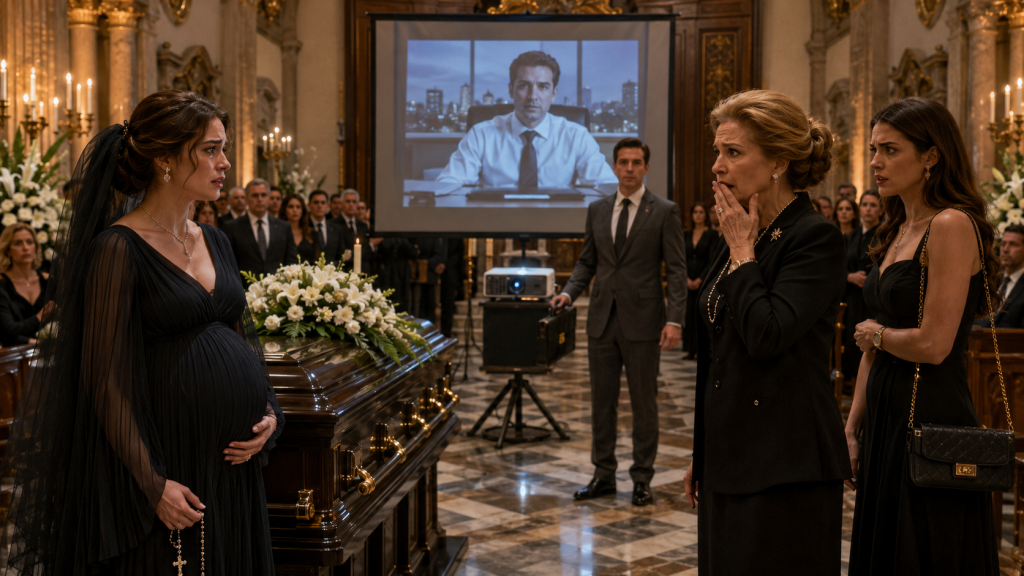
I stood beside Julián’s coffin with one hand on my eight-month pregnant belly and the other wrapped around the rosary he had given me on our wedding day.
The white lilies on the coffin smelled too sweet.
The marble floor felt too cold beneath my shoes.
Everything around me looked unreal—the golden altar, the candles, the polished pews filled with Mexico City’s most powerful people.
And in the middle of it all lay my husband.
Four days earlier, Julián Mendoza had kissed my forehead before leaving for Valle de Bravo.
“I’ll be back before dinner,” he said.
He never came home.
A police officer arrived at our house in Las Lomas just after midnight. His car had gone off the road into a ravine. They said the accident was sudden. They said he probably had no time to suffer.
People say things like that because they need something to offer the living.
But grief does not care about kind sentences.
Julián was only thirty-eight.
He owned one of Mexico’s most influential technology companies. He signed contracts with hospitals, banks, and government offices. Magazines called him brilliant. Investors called him visionary.
But to me, he was the man who burned toast every Saturday morning, left books open on every table, and spoke to our unborn son as if the baby were already sitting beside him.
“Mateo,” he would whisper against my stomach, “your mother is the strongest person I know.”
I had believed that once.
But standing in that church, surrounded by people watching me like I was an intruder at my own husband’s funeral, I felt anything but strong.
Doña Teresa had never accepted me.
To her, I was always “that public school teacher from Iztapalapa,” the woman who had somehow entered a family with a powerful surname.
At dinners, she corrected my pronunciation of French dishes.
At parties, she introduced me without mentioning I was Julián’s wife.
At Christmas, she told me my dress was “sweet,” which in her mouth meant cheap.
Her daughter, Fernanda, was worse.
She had once told me, while sipping champagne beside our pool, “I hope the baby at least looks like a Mendoza. Otherwise people will ask questions.”
Julián heard her.
He did not shout.
He simply stood, took my hand, and said, “Then let them ask. The answer will be that my wife and child are the only Mendoza family that matters.”
After that, they behaved more carefully.
Not kindly.
Carefully.
But now Julián lay silent inside a dark wooden coffin, and they no longer feared his protection.
Doña Teresa stepped closer, holding a yellow envelope.
“Everyone should know the truth,” she announced.
The priest stiffened near the altar.
“Señora, this is not the time.”
“It is exactly the time,” she snapped. “My son deserves to be buried with dignity, not with this woman’s lies standing beside him.”
She opened the envelope and pulled out papers.
“A DNA test,” she said loudly. “This child is not Julián’s.”
The church erupted in whispers.
My throat closed.
“That’s not true,” I said.
But my voice was small, swallowed by marble and judgment.
Doña Teresa lifted the papers higher.
“My son was not a fool. He knew exactly what you were. A nobody. An opportunist. A woman trying to trap him with another man’s child.”
My baby moved inside me, a slow painful shift beneath my ribs.
I touched my belly protectively.
“Don’t say that about him.”
“About him?” Fernanda laughed, stepping forward in her black designer dress. “You still think you can play the grieving widow?”
Before I understood what she was doing, she grabbed my left hand.
“Fernanda, stop.”
She twisted my fingers hard.
Pain shot through my hand as she forced my wedding ring over my knuckle.
The ring Julián had placed there three years earlier beneath an arch of white roses.
The ring he had kissed every time he left for a trip.
Fernanda held it up like a prize.
“This doesn’t belong to you either.”
I heard someone gasp.
Someone else whispered my name.
But no one moved.
That was the cruelty of powerful families. They made everyone afraid to interfere.
Doña Teresa placed the false paternity papers on top of Julián’s coffin.
“After the burial, you will leave the house. The accounts are frozen. The cars, the properties, the company shares—all of it returns to the real family.”
I stared at the coffin, wishing with an ache so sharp it felt physical that Julián would open his eyes.
On the morning he left, he had said something strange.
“No matter what happens, trust Arturo. I already protected everything.”
At the time, I thought he meant routine legal paperwork. Julián was careful. He had enemies in business. He planned for risks the way other men planned vacations.
But now Arturo Salcedo, his lawyer, was nowhere in the church.
Doña Teresa lifted one hand.
Two private security men near the entrance began walking toward me.
“Get her out,” she said. “Before she embarrasses this family any further.”
That was when the massive church doors flew open.
The sound thundered through the chapel.
Everyone turned.
A man in a gray suit strode down the center aisle with two assistants behind him. One carried black briefcases. The other carried a portable screen and projector.
Arturo Salcedo.
His face was calm, but his eyes were cold enough to stop the guards in their tracks.
“By strict instruction of Mr. Julián Mendoza,” he announced, “no burial will take place until this video has been played.”
Doña Teresa’s face changed for only a second.
Then she smiled.
Of course she smiled.
She thought the video would be a final tribute to her son. Perhaps a speech about family, legacy, duty, the Mendoza name.
The assistants set up the screen near the altar.
The projector hummed.
A pale rectangle of light appeared against the fabric.
Then Julián’s face filled the screen.
My knees weakened.
He was sitting in his office, wearing the blue shirt I had bought him for his birthday. Behind him, the lights of Mexico City glittered through the windows.
He looked tired.
But alive.
So alive that I almost reached for him.
“If you are watching this,” Julián said, “then I am gone, and my mother has probably decided grief is a business opportunity.”
A shocked murmur moved through the church.
Doña Teresa’s smile vanished.
Julián continued.
“First, Valeria, my love, forgive me for making you face this in public. I knew they would attack you the moment I could no longer stand beside you.”
My hand flew to my mouth.
Tears blurred the screen.
On the video, Julián lifted a sealed folder.
“The DNA test my mother may present is false. I discovered three weeks ago that she paid a private lab employee to alter documents. Arturo has the real prenatal paternity results, certified and witnessed. The child is mine.”
The church exploded into whispers.
Doña Teresa stepped backward.
“No.”
Arturo opened one of the briefcases and removed a notarized file.
“The original results are here,” he said.
Fernanda’s hand tightened around my stolen ring.
Julián’s voice grew colder.
“Second, the house in Las Lomas is not part of the Mendoza family estate. I purchased it through a private trust in Valeria’s name before our wedding. Mother, you have no legal right to the keys.”
Doña Teresa’s lips parted.
“The vehicles assigned to Valeria, her personal accounts, and the domestic staff contracts have also been secured under separate protections.”
Fernanda looked at her mother.
“Did you know?”
But Julián was not finished.
“Third, any relative who harasses my wife, contests my son’s inheritance, or attempts to remove Valeria from our home loses every share, account, property benefit, and voting privilege I ever assigned to them.”
The words hit the room like breaking glass.
Doña Teresa grabbed the back of a pew.
Julián leaned closer to the camera.
“Mother, I warned you. I warned you when you insulted her at our engagement party. I warned you when you tried to convince my board that Valeria was unsuitable. I warned you when you suggested my child might not be mine because you could not tolerate that he would be born from a woman you considered beneath you.”
His voice softened then.
“But I know you. You mistake silence for weakness. You mistake kindness for permission. And you mistake family for ownership.”
I could barely breathe.
For years, I had begged Julián not to fight them too openly. I wanted peace. I wanted our son to have grandparents, cousins, a family name not stained by hatred.
But Julián had seen what I tried not to see.
He had prepared for the moment love would no longer be enough protection.
On the screen, he looked directly into the camera.
“Valeria, our son and everything I built belong with you. Not because of money. Not because of law. Because you are my wife, and Mateo is my child.”
My baby kicked.
For the first time since the funeral began, I smiled through my tears.
Then Julián’s gaze hardened again.
“And Mother, if you called my wife an incubator today, remember this: the only person leaving my house is you.”
The church went silent.
Completely silent.
Even the candles seemed to stop flickering.
Fernanda dropped my wedding ring as if it had burned her.
It struck the marble floor with a tiny sound that somehow reached every corner of the chapel.
Arturo bent, picked it up, and walked to me.
He placed it in my palm with great care.
“Señora Mendoza,” he said gently.
That title had never felt real until that moment.
My hand shook as I slid the ring back onto my finger.
Doña Teresa suddenly found her voice.
“This is manipulation,” she snapped. “My son was under stress. That woman controlled him.”
Arturo turned to her.
“Señora, I advise you to stop speaking.”
“You work for me.”
“No,” Arturo said. “I worked for your son. Now I represent his estate, his wife, and his child.”
Her face twisted.
“I am his mother.”
“And you are also the subject of documents Mr. Mendoza left with me.”
The color drained from her cheeks.
Arturo opened another folder.
“Mr. Mendoza discovered irregular attempts to access company records, alter trust documents, and obtain unauthorized medical and paternity files related to Señora Valeria Mendoza.”
Fernanda whispered, “Mamá?”
Doña Teresa looked around as if searching for allies, but the people who had stood behind her power were suddenly fascinated by the floor.
Power is loyal only while it believes you cannot fall.
Arturo continued.
“Copies have been delivered to the board, the probate court, and the appropriate authorities. This funeral will proceed respectfully. Afterward, Señora Teresa and Señora Fernanda will leave the premises and refrain from contacting Valeria directly.”
Doña Teresa laughed, but it came out broken.
“You cannot keep me from my grandchild.”
I placed one hand on my stomach and looked at her.
“You did that yourself.”
Her eyes snapped to mine.
For years, I had lowered my gaze around her.
Not today.
“You called him illegitimate. You tried to erase him before he was born. You put false papers on his father’s coffin.”
She opened her mouth.
I did not let her speak.
“You will never hold my son.”
The words were quiet.
But they were stronger than any shout I had ever made.
Fernanda stepped forward, suddenly desperate.
“Valeria, please. This is grief. We all said things.”
I looked at her.
“You ripped my wedding ring from my finger.”
She swallowed.
“I was upset.”
“No,” I said. “You were enjoying it.”
Her face crumpled, but I felt nothing.
Maybe one day I would.
Not then.
The priest, who had stood pale and stunned throughout the video, finally moved forward.
“This is a house of God,” he said softly. “There has been enough cruelty today.”
He turned toward me.
“Señora, are you able to continue?”
I looked at Julián’s coffin.
The lilies.
The rosary in my hand.
The screen where his face had frozen on the final frame.
My husband had protected me even from the grave.
Now I had to be strong enough to say goodbye.
“Yes,” I whispered. “We continue.”
Doña Teresa tried to remain seated in the front pew, but Arturo’s assistants and church security approached her calmly.
She looked around for support.
No one stood.
Not the cousins who had laughed at her jokes.
Not the board members who once kissed her cheeks at galas.
Not the family friends who had whispered about my cheap shoes.
One by one, they looked away.
She walked out stiffly, Fernanda following with her head lowered.
The doors closed behind them.
Only then did I realize I had been shaking.
Arturo offered his arm.
I took it because my legs felt weak and my son was heavy inside me.
The funeral continued.
This time, the silence was different.
Not judgment.
Respect.
When the priest spoke of love, I looked at Julián’s coffin and wept without shame.
When the choir began singing, I pressed the rosary to my lips.
When it was time to say goodbye, I leaned over the coffin and whispered the words I had not been ready to say.
“You kept your promise.”
After the burial, Arturo drove me home.
Not to an empty house.
To my house.
The house Julián had protected in my name.
The staff stood in the foyer when I entered. Our housekeeper, Marisol, began crying the moment she saw me.
“We are with you, señora,” she said.
For so long, I had felt like a guest inside the Mendoza world.
That evening, I walked through each room slowly.
The kitchen where Julián ate sweet bread at midnight.
The nursery he had painted pale green himself, ruining one shirt and half the floor.
The bedroom where his book still lay open on the nightstand.
I sat on the edge of the bed and finally let myself break.
Not the quiet tears from church.
Real grief.
Raw.
Ugly.
Deep enough to empty me.
For hours, I cried for the life we had planned. For the son who would know his father through videos and stories instead of arms. For the man who loved me enough to prepare for the cruelty I refused to believe would come.
Near midnight, Arturo called.
“The board has confirmed your voting control,” he said. “No one can remove you.”
“I don’t know how to run Julián’s company.”
“He knew that,” Arturo replied. “He appointed an executive committee for operations. You control the trust and the child’s inheritance. You do not have to become him.”
That made me cry again.
Because even in planning, Julián had not tried to make me into someone else.
He had only given me space to remain myself.
Two months later, Mateo was born.
He came into the world angry and loud, with Julián’s dark hair and my stubborn chin.
When the nurse placed him on my chest, I sobbed so hard I could barely see him.
“Hola, mi amor,” I whispered. “Your father was right. You could answer after all.”
I named him Mateo Julián Mendoza.
News traveled fast.
Flowers arrived from employees, board members, old friends, and people who had probably ignored me in church because they were ashamed.
Doña Teresa sent nothing.
That was the only gift she ever gave me.
A year passed.
Then another.
Grief did not leave.
It changed shape.
Some mornings, I woke reaching for Julián before remembering.
Some nights, I played his video messages for Mateo, and my son would clap at the screen when his father smiled.
Arturo gave me a sealed box Julián had left for Mateo. Inside were letters for birthdays, graduations, hard days, and one envelope labeled:
For the day he asks why I am not there.
I put that one away carefully.
Some truths should wait until a child has shoulders strong enough to carry them.
As for Doña Teresa and Fernanda, they contested nothing after the video. The evidence against them was too heavy, and their own pride too public.
The family fortune they thought would return to them remained exactly where Julián intended.
With his wife.
With his son.
With the future they tried to erase.
Sometimes people still ask me about that day in the church.
They ask whether I was angry.
Of course I was.
But what I remember most is not anger.
It is the moment Julián’s face appeared on that screen.
The moment I realized I had not been abandoned.
The moment my son kicked beneath my hand as his father defended him before the world ever had the chance to reject him.
Doña Teresa thought widowhood made me powerless.
Fernanda thought stealing my ring made me less of a wife.
They both forgot something important.
Marriage is not made real by the permission of a family.
Motherhood is not made legitimate by their approval.
And love, real love, does not end just because a coffin closes.
Sometimes it leaves instructions.
Sometimes it signs documents.
Sometimes it walks through church doors in the hands of a lawyer and speaks from a screen when everyone thought silence had finally won.
That day, Doña Teresa told me to pack my bags.
But I never left.
I stayed in the house my husband gave me.
I raised the son he loved before he ever saw his face.
And every night, when Mateo sleeps beneath the photograph of his father smiling, I touch my wedding ring and remember the sentence that saved us both.
“The only person leaving my house is you.”
THE END! THANKS FOR READING!