
My daughter-in-law tore the wig from my wife’s head at my son’s wedding.For a few seconds, the whole ballroom forgot how to breathe.One moment, Jennifer was smiling in her white designer dress, standing beneath chandeliers and flowers that had cost more than my first car.The next moment, she was holding my wife’s brown wig in her hand like a party trick.My wife, Mary, stood frozen under the bright stage lights.👇
Her bare head was exposed.Thin gray hair.Tender skin.The visible signs of months of cancer treatment.The room went silent at first.That silence should have saved everyone.It should have reminded every guest in that ballroom that they were not watching entertainment. They were watching a sick woman being humiliated in public.But then someone laughed.
Just one laugh at first.Short.Nervous.Cruel enough to give others permission.A few more followed.Jennifer held the microphone near her lips and gave a little gasp that sounded rehearsed.
“Oh my God,” she said. “I had no idea it would come off so easily.”
I sat at the parents’ table, my hands gripping the edge of the chair so tightly my knuckles hurt.
Beside me, the empty place setting meant for Mary looked untouched. She had barely eaten all evening.
She had been too tired.
Too nervous.Too determined to pretend that she felt fine.That morning, she had spent forty minutes choosing that wig.She stood in front of our bedroom mirror, wearing the pale blue dress our son Lucas once told her made her look beautiful. Her hands had trembled as she adjusted the soft curls around her face.
“Do I look strange?” she had asked me.
I looked at the woman who had held our family together for thirty-five years.
The woman who had raised Lucas with patience I did not always have.
The woman who had made soup for neighbors, remembered birthdays, saved every school project, and still apologized to nurses when treatment made her weak.
“You look like yourself,” I told her.
That made her smile.
Not a big smile.
Cancer had made even smiling expensive.
But it was real.
She only wanted one thing that day.
To attend her son’s wedding as his mother, not as a patient.
Jennifer knew that.
Lucas knew it too.
Everyone close to us knew Mary had been receiving treatment for stage-three cancer. Mary had never hidden her diagnosis from family. She simply did not want it displayed like a label.
And Jennifer had just turned it into a joke.
I looked at Lucas.
My son stood only a few feet from his mother.
Close enough to protect her.
Close enough to take the wig from Jennifer’s hand.
Close enough to say, “That is my mother. Stop.”
But he did nothing.
His face flushed, not with anger, but with embarrassment.
Not embarrassment for Jennifer.
Embarrassment because of Mary.
Then he turned slightly away.
That small movement broke something in me.
Mary did not scream.
She did not slap Jennifer.
She did not run.
She only raised both hands toward her head, then stopped, as if she did not know what part of herself she was allowed to cover first.
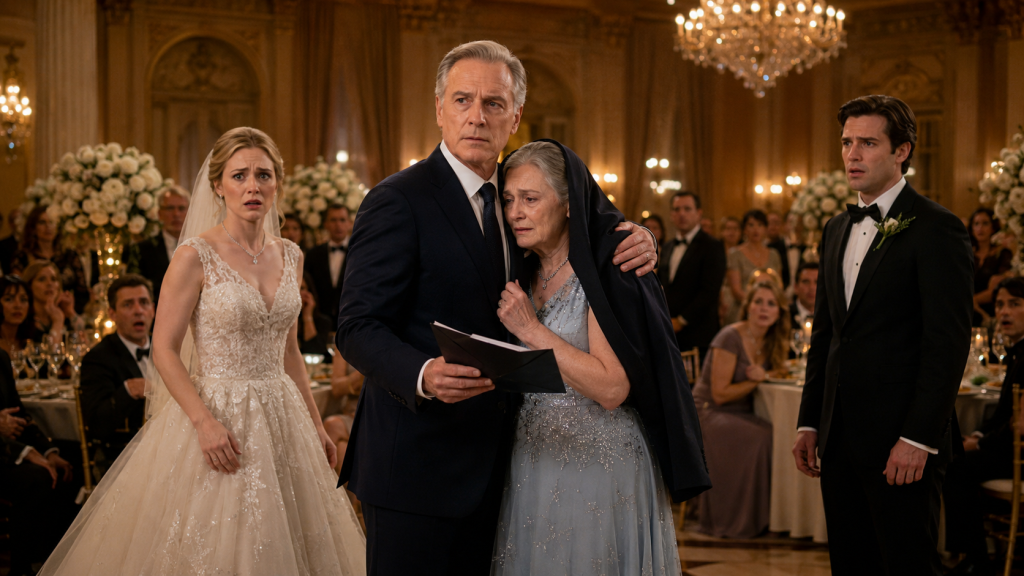
Her shoulders folded inward.
She looked smaller than I had ever seen her.
And then she searched the room.
Not for me.
For Lucas.
Even after he failed her, she still searched for him.
That was the moment I stood up.
The legs of my chair scraped loudly across the floor.
The laughter stopped.
I did not rush.
I did not yell.
I walked to the stage with the calm of a man who had already made his decision long before entering that ballroom.
Guests moved aside.
Some lowered their eyes.
Some had the decency to look ashamed.
Jennifer still wore that polished bride smile, though now it seemed uncertain around the edges.
Mary saw me coming.
Her lips trembled.
I climbed the steps, removed my navy jacket, and wrapped it gently around her shoulders. Then I lifted the collar slightly to cover her head as best I could.
She leaned into me for one second.
Only one.
Mary had always been proud.
She had never liked needing help.
I put one hand on her back, then reached out with the other and took the microphone from Jennifer.
She resisted for half a second.
I looked at her hand.
She let go.
The ballroom was so quiet I could hear the soft buzz of the speakers.
“I apologize for interrupting the evening,” I said.
My voice sounded calmer than I felt.
“But since all of you have just watched a sick woman be turned into entertainment, it only seems fair that you also witness the wedding gift I brought for my son.”
A ripple moved through the guests.
Jennifer’s smile stiffened.
Lucas finally looked at me.
“Dad,” he said softly. “Please don’t.”
I stared at him.
Those two words told me everything.
He knew.
Maybe he had not known Jennifer would do it exactly that way.
Maybe he had not expected her to pull the wig fully off.
But he knew enough to fear what I was about to reveal.
I reached into my shirt pocket and pulled out a thick black envelope sealed with wax.
It was not a greeting card.
It was not cash.
It was not a cheerful wedding gift meant to be opened between cake and champagne.
I had prepared that envelope six months earlier, the same week Mary received her diagnosis.
Back then, the doctors had spoken carefully.
Treatment plan.
Response rate.
Aggressive schedule.
Side effects.
Financial preparation.
Mary had squeezed my hand under the consultation table. Not because she was afraid to die, but because she was afraid of becoming a burden.
That night, after she fell asleep, I sat at the kitchen table until three in the morning, reviewing our accounts.
The house.
The savings.
The family trust.
The business shares.
The beneficiary documents.
The medical fund.
For years, Mary and I had planned to leave most of our assets to Lucas.
He was our only child.
Our miracle after two miscarriages.
The boy Mary had once carried from room to room when he had pneumonia at age six.
The teenager she had defended when I was too strict.
The college student she had sent care packages to every month, even when he rarely called home.
But after Mary’s diagnosis, something changed.
Not in Mary.
In Lucas.
He visited less.
Called less.
When he did call, he often asked about money.
Whether the lake house was still in the trust.
Whether I planned to help him and Jennifer with a restaurant investment.
Whether it made sense to “restructure” Mary’s medical account so unused funds would not “sit there forever.”
Unused funds.
That was what he called money meant to keep his mother alive.
Jennifer was worse.
She never said anything openly cruel at first.
She simply smiled while asking questions.
“Is Mary really comfortable attending the wedding?”
“Won’t all the photos be awkward if she looks sick?”
“Maybe she should rest at home and watch the video later.”
Mary heard those things.
She pretended not to.
I did not.
So I made changes.
Quietly.
Legally.
Completely.
I met with an attorney.
I reviewed every document.
I changed what needed to be changed.
Not because I wanted revenge.
Because love must sometimes become protection before cruelty starts planning ahead.
Now, standing on that flower-covered stage, I broke the wax seal.
The documents slid into my hand.
Signed.
Dated.
Notarized.
Stamped.
Jennifer gave a nervous laugh.
“So dramatic.”
I did not look at her.
I turned the first page toward Lucas.
The heading was printed in bold letters.
REVOCATION OF FAMILY TRUST BENEFICIARY AND BUSINESS SUCCESSION RIGHTS.
Lucas’s face emptied of color.
Jennifer’s laugh died.
“What does that mean?” she whispered.
I looked at my son.
“It means the house you expected to receive after the honeymoon is no longer being transferred to you.”
Jennifer’s eyes widened.
“It means the restaurant investment you asked me to fund is canceled.”
Lucas swallowed.
“It means the business shares scheduled to move into your name next year have been reassigned.”
A chair scraped somewhere near the front.
Jennifer’s mother stood up, red-faced and furious.
“This is outrageous.”
I turned toward her.
“No. Outrageous is your daughter humiliating a woman with cancer in front of two hundred guests.”
No one moved.
Even the guests who had laughed earlier looked down at their plates.
Jennifer pointed at Mary, who was still wrapped in my jacket.
“She’s making this into something it wasn’t. I was trying to help her fix her hair.”
Mary flinched.
That was enough.
“You raised the wig above your head,” I said. “You spoke into a microphone. You waited for people to laugh.”
Jennifer’s lips parted, but nothing came out.
Lucas stepped closer.
“Dad, please. This isn’t the place.”
I looked at him for a long time.
Then I said, “The place to defend your mother was five minutes ago.”
His eyes filled with tears.
I wanted those tears to move me.
I wanted to see the little boy who once fell asleep on Mary’s lap during thunderstorms.
But all I could see was the grown man who had stood still while his mother was shamed in front of strangers.
“Mom,” Lucas said, his voice breaking.
Mary lifted her head.
The ballroom seemed to hold its breath.
Her face was pale. Her lips trembled. But her eyes were clear.
“I came tonight,” she said quietly, “because I loved you more than my pain.”
Lucas covered his mouth.
Mary continued.
“I sat through the ceremony when I felt dizzy. I smiled for photos when my bones hurt. I told your father I was strong enough because I wanted you to remember me standing beside you on your wedding day.”
Her voice cracked.
“And when your wife hurt me, you turned away.”
Lucas stepped toward her.
I moved between them.
Not aggressively.
Just enough.
He stopped.
Jennifer suddenly snapped, “So what? You’re going to destroy your son’s future over one awkward joke?”
There it was.
The truth beneath the flowers.
To Jennifer, Mary’s pain was awkward.
Lucas’s inheritance was the future.
I pulled out the second document.
“This is the revised medical protection account,” I said. “It cannot be borrowed against, transferred, or accessed by Lucas, Jennifer, or any third party. Every dollar remains for Mary’s treatment, recovery, care, and comfort.”
Jennifer stared at me.
“Why would we access her medical account?”
I smiled sadly.
“Because you already asked my banker how soon those funds would be released if Mary passed.”
The entire room shifted.
A gasp came from somewhere near the bridesmaids.
Jennifer’s mother sat down slowly.
Lucas turned toward his bride.
“Jennifer?”
She looked at him quickly.
“That’s not what I meant.”
I pulled another page from the envelope.
“Would you like me to read the email?”
Jennifer went silent.
Lucas looked sick.
The paper trembled slightly in my hand, not from fear, but anger I had worked very hard to control.
“In that email,” I said, “Jennifer asked whether medical funds set aside for Mary would revert to Lucas upon death, and whether they could be pledged as collateral for a restaurant lease before probate concluded.”
Mary closed her eyes.
I hated that she had to hear it.
But some poison only stops spreading when it is brought into the light.
Lucas whispered, “You asked that?”
Jennifer’s face hardened.
“Your father is twisting this.”
“No,” I said. “Your words did that by themselves.”
I placed the document on the table beside the wedding cake knife.
Then I removed the final paper.
Jennifer stared at it with the expression of someone watching a locked door open.
“This,” I said, “is the updated charitable designation.”
Lucas frowned.
“What charitable designation?”
“The one that receives the portion of the estate you were supposed to inherit.”
Jennifer’s mouth fell open.
I let the silence stretch.
“The Mary Whitmore Cancer Care Foundation,” I said.
Mary turned to me.
She had not known the name.
I had chosen to use her maiden name because it was who she had been before she became a wife, before she became a mother, before illness tried to make her small.
Her eyes filled again.
But this time, the tears were different.
“The foundation will help women receiving cancer treatment with transportation, wigs, home care, medical bills, and family support,” I said. “Everything originally meant to secure your luxury future will now help people who understand basic human dignity.”
Jennifer looked as though the floor had dropped beneath her.
“You can’t do that,” she said.
“My attorney says otherwise.”
Lucas sat down on the nearest chair.
His perfect tuxedo wrinkled at the waist.
For the first time all day, he looked less like a groom and more like a lost child.
“Dad,” he whispered. “I didn’t know about the email.”
I believed him.
And somehow that made it worse.
Because he did not need to know about the email to know what had happened on that stage.
He had eyes.
He had a voice.
He had a mother.
“You knew enough,” I said.
Mary touched my arm.
I looked down at her.
She shook her head slightly.
Not to stop me.
To remind me not to become cruel while punishing cruelty.
That was Mary.
Even humiliated, even sick, she still worried about what anger might do to me.
I handed the microphone back to the wedding planner, who looked like she wanted to disappear into the flower arrangements.
Then I bent and picked up Mary’s wig from the floor where Jennifer had dropped it.
I did not put it back on Mary’s head.
That was her choice.
Instead, I folded it carefully and placed it in my wife’s hands.
“Are you ready to go?” I asked.
Mary looked once more at Lucas.
He stood slowly.
“Mom, please.”
For a second, I thought she might walk to him.
A mother’s heart is a dangerous thing. It can forgive before the wound even stops bleeding.
But Mary stayed beside me.
“Not tonight,” she said.
Lucas’s face crumpled.
Jennifer grabbed his arm.
“Lucas, do something.”
He looked at her as if seeing her clearly for the first time.
“Let go of me,” he said.
The words were quiet, but they carried.
Jennifer released him.
Her diamond bracelet flashed under the lights.
All that money.
All that beauty.
And not a single ounce of grace.
Mary and I walked down the stage steps together.
No music played.
No one clapped.
The ballroom had become a courtroom without a judge, and everyone knew what they had witnessed.
At the exit, an older woman I did not recognize stood from a back table.
She removed her own scarf and touched her bald head.
Then she looked at Mary and said, “You are beautiful.”
Mary stopped.
Her face broke.
Not from shame this time.
From being seen.
Another woman stood.
Then another.
By the time we reached the doors, half the room was standing.
Not for Jennifer.
Not for Lucas.
For Mary.
Outside, the night air was cool.
The valet hurried toward us, but I waved him back for a moment.
Mary leaned against me beneath the portico, my jacket still around her shoulders.
“I’m sorry,” she whispered.
I looked at her in disbelief.
“For what?”
“For ruining the wedding.”
I turned her gently toward me.
“You did not ruin anything.”
Her eyes shone under the lights.
“I wanted him to be happy.”
“I know.”
“I still do.”
“I know that too.”
She looked through the glass doors toward the ballroom.
Inside, Lucas stood alone near the stage while Jennifer argued with her mother. Guests gathered in tight groups, whispering. The wedding had not ended, but the fantasy had.
Mary exhaled slowly.
“I don’t want to hate him.”
“You don’t have to.”
“What do I do?”
I took her hand.
“You heal. And he learns whether he is still worthy of being your son.”
For the first time that night, Mary almost smiled.
The car arrived.
I helped her into the passenger seat and tucked my jacket around her before closing the door.
As I walked around to the driver’s side, my phone buzzed.
A message from Lucas.
Dad, please. I need to talk to Mom.
I looked through the windshield at Mary.
She had placed the folded wig on her lap. Her bare head rested against the seat. Her eyes were closed, and for the first time all evening, she looked peaceful.
I typed one sentence back.
Not tonight. Tonight she is protected.
Then I turned off the phone.
A month later, Lucas came to our house alone.
No Jennifer.
No excuses.
He stood on the porch holding flowers Mary used to grow in the garden when he was small.
Peonies.
Her favorite.
I opened the door and looked at him.
He had lost weight. His eyes were tired. His wedding ring was gone.
“Dad,” he said. “Can I see Mom?”
“That depends.”
He nodded.
“I know.”
Mary was in the living room, wrapped in a soft blanket, reading by the window. Her hair had begun to grow back in tiny silver wisps.
When Lucas saw her, he started crying.
Not dramatic tears.
Real ones.
Ugly.
Silent.
Ashamed.
He knelt in front of her chair like he had done as a little boy when he scraped his knee.
“Mom,” he said. “I failed you.”
Mary looked at him for a long time.
“Yes,” she said.
He flinched, but he accepted it.
“I was embarrassed,” he said. “Not because of you. Because I was weak. Because I wanted everything to look perfect. Because I let Jennifer decide what mattered.”
Mary’s hands tightened around her book.
“And what matters now?”
Lucas wiped his face.
“You do.”
Mary closed her eyes.
I stood in the doorway, ready to step in if she needed me.
She did not.
She reached out one thin hand.
Lucas took it and bowed his head over it.
Forgiveness did not happen that day.
Not fully.
Real forgiveness is not a wedding speech. It does not arrive dressed in lace and applause.
It comes slowly.
If it comes at all.
But a beginning happened.
That was enough.
The foundation opened six months later.
Mary insisted on attending the small ceremony.
She did not wear a wig.
She wore the pale blue dress again.
Her silver hair had grown into a soft, short halo around her head. She looked tired, proud, and more beautiful than any bride I had ever seen.
Women came to thank her.
Mothers.
Grandmothers.
Young wives.
Patients who needed rides.
Women who needed wigs.
Families who needed help paying bills.
Mary listened to every one of them as if each story mattered.
Because to her, it did.
Lucas came too.
He stood in the back at first, uncertain of his place.
Then Mary waved him forward.
He helped carry boxes, arranged chairs, and stayed long after the ceremony ended.
He was learning.
Late that afternoon, after everyone left, Mary and I stood outside the foundation doors.
The sign above the entrance read:
THE MARY WHITMORE CANCER CARE FOUNDATION.
Mary stared at it quietly.
“Do you ever regret it?” she asked.
“Changing the inheritance?”
She nodded.
I took her hand.
“No.”
She leaned against my shoulder.
“Even though he’s our son?”
“Because he’s our son.”
She looked up at me.
I said, “Money would have rewarded who he became that day. Consequences gave him a chance to become someone better.”
Mary squeezed my hand.
Across the parking lot, Lucas was loading donated supplies into a van. He looked over and gave a small wave.
Mary waved back.
Not the way she used to.
Not completely.
But enough.
That night, we went home and had soup at the kitchen table.
Nothing fancy.
No chandeliers.
No flowers worth thousands of dollars.
No guests pretending cruelty was funny.
Just Mary, me, two bowls of soup, and the quiet sound of rain against the windows.
She touched her short new hair and smiled.
“I think I’m done hiding,” she said.
I reached across the table and held her hand.
“You never had anything to hide.”
She looked at me for a long moment.
Then she laughed softly.
It was small.
It was tired.
It was beautiful.
And after months of hospitals, fear, humiliation, anger, and grief, that laugh felt like music returning to a house that had been silent too long.
Jennifer thought she had exposed my wife.
She was wrong.
She exposed herself.
She exposed Lucas’s weakness.
She exposed every person in that room who laughed before choosing compassion.
But Mary?
Mary stood in the light without the thing she thought she needed to be accepted.
And the world did not end.
It simply saw her more clearly.
As for the envelope, people still ask me if I planned to open it that night.
The truth is yes.
But not like that.
I had intended to speak privately with Lucas after the wedding. I had intended to explain that things had changed, that his mother’s care came first, that inheritance was not a right handed to someone who treated family like an inconvenience.
Jennifer chose the stage.
So I used it.
She chose the audience.
So I let them witness the truth.
And when she tore the wig from Mary’s head, she thought she was taking away my wife’s dignity.
But dignity is not made of hair.
It is not made of makeup.
It is not made of silence, money, youth, or approval.
Dignity is what remains when cruelty has done its worst and you still rise.
That night, I wrapped my jacket around my wife.
But in the end, Mary did not need me to cover her shame.
Because the shame was never hers.
THE END! THANKS FOR READING!