
I kicked my seventeen-year-old daughter out for coming home drunk.At the time, I told myself I was teaching her responsibility.Now I know I was teaching her that my pride mattered more than her pain.It was two in the morning when Kayla came home.Rain was beating against the porch roof. The kind of cold, heavy rain that makes the whole street look abandoned.I had been pacing the living room for almost an hour.…..More article below👇
My wife, Amanda, kept telling me to calm down.“She’s seventeen,” she said. “Teenagers make mistakes.”But I was angry before Kayla even opened the door.I had rules in my house.No drinking.No lying.No sneaking around.My father had raised me hard, and I had carried that hardness like a badge.
I believed love without discipline made weak children. I believed fear was sometimes necessary. I believed a parent had to draw lines and defend them.
Then the front door opened.
Kayla stepped inside soaked from the rain, her mascara running down her cheeks, her backpack hanging off one shoulder.
I smelled vodka before she spoke.
My anger ignited.
“Where have you been?”
She looked at me, and I remember something now that I did not let myself see then.
She was terrified.Not guilty.Terrified.“Dad,” she whispered. “Please, I need to tell you something.”I grabbed her backpack from her shoulder and unzipped it.There was a bottle of vodka inside, half empty.
That was all I needed.
I held it up.
“What is this?”
She burst into tears.
“I can explain.”
“No,” I snapped. “You can’t.”
Amanda stepped between us.
“David, let her talk.”
But I was already too far inside my anger to hear anyone.
Kayla reached for me.
“Dad, please. Something happened. I didn’t know how to—”
“Not under my roof,” I said.
Her face changed.
Like the floor had disappeared.
“What?”
“You want to come home drunk at two in the morning? You want to bring alcohol into this house? Then you can leave.”
Amanda shouted my name.
My fourteen-year-old son, Ethan, stood on the stairs in his pajamas, pale and silent.
Kayla clutched her arms around herself.
“Dad, please don’t do this. I’m scared.”
I mistook fear for manipulation.
I thought she was trying to escape consequences.
“Then you should have thought about that before you made your choices.”
I opened the front door.
Rain blew in.
Amanda grabbed my arm.
“She is a child.”
“She is old enough to learn.”
Kayla stood on the porch crying so hard she could barely breathe.
“I need you,” she sobbed. “Please. I need you to listen.”
But I had decided what kind of father I wanted to be in that moment.
Strong.
Firm.
Unmovable.
Heartless, though I would not have called it that yet.
I shut the door.
Behind it, Kayla screamed, “Dad!”
That scream still wakes me sometimes.
Amanda tried to open the door, but I stood in front of it.
“She needs to learn.”
My wife slapped me.
Not hard enough to hurt.
Hard enough to speak.
“You just threw our daughter into the rain.”
“She’ll come back when she understands.”
But Kayla did not come back.
By morning, she was gone.
I changed the locks before noon.
That was the part people never forgave me for.
My mother called me heartless.
Amanda packed a suitcase two days later.
“She begged you,” she said through tears. “She begged you to listen.”
“She was drunk.”
“She was our daughter.”
Then she left too.
She went to stay with her sister.
Ethan barely spoke to me after that.
The house became quiet.
At first, I told myself silence was proof that everyone would eventually see I had been right.
Kayla had crossed a line.
There had to be consequences.
I repeated that sentence for months.
There had to be consequences.
When Amanda texted asking if Kayla had called me, I said no.
When my mother told me to file a missing person report, I said Kayla was almost eighteen and had chosen to run.
When Ethan looked at me with hatred in his young face, I told him he would understand when he was a father.
He never answered.
Eight months passed.
No calls.
No letters.
No messages.
Sometimes I drove past her school, though she was no longer enrolled. Sometimes I looked at old photos on my phone and felt something crack inside me before I shoved it down.
In every picture, Kayla was smiling.
Kayla with braces.
Kayla holding a science fair ribbon.
Kayla asleep on the couch with our old dog curled beside her.
Kayla at sixteen, wearing a blue dress for homecoming, asking me if she looked okay.
I had said, “You look beautiful, kiddo.”
She had rolled her eyes, but she smiled.
I wondered where that girl had gone.
Then one Thursday evening, Ethan came home shaking.
He stood in the kitchen doorway holding his phone like it was something dangerous.
“Dad,” he said. “I found Kayla.”
Every part of me went still.
“What?”
He came closer.
His hands were trembling.
“There’s a Facebook post from a homeless shelter in Phoenix.”
Phoenix.
We lived in Colorado.
My daughter was eight hundred miles away.
Ethan handed me the phone.
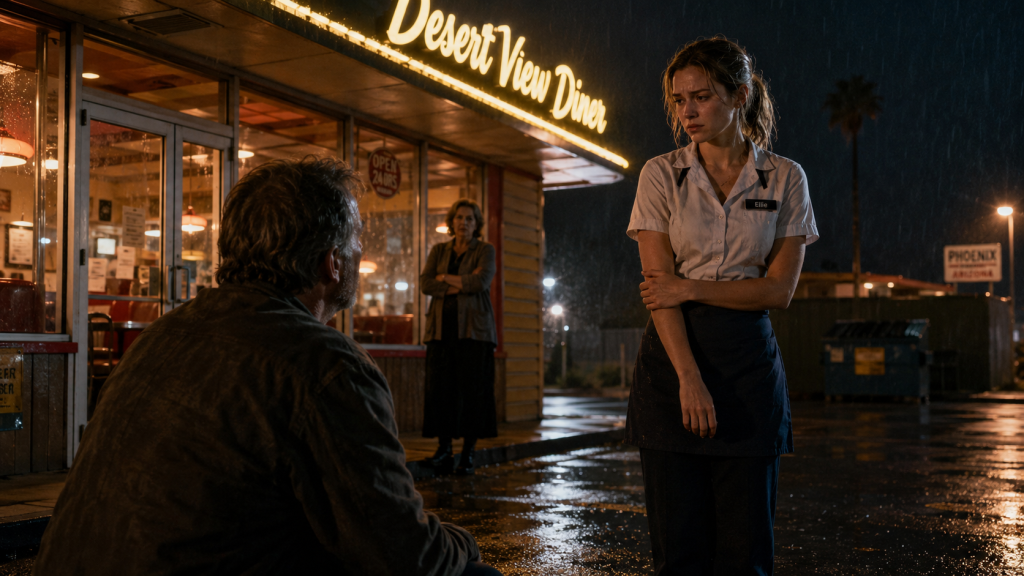
The post showed a photo of Kayla standing beside two women outside a shelter. She wore a Waffle House uniform. Her hair was tied back. Her cheeks were hollow. Her arms looked too thin.
I almost did not recognize her.
Then I saw her eyes.
My daughter’s eyes.
The caption explained that Kayla was working, saving money, and trying to finish school through a community program. The shelter had shared her story to raise awareness about homeless teens.
Then Ethan scrolled to the part Kayla had written herself.
I read the first sentence.
My dad threw me out over one mistake.
My throat tightened.
Ethan whispered, “Keep reading.”
I did.
I wasn’t drunk to rebel. I was trying to tell him that night that I was scared. I had not been drinking for fun. I drank because I didn’t know how else to walk into that house and say what happened after school.
The phone blurred.
I gripped the counter.
Kayla’s words continued.
I was seventeen, and the man Dad trusted as my math tutor had been touching me for months. I kept thinking if I ignored it, it would stop. Then he cornered me after tutoring and I finally understood I had to tell someone. I bought vodka from a man outside a gas station because I was shaking so badly I thought I would die before I could say it out loud. But Dad saw the bottle before he saw me.
I dropped the phone.
It clattered against the tile.
Ethan picked it up, crying silently.
The room spun around me.
The tutor.
Mr. Harlan.
A quiet man from church. Former teacher. Recommended by another parent. I had trusted him because he spoke politely, dressed neatly, and shook my hand firmly.
Kayla had begged me to listen.
Something happened.
I need you.
I’m scared.
I had thrown her into the rain.
I stumbled backward into a chair.
Ethan’s voice broke.
“She tried to tell you.”
I looked at my son.
There was no defense.
No explanation.
No sentence strong enough to protect me from what I had done.
“I didn’t know,” I whispered.
Ethan’s face twisted.
“Because you didn’t let her talk.”
That was the truth.
Not a dramatic truth.
Not a complicated one.
Just the cleanest, cruelest truth I had ever heard.
I drove to Phoenix that night.
Ethan came with me.
Amanda refused my call at first. When she finally answered and I told her, she went silent for so long I thought the line had disconnected.
Then she said, “Find my baby.”
I drove eight hours without stopping except for gas.
Every mile became a punishment.
I remembered Kayla at five, asleep against my shoulder during a thunderstorm.
Kayla at ten, crying because a girl at school called her weird.
Kayla at thirteen, slamming doors but still leaving Father’s Day cards on my pillow.
Kayla at seventeen, standing on the porch in the rain, begging me not to close the door.
By morning, we reached the shelter address.
They told us she was at work.
Waffle House.
A small yellow building beside a busy road.
I saw her through the window before she saw me.
She was pouring coffee for a truck driver, smiling politely in that tired way people smile when they cannot afford to fall apart.
She had lost weight.
Too much.
Her uniform hung loose.
Her hair was shorter.
My daughter looked older than I did.
When she stepped outside for trash duty, carrying two black bags toward the dumpster, Ethan called her name.
“Kayla.”
She froze.
The bags slipped from her hands.
For one second, I saw hope cross her face.
Then she saw me.
The hope disappeared.
“No,” she whispered.
I took one step.
“Kayla.”
She backed away.
“You don’t get to come now.”
Ethan ran to her.
She let him hug her.
They held each other so tightly that I could hear both of them crying.
I stood there useless, a man who had driven eight hundred miles and still could not cross the distance he had created.
“I’m sorry,” I said.
Kayla looked at me over Ethan’s shoulder.
Her eyes were dry now.
Hard.
“Sorry for what?”
The question struck deeper than anger.
I fell to my knees in the parking lot.
Not because I wanted forgiveness.
Because my legs would not hold the weight of myself anymore.
“I should have listened,” I said. “I should have opened the door. I should have believed you before I judged you. I failed you.”
Her mouth trembled.
“You changed the locks.”
I nodded, crying harder than I had in my life.
“Yes.”
“I slept in a bus station the first night.”
A sound came out of me I did not recognize.
“I’m sorry.”
“A man tried to follow me into the bathroom.”
Ethan sobbed.
“I’m sorry.”
“I called Mom once from a borrowed phone, but I hung up because I thought if you answered, you’d tell me I deserved it.”
I covered my face.
“I never should have made you think that.”
She looked at me for a long time.
People passed around us. A waitress stared from the doorway. Cars moved behind us. The world kept going, even though mine had stopped.
Finally Kayla said, “Did you report him?”
I lifted my head.
“I will.”
“No,” she said. “We will. But not because you decided to become a father again for one day. Because I decide what happens now.”
I nodded.
“Anything you want.”
She shook her head.
“No. Don’t say anything. You always say things like rules. Like decisions. Like you can fix everything by making it official.”
She stepped closer, still keeping distance.
“You don’t get to bring me home and pretend this is over.”
“I know.”
“You don’t get to make Mom forgive you.”
“I know.”
“You don’t get to call yourself my dad just because you finally showed up.”
That sentence broke me.
But I deserved it.
“I know.”
Kayla wiped her face with her sleeve.
“I don’t want to go with you.”
Ethan looked devastated.
I forced myself to nod.
“Okay.”
I had spent years believing fatherhood meant controlling what happened next.
That morning in Phoenix, I learned fatherhood sometimes means accepting that you are no longer trusted to lead.
We got her a hotel room.
Not with me.
With Amanda, who flew in that afternoon.
When Kayla saw her mother, she collapsed into her arms and made a sound like a child finally reaching shore after nearly drowning.
Amanda held her and looked at me over Kayla’s head.
There was love in her eyes.
But not for me.
Not then.
There was only grief.
I stayed across the parking lot and watched my family begin without me.
Over the next weeks, Kayla gave her statement.
Mr. Harlan denied everything.
Then another girl came forward.
Then another.
By the time police arrested him, five families were standing in a courthouse hallway with faces like ruined houses.
I sat beside Kayla but never too close.
Only where she allowed.
Sometimes she asked me to leave.
I left.
Sometimes she asked me to stay.
I stayed.
That became my new rule.
Not control.
Consent.
Amanda filed for separation.
I did not fight it.
Ethan lived mostly with her.
I did not fight that either.
I sold the house.
The one whose locks I had changed.
I could not sleep there anymore.
A year later, Kayla was living with Amanda again and taking classes online. She worked part-time at a café. She went to therapy twice a week. She laughed sometimes, especially with Ethan, but never the way she used to.
Maybe she will again.
Maybe she will not.
I am learning not to demand healing on my schedule.
Every Sunday, I write her a letter.
Not excuses.
Not pressure.
Just truth.
I write about memories.
About regret.
About what I am learning in the parenting class my therapist recommended.
I tell her I love her.
I tell her she owes me nothing.
Most weeks, she does not answer.
Once, she wrote back one sentence.
I read your letter.
I cried over those four words for an hour.
That is where we are now.
Not repaired.
Not ruined beyond hope.
Somewhere in between.
I used to believe being a good father meant keeping a strong house.
Rules.
Locks.
Consequences.
Now I know a strong house is not measured by whether a child is afraid to break rules.
It is measured by whether a child can come home broken and still be safe.
Kayla came home broken.
And I made the door another danger.
I cannot undo that night.
I cannot erase the rain, the lock, the silence, the eight months she spent surviving when she should have been protected.
But I can spend the rest of my life making sure I never again mistake punishment for parenting.
The last time I saw Kayla, she let me walk beside her from the courthouse to the car.
Not close.
But beside her.
Halfway across the parking lot, she stopped and looked at me.
“I’m not ready to forgive you,” she said.
I nodded.
“I know.”
“But I don’t hate you every day anymore.”
My chest tightened.
It was not forgiveness.
It was not absolution.
It was not the happy ending I had no right to ask for.
But it was a door unlocked by one inch.
And this time, I knew better than to push it open.
THE END! THANKS FOR READING!