
My parents ignored nine urgent calls from my hospital bed because they were helping my sister unpack her new suburban home. So I called my estate lawyer to the hospital, changed everything on the spot, and when they finally arrived, they learned exactly what their cruelty had cost them.
I counted the calls because the clock on the hospital wall was directly across from my bed. Nine. Nine times my thumb trembled against the hospital phone while monitors beeped softly beside me.
Nine times I called my mother, then my father, then the family group chat. Nine times the same answers came back. Voicemail. Silence. One brief text from Mom that said, “We’re at Lauren’s. Is this urgent?”
I stared at the word urgent while a nurse adjusted the IV in my arm.
The day before, a delivery truck had run a red light and crashed into my car. I remembered the sound more than the impact. Metal folding. Glass bursting. Someone screaming.
Then the taste of blood in my mouth and the smell of gasoline on hot pavement.
When I woke up after surgery, my body felt like it had been taken apart and put back together by strangers.
My ribs were bruised.
My left arm was in a sling.
My abdomen had been stitched carefully beneath layers of bandages.
The doctors had told me the next twenty-four hours would be critical for my recovery.
So yes, I thought.
It was urgent.
My sister Lauren, however, had just moved into a new suburban home in Ridgefield.
A beautiful place with a white kitchen, wide front porch, nursery she was not using yet, and a husband named Grant who believed lifting boxes was beneath him.
My parents had driven there “for a few hours” the morning after my surgery.
They promised they would stop by the hospital right after lunch.
Lunch became afternoon.
Afternoon became evening.
At 6:40 p.m., my phone buzzed.
Lauren had posted a video.
“Couldn’t have done today without Mom and Dad!” she sang, turning the camera toward them.
My father was carrying a lamp.
My mother was arranging throw pillows.
Lauren stood in the middle of her perfect white kitchen holding a glass of champagne.
Champagne.
While I lay in a hospital bed, trying not to breathe too deeply because every breath made pain burn across my ribs.
My father smiled in the video and said, “Anything for our girl.”
Our girl.
Not our girls.
I watched the video twice.
Not because I wanted to hurt myself.
Because sometimes you need to look at the truth long enough to stop making excuses for it.
I had been making excuses for my parents my whole life.
When Lauren cried because I got better grades, my mother said, “Don’t make your sister feel insecure, Miranda.”
When Lauren crashed my car at nineteen, my father said, “You’re more responsible. You’ll recover faster.”
When I built my medical software company from a tiny rented office and sold it eight years later for more money than anyone in our family had ever imagined, my parents called it “luck.”
When Lauren married Grant, a man with expensive shoes and no visible ambition, they called it “building a beautiful future.”
Lauren’s future always had a ribbon around it.
Mine was treated like a tool everyone could borrow.
I paid off my parents’ mortgage.
I covered Lauren’s student loans.
I bought my father a new truck after his old one “became embarrassing.”
I paid for my mother’s dental implants after she told everyone she was too ashamed to smile.
I loaned Lauren money for her wedding, then forgave the loan when my mother said, “Don’t ruin your sister’s happiness over numbers.”
Numbers.
That was what my success became to them.
Numbers on paper.
Money in accounts.
A lake house they loved using every summer.
Education trusts they discussed for Lauren’s future children, even though Lauren had not even decided if she wanted children.
A charitable foundation where my mother loved introducing herself as “one of the family advisors.”
They liked my wealth.
They did not like me needing anything.
That evening in the hospital, I pressed the call button, but not for a nurse.
When nurse Marisol leaned beside my bed, I asked her to call the number saved under “Harding & Vance — Estate.”
My voice was weak, but I spoke every word clearly.
“Are you sure?” she asked gently.
Marisol had been with me since morning.
She had watched me try not to cry after every ignored call.
She had watched me smile politely when doctors came in, then turn my face to the wall when they left.
“Completely,” I said.
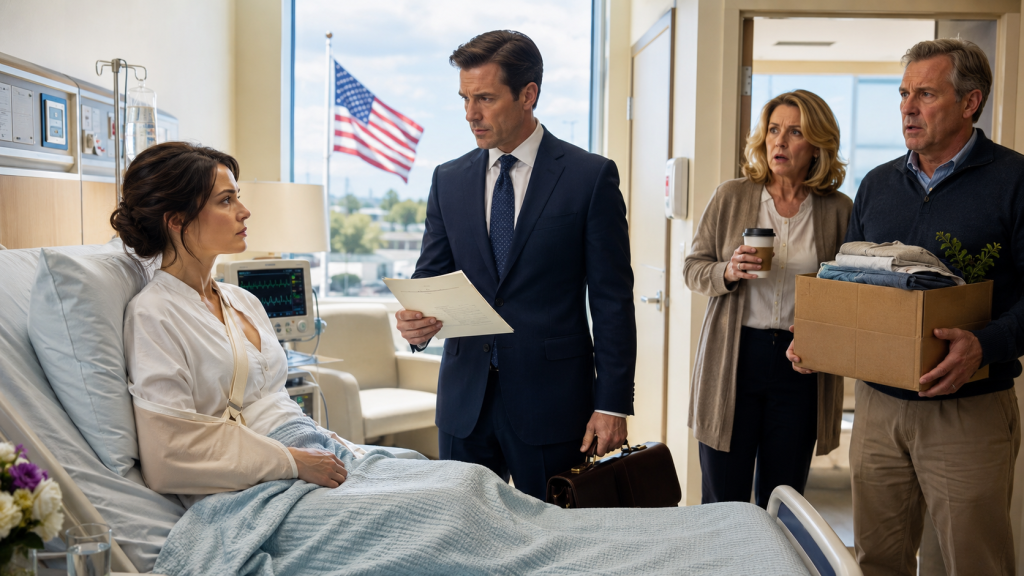
By 8:15 p.m., my estate lawyer, Julian Vance, stood at the foot of my bed in a navy suit, his briefcase resting on a chair.
Julian had represented me since I sold my company two years earlier.
He was calm, careful, and impossible to intimidate.
That was why I trusted him.
He looked at the machines, the IV, the bruises along my collarbone, and then at my face.
“Miranda,” he said gently, “you don’t have to do this tonight.”
“Yes,” I whispered. “I do.”
“Major estate decisions are often better made after emotional events have passed.”
I gave him a faint smile.
“This is not emotional, Julian. This is clarity.”
He studied me for a moment.
Then he nodded.
“All right.”
He opened his briefcase and took out the documents.
My parents knew I was wealthy.
They had no idea how wealthy.
More importantly, they had no idea they were still listed in my will.
My mother had once said, “You never know what can happen, Miranda. Family should always be protected.”
At the time, I believed that.
So I protected them.
I gave my parents a percentage of my estate.
I left Lauren a separate trust.
I named my parents as alternate decision-makers on emergency financial accounts.
I gave them future board seats in the foundation.
I gave Lauren’s future children education trusts that could have funded private school, college, graduate school, and probably a house each.
And the lake house.
The lake house was the worst part.
I bought it five years earlier after one of the hardest months of my life.
It sat on clear water in Vermont, with a wraparound porch, old pine trees, and a dock where I could sit with coffee before the rest of the world woke up.
It was the only place I had ever felt quiet inside.
My parents loved it.
Lauren loved it more.
She had already started calling it “our family lake house.”
Once, I heard her tell a friend, “Eventually it’ll probably be mine. Miranda doesn’t really need that much space.”
That should have been enough.
But I let it go.
I always let things go.
Not that night.
Julian read every change aloud.
My parents were removed as beneficiaries.
Lauren was removed entirely.
Their access to emergency accounts was revoked.
The lake house would go into a protected trust for my foundation’s retreat program for young women recovering from traumatic injury.
The education trusts for Lauren’s future children were dissolved.
The charitable foundation board seats my parents proudly mentioned to their friends were canceled.
A medical research grant would receive the bulk of the assets previously assigned to my family.
My personal possessions would go to people who had actually shown up for me.
My college roommate, Nora, who flew across three states the moment she heard about the crash.
My assistant, Ben, who had stayed at the hospital until security forced him home.
My goddaughter, Sophie, who made me laugh more than anyone.
And Marisol, though she did not know it yet, would receive a donation in her name to the nursing scholarship fund at the hospital.
When Julian finished, he looked at me.
“Are you certain?”
I looked at the phone beside me.
No missed calls.
No apology.
No one asking if I was alive.
“Yes.”
He passed me the pen.
My hand trembled, so Marisol helped steady the clipboard.
I signed.
Every page.
Every change.
Every line that returned my life to my own hands.
At 10:03 p.m., my mother finally walked into my hospital room holding a takeout coffee.
My father followed behind her with a cardboard box tucked under one arm.
It had Lauren’s name written on the side in pink marker.
They had brought my sister’s moving box into my hospital room.
For a second, I thought pain medication was making me hallucinate.
“Miranda,” my mother sighed, “you scared us.”
Julian turned from the window.
My father stopped.
His eyes narrowed.
“Why is your lawyer here?”
I looked straight at both of them.
“No,” I said quietly.
“You scared me.”
My mother blinked as if I had slapped her.
“What does that mean?”
“It means I called nine times.”
“We were busy,” my father said. “Lauren needed us.”
“I was in the hospital.”
“We knew that,” Mom said, setting her coffee on the windowsill. “But the doctors were with you. We didn’t want to crowd you.”
I stared at her.
“You didn’t want to crowd me?”
She gave me the look she always gave when she wanted me to sound unreasonable.
“Miranda, don’t start. We came as soon as we could.”
Julian stepped forward.
“Mr. and Mrs. Carter, your daughter has updated her estate documents.”
My father’s expression changed first.
He had always been better at hearing money than pain.
“Updated how?”
I answered before Julian could.
“You’re no longer beneficiaries. Neither is Lauren.”
The room went silent except for the monitor beside me.
My mother laughed once.
A tiny, brittle sound.
Like she expected me to take it back.
“You’re punishing us over one busy afternoon?”
“No,” I whispered. “I’m protecting myself after thirty-four years of being second place.”
Dad’s voice sharpened.
“Miranda, don’t be foolish. Family comes first.”
I looked at the woman who had arranged throw pillows while I called from a hospital bed.
“Then why didn’t I?”
My mother’s mouth opened.
Closed.
Opened again.
“Your sister needed help moving into her first real home.”
“And I needed my parents while I was recovering from emergency surgery.”
“That’s unfair,” Mom snapped. “You always make things sound worse than they are.”
I turned my head slightly toward Julian.
“Julian, please read the summary.”
He did.
Calmly.
Professionally.
Without emotion.
He read that my parents had been removed.
Lauren removed.
Emergency access revoked.
Lake house reassigned.
Foundation roles canceled.
Future trusts dissolved.
Every sentence landed harder than the last.
My father’s face turned red.
My mother’s eyes widened when Julian mentioned the lake house.
“The lake house?” she said.
I smiled sadly.
“That was the first thing I removed.”
Mom’s hand flew to her chest.
“Miranda, you know how much that place means to us.”
“No,” I said. “I know how much it means to me. You just enjoyed using it.”
Dad stepped closer to the bed.
“You need to rest. We can talk about this when you’re thinking clearly.”
“I have never thought more clearly in my life.”
“You can’t just cut off your family.”
“I didn’t. I answered what my family already told me.”
My mother shook her head, tears forming quickly.
She had always been able to cry on command.
When I was younger, those tears could pull guilt out of me like thread.
But that night, I watched them fall and felt nothing but exhaustion.
“We made one mistake,” she whispered.
“One?”
My voice cracked.
Not from weakness.
From years of swallowed truth rising too fast.
“You missed my graduation dinner because Lauren broke up with her boyfriend. You left my company launch early because Lauren had anxiety about a dress fitting. You asked me to pay for her wedding and then seated me near the bathrooms. You used my lake house every summer but never asked if I wanted to come. You told people I was lucky, but Lauren was special.”
My father looked away.
My mother whispered, “That’s not true.”
“It is true,” I said. “And today, when I was lying here wondering if I would survive the night, you chose Lauren’s throw pillows.”
That sentence finally broke something in the room.
My mother’s tears stopped.
My father looked at the box under his arm and seemed to realize, maybe for the first time, how absurd it was.
Lauren’s moving box.
In my hospital room.
At my bedside.
He set it down slowly.
“Miranda,” he said, softer now. “We didn’t understand how serious it was.”
“I told you.”
“You always handle things,” Mom said.
There it was.
The family excuse for neglecting me.
Miranda handles things.
Miranda is strong.
Miranda can wait.
Miranda will pay.
Miranda will forgive.
Miranda will still be there.
“I handled it,” I said.
My mother looked confused.
Then afraid.
“What does that mean?”
“It means I finally made decisions based on who shows up, not who shares my last name.”
My father’s jaw tightened again.
“You’ll regret this.”
“No,” Julian said smoothly. “She won’t. These documents are valid.”
My father glared at him.
“This is family business.”
Julian’s eyes cooled.
“This is legal business.”
For the first time that night, I almost smiled.
My mother sat down hard in the chair beside the bed.
“What are we supposed to tell Lauren?”
I stared at her.
Even then.
Even in that room.
Even after everything.
Her first thought was Lauren.
“Tell her the truth,” I said.
“That her sister almost died, and she was too busy filming a moving day video to notice.”
Mom flinched.
“She didn’t know it was that bad.”
“Because none of you asked.”
My father rubbed his face.
“Miranda, we can fix this.”
“No, Dad. You can’t fix it tonight. Tonight, you can leave.”
My mother looked horrified.
“You’re kicking us out?”
“I need rest.”
“We just got here.”
“I know.”
That was all I said.
Julian opened the door.
My father stared at me for a long time.
Maybe he expected me to soften.
Maybe he expected the old Miranda to come back.
The one who apologized after being hurt because everyone else felt uncomfortable.
But she did not come back.
Finally, he helped my mother stand.
They left without taking Lauren’s box.
Julian picked it up, looked at the label, and raised an eyebrow.
“Do you want this removed?”
“Yes.”
He carried it out and gave it to the nurse’s station.
When he came back, my eyes were wet.
He did not comment.
He simply stood beside the bed and said, “You did something difficult.”
“I feel terrible.”
“Difficult things often feel terrible before they feel right.”
I closed my eyes.
“Will they challenge it?”
“Possibly. But unsuccessfully, if they do.”
“Good.”
“Rest, Miranda.”
He left a few minutes later.
For the first time all day, the room was quiet.
Not lonely.
Quiet.
The next morning, my phone exploded.
Thirty-seven missed calls.
Twelve from Mom.
Nine from Dad.
Eleven from Lauren.
Five from Grant.
Messages filled the screen.
Mom: We need to talk. You misunderstood everything.
Dad: Don’t let that lawyer poison you against us.
Lauren: Seriously? You’re taking away MY kids’ future because Mom and Dad helped me move?
Lauren: You’ve always been jealous of me.
Lauren: You’re rich. Why are you acting like a victim?
Grant: This is cruel and financially abusive.
I laughed so hard my ribs hurt.
Financially abusive.
From a man who had once asked me to invest in his “luxury outdoor pizza oven concept.”
I did not reply.
Nora arrived that afternoon with flowers, clean pajamas, and the kind of fury only a best friend can carry safely on your behalf.
“I will fight them in the parking lot,” she announced.
“You are five foot two.”
“I said what I said.”
I laughed, then winced.
She sat beside me and took my hand.
“I’m proud of you.”
“For what?”
“For choosing yourself while it still hurt.”
That made me cry.
Not dramatically.
Just quietly.
Nora wiped my face with a tissue and pretended not to.
Over the next week, my family tried everything.
Guilt.
Anger.
Love bombing.
Threats.
My mother sent childhood photos.
My father sent a message about how “money changes people.”
Lauren sent a long email accusing me of ruining Thanksgiving, even though Thanksgiving was months away.
Grant asked whether the education trusts could at least remain “for the innocent children who may someday exist.”
I forwarded everything to Julian.
He replied each time with, “Documented.”
That word became a comfort.
Documented.
Their entitlement had a paper trail now.
When I was released from the hospital, I did not go home alone.
Nora stayed with me for two weeks.
Ben organized meal deliveries.
Marisol checked on me even after her shift ended.
Sophie drew a terrible picture of me in a superhero cape and taped it to my refrigerator.
It was crooked.
I kept it there.
My parents came to my house three days after I returned.
They did not call first.
They simply appeared on my porch holding flowers and a casserole.
I watched them through the camera.
Nora stood beside me.
“Want me to answer?”
“No.”
I opened the door myself.
My mother’s face softened instantly.
“Oh, honey,” she said. “You look so pale.”
I said nothing.
She held out the flowers.
“We brought dinner.”
My father cleared his throat.
“We all said things we didn’t mean.”
“No,” I said. “You said exactly what you meant. You just didn’t like the consequences.”
Mom’s eyes filled again.
“Can we come in?”
“No.”
Her face changed.
Just slightly.
The softness slipped.
“Miranda, this is childish.”
“There she is,” Nora muttered behind me.
My mother’s gaze snapped toward her.
“This doesn’t concern you.”
Nora smiled.
“Funny. I was at the hospital before you were, so I think I made the concern list.”
My father’s face reddened.
“We came to apologize.”
I looked at him.
“Then apologize.”
He looked uncomfortable.
“We’re sorry you felt abandoned.”
Nora actually laughed.
I raised a hand to stop her.
“That is not an apology.”
My mother exhaled sharply.
“What do you want from us?”
There it was.
Not sorrow.
Not remorse.
Frustration.
They wanted a script that would unlock my money again.
“I want honesty,” I said.
My father looked tired.
“We made a mistake.”
“You made a choice.”
My mother’s voice dropped.
“You know Lauren needs more help than you.”
I stared at her.
The sentence was so familiar that it almost sounded like home.
Lauren needs more.
Lauren feels more.
Lauren hurts more.
Lauren matters more.
“Maybe she does,” I said softly. “But needing more never gave her the right to take everything.”
My mother’s mouth tightened.
“And what about us?”
“What about you?”
“We’re your parents.”
“Yes.”
I looked at both of them.
“And when I needed parents, you were arranging pillows.”
My father looked away first.
That was when I knew some part of him understood.
My mother did not.
Or would not.
She set the casserole down on the porch.
“I hope you can live with this.”
I looked back into my house.
At Nora.
At the flowers Ben had sent.
At Sophie’s crooked superhero drawing.
At the quiet space I had built with my own hands.
“I think I can.”
I closed the door.
The fallout continued for months.
Lauren told relatives I had “cut off the whole family over a misunderstanding.”
My mother told her friends I was unstable after the accident.
My father avoided talking about it entirely.
I heard all of this through cousins who suddenly remembered my phone number.
Some called to scold me.
Some called to fish for details.
One aunt, my father’s older sister, called and said only, “It took you long enough.”
I laughed.
Then I cried.
She told me stories I had never heard.
How my parents had always favored Lauren.
How my grandparents noticed.
How my grandmother once said, “Miranda will grow up thinking love is something she has to earn.”
I sat in my kitchen listening to that sentence with a blanket around my shoulders.
My grandmother had been right.
The accident healed slowly.
So did I.
Physical therapy was brutal.
Some mornings, I woke angry at my own body.
Some nights, I dreamed of the truck hitting me and woke up gasping.
But the strange thing was, outside the pain, my life became lighter.
No more emergency requests for money.
No more family group chat full of Lauren’s needs.
No more last-minute calls asking if I could cover this, fix that, fund something, forgive someone.
Julian helped restructure my foundation.
The lake house became a retreat for women recovering from severe accidents and medical trauma.
The first group arrived the following spring.
I was there to greet them.
Seven women.
Some with canes.
Some with scars.
Some with fear still living in their eyes.
I watched one woman sit on the dock at sunrise, wrapped in a blanket, crying quietly into her coffee.
Later, she told me, “This is the first place I’ve felt like my body isn’t a crime scene.”
That alone made every angry message from my family worth it.
The education trust money became scholarships for nursing students.
Marisol was invited to help choose the first recipients.
When I told her, she cried so hard she had to sit down.
“You didn’t have to do this,” she said.
“I know,” I replied. “That’s why it counts.”
One year after the accident, I returned to the hospital for a donor event.
I stood in the same hallway where Julian had walked in with his briefcase.
My body still ached sometimes.
My left shoulder never regained full strength.
But I was alive.
More than alive.
Free.
As I was leaving, I saw my father near the entrance.
He looked older.
Smaller.
For a moment, we simply stared at each other.
Then he walked toward me.
“Miranda.”
“Dad.”
He held his hands awkwardly at his sides.
“I didn’t know you’d be here.”
“I’m on the hospital board now.”
He nodded.
“I heard.”
Silence stretched between us.
Then he said, “Your mother and Lauren still think you overreacted.”
“I know.”
“I don’t.”
That surprised me.
He looked down.
“I watched that video again. The one Lauren posted. I saw your messages coming in on your mother’s phone while we were laughing in that kitchen.”
My chest tightened.
“You saw them?”
“Not at first. Later. In the video.” His voice cracked. “Your name kept lighting up on the counter.”
I said nothing.
He swallowed.
“I should have answered.”
“Yes,” I said. “You should have.”
His eyes filled.
“I am sorry, Miranda. Not that you felt abandoned. Not that you were upset. I am sorry I abandoned you.”
The words hit me harder than I expected.
Because they were finally the right ones.
I looked away for a moment.
A nurse passed us.
Somewhere down the hall, a monitor beeped.
“I believe you,” I said.
He closed his eyes like those three words had weight.
“Can we ever fix this?”
I thought about the lake house.
The hospital room.
The nine calls.
The years before them.
“No,” I said gently. “We cannot fix what happened.”
His face fell.
“But we can build something different if you are willing to stop pretending Lauren is the only daughter who needs love.”
He nodded quickly.
“I am.”
“I hope so.”
We did not hug.
Not then.
But he walked me to my car.
It was a beginning.
A small one.
My mother did not change as quickly.
Lauren did not change at all.
She sent one final message after she learned the lake house retreat had opened.
Lauren: So strangers get the lake house but family gets nothing?
I replied for the first time in months.
Me: Strangers came when I called.
She never answered.
My relationship with my father became careful.
Coffee once a month.
Then lunch.
Then a walk around the park near my house.
He listened more.
Defended Lauren less.
Sometimes he failed.
Sometimes I left early.
But he kept showing up.
That mattered.
My mother refused invitations unless Lauren was included.
I stopped sending them.
Two years after the accident, I hosted a small dinner at my house.
Nora was there.
Ben.
Marisol.
Sophie.
My aunt.
My father.
People who had shown up in different ways, at different times, with different kinds of love.
Before dinner, Sophie pointed to the crooked superhero drawing still on my refrigerator.
“You kept it?” she asked.
“Of course.”
“It’s bad.”
“It’s priceless.”
She grinned.
My father looked at it for a long time.
Then he turned to me and said quietly, “You were always strong.”
I set down the salad bowl.
“I know you mean that kindly. But I don’t want to be loved only because I’m strong.”
He nodded slowly.
“You’re right.”
Then he added, “You should have been allowed to be scared.”
I had to turn away because my eyes filled.
That was what I had needed all along.
Not money.
Not apology flowers.
Not casseroles on the porch.
Permission to be scared.
Permission to need.
Permission to matter without performing strength.
That night, after everyone left, I sat alone in my living room.
The house was quiet.
The good kind.
On the table beside me was a framed photo from the lake house retreat.
Seven women standing on the dock at sunset, arms around each other, faces tired and bright.
Behind them, the water glowed gold.
My phone buzzed.
A message from Dad.
Thank you for dinner. I’m proud of you. Not because of the foundation or the money. Because of who you are.
I read it twice.
Then I put the phone down and let myself cry.
Not because everything was healed.
It was not.
Some wounds become part of the body.
But crying no longer felt like losing.
It felt like release.
I thought back to the hospital room.
The clock on the wall.
The nine calls.
The monitor beeping.
Julian’s pen in my shaking hand.
My mother walking in with coffee.
My father carrying Lauren’s box.
That night had felt like an ending.
And it was.
It was the end of begging to be chosen by people who had trained me to accept being second.
But it was also the beginning of something I had never had before.
A life where love was measured by presence, not promises.
A family built from people who answered.
A future protected from entitlement.
And a version of myself who finally understood that being strong did not mean staying silent.
Sometimes strength was calling the lawyer.
Sometimes it was signing the papers.
Sometimes it was saying, “No, you scared me.”
And sometimes it was looking at the people who abandoned you in your weakest moment and refusing to hand them the keys to everything you built.
My parents ignored nine urgent calls from my hospital bed.
For years, I thought that proved I was unloved.
Now I know it proved something else.
It proved I had been giving my inheritance to the wrong people.
So I took it back.
Not just the money.
Not just the lake house.
My peace.
My voice.
My life.
💬THE END! THANK YOU FOR READING!