
My son did not speak for eight years after his twin sister’s funeral. His first words, spoken on the anniversary of her disappearance, made every person at our dining table go completely still. Jeremy and Janice were born eleven minutes apart on a cold March morning.
Jeremy came first, red-faced and furious, his tiny fists clenched as if he had entered the world prepared for battle. Janice followed quietly. One of the nurses laughed and said she was already reaching for her brother before she had even opened her eyes.
Her little hand stretched across the space between the bassinets, fingers searching. When they placed Jeremy beside her, he stopped crying. That was how they were from the beginning.
Together, they were calm. Apart, they seemed to feel something missing.
As toddlers, they developed their own language. They used sounds and gestures that made no sense to anyone else. Jeremy would tap the table twice, and Janice would bring him a blue crayon. Janice would tilt her head, and Jeremy would move over to make room beside him.
By the time they started preschool, they finished each other’s sentences. “I want the red—” Jeremy would begin. “Cup,” Janice would finish. “Mom, can we go to—” “The park?”
They shared toys without being told. They defended each other against older children. At night, even though they had separate beds, I often found Janice curled beside Jeremy, both of them sleeping under the same blanket.
They had entire conversations with their eyes.
My husband, Richard, used to joke that the twins knew secrets the rest of us would never understand.
At the time, I thought it was sweet.
Years later, I would remember those words and wonder whether they had been a warning.
The summer they turned five, Richard took them to Lake Briar.
I was supposed to go, but my mother had fallen and fractured her wrist. She needed someone to drive her to the hospital, so Richard told me not to worry.
“It’s only an afternoon,” he said. “I’ll keep them close.”
I knelt in front of Janice and tied the ribbon on her sunhat.
She kissed my cheek and promised to bring me a smooth stone from the shore.
Jeremy hugged my waist.
He seemed unusually reluctant to leave.
“You’ll have fun,” I told him.
He looked at his father, then back at me.
Janice took his hand.
“Come on,” she said brightly. “We’ll find Mom the best rock.”
Those were the last words I ever heard my daughter speak.
At 4:37 that afternoon, Richard called me.
His voice sounded strange—too loud and too controlled at the same time.
“Laura,” he said, “there’s been an accident.”
The hospital corridors smelled of disinfectant and wet clothing.
Jeremy sat wrapped in a gray blanket, his lips blue and his eyes fixed on the floor.
Richard’s shirt was soaked.
There was a scratch along his jaw and mud on his trousers.
“Where is Janice?” I asked.
No one answered quickly enough.
I grabbed Richard’s arms.
“Where is my daughter?”
He told me she had slipped near the water.
He said the current had pulled her away.
He claimed he jumped in and tried to reach her, but the water was too strong.
Search teams worked until darkness fell. Divers returned the next morning. Boats dragged the deeper sections of the lake.
They found one of Janice’s sandals caught between two branches.
They found her yellow sunhat near the southern bank.
They never found her.
The police called it a tragic accident.
There were no witnesses.
The weather had changed suddenly that afternoon, and the lake had become rough. Richard’s story sounded possible. There was no evidence of a crime.
Jeremy did not speak during the search.
He did not speak when officers questioned him.
He did not speak when we held a funeral without a body.
At the graveside, he wore a small black suit and gripped my hand so tightly that my fingers went numb.
Richard stood on his other side.
When the minister said Janice’s name, Jeremy looked up at his father.
The expression on his face was not grief.
It was terror.
I noticed it.
But I was drowning in my own sorrow, and I told myself that a five-year-old could not understand what had happened.
After the service, Jeremy stopped speaking completely.
Doctors called it selective mutism caused by acute traumatic grief.
One specialist explained that some children shut down after witnessing a terrifying event.
Another said Jeremy might believe that speaking about Janice would make the loss real.
We tried everything.
Therapy.
Art classes.
Music sessions.
Play therapy.
Medication for anxiety.
A dog named Luna, after Janice’s favorite cartoon princess.
I read aloud to Jeremy every night.
Sometimes I read the same story Janice had loved, hoping a familiar sentence might pull his voice back to the surface.
He never spoke.
He communicated by nodding, pointing and writing short answers on paper.
He did well in school.
His teachers described him as intelligent, gentle and extraordinarily observant.
He noticed when another child was lonely.
He remembered small details.
He never caused trouble.
But he avoided deep water.
He panicked when someone locked a door.
And whenever Richard entered a room unexpectedly, Jeremy’s entire body tightened.
My marriage began to collapse within a year of Janice’s disappearance.
Richard became impatient with Jeremy.
“He has to move on,” he would say.
“He was five,” I replied. “He lost his sister.”
“We all lost her.”
But Richard’s grief never looked like mine.
He did not sit in Janice’s room and hold her clothes.
He did not wake calling her name.
He did not search online for stories of missing children found years later.
He did not visit the lake after the official search ended.
He became irritated whenever I mentioned reopening the case.
“The police did everything they could,” he said.
Once, when I suggested hiring a private investigator, he slammed his fist onto the table so hard that Jeremy dropped his glass.
“What do you expect them to find?” Richard shouted. “She drowned!”
Jeremy stared at him with enormous, frightened eyes.
That night, he crawled into my bed and slept beside me for the first time in years.
Richard and I divorced when Jeremy was eight.
The official reason was irreconcilable differences.
The real reason was that I could no longer bear the silence between us.
Richard moved to another part of Virginia and remarried two years later.
He came to see Jeremy occasionally, usually on holidays or birthdays.
Jeremy never refused the visits, but he remained distant.
He watched his father carefully.
Richard rarely looked directly at him.
Every year, on the anniversary of Janice’s disappearance, I held a small dinner.
My parents came.
My sister, Rebecca, came with her husband.
Sometimes Janice’s former kindergarten teacher joined us.
We placed her photograph on the mantel and arranged daisies on the table because they had been her favorite.
It was not a funeral.
It was a way to remind the world that she had existed.
Richard always attended.
He sat at the far end of the table, drank too much wine and left before dessert.
The eighth anniversary arrived on a rainy Saturday.
Jeremy was thirteen.
He had grown tall and thin, with dark hair that fell across his forehead. He looked like Richard from certain angles, but his eyes were mine.
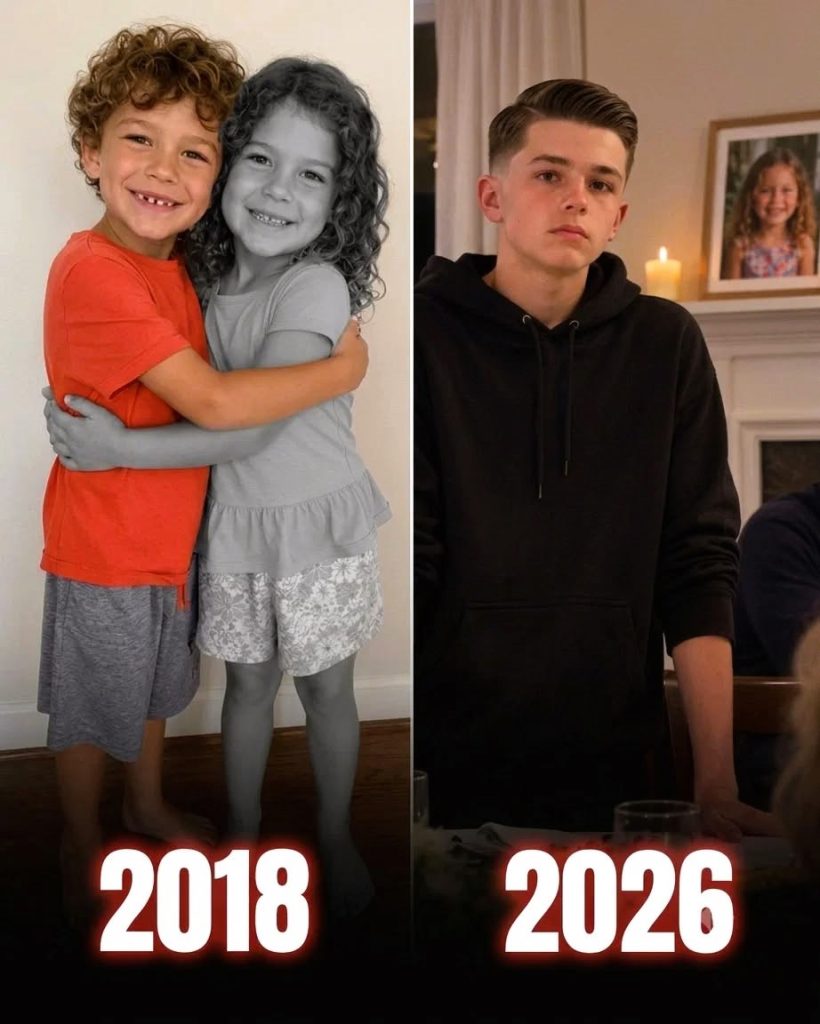
Or perhaps they were Janice’s.
That evening, the family gathered around the dining table.
The atmosphere felt different from previous years.
Jeremy had been restless all day.
He kept checking the window.
At four o’clock, I found him in Janice’s old bedroom, sitting on the floor with a wooden box in his lap.
The box had belonged to both twins.
They used to keep marbles, feathers, stickers and tiny treasures inside it.
I had not seen it in years.
Jeremy closed the lid when I entered.
“Are you okay?” I asked.
He nodded.
“Do you want me to stay?”
He shook his head.
I touched his shoulder and left him alone.
At six thirty, Richard arrived.
He carried a bottle of expensive wine and kissed my cheek as if we were old friends.
“Laura.”
“Richard.”
His hair was grayer than the year before. He wore a navy suit and the watch I had given him on our tenth anniversary.
When he saw Jeremy standing in the hallway, his smile faltered.
“Hey, son.”
Jeremy did not move.
Richard held out his hand.
Jeremy stared at it until Richard slowly lowered it.
During dinner, Jeremy watched his father continuously.
It was not subtle.
My mother noticed.
So did Rebecca.
Richard shifted in his chair.
“What?” he finally asked.
Jeremy looked down at his plate.
No one spoke.
We continued eating.
Halfway through the meal, rain began striking the windows harder.
The sound reminded me of the night after Janice vanished, when a storm had flooded the streets and forced the search teams to stop.
Richard poured himself another glass of wine.
My father began telling a story about the twins’ fifth birthday. He described how Janice had pushed her entire face into the cake because Jeremy dared her.
Everyone smiled sadly.
Everyone except Jeremy.
He set down his fork.
The sound was soft, but it cut through the room.
He looked at me.
Then at his grandparents.
Then at Rebecca.
Finally, he turned toward his father.
Jeremy raised one trembling hand and pointed at Richard.
His mouth opened.
For one breathless second, nothing came out.
Then he spoke.
“You pushed her.”
My mother gasped.
Rebecca dropped her napkin.
Richard’s face emptied of color.
I could hear the clock ticking on the wall.
Eight years of silence, and my son’s first words were an accusation.
I stared at him.
“Jeremy,” I whispered.
His eyes remained fixed on Richard.
“You pushed Janice into the lake.”
Richard stood so quickly that his chair scraped backward.
“That is not true.”
Jeremy flinched but did not lower his hand.
“You told her to stand near the edge.”
“Stop this.”
“You were angry.”
Richard’s voice hardened.
“He doesn’t know what he’s saying. He was traumatized.”
Jeremy’s breathing became ragged.
I moved beside him.
“You’re safe,” I said. “Tell us what happened.”
Richard pointed at me.
“Laura, don’t encourage this.”
I ignored him.
Jeremy reached into the pocket of his sweater and pulled out a folded piece of paper.
His hands shook as he opened it.
It was a drawing.
Three stick figures stood beside blue waves.
One small figure was in the water.
Another child stood on the shore.
The tallest figure had one arm extended.
Above the picture, written in a child’s uneven handwriting, were four words:
Daddy made Janice fall.
My knees weakened.
“When did you draw this?” I asked.
Jeremy swallowed.
“The night she disappeared.”
The sound of his own voice seemed to frighten him. He touched his throat as though it belonged to someone else.
Richard moved toward him.
“Give me that.”
My father stood immediately.
“Sit down, Richard.”
Richard froze.
My father had never spoken to him with such cold authority.
Jeremy held the drawing against his chest.
“I hid it,” he said. “I thought he would find it.”
A terrible pressure built behind my ribs.
“Why didn’t you tell me?”
Tears filled Jeremy’s eyes.
“He said you would die.”
The room seemed to tilt.
Richard shook his head rapidly.
“This is fantasy. He was five years old.”
Jeremy’s voice grew stronger.
“You said if I told, you would push Mom too.”
I looked at Richard.
He could not meet my eyes.
That was when I knew.
Not because of the drawing.
Not because of the words.
Because Richard looked guilty.
I had lived with that man for eleven years. I knew every movement of his face. I knew how his left cheek tightened when he lied. I knew how he glanced toward the nearest exit when he felt trapped.
He was doing both.
My father stepped between Richard and the door.
“You’re not leaving.”
Richard laughed nervously.
“You can’t hold me here.”
Rebecca already had her phone in her hand.
“I’m calling the police.”
Richard lunged toward her.
Jeremy screamed.
It was not a word, just a raw sound of terror.
Richard stopped.
I pulled Jeremy against me.
For eight years, my son had carried this alone.
For eight years, he had believed that his silence was the only thing keeping me alive.
“Call them,” I told Rebecca.
Richard’s expression changed.
The panic disappeared, replaced by something cold.
“You have no proof,” he said.
Jeremy looked up.
“Yes, I do.”
He returned to the wooden box in Janice’s bedroom.
No one moved until he came back.
He carried a small plastic bag.
Inside was an old silver voice recorder.
Richard stared at it.
His knees appeared to weaken.
The recorder belonged to my father.
He had given it to the twins shortly before the lake trip because they loved recording songs and silly stories.
I thought it had been lost with Janice.
Jeremy placed it on the table.
“I found it in Dad’s car after the lake,” he said. “I took it because I thought Janice’s voice might be inside.”
“Did you listen to it?” I asked.
He nodded.
“Once.”
His face crumpled.
“Then I hid it.”
The battery had corroded long ago, but the memory card remained inside.
Rebecca’s husband retrieved his laptop from the car.
Richard stood motionless near the dining room wall.
No one tried to speak to him.
The recording began with wind and children laughing.
Janice’s voice filled the room.
“Mom’s rock has to be shiny!”
My hands flew to my mouth.
It had been eight years since I had heard her voice.
Jeremy answered in the recording.
“This one is better.”
Then Richard spoke.
“Come closer to the water, Janice.”
“No. Mom said not to.”
“I’m standing right here.”
There was a pause.
The sound of footsteps on gravel.
Then Janice said, “I don’t want to.”
Richard’s voice became sharp.
“Stop being difficult.”
Jeremy said, “Dad, she’s scared.”
“Both of you be quiet.”
A gust of wind distorted the next few seconds.
Then Janice cried out.
There was a splash.
Jeremy screamed her name.
Richard cursed.
The recording shook violently, as though the device had fallen.
Then came words that destroyed the final fragment of doubt.
Jeremy’s five-year-old voice sobbed, “You pushed her!”
Richard answered, low and furious.
“It was an accident. Do you understand me?”
“You pushed her!”
“If you ever tell your mother, she’ll end up in the lake too.”
Someone in the dining room began crying.
I think it was my mother.
The recording continued with Jeremy sobbing, Richard ordering him to stop, and distant voices approaching.
Then it ended.
Richard moved first.
He grabbed the laptop and threw it across the room.
Rebecca screamed.
My father restrained him until the police arrived.
They handcuffed Richard in the hallway beneath the framed photographs of our children.
As officers led him toward the door, he looked at Jeremy.
“You ruined everything,” he said.
I stepped between them.
“No,” I replied. “You did.”
The investigation reopened immediately.
Detectives searched the old case files, reexamined the lake and interviewed everyone who had been there that day.
Richard eventually confessed that he had been angry with Janice because she refused to stand near the edge for a photograph.
He claimed he shoved her lightly and never intended for her to fall.
But after she slipped into the water, he hesitated.
He was afraid of being blamed.
Those seconds cost Janice her life.
Instead of admitting what he had done, he threatened a terrified five-year-old boy into silence.
The prosecutor charged him with manslaughter, child endangerment, obstruction of justice and witness intimidation.
During the trial, his attorney argued that the death had been accidental.
The jury listened to the recording.
They watched Jeremy testify through tears.
They saw the drawing he had hidden for eight years.
They found Richard guilty on every count.
He was sentenced to decades in prison.
But punishment did not bring Janice back.
It did not return the childhood Jeremy had lost.
For months after the trial, he struggled with speaking.
Some days he talked freely.
Other days he returned to silence.
His therapist explained that healing was not a straight road.
Jeremy had spent eight years believing his voice could kill someone he loved.
Learning that his voice could also protect people took time.
One evening, about a year after the truth came out, he found me sitting in Janice’s room.
I still had not changed it much.
Her books remained on the shelf. Her faded yellow sweater hung behind the door.
Jeremy sat beside me on the floor.
For a while, neither of us spoke.
Then he said, “I’m sorry.”
I turned toward him.
“For what?”
“For not telling you.”
I took his face in my hands.
“You were five years old.”
“I knew what happened.”
“You were a child being threatened by someone you trusted.”
He looked down.
“I thought if I talked, he would hurt you.”
“You protected me the only way you knew how.”
Tears slid down his cheeks.
“But I couldn’t protect her.”
I pulled him against my chest.
“That was never your job.”
He cried then.
Not silently.
Not with his hands pressed over his mouth.
He cried loudly, painfully and freely.
I held him until the room grew dark.
The following spring, we returned to Lake Briar.
It was the first time Jeremy had agreed to go back.
My parents came with us.
So did Rebecca.
We carried daisies and a small polished stone.
The sky was bright, and the water was calm.
Jeremy stood at the shore for a long time.
His hands trembled.
I asked whether he wanted to leave.
He shook his head.
“No,” he said. “I need to say something.”
We walked to the place where Janice had disappeared.
Jeremy knelt and placed the stone beside the flowers.
It had been sitting in the wooden box all those years.
A smooth gray rock with a thin white line through the center.
The rock Janice had chosen for me.
Jeremy had picked it up after she fell.
He had kept it hidden with the recorder and the drawing.
He touched the stone gently.
Then he looked across the water.
“I remember you,” he said.
The wind moved through the trees.
“I remember your laugh. I remember how you stole my blankets. I remember you weren’t scared until he made you stand near the edge.”
His voice shook.
“I’m sorry I stayed quiet.”
I knelt beside him.
Jeremy took a deep breath.
“But I’m not quiet anymore.”
The water carried his words away from us.
For the first time in eight years, the lake did not feel like a grave.
It felt like a witness.
We never recovered Janice’s body.
But we recovered the truth.
We recovered Jeremy’s voice.
And slowly, piece by piece, we began recovering our lives.
Jeremy is twenty-one now.
He studies child psychology and volunteers with children who have survived trauma.
He speaks softly, but people listen when he does.
On his desk, he keeps a photograph of Janice holding his hand on their fifth birthday.
Beside it sits the smooth gray stone.
Every year on the anniversary of her passing, we still gather for dinner.
There are daisies on the table.
Her photograph remains on the mantel.
But the room is no longer ruled by silence.
We tell stories.
We laugh.
We cry when we need to.
And before dessert, Jeremy always raises his glass.
“To Janice,” he says.
Then all of us repeat her name.
Not as a secret.
Not as a tragedy hidden beneath fear.
But as a child who lived, who mattered and who was finally given the truth she deserved.
THE END! THANKS FOR READING!