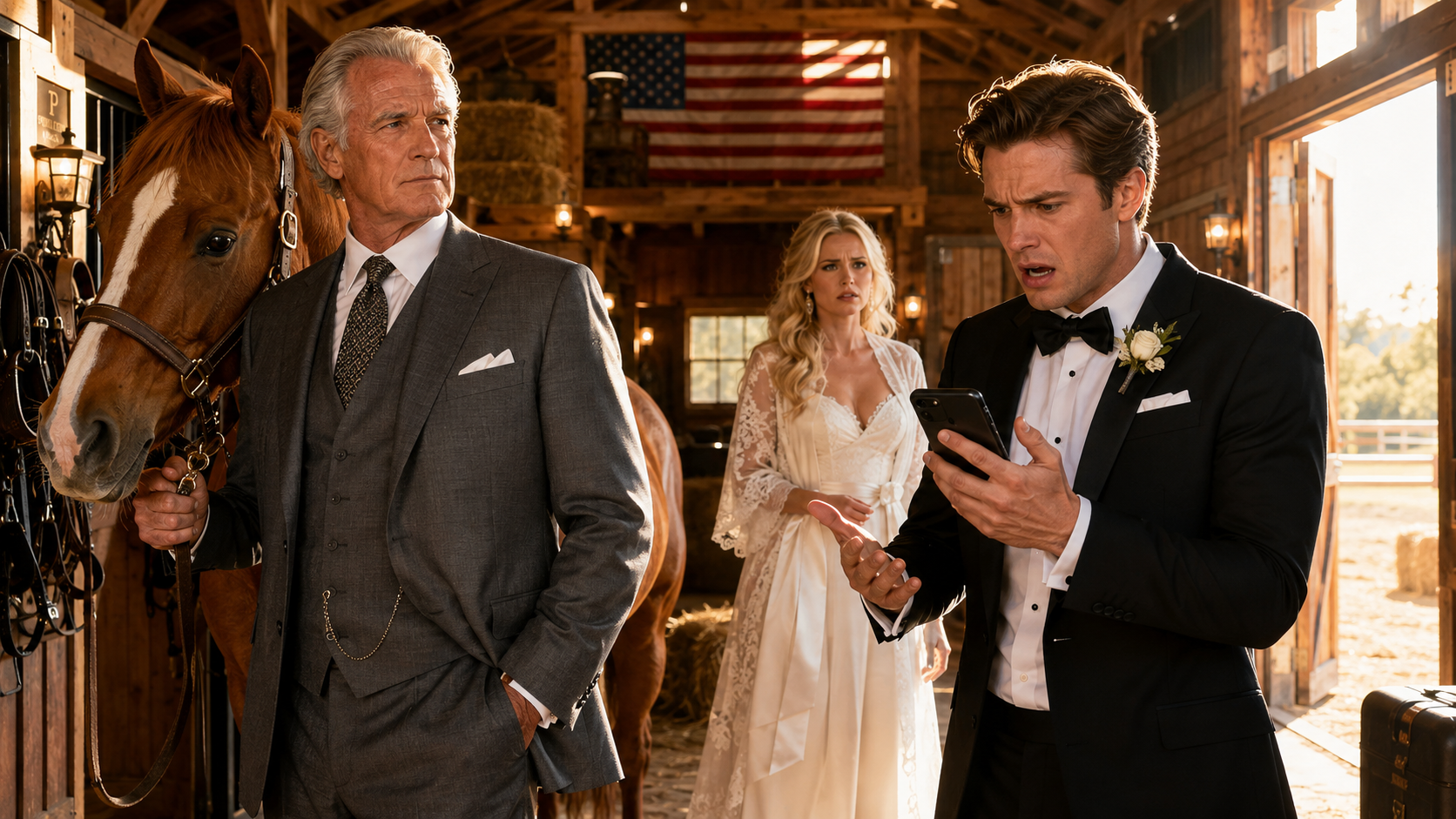
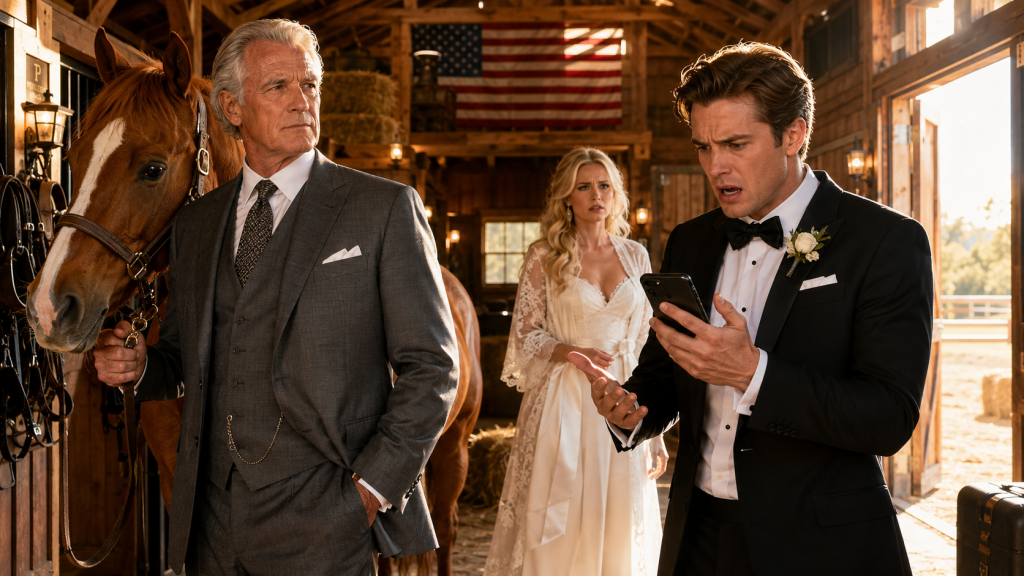
The day my son got married, I kept the most expensive secret of my life: the four-hundred-million-dollar ranch wasn’t his, it was mine. And when his wife sent me to sleep in the stable as if I were an old field hand, I understood why my late Margaret made me stay quiet.
“Because they were never yours,” I told him.
Jason looked up as if I had slapped him.
His cell phone was trembling in his hand. On the screen, bank notifications kept popping up, one after another, like funeral bells: card declined, line suspended, transaction unauthorized.
“What do you mean they weren’t mine?” he asked.
I kept brushing Maverick.
The horse snorted, restless, as if he too smelled the storm. Outside, the ranch was waking up with that crisp air of Jackson Hole—dark soil, smelling of damp alfalfa, manure, and fresh coffee brewing in Mary’s kitchen.
“They were extensions of my accounts,” I said. “I was paying for them.”
Jason laughed, but it wasn’t a real laugh.
“Dad, don’t start. All of this is mine too. It’s the family estate.”
“The family’s, yes. Yours, no.”
He froze.
For the first time in years, my son didn’t know what to say.
Lauren appeared behind him, wrapped in a white robe as if she were still posing for wedding photos. But her face no longer matched the silk. It was hard, sharp, with her lips tightly pressed.
“What’s going on?” she asked.
“My dad canceled my cards,” Jason said, still in disbelief.
Lauren looked at me.
She no longer smelled of expensive perfume. She smelled of fear.
“Mr. Bennett, this is an insult.”
I set the brush down on a shelf.
“The insult was sending the owner of the house to sleep with the horses.”
The word owner hung in the air.
Lauren blinked.
Jason took a step toward me.
“What did you say?”
I reached into my vest pocket and pulled out the old keychain, the very one Helen gave me when we bought the first corrals. Then I pulled out a folded copy of the deed.
I didn’t hand it to them. I just let them see the seal.
“The Oak Ridge Ranch is in my name. The house, the lands, the wells, the warehouses, the cattle, the export contracts, and even the Western saddle your wife ordered removed because ‘it looked too country.’”
Lauren turned white.
Jason shook his head.
“No. Mom would never have done that.”
Right there, it hurt.
Not because he doubted me. But because he was still using Helen as a shield after having let them humiliate me in her garden.
“Your mother did it precisely because she knew you,” I told him.
Jason took a step back.
“You’re punishing me.”
“No, son. I’m stopping the rewards.”
Lauren reacted first. She always reacted first when she smelled money slipping through her fingers.
“This doesn’t change anything,” she said. “Jason is the heir. You can’t just erase your son over a tantrum.”
“It’s not a tantrum,” I replied. “It’s an inventory.”
“An inventory?”
“Yes. I’m counting what’s left of the family.”
She didn’t wait any longer. She yanked Jason by the arm and pulled him out of the stable. Before crossing the doorway, she looked at me the way one looks at an old animal before selling it off.
“You don’t know who you’re messing with.”
I stroked Maverick’s neck.
“I do know, Lauren. That’s why I started early.”
I didn’t go to the main house that day. I stayed with the workers.
Bill, the foreman, arrived with his worn-out hat and dust-covered boots. He brought me coffee in a thick mug—the strong kind, the kind you drink before checking fences.
“Is the sky cracking open yet, boss?” he asked.
“It already cracked.”
Bill looked toward the house, where the wedding floral arrangements were wilting under the sun.
“Miss Helen used to say that one day this was going to happen.”
“Helen saw more than we did.”
He nodded.
In the corral, the boys were separating calves. Beyond them, the rows of pine trees stretched out in perfect lines, with that ancient patience one learns on the land: planting today to harvest years later, enduring harsh winters, waiting for the spring thaw, trusting the root.
That was the ranch. Not champagne flutes. Not corporate contracts. Not the Montgomery last name.
In the mid-afternoon, David Collins arrived from Denver. He came in a discreet truck, with his sleeves rolled up and a black folder under his arm.
He didn’t enter through the front door. He entered through the stable, like men who know where the truth is kept.
“Your daughter-in-law already called two notaries,” he told me without greeting. “She also asked about a medical evaluation to declare you incompetent.”
It didn’t surprise me. Even so, I felt a pang in my chest.
“Jason?”
David lowered his gaze.
“He signed as the petitioner.”
For a moment, the noise of the ranch disappeared. No engine hums. No wind. No Maverick stomping the ground.
I only heard Helen’s voice, that night at the hospital, when she asked me to stay quiet.
“First, let life show you who everyone really is.”
It had already shown me. But it still hurt to see it face-to-face.
“Then let’s do it right,” I said.
David opened the folder.
Inside were the trust papers, the affidavits, the bank statements, Helen’s letter, and a video saved on a flash drive. Helen had left everything prepared with a precision that broke my heart.
My wife was dying, and yet she was still protecting me.
“The investors are coming on Saturday,” David said. “They want to sign a land-sale agreement for the valley sectors and the water rights. If they manage to make you look incompetent, they’ll try to push it through family legal channels.”
“Let them come.”
“Samuel…”
“Let them all come. Lauren, Jason, the investors, the notaries, and anyone who thinks an old man who smells like a stable no longer knows how to defend his home.”
David looked at me for a long time. Then he smirked slightly.
“Helen would have said that with fewer words.”
“Helen would have won before breakfast.”
On Friday night, Jason came looking for me.
I found him in the small chapel Helen had ordered built next to the rosebushes in the south garden. It was a simple chapel, with wooden benches, a small Madonna statue, and a cross carved by a local craftsman.
Jason was sitting on the front bench.
Without Lauren. Without a suit. Without a phone.
For a second, he looked like my son.
“Dad,” he said, “did Mom really think so poorly of me?”
I sat beside him. The chapel smelled of wax and dried flowers.
“Your mother thought well of you. That’s why it hurt her so much to watch you lose yourself.”
Jason rubbed his face.
“I just wanted to make the ranch grow.”
“No. You wanted to prove you were bigger than the ranch.”
He looked at me with red eyes.
“Lauren says that if we don’t sign with Alpine Holdings, they’re going to drown us in debt. That the water is already worth more than the cattle. That the lands can be turned into a resort, an equestrian club, luxury experiences for out-of-towners…”
I let out a bitter laugh.
“Experiences. That’s what they call selling someone else’s history now.”
“It’s not that simple.”
“Of course it isn’t. It never is when you want to justify a betrayal.”
Jason lowered his head.
“I’m in debt, Dad.”
I didn’t say anything.
“A lot. Before the wedding. Lauren doesn’t know everything. I thought with this contract we’d get out. I thought I’d explain it to you later.”
“And the nursing home was also part of your explanation?”
His face broke down.
“I didn’t want that.”
“But you signed.”
“Lauren told me it was temporary.”
“Lauren told you. Lauren wanted. Lauren decided. And where were you, Jason?”
He didn’t answer.
Outside, the distant sound of music began to play. The remaining guests at the ranch kept toasting, as if life were a show where others fall and they applaud from the shadows.
“Your mom left you a letter,” I said.
Jason raised his face.
“To me?”
“Yes. But I’m not giving it to you yet.”
“Why?”
“Because a letter from Helen isn’t used to quiet your guilt. It’s received when you are ready to change.”
I stood up slowly. Before I left, Jason grabbed my sleeve.
“Can I still fix it?”
I looked at him.
I was seventy years old, and for the first time, I didn’t know if I wanted to save my son or let him sink so he could learn to swim.
“Tomorrow we’ll find out.”
Saturday dawned clear.
The sky over the Tetons was clean, that shade of blue that makes the leaves shine like knives. In the kitchen, Mary prepared a hot stew for the workers, because out here, even days of war need hot broth, lemon, and fresh biscuits.
At eleven o’clock, the cars arrived. Three black SUVs. A sedan with out-of-state plates. Two lawyers. A notary.
The men from Alpine Holdings got out smiling, wearing brand-new boots and hats that had never seen sweat. Lauren went out to greet them in a beige dress, a pearl necklace, and a confidence that wasn’t that of a bride, but of a fake boss.
Jason came behind. Pale.
They looked for me in the main house. I wasn’t there.
I made them walk all the way to the old riding arena, the one Helen refused to demolish because that’s where Jason rode his first horse. In the stands were Bill, Mary, the ranch hands, the cooks, the children of the workers, and several local suppliers who had worked with me for decades.
Lauren stopped when she saw me.
I was in the middle of the ring, with my hat, a clean shirt, and a cane. David was by my side.
“What kind of circus is this?” Lauren whispered.
“A proper country one,” I said. “Out here, important things are spoken face-to-face.”
One of the investors smiled uncomfortably.
“Mr. Bennett, perhaps it would be better to handle this in private.”
“You wish.”
David pulled out the documents.
Lauren tried to interrupt, but the notary she had brought stepped closer to look. It took only thirty seconds for his face to change.
“The property is locked down,” he murmured.
“What?” Lauren said.
David spoke loudly so everyone could hear.
“The Oak Ridge Ranch legally belongs to Samuel Bennett. Miss Helen established an irrevocable trust. No sale, transfer, mortgage, or exploitation of water rights can be carried out without the direct signature of Mr. Samuel and the validation of two witnesses designated by her.”
Lauren clenched her fists.
“This is manipulation. He isn’t well. He doesn’t understand.”
I raised my hand.
Bill connected a screen they used for cattle auctions.
Helen’s face appeared. Thin. Pale. Beautiful.
The murmuring died instantly.
Jason put his hand over his mouth.
My wife’s voice came through clearly, though tired.
“If you are seeing this, it is because someone tried to remove Samuel from his home. Don’t fool yourselves. My husband isn’t stubborn because he’s old. He’s stubborn because he knows how to love what others only know how to sell.”
I felt my chest open up. Helen continued:
“Jason, if you are there, listen to me carefully. A ranch is not inherited by blood. It is earned with loyalty. And you will have a right to this land only when you learn to take care of your father, the workers, and the water the way you take care of a child.”
Jason started to cry.
Lauren didn’t. Lauren stared at the screen as if she wanted to break it with her eyes.
“And to anyone who thinks they can use my death to keep what we built, I leave my last will: every single stone will be sold to pay for legal defense before Oak Ridge is handed over to greedy hands.”
The video ended. Nobody applauded. There was no need.
The silence weighed more than any applause.
Lauren took a step toward Jason.
“Say something.”
Jason didn’t move.
“Jason,” she commanded. “Tell them your father is confused.”
My son closed his eyes. When he opened them, he looked at me.
“My father isn’t confused.”
Lauren stood frozen.
“Excuse me?”
Jason swallowed hard.
“I am.”
That phrase cost him more than any amount of money.
The primary investor picked up his contract folder.
“Mrs. Montgomery, you assured us you had family control and the authorization of the operating heir.”
David stepped in.
“We also have copies of emails discussing pressuring a medical evaluation and transferring rights without the owner’s knowledge. I recommend you leave the ranch before this turns into a criminal complaint.”
Lauren’s notary closed his briefcase.
“I’m not signing anything here.”
Lauren lost her mask.
“You ridiculous old man!” she yelled. “Do you think they love you? Everyone is here for your money. Even your son.”
The entire arena tensed.
I walked toward her slowly.
“Maybe. But you were the only one who sent me to the stable believing the stable was a punishment.”
Lauren was breathing heavily.
“Jason, let’s go.”
My son did not follow her.
Then she understood. She hadn’t lost the ranch. She had lost control.
She tore off her ring and threw it to the ground of the arena. Then she walked out between the black SUVs, without looking back, her beige dress kicking up dust from that earth she despised so much.
Nobody stopped her. Sometimes the worst defeat is leaving without anyone begging you to stay.
When the investors left, Jason remained in the middle of the ring. Alone. Like a disciplined child.
I picked up the ring from the ground and placed it in his hand.
“This is yours too,” I told him. “Your decisions.”
He broke down. He knelt before me, right there on the dark dirt, in front of everyone.
“Forgive me, Dad.”
I didn’t hug him right away.
I had too many years inside me of rescuing him from everything—from debts, from embarrassments, from women, from failed ventures. A father also gets tired of being a bridge for a son who insists on burning the other side.
“I don’t know if I can today,” I told him.
Jason nodded, crying.
“I understand.”
“But you can start tomorrow at five, with Bill, checking the water troughs.”
He looked at me.
“What?”
“You wanted a ranch. Start by carrying buckets.”
Bill let out a laugh. Mary did too.
Jason cried and laughed at the same time, like when he was a boy and fell off his horse but wanted to get right back on.
That afternoon, I walked back into my bedroom. The master suite. My room.
The bed was covered in new sheets Lauren had chosen. I ripped them off one by one and asked Mary to bring Helen’s embroidered quilts.
I opened the windows. The wind came in smelling of pine.
On the nightstand, a photo of my wife remained, smiling under the sun of the south garden, her hands full of dirt.
“You see, old girl,” I said to her. “You were right.”
I didn’t hear her voice, but I felt something like her hand on my shoulder.
The following dawn, Jason arrived at the corral.
No blazer. No expensive watch. Wearing old boots he found in the warehouse.
Bill put a bucket in each of his hands.
“Let’s see, heir,” he said. “You don’t brag about water. You carry it.”
Jason didn’t complain.
I watched him from afar.
I didn’t feel pride yet. I felt a tiny, cautious hope, like a green sprout after a harsh winter.
The ranch was still standing. The pines kept reaching for the sky.
Maverick neighed in the stable, the roosters crowed, and the kitchen began to smell of fresh coffee.
Oak Ridge hadn’t been saved by deeds. Helen had saved it. With her silence. With her last act of love.
And with me, an old man who finally understood that sometimes staying quiet isn’t cowardice. Sometimes it’s waiting for the truth to saddle its horse.
And when it rides out, there is no fancy last name, million-dollar contract, or greedy heart that can stop it.
THE END! THANKS FOR READING!