
My parents had ignored me for years. But the moment my father saw a photograph of me stepping out of a $78,000 Tesla, he suddenly wanted a “family meeting.”
He thought he was about to shame the daughter he had always treated like a failure.
He had no idea that by the end of the night, his spotless reputation, my brother-in-law’s hidden crimes, and every lie our family had protected for decades would collapse in front of the very people they had spent their lives trying to impress.
Four days before the meeting, an Atlanta business magazine published a photograph of me arriving at a national cybersecurity conference.
I was stepping out of my Tesla in a dark government coat, my hair pinned into a regulation bun, answering a secure call from Washington.
The caption identified me only as Colonel Ava Lane, a Department of Defense cybersecurity adviser.
It did not mention the Whitmore family.
That omission was intentional.
For years, my parents had treated my accomplishments as embarrassing inconveniences. When I graduated from West Point, they did not attend because my older sister, Marissa, was hosting an engagement party that same weekend.
When I was promoted to major, my mother sent me a text asking whether military women were allowed to wear attractive clothes.
When I became a colonel, my father told one of his church elders that I “worked with computers somewhere near the Pentagon.”
He never asked what I did.
He never asked where I had served.
He never asked why I sometimes woke in the middle of the night unable to breathe.
My family preferred stories in which Marissa was the successful daughter and I was the stubborn disappointment who had run away to join the Army.
Then the photograph appeared.
Two hours after it was published, my father called.
“Ava,” Reverend Charles Whitmore said without greeting me, “I saw something interesting online.”
There was no pride in his voice.
Only suspicion dressed as concern.
“We’re having a family meeting tomorrow evening,” he continued. “Your mother has questions about where your money came from.”
My father had ignored me for years. Now he wanted answers because I looked successful.
“Where?” I asked.
“The Oakwood Legacy Club. Seven o’clock.”
The Oakwood Legacy Club was not a place our family used for private conversations. It was an exclusive venue where my father entertained donors, politicians, business owners, and members of his church board.
If he had invited me there, he was not planning a family meeting.
He was planning a public humiliation.
“I’ll be there,” I said.
He paused, apparently surprised that I had agreed so easily.
“Wear something appropriate,” he added. “Your mother will send you suggestions.”
He hung up before I could answer.
A minute later, my phone buzzed.
My mother had sent photographs of three designer dresses, each more expensive and uncomfortable-looking than the last.
Beneath them, she wrote, “Please try not to embarrass us.”
I stared at the message for several seconds.
Then I forwarded it to Brigadier General Nora Pierce.
Her reply came immediately.
“Wear the uniform under your coat.”
The next evening, I arrived at the Oakwood Legacy Club at exactly 6:55.
My Tesla rolled beneath the entrance canopy, and a valet hurried to open my door.
My older sister, Marissa, and her husband, Blake Harrington, were waiting outside.
Marissa wore a pale blue gown and enough diamonds to finance a small military unit. Her blond hair was twisted into an elaborate knot, and her smile looked as carefully arranged as the flowers beside the entrance.
Blake stood next to her in a tailored tuxedo.
“So the Tesla really belongs to you?” he asked with a smug smile.
“That’s right.”
He walked around the car as though inspecting stolen property.
“Seventy-eight thousand dollars,” he said. “That’s a lot of money for a government employee.”
“I saved for it.”
He laughed.
“People who suddenly come into money usually make bad decisions.”
If only he knew.
For months, federal investigators had been quietly studying his finances.
Gambling debts.
Shell companies.
Falsified investment statements.
Suspicious transfers disguised as charitable donations.
I already knew far more about his life than he realized.
Marissa touched my coat sleeve.
“Mom told you to wear the green dress.”
“I’m comfortable.”
“You look like you’re going to a funeral.”
I looked past her toward the ballroom doors.
“Maybe I am.”
She frowned, but Blake laughed as if I had made a joke.
Inside, my mother, Celeste, greeted me with the same cold smile I remembered from childhood.
“What are you wearing?” she whispered.
“A coat.”
“I can see that. Take it off.”
“No.”
Her mouth tightened.
“Ava, there are important people here tonight.”
“There usually are when Dad wants witnesses.”
She glanced around quickly to make sure no one had heard.
“This meeting is for your own good.”
“Of course it is.”
“Your father is concerned. You disappeared for years, refused to discuss your finances, and now photographs of you with an expensive car are circulating online.”
“I didn’t disappear. You stopped calling.”
“That isn’t fair.”
Fairness had never survived long in our family.
When Marissa wanted dance lessons, my parents paid for private instruction.
When I wanted to join the science club, my father said the membership fee was wasteful.
When Marissa failed a college course, my mother blamed the professor.
When I earned a military scholarship, they accused me of choosing a dangerous career simply to embarrass them.
In our family, appearances mattered more than truth.
Then my father arrived, greeting donors with the polished smile that had made him famous as a respected pastor.
Reverend Charles Whitmore had built his reputation on sermons about honesty, sacrifice, and family values.
His church broadcasts reached hundreds of thousands of people.
His foundation funded food drives, scholarship programs, housing projects, and international missions.
At least, that was what the brochures claimed.
“There she is,” he announced, placing a hand on my shoulder. “My youngest daughter works with computers for the government.”
Computers.
That was all he thought I did.
He did not know that I had helped defend military networks during overseas operations.
He did not know that I advised federal agencies on cyberattacks targeting critical infrastructure.
He did not know that I had spent the previous eighteen months assisting a joint task force investigating one of the largest charitable fraud networks in Georgia.
And he certainly did not know that the trail led directly to his favorite son-in-law.
Dinner began with speeches about honesty, family, and integrity.
Listening to my father preach those words almost made me laugh.
He stood at the center of the ballroom beneath a gold chandelier, surrounded by donors who trusted him.
At the nearest table sat state legislators, real-estate developers, church elders, and local television hosts.
Several people greeted Blake warmly.
He shook hands, posed for photographs, and joked about an upcoming charity golf tournament.
No one seemed to notice that he checked his phone every thirty seconds.
No one except me.
At 8:10, my father called me onto the stage.
“Many of you saw Ava’s photograph this week,” he said into the microphone. “As parents, we were surprised.”
A few guests smiled politely.
My mother lowered her eyes in rehearsed embarrassment.
“Military service is honorable,” my father continued. “But sudden displays of wealth naturally create questions. Our family believes in accountability.”
There it was.
The trap.
He intended to imply that I had stolen money or accepted bribes. He would present himself as a courageous father demanding honesty from his wayward daughter.
Every eye turned toward me.
Exactly what he wanted.
He expected me to defend myself.
Instead, I walked onto the stage and took the microphone.
“I’ll answer that,” I said. “But first, Dad, I have one question for you.”
His smile faded slightly.
“When did you first learn that the Whitmore Legacy Foundation received millions of dollars through organizations connected to Blake Harrington?”
The ballroom fell silent.
Blake shot to his feet.
“What are you talking about?”
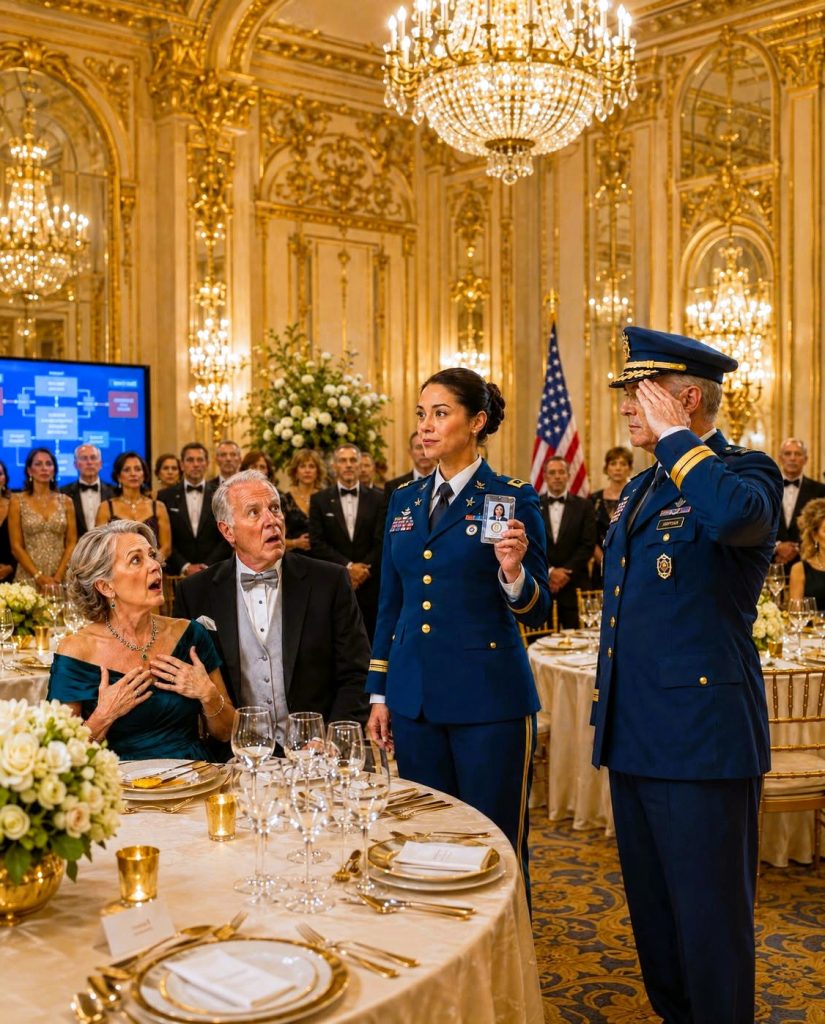
Before anyone could answer, the screen behind me lit up.
Financial records appeared.
Shell companies.
Transfer diagrams.
Account numbers.
Money trails.
One chart showed charitable donations entering the Whitmore Legacy Foundation, moving through construction contractors controlled by Blake, and disappearing into private accounts in the Cayman Islands.
Another showed church money paying inflated consulting fees to businesses that had no employees, no offices, and no legitimate operations.
My father stared at the screen.
“What is this?” he demanded.
“Your accountability meeting.”
Blake moved toward the stage.
“Turn that off.”
Then the ballroom doors opened.
Two federal agents entered, followed by an assistant United States attorney and my commanding officer in full Army dress uniform.
Brigadier General Nora Pierce stopped beside the stage.
“Colonel Lane,” she said.
My mother froze.
My sister’s mouth fell open.
Blake went white.
I removed my military identification from my purse and held it up.
General Pierce faced the room.
“Colonel Lane is not under investigation,” she said. “She has been assisting a federal task force examining cyber-enabled fraud, money laundering, and theft involving defense contractors and charitable organizations.”
Whispers raced across the ballroom.
My father gripped the podium.
“This is a misunderstanding,” he said. “Our foundation helps families.”
Assistant United States Attorney Marcus Reed opened a folder.
“Then perhaps you can explain why more than three million dollars passed through accounts controlled by your son-in-law before reaching your ministry.”
Blake rushed toward the nearest exit, but the agents blocked him.
One calmly instructed him to step away from the door.
Marissa began crying.
“Ava, stop this,” she pleaded. “You’re humiliating us.”
I looked at my sister.
I remembered every birthday she had forgotten, every achievement she had mocked, and every time she had defended Blake while calling me jealous.
“I didn’t create this,” I said. “I only stopped protecting it.”
Then the screen changed.
A scanned ledger appeared in my mother’s handwriting.
Beside several transfers were the initials C.W.
Celeste Whitmore.
My mother’s face drained of color.
My father slowly turned toward her.
“What did you do?”
Before she could answer, an elderly donor named Harold Mercer stood from his table.
He held a folded statement in one trembling hand.
“My retirement savings disappeared after I invested through Blake,” he said. “He told me the foundation guaranteed the project.”
Several other guests stood.
A widow said she had lost the insurance money her husband left her.
A business owner said Blake had convinced him to invest in a housing development that was never built.
A former church employee shouted that she had been fired after questioning invoices.
The polished gathering disintegrated into anger and confusion.
My father struck the podium with his palm.
“Everyone, please sit down.”
No one listened.
For the first time in his life, Charles Whitmore could not control the room.
Blake pointed at me.
“She hacked us!”
Agent Daniel Kim stepped forward.
“Colonel Lane did not obtain these records illegally. They were recovered through warrants, subpoenas, cooperating witnesses, and court-authorized forensic examinations.”
Blake’s expression changed.
He had expected to dismiss the evidence as a family dispute.
Now he understood that this was larger than me.
Agent Kim held out his hand.
“Mr. Harrington, please turn around.”
Marissa screamed.
“You can’t arrest my husband in front of everyone!”
Blake looked toward my father.
“Charles, tell them.”
My father stared back at him.
Something unspoken passed between them.
Fear.
Recognition.
And betrayal.
That single look told me what months of investigation had not yet proven.
My father knew more than he had admitted.
Blake saw the realization on my face.
“You said she didn’t know anything,” he snapped.
My father’s shoulders stiffened.
The ballroom became silent again.
I stepped closer.
“What exactly did Dad say I didn’t know?”
Blake’s mouth opened, but my mother interrupted.
“Don’t.”
It was not a plea to me.
It was a warning to Blake.
He laughed bitterly.
“So now you want me quiet?”
Agent Kim took Blake by the arm.
Blake pulled away.
“Ask your perfect father who approved the transfers,” he shouted. “Ask him who told me which accounts to use.”
My father’s face hardened.
“You are confused and frightened.”
“No, Charles. I’m finished taking the blame for your family.”
Marissa stared at her husband.
“What are you saying?”
Blake looked at her, and for the first time that night, his arrogance disappeared.
“I’m saying your parents knew.”
My mother sank into a chair.
My father reached for the microphone, but General Pierce removed it from the stand before he could speak.
“You will have an opportunity to answer questions in the appropriate setting,” she said.
“This is my event,” he snapped.
“Not anymore.”
The federal agents placed Blake under arrest.
As they guided him toward the doors, donors backed away from him as though dishonesty were contagious.
Marissa followed, sobbing and demanding to accompany him.
He did not look back at her.
At the doorway, he turned toward my father.
“You promised the foundation would protect us.”
The agents led him away.
The ballroom erupted.
Reporters who had been invited to cover the charity dinner rushed toward the stage.
Camera flashes exploded.
Church elders surrounded my father.
Donors demanded their money.
My mother remained motionless, staring at the ledger projected behind her.
Then my father looked at me with pure hatred.
“You did this,” he said.
“No. You did.”
“You brought federal agents into a private family matter.”
“Fraud involving millions of dollars isn’t a private family matter.”
He stepped closer.
“You have always wanted to destroy us.”
That accusation struck a place inside me that I had spent years learning to protect.
When I was twelve, I discovered that my father had used money from my college account to pay for Marissa’s private school.
When I confronted him, he called me selfish.
When I was seventeen, one of his church associates cornered me in an office after a youth event. I escaped before anything worse happened, but when I told my parents, they warned me not to ruin a good man’s reputation.
When I left for West Point, my father told everyone I had been rebellious and unstable.
For years, I wondered whether they were right.
Maybe I was difficult.
Maybe I was ungrateful.
Maybe expecting my parents to protect me had been unreasonable.
The Army taught me otherwise.
It taught me that loyalty without integrity was corruption.
It taught me that silence could be a weapon.
And it taught me that protecting an institution at the expense of innocent people was not honor.
“I didn’t want to destroy this family,” I said. “I wanted this family to stop destroying everyone else.”
My father raised his hand.
For one second, I thought he might strike me.
General Pierce stepped between us.
“Reverend Whitmore,” she said quietly, “lower your hand.”
He did.
Not because I was his daughter.
Because witnesses were watching.
Assistant U.S. Attorney Reed approached my mother.
“Mrs. Whitmore, we need to speak with you regarding the ledger.”
She looked toward my father.
He gave her the smallest shake of his head.
I saw it.
So did Reed.
My mother stood.
“I don’t know anything about those transfers.”
“Your handwriting appears throughout the records.”
“I handled bookkeeping. Charles made the decisions.”
My father’s head snapped toward her.
The room went still.
For decades, my mother had obeyed him.
She had defended him, excused him, and polished every crack in his reputation.
Now, faced with prison, she had chosen herself.
“That is a lie,” my father said.
Celeste laughed once, a broken, humorless sound.
“A lie? You want to discuss lies?”
He stared at her.
She turned toward the screen.
“Charles told me the money was being moved temporarily. He said Blake had found a legal way to increase donations.”
“You signed the documents.”
“Because you told me to.”
“You benefited from the money.”
“So did you.”
My father looked toward the donors.
“This woman is under tremendous emotional strain.”
My mother’s eyes widened.
Even then, his first instinct was to discredit her.
“You told me that Ava was dangerous,” she said. “You said her government work made her paranoid. You said she hated us.”
He said nothing.
“You told me Marissa’s marriage would collapse if I questioned Blake. You said the foundation would fail if I asked where the money came from. You told me everything was for the family.”
My father’s expression became cold.
“And you believed me.”
The cruelty in his answer finally broke something inside her.
My mother reached into her purse and removed a small black flash drive.
“I made copies,” she whispered.
My father lunged toward her.
Agent Kim’s partner, Agent Sofia Alvarez, caught his arm before he reached the purse.
The room exploded again.
Assistant U.S. Attorney Reed took the drive.
“What is on this?”
“Emails. Account statements. Meeting recordings.”
My father stared at my mother as if she had become a stranger.
“You recorded me?”
“I knew one day you would blame me.”
He lowered his voice.
“You ungrateful coward.”
My mother flinched.
I had heard him use that tone throughout my childhood.
It was the voice he used behind closed doors.
The voice never captured by television cameras.
The voice that turned affection into obedience.
My mother looked at me.
For the first time, I did not see the elegant pastor’s wife who had criticized my clothes and ignored my pain.
I saw a frightened woman who had spent most of her life protecting a man who despised weakness while creating it in everyone around him.
That did not erase what she had done.
But it explained why she had done it.
Agent Alvarez asked my father to step away from the stage.
“Am I being arrested?” he demanded.
“Not at this moment.”
He smiled faintly, mistaking procedure for victory.
“Then I am leaving.”
Assistant U.S. Attorney Reed shook his head.
“You are free to leave the ballroom, but agents are executing search warrants at your residence, the foundation offices, and several affiliated properties.”
My father’s smile vanished.
“What properties?”
“The church administrative building, your lake house, the Harrington residence, and a warehouse registered to Whitmore Community Outreach.”
My father looked at my mother.
Her expression confirmed that she knew about the warehouse.
I did too.
Three months earlier, investigators had discovered that the foundation was claiming to distribute millions of dollars in emergency equipment.
Invoices listed medical generators, water filtration units, and communications systems supposedly purchased for disaster relief.
The equipment did not exist.
But the warehouse contained something else.
Servers.
Thousands of stolen identities.
Fraudulent loan applications.
Records connected to military families, elderly donors, and disaster victims.
Blake had not simply stolen from wealthy investors.
His network had stolen from people least able to fight back.
My father moved toward me.
“You had our home searched?”
“A judge authorized the warrants.”
“You invaded your mother’s privacy.”
“You used other people’s identities to buy luxury properties.”
His eyes flickered.
That reaction told me he already knew what agents would find.
Reed’s phone rang.
He answered, listened for several seconds, and looked toward General Pierce.
“They found the server room.”
General Pierce nodded.
My father gripped the edge of a table.
Celeste closed her eyes.
One of the church elders, Thomas Bell, stepped forward.
“Charles, what server room?”
My father ignored him.
Bell had worked beside my father for twenty-three years.
He had defended him during controversies, raised money for the foundation, and persuaded skeptical donors to trust the Whitmore name.
“Charles,” he repeated, “tell me this isn’t true.”
My father finally looked at him.
“Everything I did was to protect the ministry.”
Thomas Bell’s face collapsed.
“You stole from us.”
“I built this church.”
“No. People built it. People who trusted you.”
My father straightened his jacket.
“You would have nothing without me.”
Bell removed his church board pin and placed it on the table.
“Then perhaps we deserve nothing.”
One by one, two other board members did the same.
My father watched them with contempt.
“You weak men will come crawling back when this is over.”
That was the moment I realized he still believed he could survive.
Scandals had touched his ministry before.
A missing donation.
A silenced employee.
A suspicious property purchase.
Each time, he had blamed someone else, delivered a tearful sermon, and emerged stronger.
He thought this would be another crisis to manage.
He did not understand how much evidence existed.
He did not know that Blake’s financial assistant had been cooperating for six months.
He did not know that several recorded calls captured him approving transfers.
And he did not know that his own daughter had spent years learning how corrupt networks collapsed.
Not through one dramatic revelation.
Through patience.
Documentation.
And the certainty that arrogant people eventually repeated their mistakes.
The agents escorted my father and mother from the ballroom separately.
My mother went quietly.
My father paused at the doorway and turned toward the cameras.
“My family is experiencing a painful misunderstanding,” he announced. “I ask for prayer, compassion, and restraint.”
Even then, he performed.
Then a reporter shouted, “Reverend Whitmore, did you steal from disaster victims?”
His expression cracked.
Agents guided him away before he could answer.
The ballroom emptied slowly.
Some donors cried.
Others shouted into phones.
Staff members removed food from abandoned tables while camera crews broadcast live reports from the lobby.
I remained near the stage, exhausted.
General Pierce came beside me.
“You held steady,” she said.
“I feel like I detonated a building.”
“No. You exposed one that was already burning.”
Across the room, Marissa sat alone.
Her mascara had streaked down her cheeks.
For a moment, I considered leaving without speaking to her.
Then she looked up.
“Did you know they were going to arrest Blake?”
“Yes.”
“How long?”
“I learned the investigation had reached him about eight months ago.”
“Eight months?”
“I wasn’t allowed to warn you.”
“You could have found a way.”
“If I had warned you, would you have believed me?”
She opened her mouth.
Then closed it.
We both knew the answer.
She had spent years telling me that Blake was smarter, richer, and more successful than I would ever be.
When I once asked why his companies changed names so often, she accused me of jealousy.
When I pointed out that his supposed real-estate projects never appeared to have tenants, she told our parents I was trying to ruin her marriage.
“I loved him,” she whispered.
“I know.”
“Was any of it real?”
“I don’t know.”
She looked toward the door through which he had disappeared.
“Did he cheat on me?”
The question surprised me.
“Financial investigators don’t usually focus on affairs.”
“That means yes.”
“It means I don’t know.”
She pressed her hands against her face.
“I gave him everything.”
“You defended him even when the evidence was in front of you.”
“Because Mom said wives protect their husbands.”
I looked toward the empty chair where our mother had been sitting.
“That lesson cost her too.”
Marissa lowered her hands.
“Are Mom and Dad going to prison?”
“I don’t know. That will depend on the evidence, their involvement, and whether they cooperate.”
“And Blake?”
“The charges are serious.”
She swallowed.
“What am I supposed to do now?”
It was the first time my sister had ever asked me that without sarcasm.
“Get an attorney who represents you, not Blake and not Dad. Protect your personal accounts. Don’t destroy anything. Don’t lie to investigators.”
She stared at me.
“You sound like you don’t care.”
“I care enough to tell you the truth.”
She began crying again.
I sat beside her.
For several minutes, neither of us spoke.
When we were children, Marissa used to crawl into my bed during thunderstorms.
She would hold my hand until the noise stopped.
Then our father began comparing us.
Marissa was beautiful.
I was difficult.
Marissa was graceful.
I was aggressive.
Marissa brought honor to the family.
I asked too many questions.
Eventually, she learned that loving me openly threatened her place beside our parents.
So she stopped.
Sitting in the ruined ballroom, I wondered whether we had ever been enemies or simply children competing for safety.
“I’m sorry,” she said.
“For what?”
“For not knowing you.”
I looked at her.
She wiped her eyes.
“I didn’t know your rank. I didn’t know what you did. I didn’t even know you had been deployed.”
“You never asked.”
“I know.”
That apology did not repair us.
But it opened a door.
The following morning, every major news station in Atlanta carried the story.
Federal agents had seized computers, financial records, and luxury vehicles.
The Whitmore Legacy Foundation suspended operations.
The church board placed my father on administrative leave.
Blake was charged with conspiracy, wire fraud, identity theft, money laundering, and obstruction.
My parents had not yet been charged, but reporters camped outside their home.
My photograph appeared beside headlines describing me as the colonel who had exposed her own family.
I hated that description.
It made the case sound personal.
It was not.
At least, it had not begun that way.
Eighteen months earlier, a military widow named Lydia Carter had contacted a federal fraud hotline after discovering loans opened in her deceased husband’s name.
Her husband had been killed overseas.
The stolen identity had been used to obtain more than six hundred thousand dollars.
The application was connected to a relief program administered by a contractor linked to Blake.
Investigators traced the data breach to a network that had accessed records belonging to service members and their families.
Because of my cybersecurity role, I was asked to assist.
At first, I did not recognize the shell company names.
Then I saw Blake’s signature on an archived document.
I reported the conflict immediately and requested removal from the investigation.
General Pierce refused.
“You will not make charging decisions,” she told me. “You will not contact your family. But you understand their structures, habits, and relationships better than anyone else.”
For months, I reviewed data while pretending not to recognize addresses from my childhood.
My father’s lake house.
My mother’s foundation office.
A storage facility where Marissa once hosted a charity clothing drive.
Every discovery felt like another piece of my past becoming evidence.
The worst came when investigators found records showing that the network had targeted military families deliberately.
Blake believed grieving spouses were unlikely to monitor their deceased partners’ credit.
My father approved a public campaign encouraging military widows to register for financial assistance through the foundation.
The campaign collected personal information.
That information later appeared in fraudulent loan files.
I did not know whether my father understood exactly how the data would be used.
But he had accepted money from the operation.
And he had ignored warnings.
Three days after the ballroom confrontation, Agent Alvarez called me.
“Your mother wants to speak with you.”
“Is this an official interview?”
“No. Her attorney requested a family visit before she enters a cooperation agreement.”
I nearly refused.
Then I remembered the flash drive.
We met in a federal office conference room.
My mother entered wearing a plain gray sweater, without makeup or jewelry.
I had never seen her look so ordinary.
Her attorney sat near the door.
“I suppose you’re pleased,” she said.
“No.”
“You finally proved you were better than us.”
“That was never the point.”
She folded her hands.
“Your father says you planned this because you hate him.”
“Dad says whatever protects Dad.”
Her eyes filled with tears.
“He wasn’t always like this.”
I waited.
“When we married, he was kind,” she said. “Ambitious, but kind. The church started with twelve people in a rented storefront. We slept on folding chairs during renovations. We gave away groceries when we barely had enough food ourselves.”
“What changed?”
“People began praising him.”
She looked toward the window.
“Every donation, every television appearance, every politician who asked for his endorsement—he became more certain that he had been chosen. Then anyone who questioned him became an enemy.”
“You helped him.”
“Yes.”
The answer came without hesitation.
“I corrected financial reports. I pressured employees to remain silent. I repeated lies because admitting the truth would have destroyed the life I had built.”
“You also failed to protect me.”
Her eyes dropped.
“I know.”
“When I told you what happened in that church office, you told me to stop making accusations.”
“I was afraid.”
“I was seventeen.”
“I know.”
“You chose his reputation over me.”
She began to cry.
“I know.”
For years, I had imagined confronting her.
In those fantasies, she denied everything, and I delivered the perfect speech.
But her admission left me with nowhere to place my anger.
“You don’t get forgiveness because you finally became afraid for yourself,” I said.
“I understand.”
“Do you?”
“No,” she whispered. “Probably not.”
She opened her purse slowly and removed an envelope.
Her attorney nodded, indicating it had been inspected.
Inside was a photograph of me at twelve years old, holding a homemade robot at a school competition.
I remembered that day.
My parents had promised to attend.
They did not.
The photograph had been taken by my science teacher.
“I kept every article about you,” my mother said. “Every promotion announcement I could find. I watched your West Point graduation online.”
“Why didn’t you tell me?”
“Because your father said contacting you would reward your disobedience.”
“And you listened.”
“Yes.”
I returned the photograph.
“I can’t make you feel better about that.”
“I didn’t ask you to.”
She took a trembling breath.
“The recordings on the drive go back nine years. Your father approved payments and discussed destroying documents. Blake explains how the identity data was obtained.”
“Why did you keep them?”
“At first, protection. Later, insurance.”
“Against Dad?”
“Against everyone.”
She leaned forward.
“There is something else.”
Her attorney shifted uncomfortably.
My mother continued.
“Blake was not the first person to use the foundation.”
I felt cold.
“What does that mean?”
“Your father has been hiding money since before Blake married Marissa.”
She described an older scheme involving land purchased through church-controlled companies.
Properties donated for affordable housing were quietly sold to developers.
Families were displaced.
Records were altered.
One of the accountants who questioned the transactions died in a car accident shortly before he was scheduled to meet with state investigators.
“You think Dad caused the accident?”
“I don’t know,” she said quickly. “But Charles met with someone the night before. Afterward, the investigation disappeared.”
“Who?”
She wrote a name on a legal pad.
Senator Franklin Voss.
Voss was one of the most powerful political figures in Georgia.
He had attended the ballroom dinner but left shortly before my father called me to the stage.
My mother looked at me.
“Charles didn’t build his reputation alone.”
The investigation expanded.
Federal prosecutors examined land records, political donations, and contracts reaching back more than twenty years.
Senator Voss denied wrongdoing.
My father appeared on television and claimed he was the victim of an attack on religious freedom.
He blamed Blake.
He blamed my mother.
He blamed corrupt government officials.
Most of all, he blamed me.
During a livestream watched by nearly a million people, he said, “My own daughter has allowed bitterness to poison her heart.”
For a moment, the words hurt.
Then the comments began filling with stories from former church members.
Employees who had been threatened.
Families who had lost homes.
Women who had reported harassment and been silenced.
People who had spent years believing they were alone.
My father’s attack gave them permission to speak.
Two weeks later, prosecutors charged him with conspiracy, wire fraud, money laundering, obstruction of justice, and theft involving federal programs.
My mother was charged with lesser offenses but entered a cooperation agreement.
Senator Voss resigned after investigators found payments linked to foundation land deals.
Blake remained in custody.
Marissa filed for divorce.
The church removed my father permanently and appointed an independent board to review its finances.
But the collapse of his public reputation did not happen in one dramatic instant.
It happened slowly.
Sponsors withdrew.
Television stations canceled his program.
Universities removed his name from buildings.
Donors filed lawsuits.
The same people who once waited hours to shake his hand began pretending they had never trusted him.
Three months after the gala, I visited him in federal detention.
I did not go because he requested it.
I went because I needed to know whether seeing him powerless would change anything inside me.
He entered the visitation room wearing a brown uniform.
Without his tailored suit, stage lighting, and audience, he looked smaller.
Older.
But his eyes were unchanged.
“You look satisfied,” he said.
“I’m not.”
“Your mother betrayed me.”
“She gave investigators evidence.”
“She betrayed her husband.”
“You betrayed everyone who trusted you.”
He leaned toward the glass.
“I gave people hope.”
“You stole their homes and identities.”
“I built institutions. I employed hundreds. I fed thousands.”
“And you decided that made you entitled to steal.”
“Leadership requires compromises.”
“No. Corruption requires excuses.”
His jaw tightened.
“You always were arrogant.”
“I learned from you.”
For a second, anger flashed across his face.
Then he smiled.
“You think that uniform makes you important?”
“No.”
“That car?”
“No.”
“Your title?”
“No.”
“Then why did you come?”
I considered the question.
“Because I spent years believing I failed you.”
He stared at me.
“I thought if I worked harder, achieved more, became disciplined enough, you would finally see me. When you called after the Tesla photograph, part of me still hoped you were proud.”
His smile returned.
“That is what children want.”
“But you didn’t call because you were proud. You called because my success threatened the story you told about me.”
He said nothing.
“You needed me to be the failed daughter,” I continued. “Because if I succeeded without you, people might wonder what else you had lied about.”
“You owe everything to the values I taught you.”
“You taught me what happens when authority has no accountability.”
His expression hardened.
“You will regret doing this to your family.”
“I regret waiting so long to understand that protecting a family’s lies isn’t love.”
I stood.
For the first time, he looked uncertain.
“Ava.”
I paused.
“When this ends,” he said, “people will forgive me.”
“Maybe some will.”
“They always do.”
“Then I hope you become someone worthy of it.”
I left before he could answer.
My mother received a reduced sentence because of her cooperation.
She sold the lake house and most of her jewelry to contribute to a restitution fund.
It did not repay everything.
Nothing could.
But dozens of victims recovered part of what they had lost.
The church converted one of the disputed properties into housing for displaced families.
Harold Mercer, the elderly donor who confronted Blake at the gala, became part of the independent oversight committee.
Marissa moved into a small apartment with her two children.
For the first time in her life, she had no housekeeper, no luxury allowance, and no family reputation protecting her.
She struggled.
She also changed.
One afternoon, she called and asked whether I would meet her for coffee.
When I arrived, she was wearing jeans and no makeup.
“I got a job,” she said.
“Doing what?”
“Administrative work at a medical clinic.”
I smiled.
“That’s good.”
“Dad would say it’s beneath me.”
“Dad is awaiting trial.”
She laughed.
It was not the polished laugh she used at charity events.
It sounded real.
“I found something,” she said.
She handed me a box.
Inside were letters I had written from West Point.
I had sent them to my parents during my first year.
None had received replies.
“They were in Mom’s storage unit,” Marissa explained. “Most were unopened.”
I picked up one addressed in my seventeen-year-old handwriting.
On the back, I had written, “Please call when you get this.”
My throat tightened.
“I’m sorry,” Marissa said.
“You didn’t hide them.”
“No, but I knew they ignored you. I enjoyed being the favorite.”
Her honesty hurt more than an excuse would have.
“I thought love was something we competed for,” she continued. “If they gave you any, I believed there would be less for me.”
“We were children.”
“I kept believing it after we grew up.”
I closed the box.
“Why are you telling me this?”
“Because I don’t want my children to become us.”
That was the beginning of our reconciliation.
Not forgiveness.
Not trust.
A beginning.
We met occasionally.
She asked about my work, though there were many details I could not discuss.
I learned that her daughter loved engineering and that her son was terrified of public speaking.
Marissa stopped correcting them when they expressed opinions that differed from hers.
She began seeing a therapist.
So did I.
A year after the gala, Blake pleaded guilty to multiple federal charges.
He agreed to testify against my father and Senator Voss’s associates in exchange for a reduced sentence.
During his statement, he admitted that he had married Marissa partly because he believed access to the Whitmore name would protect his businesses.
Marissa listened from the courtroom gallery.
She did not cry.
My father refused every plea offer.
He insisted on a trial.
The evidence lasted six weeks.
Prosecutors played recordings of him approving fraudulent transfers.
Former employees described intimidation.
Victims testified about stolen savings and lost homes.
My mother took the stand and explained how records had been altered.
When the defense suggested she had acted alone, prosecutors displayed messages in which my father instructed her exactly what to do.
Then Lydia Carter testified.
She spoke about losing her husband overseas.
She described discovering that someone had used his identity after his death.
She explained how the fraudulent debt nearly cost her home.
My father watched her without expression.
I sat behind Lydia with General Pierce.
At one point, Lydia turned and found me in the gallery.
She nodded.
That single gesture meant more than every word of praise my father had denied me.
The jury deliberated for less than two days.
They found Reverend Charles Whitmore guilty on nearly every count.
When the verdict was read, he looked at me.
Not my mother.
Not Marissa.
Me.
His expression contained no apology.
Only disbelief that I had escaped the role he created for me.
At sentencing, several victims spoke.
Harold Mercer described postponing retirement.
A former employee described losing her career after reporting suspicious invoices.
Families explained how fraudulent debts had destroyed their credit.
Then the judge asked whether my father wished to speak.
He stood.
For the first time, there were no cameras he controlled, no donors waiting to applaud, and no choir ready to soften his words with music.
“I dedicated my life to service,” he said. “Whatever mistakes were made, they must be weighed against the good I accomplished.”
The judge studied him.
“Good deeds do not purchase permission to exploit vulnerable people.”
My father received a lengthy federal sentence.
He would be an old man, if he survived long enough to complete it.
Outside the courthouse, reporters surrounded me.
“Colonel Lane, do you feel justice was served?”
“How do you feel about your father’s sentence?”
“Would you ever forgive him?”
I stopped beside the courthouse steps.
“Today was not about a daughter defeating her father,” I said. “It was about victims being heard after powerful people spent years silencing them.”
A reporter shouted another question.
I continued walking.
My Tesla waited at the curb.
The same kind of car that had started the family meeting.
The same symbol my father had mistaken for evidence of dishonesty.
I stood beside it for a moment, remembering the magazine photograph.
The public believed that photograph had exposed my success.
In truth, the car was one of the least important things I owned.
I valued the West Point ring in my desk.
The letters from soldiers whose families our team had protected.
A chipped coffee mug General Pierce gave me after a difficult deployment.
The photograph of twelve-year-old me holding a homemade robot.
And the box of unanswered letters that reminded me how far I had traveled without my parents’ approval.
My mother lived quietly after completing her sentence.
We spoke occasionally.
Our conversations remained careful.
She apologized more than once, but I never promised her the closeness she wanted.
Some relationships cannot be restored to what they were supposed to be.
They can only become something honest.
Years later, she attended a ceremony where I received another military honor.
She sat in the back row beside Marissa.
When my name was announced, both of them stood.
My mother was crying.
For once, I did not wonder whether my father would have been proud.
I no longer needed the answer.
After the ceremony, Marissa’s daughter, Sophie, ran toward me.
“Aunt Ava,” she said, “Mom told me you built a robot when you were my age.”
“I did.”
“Can you help me build one?”
Marissa smiled nervously.
I looked down at my niece.
“Yes,” I said. “But you’ll do most of the work.”
That weekend, Sophie covered my dining table with wires, sensors, and tiny screws.
She asked endless questions.
I answered every one.
When the robot finally moved across the floor, she cheered so loudly that my neighbor knocked on the wall.
Marissa laughed.
My mother clapped.
And I realized that ending a family pattern did not mean ending the family.
It meant refusing to pass the damage forward.
My father had spent his life constructing a legacy from buildings, money, influence, and fear.
It collapsed because it had never been built on truth.
The legacy I wanted was smaller.
A niece who knew her questions were welcome.
A sister learning that love was not a competition.
Victims who understood that powerful people could be held accountable.
And a life in which I no longer measured my worth through the eyes of people committed to misunderstanding me.
The photograph of the Tesla remained online for years.
Strangers shared it with captions about wealth, power, revenge, and success.
They saw a colonel stepping out of an expensive car.
They did not see the frightened girl who had once waited beside a telephone for parents who never called.
They did not see the woman who had struggled to expose the truth without letting anger control her.
They did not see the cost of standing in that ballroom and watching an entire family story collapse.
But I saw all of it.
And whenever someone asked what had happened at the family meeting, I gave them the simplest answer I could.
My father invited me there to explain how I could afford a Tesla.
Instead, he finally learned the price of every lie he had ever told.
THE END! THANK YOU FOR READING!