
For years, I cheated on my wife and swore she never suspected a thing. But the day I saw her holding another man’s hand, I felt the same knife I’d spent years driving into her heart.
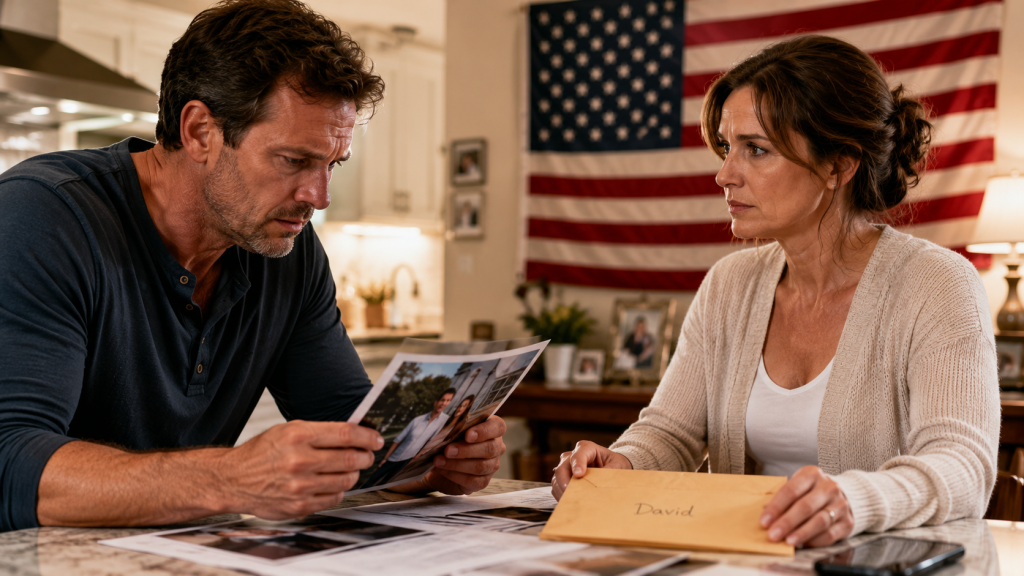
I wrote my name on that envelope as if it were the name of a dead man.
My hands refused to obey.
The paper weighed more than all my lies put together.
Sarah stood next to the table.
With that calm that was no longer patience, but a door locked from the inside.
I tore the envelope open.
Inside was a handwritten letter.
“David: You don’t know me, although I know entirely too much about you.
My name is Andrew.
I am a lawyer.
Sarah hired me eight months ago, not to destroy you, but to help her save the only things she still could: herself and your children.
Today I held her hand because she had just signed the divorce papers.”
I felt the kitchen floor sinking beneath my feet.
I kept reading, but the letters were blurring and jumping.
“Sarah asked me not to move forward until you knew the whole truth.
She didn’t want revenge.
She didn’t want to expose you.
She wanted you, for once, to listen without having a way out.”
I looked up.
“Divorce?” I asked, as if that word didn’t exist in my language.
Sarah didn’t answer right away.
She crossed her arms, not to defend herself, but to keep herself from falling apart.
“Yes, David.”
The stew was still warm on the stove.
In the living room, my kids’ toys were scattered as if normal life had been interrupted right in the middle.
“Since when?” I asked.
“Since I realized I wasn’t going to die waiting for you.”
I wanted to get angry.
I wanted to tell her she was exaggerating, that we all make mistakes, that you don’t destroy a family like this.
But the folder was still open on the table.
Full of photos of me leaving hotels, restaurants, and other people’s cars.
My defense was completely dismantled by photographs.
“I can change,” I said.
Sarah smiled.
But not with tenderness.
She smiled with sheer exhaustion.
“You should have said that when I still cared enough to believe you.”
That night I didn’t sleep in our bed.
Sarah closed the bedroom door.
I stayed on the couch, staring at the ceiling, listening to the hum of the refrigerator and the breathing of my children down the hall.
At three in the morning, I opened the folder again.
It wasn’t a folder of jealousy.
It was a chronicle of abandonment.
There were photos of birthdays I didn’t attend.
Medical bills that Sarah had paid while I claimed I was stuck in meetings.
Screenshots of another woman texting me: “I miss you.”
While I was lying to my wife.
Then I found the photo that completely destroyed me.
Sarah at the Charleston Children’s Hospital, holding our youngest son while he burned with a fever.
On the back of the photo, she had written: “David said he couldn’t come.”
“That night he was in Mount Pleasant with Jessica.”
I covered my mouth.
For the first time, I understood the true magnitude of my cruelty.
The next morning, Sarah took the kids to school.
Before leaving, my daughter hugged me.
“Are you picking us up today, Dad?”
I looked at Sarah.
She didn’t say anything.
“Yes,” I replied.
“I’m going to pick you up.”
And for the first time in years, I kept my word.
I picked them up after school.
We bought pralines on Market Street because my daughter really wanted them.
We walked through downtown Charleston.
The church steeples disappeared under gray clouds.
My kids laughed among the pigeons.
Shame closed my throat.
For years I said I worked for them.
It was a lie.
I did work.
But I also escaped.
From the bills, the exhaustion, the routine, and my own mediocrity.
Meanwhile, Sarah held the entire house together on her own.
When we returned, she was packing clothes into boxes.
“Don’t do this,” I whispered.
“I am not doing this today, David.”
“I did it every night you didn’t come home.”
“And Andrew?”
“He is my lawyer.”
“He listened to me when you stopped doing it.”
Then she added in a low voice: “I didn’t sleep with him.”
“I didn’t betray you.”
“But he held my hand when I felt alone.”
That hurt more than any infidelity.
The days passed in silence.
I slept in the guest room.
One Sunday, we went to the French Quarter with the kids.
My son bought a small hand-painted pottery plate.
“Be careful,” Sarah told him.
“Pottery breaks if you don’t take care of it.”
I didn’t know if she was talking about the plate or our marriage.
Later, near Waterfront Park, I asked her: “Tell me what you need from me.”
“Don’t use the kids to keep me here.”
“I won’t.”
“And don’t apologize just because you are afraid.”
“I am afraid,” I admitted.
“But I also feel ashamed.”
Sarah looked at me for a long time.
“Shame doesn’t fix anything, David.”
That night I understood something brutal.
Asking for forgiveness was easy.
Changing without expecting a reward was the hard part.
So I started to change.
I took the kids to school.
I went to therapy.
I blocked old contacts.
I stopped lying.
Sarah didn’t applaud.
She had no reason to do so.
Weeks later, she asked me to accompany her to Summerville.
I thought it meant hope.
But we went to Andrew’s office.
The divorce papers covered the desk.
Joint custody.
Child support.
Division of assets.
Every word felt like another wound.
“But I am changing,” I told her.
“I know,” Sarah replied.
“But I don’t want to come back just to find out if it’s true.”
So I signed.
Nine years reduced to a single signature.
Outside, the rain pounded Charleston.
Sarah slipped on the wet sidewalk.
I caught her by the arm.
For a second, we were entirely too close.
Then she pulled away.
“Thank you,” she said quietly.
Without promises.
Without love.
Only distance.
Two weeks later, everything got worse.
It was my daughter’s birthday.
Sarah had prepared pot roast, macaroni and cheese, and sweet tea.
My mother brought the cake.
My sister brought balloons.
Then Jessica showed up at the door.
One of my lies dressed in red.
“I need to talk to you,” she said nervously.
“Not here.”
“I’m pregnant, David.”
The world stopped.
My mother dropped a plate in the kitchen.
Sarah closed her eyes for a second.
As if all the pain she had kept neatly organized inside herself had broken all over again.
“Get this out of my house,” she said coldly.
Outside, Jessica was crying in the rain.
“You can’t just disappear like this,” she snapped.
“It’s your child, too.”
“I will take responsibility for whatever is true,” I replied.
Then she let out a bitter laugh.
“How nice.”
“Now you finally decided to be a father.”
When I went back into the house, Sarah was kneeling on the floor cleaning up the spilled pot roast.
That image destroyed me more than the pregnancy.
Once again, she was cleaning up my messes.
I knelt next to her.
“Let me do it.”
“I don’t need you to save me,” she replied.
“No.”
“You need me to stop destroying everything.”
For the first time, she handed me the rag.
Not to forgive me.
But to let me clean.
Months later, the test confirmed the baby wasn’t mine.
There was relief.
But no celebration.
The damage was already done.
Sarah ended up moving to a small apartment near the historic district.
Bright windows.
Flower pots.
Hand-painted pottery plates hung on the walls.
The kids loved it.
We learned to be separated parents.
Not perfect ones.
But honest ones.
Sometimes we argued over schedules.
Sometimes Sarah called me when our son got sick, and I went over immediately.
Little by little, trust stopped seeming impossible.
And it became a daily effort.
A year later, we met up at Marion Square after the kids’ school festival.
The church steeples glowed orange under the evening sky.
Sarah looked at peace.
Not happy like in the movies.
Truly at peace.
“I never wanted to keep you away from the kids,” she told me.
“I just wanted to escape the pain.”
I nodded in silence.
“Forgive me,” I whispered.
This time, I expected nothing in return.
Sarah watched the kids chasing pigeons before answering.
“I forgive some things.”
“Others still hurt.”
“And some just need distance.”
I understood.
We walked together through the historic district.
No longer as husband and wife.
But not with hatred either.
Sarah held our daughter by the hand.
I held our son by the hand.
And as the church bells rang out over Charleston, I finally understood something.
Not all stories end with two people getting back together.
Some end with a woman recovering herself.
With a man facing the ruins he created.
And with two kids finally growing up alongside parents who stopped pretending.
THE END! THANKS FOR READING!