
My name is Sarah Mitchell, and the text that changed everything arrived at exactly 9:47 on a Tuesday morning in Palo Alto.
My dissertation was spread across my kitchen table beside a cold cup of coffee, a yellow legal pad filled with handwritten notes, and half a bagel I had forgotten to finish. Less than twenty-four hours later, I would defend eight years of research—eight years spent inside Stanford laboratories, chasing one stubborn dream that refused to let me quit.
I wanted to create affordable solar microgrids that could bring electricity to communities where nightfall meant total darkness.
Then my phone buzzed.
It was my mother.
“Sarah, your father and I have decided we’re not coming to your graduation. We think you’ve wasted eight years on something impractical. Your brother’s MBA graduation is in two years, and that’s the one that actually matters for his future.”
I read the message twice, hoping I had misunderstood.
Before I could process it, another text appeared . “It’s embarrassing telling people you’re still a student at thirty.” The apartment suddenly felt impossibly quiet.
Outside my window, a delivery truck rolled slowly down the street while a neighbor’s dog barked somewhere in the distance. California sunshine continued pouring across the hardwood floor as though my heart had not just broken.
I set my phone facedown on the table.
For several minutes, I did nothing.
I had always known that my parents respected my brother’s choices more than mine. Derek had been the easy child. He played football, joined a fraternity, studied business, and learned early how to speak confidently about things he barely understood.
I was the girl who took apart radios to see why they worked.
I was the teenager who spent Friday nights studying physics while everyone else went to football games.
I was the daughter who asked difficult questions at the dinner table and refused to accept “because that’s the way it is” as an answer.
My parents did not know what to do with me.
When Derek announced he wanted an MBA, my father called every relative he knew.
“My son is going into business,” he said proudly. “He’s going to run a company someday.”
When I received a full scholarship for doctoral study at Stanford, my mother sighed and asked, “How many more years will this take?”
I kept believing that my graduation would change everything.
I imagined my parents sitting in the audience while my name was called. I pictured my mother crying, my father taking too many photographs, and Derek teasing me about finally being finished with school.
Instead, they had decided that my achievement was not worth the price of two airline tickets.
I picked up my phone and typed several responses.
I deleted all of them.
Finally, I wrote, “I understand.”
My mother replied with a thumbs-up symbol.
That small blue hand hurt more than the original message.
The following morning, I defended my dissertation before a panel of professors who had spent months challenging every equation, assumption, and conclusion.
My hands shook during the first five minutes.
Then I looked at the images projected behind me.
A village health clinic powered by one of our early solar systems.
A refrigerator preserving vaccines through the night.
A classroom where students could finally read after sunset.
I remembered why I had begun.
The fear disappeared.
For nearly two hours, I answered every question. I defended my research, explained the failures, acknowledged the limitations, and outlined the possibilities.
When the committee asked me to step outside, I stood alone in the hallway staring at a framed photograph of Stanford’s graduating class from 1952.
Ten minutes later, the door opened.
My adviser, Professor Helen Park, smiled through tears.
“Congratulations, Dr. Sarah Mitchell.”
The words should have made me feel ten feet tall.
Instead, my first instinct was to reach for my phone and call my mother.
I stopped myself.
Professor Park wrapped me in a hug.
“You did it,” she whispered.
“Yes,” I said, fighting back tears. “I did.”
Three days later, I stood before a secondhand mirror in my apartment and adjusted my doctoral hood by myself.
There was no mother fixing my robe.
No father holding up a camera.
No brother shouting that I looked ridiculous in the velvet hat.
Just me.
At the ceremony, families crowded the walkways carrying flowers, balloons, cameras, and handmade signs. Parents embraced their children. Grandparents wiped away tears. Young children sat on shoulders and waved at graduates they could barely see.
I found my assigned seat and folded my hands in my lap.
When Stanford called my name, I walked across the stage to applause from strangers.
Professor Park stood near the end of the platform. She squeezed my shoulder and whispered, “We are proud of you.”
I smiled for the official photograph.
Nobody looking at that picture would have known I was trying not to cry.
That evening, I celebrated alone with Chinese takeout in my apartment. I placed my diploma against the wall because I had not yet bought a frame. Then I updated my email signature.
Sarah Mitchell, PhD.
For nearly an hour, I stared at my phone, waiting for a message that sounded like love.
At 8:16, my mother finally texted.
“Did it go okay?”
Not congratulations.
Not we are proud of you.
Not we wish we had been there.
Just four words.
I answered, “Yes. I graduated.”
She responded, “Good.”
That was the day I stopped trying to convince my family that my life had value.
The decision did not come with anger or a dramatic speech. It arrived quietly, like a door closing in another room.
I joined Solar Reach two months later.
At the time, it was hardly a company. We occupied the second floor of an aging commercial building in Oakland. The air conditioner worked only when the copier was turned off. Half the chairs were broken, the refrigerator smelled suspicious, and our whiteboards were covered with diagrams no investor seemed willing to understand.
There were seven of us.
Our founder, Mateo Alvarez, had grown up in a rural community in New Mexico where power outages were common. He believed energy should be treated as a basic necessity rather than a luxury.
I believed him.
Our first battery system failed during a demonstration for investors.
The lights flickered twice and died.
One man closed his notebook before the presentation was finished.
Another asked Mateo whether we had considered producing decorative solar garden lamps instead.
We drove back to Oakland in silence.
The next morning, we started again.
We redesigned the control system, rebuilt the battery casing, and simplified the installation process.
Then a field test in Arizona failed during extreme heat.
We lost another investor.
Three employees quit.
The company bank account fell low enough that Mateo stopped taking a salary.
I used most of my savings to keep paying rent. Some nights, I ate peanut butter directly from the jar because I was too tired to cook.
My mother called once every few weeks.
She usually asked whether I had found a “real job” yet.
“You have a doctorate,” she said during one conversation. “Surely you could teach somewhere respectable.”
“I’m building something,” I told her.
“You’ve been building something for years.”
She changed the subject to Derek.
He had been accepted into an MBA program and was already discussing internships with consulting firms.
“Your father says Derek will probably make six figures immediately after graduation,” she said.
“That’s wonderful.”
“You should ask him for career advice.”
I almost laughed.
Instead, I said I had to go.
Solar Reach came within three days of shutting down during our second year.
We owed money to suppliers, our pilot projects were delayed, and a major investor withdrew after deciding our target markets were too risky.
Mateo gathered the remaining team around a scarred conference table.
“I won’t lie to you,” he said. “We may not survive the month.”
Nobody spoke.
I looked around at the exhausted faces of people who had sacrificed jobs, savings, relationships, and sleep because they believed electricity should reach people forgotten by traditional power grids.
“What would it take to finish the Nairobi installation?” I asked.
Mateo rubbed both hands over his face.
“Another forty thousand dollars and a miracle.”
I had seventeen thousand dollars left in my savings account.
I transferred fifteen thousand to the company that afternoon.
Others contributed what they could.
Professor Park introduced us to a nonprofit foundation willing to cover the rest.
Six weeks later, I stood outside a village in Kenya as the sun disappeared behind the hills.
Dozens of residents gathered near the community center.
Children whispered and pointed at the panels.
An elderly woman held my hand while we waited.
At 7:03, the system activated.
Lights appeared one by one.
First the clinic.
Then the school.
Then several small businesses along the main road.
A cheer rose through the darkness.
Children laughed and ran beneath the new lights. A nurse opened the clinic refrigerator and placed medication inside. A shop owner switched on a sign and stared at it as though it were a miracle.
The elderly woman beside me began to cry.
She pressed both hands around mine and spoke in a language I did not understand.
A translator leaned closer.
“She says she never thought she would see her village shining at night.”
I turned away because I could no longer hold back my tears.
My parents had called the work impractical.
Standing there, I finally understood that they had never been qualified to measure its worth.
The Nairobi project changed everything.
A photograph of the illuminated village circulated online. A major humanitarian organization contacted us. Then came grants, partnerships, government contracts, and investors who had previously ignored our emails.
We expanded slowly.
We hired engineers, local technicians, logistics experts, and community coordinators. We opened regional offices and created training programs so each installation could be maintained by people living in the communities it served.
Within two years, Solar Reach systems were operating in twelve countries.
A medical clinic in Tanzania reduced vaccine spoilage by more than eighty percent.
A women’s cooperative in rural Guatemala doubled its production after gaining reliable evening power.
Schools in northern Kenya reported improved examination results because students could study after dark.
The company was eventually valued at more than $420 million.
Business magazines called Mateo and me visionary founders.
Universities invited me to speak.
Governments requested meetings.
My parents remained largely unimpressed.
My father once mailed me a clipping from a local newspaper announcing Derek’s internship at a major investment firm. He had circled my brother’s name in red ink.
No note was included.
Derek and I spoke occasionally, but our conversations stayed shallow. He was not cruel like our parents, but he had benefited from their favoritism for so long that he rarely noticed it.
He complained about the pressure they put on him.
“They expect me to become a CEO before I’m thirty-five,” he said once.
“At least they expect something from you,” I replied.
He went quiet.
“I didn’t mean it like that,” he said.
“I know.”
Neither of us knew how to repair a relationship built inside an unequal home.
Then, in early 2026, I received an email from Stanford.
The dean of the graduate business school invited me to deliver the keynote address at that year’s commencement ceremony.
I read the message three times.
Derek’s graduation was scheduled for the same event.
I called the dean’s office to confirm.
“Yes,” his assistant said. “Your brother is among the graduates. The selection committee was aware of that, but your invitation is based entirely on your professional achievements.”
I accepted.
I did not tell my family.
For two years, my parents had talked constantly about Derek’s ceremony.
My mother bought her dress four months early.
My father upgraded his phone because he wanted better photographs.
They flew from Ohio to California three days before graduation, booked rooms at an expensive hotel, and planned a celebratory dinner at a restaurant near campus.
My mother posted online before the plane had even landed.
“Flying across the country to celebrate our brilliant son’s MBA graduation! We couldn’t be prouder.”
I saw the post while sitting in Solar Reach’s headquarters reviewing the final draft of my speech.
For a moment, the old pain returned.
It was not envy.
It was the memory of standing alone in my apartment, adjusting my doctoral hood without anyone there to tell me it was crooked.
Mateo walked into my office carrying two cups of coffee.
“You all right?” he asked.
I turned the laptop toward him.
He read the post and frowned.
“You know you don’t have to use the speech to punish them.”
“I’m not going to.”
“Then what are you going to do?”
I looked at the first page.
“Tell the truth.”
The morning of commencement arrived bright and warm.
Backstage, faculty members adjusted robes, technicians tested microphones, and staff hurried through last-minute instructions.
I wore a cream-colored suit beneath my academic regalia. Professor Park had helped me choose it.
“You should look like yourself,” she said. “Not like the person they expected you to become.”
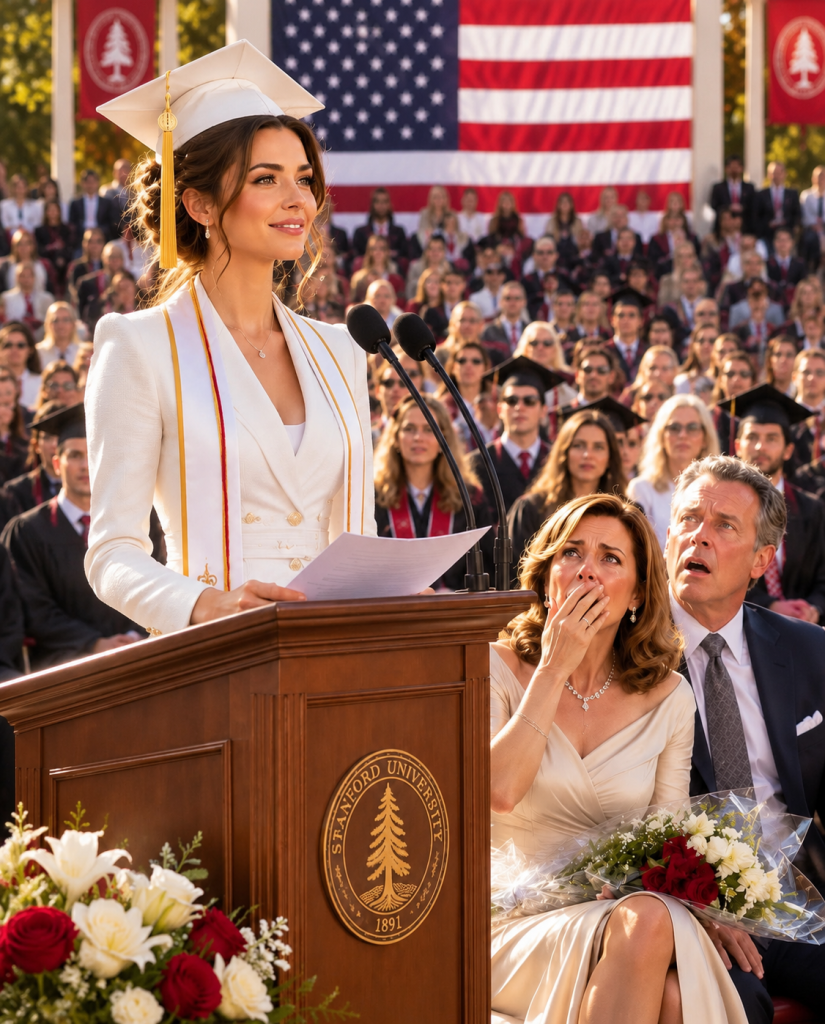
From behind the curtain, I could see Section 114.
My mother sat in the front row of the family section wearing a cream blazer. My father had his phone raised, recording everything. They looked proud, excited, and entirely present.
Derek stood with the graduates below, laughing with classmates.
For one foolish second, I imagined walking down the stairs, surprising them, and allowing all of us to pretend the past had never happened.
Then I remembered the message.
Your graduation isn’t worth the flight.
I did not want revenge.
But I would no longer protect them from the consequences of their choices.
The dean stepped to the microphone.
“Today’s keynote speaker is an engineer, entrepreneur, and humanitarian whose work has transformed access to reliable energy across several continents.”
The crowd quieted.
My mother was still smiling.
“After completing her doctoral research here at Stanford, she co-founded Solar Reach, now one of the world’s fastest-growing clean-energy companies.”
My father lowered his phone slightly.
Derek stopped smiling.
“Please welcome Dr. Sarah Mitchell.”
The stadium erupted.
I stepped through the curtain.
As I walked toward the podium, I looked directly at Section 114.
My mother’s smile disappeared.
My father stared at me as if he had seen a ghost.
Derek’s mouth fell open.
I placed my speech on the podium and waited for the applause to settle.
For a few seconds, I said nothing.
Then I began.
“Graduates, families, faculty, and friends, thank you for allowing me to stand before you today.”
My voice was steady.
“Two years ago, I stood on this campus wearing a doctoral hood. I had completed eight years of research. I had defended my dissertation and earned the right to place three new letters after my name.”
The stadium grew quiet.
“But when I crossed the graduation stage, there was no family waiting for me.”
I glanced toward my parents.
“My parents had decided that my graduation was not worth the flight.”
A murmur traveled through the audience.
My mother’s face turned pale.
“The morning before my dissertation defense, I received a message saying my work was impractical and that another graduation, belonging to someone whose future mattered more, was worth saving the trip for.”
Derek looked toward Section 114.
My father lowered his phone completely.
“I carried those words with me for a long time,” I continued. “At first, they felt like proof that I had failed. I believed that if the people who raised me could not see value in my work, perhaps the value was not there.”
I paused.
“But rejection can become a strange kind of freedom. When the approval you have chased all your life is finally denied, you are forced to decide whether you will stop—or whether you will build without it.”
The giant screens displayed images from Solar Reach projects.
A clinic glowing in the darkness.
Children studying under electric lights.
A woman operating a sewing machine after sunset.
“We failed repeatedly,” I said. “Our systems broke. Investors walked away. We ran out of money. We doubted ourselves. But each failure taught us something that praise never could.”
I looked at the graduates.
“Many of you are leaving here with plans. Some of those plans will work. Most will not work exactly as expected. You may be rejected by employers, investors, colleagues, friends, and even family members.”
I let the words settle.
“Do not confuse their inability to understand your purpose with proof that your purpose has no value.”
The audience began applauding before I had finished the sentence.
I continued.
“Success is not the moment people finally admit they underestimated you. Success is the moment you no longer need them to admit it.”
My mother covered her mouth.
Tears filled her eyes.
I felt no triumph in seeing them.
Only sadness.
“Today, I am not asking you to become bitter toward those who failed to support you. Bitterness is another form of dependence. It keeps your life tied to the people who hurt you.”
I folded my hands on the podium.
“Build because the work matters. Lead because people need courage. Create because there are problems worth solving. And when you succeed, remember those who stood alone. Be the person who shows up.”
The stadium rose in a standing ovation.
Thousands of people clapped.
Faculty members stood behind me.
Students cheered.
I looked at my parents one final time.
My father was crying openly.
My mother remained seated for several seconds before slowly standing with the rest of the crowd.
When I left the stage, Professor Park embraced me.
“You told the truth without becoming cruel,” she whispered.
“I almost became cruel.”
“But you didn’t.”
The ceremony continued.
Derek received his MBA nearly an hour later. When his name was announced, my parents stood and applauded. Their pride was real, and I did not resent him for it.
After crossing the stage, Derek surprised everyone by stepping away from the line of graduates and walking directly toward the platform where I stood with faculty members.
He wrapped his arms around me.
“I’m sorry,” he whispered.
Cameras flashed.
“You don’t have to do this now,” I said.
“Yes, I do. I knew they treated us differently. I just pretended not to notice because it benefited me.”
I pulled back and looked at him.
“That wasn’t your fault when we were children.”
“But I’m not a child anymore.”
He wiped his eyes.
“You deserved a family at your graduation.”
“I had people who believed in me.”
“That’s not the same.”
“No,” I said. “It isn’t.”
After the ceremony, my parents waited near a row of eucalyptus trees outside the stadium.
My mother still held the flowers she had brought for Derek.
My father looked older than he had in the photographs she had posted that morning.
For a moment, none of us spoke.
Then my mother stepped forward.
“Why didn’t you tell us you were the speaker?”
I almost laughed at the question.
“Would you have come for me?”
Her face crumpled.
“We were already coming.”
“For Derek.”
“That isn’t fair.”
“No, Mom. It wasn’t.”
She looked down at the flowers.
“We made a mistake.”
“You made a choice.”
“We didn’t understand what your work meant.”
“You didn’t try to understand.”
My father cleared his throat.
“We thought you were avoiding adulthood.”
“I was working eighty hours a week.”
“We didn’t know.”
“You never asked.”
My mother began crying.
“I am proud of you.”
I had waited most of my life to hear those words.
When they finally arrived, they did not heal everything.
“I believe you,” I said. “But being proud of me now is easy.”
She flinched.
“You weren’t proud when I was struggling. You weren’t there when the outcome was uncertain. You missed the years when support would have meant something.”
My father’s voice broke.
“Can you forgive us?”
I looked at the two people who had taught me to earn love through achievement and then withheld it even when I succeeded.
“I can forgive you,” I said. “But forgiveness doesn’t erase what happened. Trust has to be rebuilt through actions.”
My mother nodded quickly.
“Tell us what to do.”
“For today, celebrate Derek. This is his graduation.”
Derek stepped beside me.
“No,” he said. “Today we celebrate both of us.”
He turned to our parents.
“You flew across the country for me because you understood my degree. You stayed home for Sarah because you didn’t understand hers. That doesn’t make it acceptable.”
My mother closed her eyes.
Derek handed me half of the bouquet she had brought him.
“You should have had flowers two years ago.”
I took them.
For the first time since we were children, my brother and I stood on the same side.
We went to dinner that evening.
It was awkward, emotional, and imperfect.
My parents asked about Solar Reach.
This time, they listened.
I told them about the clinic in Kenya, the schools in Guatemala, and the engineers we were training around the world.
My father asked intelligent questions.
My mother admitted she had never understood what a microgrid was.
“You could have asked me,” I said.
“I know.”
There were no dramatic promises that everything would be different.
No sudden transformation.
Real families do not heal in a single conversation.
But my mother began calling without comparing me to Derek.
My father attended one of my public lectures six months later. He sat in the front row and took notes.
The following year, both of them traveled with me to visit a Solar Reach installation in New Mexico.
At sunset, the community center lights came on.
My mother watched children gather beneath them.
“This is what you were trying to tell us,” she whispered.
“Yes.”
She reached for my hand.
“I am sorry I made you walk alone.”
I looked at her, then at the lights stretching across the desert.
“I didn’t stay alone.”
That was the truth.
Professor Park had shown up.
Mateo had shown up.
My team had shown up.
Communities thousands of miles away had welcomed me.
And, eventually, I had learned to show up for myself.
My Stanford diploma still hangs in my office.
Beside it is the photograph from my graduation—the one where I crossed the stage alone.
I used to hate that picture.
Now I treasure it.
It reminds me that loneliness did not destroy me.
It introduced me to my own strength.
Below the photograph, I keep a framed copy of one sentence from my keynote address:
Success is not the moment people finally admit they underestimated you. Success is the moment you no longer need them to admit it.
My parents missed my graduation.
They can never undo that.
But I no longer carry their absence as evidence that I was unworthy.
I crossed that stage alone because the people who should have been there made the wrong choice.
I continued walking because I made the right one.
THE END! THANK YOU FOR READING!