
I moved my 70-year-old dad into my home because he could no longer manage the stairs on his own. My husband immediately called him a burden… and that very night, I realized the real threat wasn’t my aging father, but the man sharing my bed.
PART 2: THE RECKONING OF SHADOWS
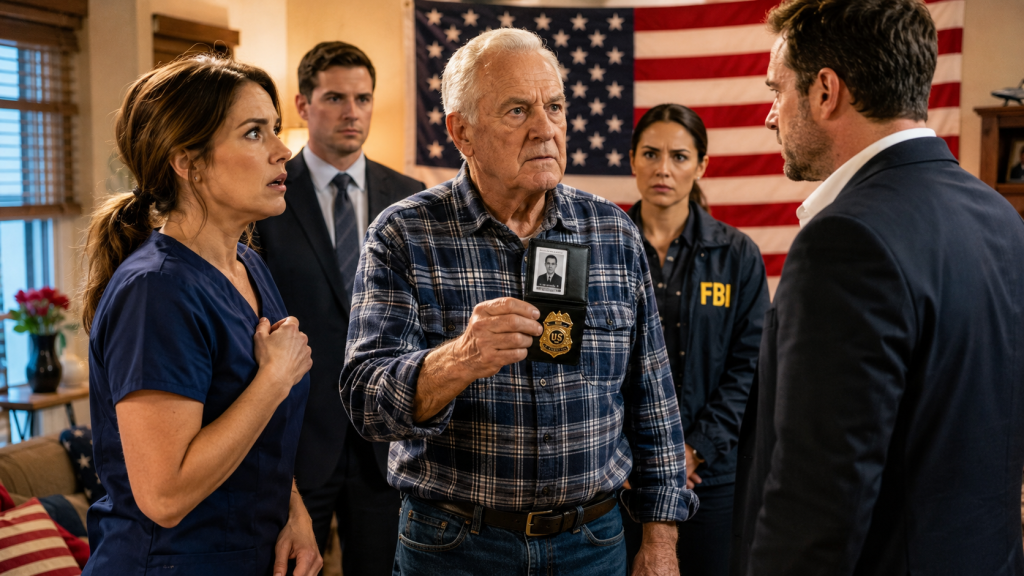
The silence that followed my father’s revelation wasn’t empty; it was heavy, suffocating, and charged with the electricity of a storm about to break. David’s face, once the picture of arrogant control, had dissolved into a mask of pure terror. The color hadn’t just drained from his skin; it looked as though his very soul had beat a hasty retreat.
“Thomas… I… it was a misunderstanding,” David stammered, his voice cracking like dry kindling. He looked at the FBI agents, then at the laminated badge on the entryway table, and finally at my father. “I was just trying to manage the finances. For the family. For Chloe.”
“Don’t use my name,” I spat, the realization of his betrayal burning in my throat like battery acid. “You didn’t do this for me. You did this because you’re a thief.”
The female agent, whose name tag read Special Agent Miller, stepped forward. “David Evans, you are under arrest for identity theft, wire fraud, and the exploitation of a vulnerable adult. You have the right to remain silent.”
As they handcuffed him, David didn’t fight. He collapsed inward, a hollow man. I watched them lead him out of the house I had bled for, the house he had turned into a prison for my father and a psychological cage for me. When the front door finally clicked shut, the silence that returned was different. It was clean.
I turned to my father. He was still standing by the table, his hand resting near the badge. He looked older than he had five minutes ago, but also infinitely more powerful.
“Dad?” I whispered. “What did Agent Miller mean? ‘Before you disappeared’?”
Thomas sighed, a long, weary sound that seemed to carry the weight of decades. He sat down, gesturing for me to join him. “Sit down, Chloe. It’s time you knew about the man your mother fell in love with, and why we lived such a quiet life up in Michigan.”
The Ghost of the Bureau
My father hadn’t just been a local accountant or a municipal clerk. In the late 80s and early 90s, Thomas Hayes had been one of the Treasury Department’s most effective forensic investigators, working alongside the FBI out of Chicago to dismantle white-collar crime syndicates that laundered money for overseas cartels.
“I was a ‘Ghost,’ Chloe,” he explained, his eyes distant. “I followed the paper trails that no one else could see. But the deeper I went into one specific network—a shell company operation known as The Iron Ledger—the more I realized the rot went all the way up.”
He told me how they had tried to buy him off, then threaten him. When he wouldn’t budge, they targeted my mother.
“We had to vanish,” he said. “The Bureau helped us stage a retirement, a total disappearance. We moved up to Michigan, changed our last name, and I took that job at the local public library. I thought if I stayed small, if I stayed ‘useless,’ the shadows would never find us.”
“But David found them,” I realized, the pieces clicking into place.
“David didn’t find the shadows,” Thomas corrected gently. “He was a small-time vulture who accidentally stumbled into a very old, very dangerous nest. He thought he was just stealing from a senile old man. He didn’t realize that the accounts he was trying to hijack were the same dormant ‘honey pots’ I had been monitoring for thirty years as a federal failsafe.”
The vintage fountain pen under the pillow hadn’t just recorded David’s verbal abuse; it had captured his phone calls, his whispered conversations with a shady offshore broker, and the sound of him forging my father’s signature on the asset transfers.
The Double Life
For the next three days, my suburban house became a hub of federal activity. Because of the nature of my father’s past, the investigation into David’s fraud was fast-tracked. It turned out David wasn’t just a bad husband; he was a desperate one. He had gambled away our savings on high-risk crypto-schemes and was being squeezed by people much more dangerous than him.
He had seen my father’s “pension” and the deed to the Michigan house as his golden ticket. He had planned to sell the property, drain the accounts, and dump Thomas in a state-run facility where he would likely never be heard from again.
On the third night, I sat with my father on the back patio. I had bought him a new cane—solid walnut with a brass handle. He hated it, saying it was too “flashy,” but he kept it close.
“I’m sorry I didn’t see him for who he was, Dad,” I said, looking at the moon. “I’m an ER nurse. I’m supposed to recognize when someone is sick or hurting. I didn’t see the rot in my own marriage.”
Thomas reached out and took my hand. His grip was firm now, no longer trembling. “Chloe, a predator’s greatest skill isn’t his teeth; it’s his camouflage. He chose you because you are kind. He chose you because you are a healer. He thought your empathy was a weakness he could exploit. He didn’t realize that your empathy is exactly what gave me the strength to fight back.”
“What happens now?” I asked. “To you? To the house?”
“The FBI is cleaning up the mess David made with the accounts. The Michigan house is safe. As for me…” He looked at me with a mischievous glint I hadn’t seen since I was a child. “I think I’m tired of being a ghost. I’d like to be a father for a while. If you’ll have me.”
The Confrontation
A week later, I was granted a ten-minute visitation with David at the holding facility before his transfer to a federal penitentiary. I didn’t go for him. I went for me.
He looked pathetic in the standard-issue orange jumpsuit. His hair was greasy, and the arrogance had been replaced by a frantic, twitching energy.
“Chloe! Thank God,” he hissed as soon as I sat down behind the plexiglass. “You have to tell them. Tell them Thomas is confused. Tell them I was doing it for us! If I get out, I can fix the money. I know a guy who—”
“Shut up, David,” I said. The voice didn’t sound like mine. It was steady, cold, and final.
He blinked, startled. “Chloe, honey—”
“I found the letters, David. The ones in the manila envelope you stole from my dad.”
His face went stark white.
“They weren’t just letters from my mom,” I continued. “They were notes my father had kept on everyone who ever tried to hurt our family. He knew you were skimming from our joint checking account two years ago. He didn’t say anything because he wanted to see if you would stop. He wanted to give me the chance to see it for myself. He was protecting me, even when he could barely walk.”
David sneered, his true face emerging one last time. “He’s a relic. A dinosaur. You’re going to spend the rest of your life changing his adult diapers and wasting your youth on a man who’s already dead.”
I leaned in closer to the glass. “My father is more alive than you will ever be. He carried me when I was small, and now I carry him. That’s not a burden, David. That’s a privilege. Something a parasite like you could never understand.”
I stood up to leave.
“Chloe, wait! They’re going to take everything! The house, the cars—it was all tied to those accounts!”
I paused at the door. “Let them take it. I’m a nurse. I know how to work. I know how to build. And I have the one thing you’ll never have.”
“What?” he barked.
“A clean conscience. And a father who knows exactly who I am.”
A New Foundation
We didn’t stay in that house. It held too many echoes of David’s cruelty—the sound of the snapped cane, the coldness of the locked sliding glass door. We sold it, and with the help of the Bureau and the recovery of my father’s actual assets (which were significantly larger than the “meager pension” he had pretended to have), we moved back to Michigan.
We bought a small, one-story lake house. No stairs. No “rules” about scuffed hardwood floors or the smell of muscle rub.
Thomas spent his days on the back deck, his walnut cane hooked onto the railing as he tended to his potted tomatoes. He wasn’t a “retired pensioner” anymore; he was a consultant for the cold-case financial crimes division, working from a laptop in the sunroom. It turned out that “Thomas Hayes” was a legend in certain federal circles, and the Bureau was more than happy to have their Ghost back on the payroll, even if only as an advisor.
One evening, as we sat out on the deck, I brought him a bowl of hot soup. This time, my hands didn’t tremble.
“You know, Dad,” I said, sitting in the Adirondack chair next to him. “David was right about one thing.”
Thomas arched an eyebrow. “Oh?”
“He said I was stubborn. Just like you.”
My father laughed, a deep, hearty sound that echoed across the Michigan lakefront. “That’s the most dangerous thing about us, Chloe. We don’t break. We just wait for the right moment to strike.”
I looked at my father—the investigator, the protector, the man who had survived the shadows to ensure I could live in the light. I realized then that the stairs he couldn’t climb weren’t a sign of his end, but a bridge to our new beginning.
The dangerous man was gone, locked away in a cell of his own making. And the hero of my life was right where he belonged: home.
THE END! THANKS FOR READING!