
The Day My Son Turned 18, He Tattooed His Stepmother’s Face on His Arm Nothing good ever follows the words, “Hey, Mom, guess what?” especially when they come from your son only days after his eighteenth birthday.
So when Dustin entered the kitchen wearing an unusually proud smile, I prepared myself for whatever reckless idea he and his friends had come up with.
I was chopping vegetables for dinner when he dropped his backpack beside the refrigerator.
“Don’t freak out,” he said.
Those three words were even worse.
I placed the knife on the cutting board and turned toward him.
“What happened?”
“Nothing happened.”
He rolled up the sleeve of his T-shirt.
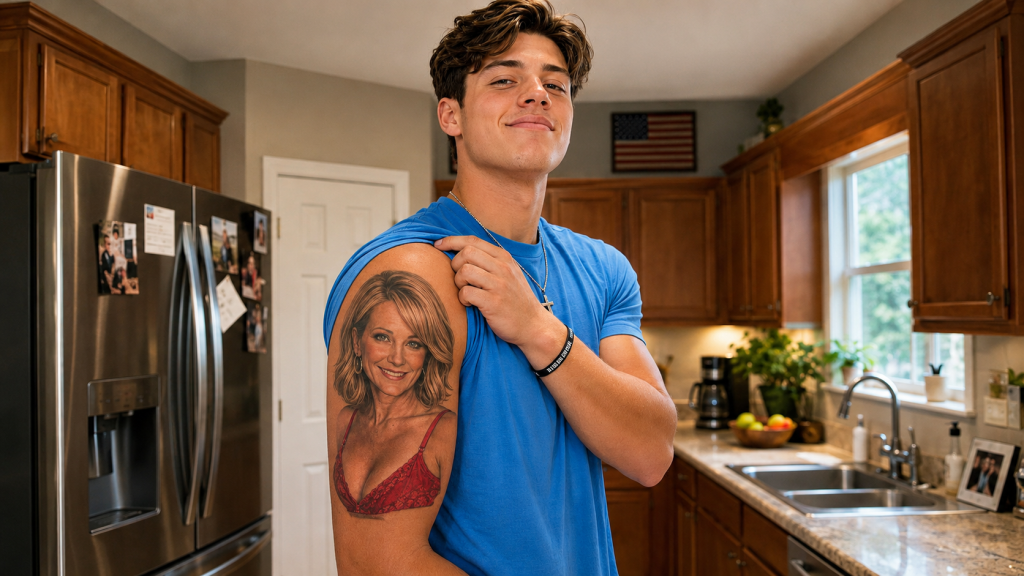
A large, realistic portrait covered most of his upper arm. For one confused second, I could not understand what I was seeing. The skin around the image was red and swollen beneath a clear protective covering. Whoever had created it was talented. The portrait had carefully shaded eyes, a wide smile, curled hair, and a small beauty mark beside the mouth.
Then I recognized the woman.
It was Barbara.
My ex-husband’s wife.
Her face had been permanently tattooed onto my son’s body.
My mind seemed to stop working.
“Is that Barbara?” I asked.
Dustin’s proud smile weakened.
“Yeah.”
I stared at the tattoo again, hoping I had somehow misunderstood.
“You tattooed your stepmother’s face on your arm?”
“She’s been in my life for six years, Mom.”
“I know how long she has been in your life.”
“You sound angry.”
“I’m trying not to sound anything until I understand why you did this.”
Dustin lowered his sleeve slightly, then rolled it back up as if he could not decide whether he wanted to display the tattoo or hide it.
I was not against tattoos.
Had Dustin asked me, we could have discussed possible designs. I might have encouraged him to wait until he was completely certain, but I would not have forbidden it. He was legally an adult now. His body belonged to him.
A favorite character, a band symbol, an animal, or even some strange image that meant something to him would have made sense.
But Barbara’s entire face?
Dustin was not especially sentimental. He had never discussed getting a portrait of anyone, not his father, not Barbara, and certainly not me.
There was no chance this decision had appeared out of nowhere.
“Sit down,” I said.
“Mom, it’s not a big deal.”
“It is a permanent portrait of another person’s face. Sit down.”
Minutes later, we were facing each other across the kitchen table.
Dustin kept touching the edge of the protective covering.
“Sweetheart, I need you to tell me the truth,” I said carefully. “Why did you choose this tattoo?”
His confident expression disappeared.
“What do you mean? Barbara is family. I thought you would understand.”
“I understand that you care about her. But you have never mentioned wanting her portrait on your body. This must have cost hundreds of dollars. Who paid for it?”
Dustin had graduated from high school only a month earlier. He worked part-time at an auto-parts store, but most of his money went toward gasoline, food, and saving for mechanic training.
He did not have enough for a portrait that detailed.
“Dad paid,” he admitted.
I stared at him.
“Your father spent five hundred dollars to put his wife’s face on your shoulder?”
“It was six hundred.”
“That does not improve the situation.”
“When you say it like that, it sounds strange.”
“It is strange.”
Dustin shifted in his chair.
Finally, he looked away.
“It was partly Dad’s idea.”
A cold feeling settled in my stomach.
“What does partly mean?”
He explained that Stephen and Barbara had been arguing for months. Barbara felt like an outsider in their blended family. She worried that Dustin still saw her as temporary, even after six years of marriage.
Stephen apparently decided that a permanent portrait would prove Barbara truly belonged.
“And you agreed to tattoo her face on your body to repair their marriage?” I asked.
Dustin lowered his eyes.
“Not exactly. It wasn’t free.”
My fingers tightened around the edge of the table.
“What does that mean?”
“It was a favor for a favor.”
“What did your father offer you?”
Dustin hesitated, clearly regretting that he had shown me the tattoo at all.
“I helped Dad make Barbara feel like part of the family,” he said quietly. “And he promised to help me with my situation.”
“What situation?”
He did not answer immediately.
His expression changed. The excitement he had carried into the kitchen disappeared, replaced by embarrassment and fear.
That was when I realized this was not about spending money, a vacation, or a new phone.
Whatever Stephen had promised, my son had needed it badly enough to allow someone else’s face to be permanently placed on his skin.
“Dustin,” I said more gently, “what did your father promise you?”
He swallowed.
“He said he would co-sign the loan.”
“What loan?”
“For the auto shop.”
I stared at him.
Dustin had dreamed of becoming a mechanic since he was fourteen. He could identify engine problems by sound and had spent nearly every weekend restoring an old pickup with his grandfather.
Two months earlier, his friend Aaron’s uncle had offered them an opportunity to buy into a small repair shop. The building was old, but the business had loyal customers. Dustin would need money for tools, equipment, licensing, and his share of the lease.
I had told him we would examine the costs together. I was not wealthy, but I had begun researching training grants and small-business programs.
Apparently, Stephen had offered a faster solution.
“Your father said he would co-sign a business loan if you tattooed Barbara’s face on your arm?”
Dustin’s face turned red.
“He said the bank wouldn’t approve me without someone established.”
“That might be true. It does not justify this.”
“He said it would prove I was serious about family.”
“No. It proved he knew how badly you wanted the shop.”
Dustin stood abruptly.
“You don’t understand. This could be my future.”
“I understand perfectly. Your father attached a permanent personal condition to financial help.”
“I agreed.”
“You are eighteen, Dustin. You are legally old enough to agree to many things. That does not mean people who love you should exploit your inexperience.”
“He didn’t force me.”
“Did you want this tattoo before he offered the loan?”
Dustin opened his mouth, then closed it.
“Did you?”
“No,” he whispered.
That single word shattered the last of my patience.
I grabbed my purse and keys.
“Where are you going?”
“To speak with your father.”
“Mom, don’t.”
“He involved you in his marriage problems and bought control over your body. I am not ignoring that.”
“You’ll make everything worse.”
“No, sweetheart. Your father made it worse when he decided your future was something he could trade.”
I walked out before my anger turned into shouting.
During the drive, I replayed every conversation Stephen and I had ever had about putting Dustin first.
Our marriage had ended seven years earlier, but we had managed to remain civil. Stephen had been unreliable as a husband, yet I believed he loved our son.
Now I wondered how often his help had come with invisible conditions.
By the time I pulled into his driveway, I was no longer questioning whether I should confront him.
Barbara’s car was parked beside Stephen’s truck.
I marched to the front door and knocked hard.
Stephen opened it wearing a surprised smile.
“Laura? What are you doing here?”
“We need to talk.”
Barbara appeared behind him.
She was holding a glass of iced tea and wearing a blouse almost the same color as the one in the tattoo.
Her gaze shifted to my keys clenched in my hand.
“Is Dustin all right?” she asked.
“That depends on what you consider all right.”
Stephen stepped onto the porch and pulled the door partly closed behind him.
“This isn’t a good time.”
“It became a good time when you paid our son to tattoo your wife’s face on his body.”
Barbara’s glass nearly slipped from her hand.
“What?”
Stephen’s expression changed.
“Lower your voice.”
“No.”
Barbara pushed the door open again.
“What did she say?”
Stephen turned toward her.
“It’s complicated.”
“Did Dustin get a tattoo of me?”
“It was supposed to be a surprise.”
Barbara stared at him as if he had begun speaking another language.
“You told me he was making something special for my birthday.”
“And he did.”
“He tattooed my face?”
“You said you wanted to feel accepted.”
Barbara’s face went pale.
“I meant family photographs, Stephen. Maybe being invited to his graduation dinner without having to remind everyone. I did not mean putting my face on his body.”
Stephen looked irritated rather than ashamed.
“Can we discuss this inside?”
I followed them into the living room.
On the mantel stood framed photographs of Stephen and Barbara’s wedding, vacations, and family holidays. Dustin appeared in some of them, usually standing at the edge.
Barbara placed her drink on the coffee table.
“Start explaining,” she said.
Stephen sighed.
“Dustin needed a co-signer for the repair-shop loan. I needed him to do something meaningful for Barbara. We reached an agreement.”
Barbara’s eyes widened.
“You used the loan to persuade him?”
“Persuade is a dramatic word.”
“What word would you use?” I asked. “Bribe? Manipulate? Purchase?”
Stephen turned toward me.
“He’s eighteen. He made his own decision.”
“You designed the choice so he would feel he had no real alternative.”
“He could have said no.”
“And lost what he believed was his only chance to build his future.”
Stephen folded his arms.
“You always treat him like a child.”
“And you treated him like property.”
Barbara stepped backward and lowered herself onto the sofa.
“Did he even want the tattoo?” she asked.
“No,” I said.
Stephen glared at me.
“You don’t know that.”
“He told me.”
The room became silent.
Barbara looked toward Stephen.
“You said it was his idea.”
“I said he agreed.”
“You told me he wanted to show how important I was to him.”
“He does care about you.”
“That is not the same thing.”
Stephen rubbed his forehead.
“You both are turning this into something ugly.”
“It was already ugly,” I said. “We simply found out.”
He walked toward the window.
“I was trying to solve two problems. Dustin needed help, and Barbara needed reassurance. Everyone received something.”
Barbara stood.
“I received a lie.”
Stephen turned toward her.
“You received proof that he considers you family.”
“No. I received proof that you pressured a teenager to perform affection.”
“He’s not a teenager in the legal sense.”
“He turned eighteen six days ago.”
Stephen’s jaw tightened.
I had seen that expression throughout our marriage. It appeared whenever his actions were questioned. He did not apologize. He looked for a technicality that allowed him to declare himself innocent.
“Show me the loan documents,” I said.
“What?”
“You promised to co-sign. Show me the paperwork.”
“We haven’t completed it yet.”
“Have you contacted the bank?”
“I’ve made some calls.”
“Which bank?”
“That’s none of your business.”
“It concerns our son.”
“He is an adult.”
“Then he can choose to discuss it with me.”
Stephen’s silence gave me the answer.
There was no approved loan.
Perhaps there was not even an application.
“You haven’t done anything, have you?” I asked.
“I told you, I made calls.”
“Did any lender agree to consider the loan?”
“That process takes time.”
“Did you prepare your financial statements?”
His eyes flickered.
Barbara noticed.
“What is she talking about?” she asked.
Stephen looked at the floor.
I felt another cold realization.
During our divorce, Stephen had been terrible with money. He earned a good salary in construction management, but he spent impulsively and concealed credit-card debt.
I had assumed he had improved after marrying Barbara.
“Can you even qualify as a co-signer?” I asked.
Stephen’s voice hardened.
“Stay out of my finances.”
“You offered your financial reputation in exchange for our son’s skin. Your finances are relevant.”
Barbara crossed her arms.
“Answer her.”
Stephen did not.
She walked to a cabinet beside the television, opened a drawer, and removed a folder.
“What are you doing?” he asked.
“Finding out what else you lied about.”
She scanned several documents.
Her face changed.
“Stephen, why is there a second mortgage application?”
“That’s unrelated.”
“It has my name on it.”
“It’s for refinancing.”
“I never signed this.”
He reached for the folder, but she pulled it away.
I felt the argument shifting into something larger than Dustin’s tattoo.
Barbara flipped through the pages.
“There are credit-card statements here. How much do you owe?”
Stephen looked toward me as if my arrival had created the debt.
“This is a private marital matter.”
Barbara laughed bitterly.
“You made my face part of a financial transaction with your son. Nothing is private anymore.”
The front door opened.
Dustin stood in the entryway, breathing heavily.
He must have followed me in his car.
“I told you not to come,” he said.
I turned toward him.
“You should hear this.”
Stephen moved quickly across the room.
“Dustin, your mother is overreacting.”
“Did you apply for the loan?” I asked.
Dustin looked at his father.
“Dad?”
“I’m working on it.”
“You said it was basically approved.”
“I said approval was likely.”
“No, you didn’t.”
Dustin’s voice cracked.
“You said the bank manager owed you a favor. You said as soon as I got the tattoo, we would sign everything.”
Stephen lifted his hands.
“These things take longer than expected.”
“Did you actually talk to a bank manager?”
“Of course.”
“Which one?”
Stephen hesitated.
Dustin’s face drained of color.
“You lied to me.”
“I did not lie. I said I would help.”
“You said you would co-sign.”
“And I intend to.”
“With what credit?” Barbara demanded, holding up the statements.
Dustin looked from her to his father.
The truth settled over him slowly.
He had made a permanent decision for a promise that might never have been real.
His shoulders collapsed.
“I can’t believe this.”
Stephen stepped closer.
“Son, listen to me.”
“Don’t call me that right now.”
The words stopped Stephen.
Dustin looked at Barbara.
“I’m sorry.”
She shook her head.
“You have nothing to apologize for.”
“I didn’t hate the idea of showing you I cared. But I wouldn’t have chosen your face. I was going to get a small wrench and Grandpa’s initials.”
Barbara’s eyes filled with tears.
“That sounds like you.”
“I thought if Dad helped with the shop, the tattoo would eventually feel worth it.”
“No tattoo should have to feel worth it because someone bought it from you.”
Stephen exhaled loudly.
“This emotional performance is unnecessary. Dustin got an excellent tattoo. Barbara received a meaningful gesture. I still plan to help with the business.”
Dustin turned toward him.
“How?”
“I’ll find a lender.”
“With your debt?”
“I have options.”
“You always have options after everyone else pays the price.”
The room went silent again.
I had never heard Dustin speak to his father that way.
Stephen’s expression hardened.
“You are being disrespectful.”
“You lied to me.”
“I am your father.”
“And I’m your son, not your bargaining chip.”
Dustin pulled up his sleeve and looked at the portrait.
For the first time, he did not seem proud or embarrassed.
He looked betrayed.
Barbara moved beside him.
“I need you to know something,” she said. “I never asked for this. I would never have allowed it.”
Dustin nodded.
“I believe you.”
Stephen scoffed.
“Everyone is pretending I committed some terrible crime.”
“No,” Barbara said. “You did something worse for a marriage than commit one obvious act. You turned affection into a transaction and expected us to thank you.”
She placed the financial folder on the table.
“I want you to leave tonight.”
Stephen stared at her.
“This is my house.”
“The deed is in both our names.”
“You’re throwing me out over a tattoo?”
“I’m asking you to leave because you lied to Dustin, lied to me, hid debt, and apparently placed my name on financial documents I never signed.”
“I did not forge anything.”
“Then you should have no problem letting an attorney examine it.”
Stephen’s face darkened.
I looked at Dustin.
“Come home with me.”
He nodded.
As we walked toward the door, Stephen called after him.
“You’re giving up on the shop because your mother became emotional?”
Dustin stopped.
I feared he might turn around and let Stephen pull him back into the argument.
Instead, he faced his father calmly.
“No. I’m giving up on believing your promises without proof.”
Then he followed me outside.
The drive home was quiet.
Dustin sat in the passenger seat with his sleeve pulled down despite the warm evening.
At a red light, he spoke.
“Do you think I’m stupid?”
“No.”
“I should have known.”
“You should have been able to trust your father.”
“I wanted the shop so badly.”
“That does not make you foolish. It means he knew what mattered to you.”
Dustin looked through the window.
“I have to live with her face on my arm forever.”
“Maybe. Maybe not.”
He turned toward me.
“What do you mean?”
“Tattoo artists can sometimes alter portraits. There is laser removal too. Neither option is simple, but this is not necessarily the final version of your arm.”
“I don’t have money for that.”
“We will figure it out.”
He gave a humorless laugh.
“That is what Dad said.”
The words stung, though I knew he did not mean them cruelly.
“You’re right to be cautious,” I said. “So I’m not going to make promises without facts. Tomorrow, we will contact reputable artists and a removal clinic. We will learn what is possible, what it costs, and how long it takes. Then you will decide.”
“What about the shop?”
“We will research that too.”
“The offer might disappear.”
“Then we find another path.”
“There might not be another path.”
“There is almost always another path. It just may take longer than the one someone uses to control you.”
The next morning, Dustin and I began making calls.
The first tattoo artist warned us not to rush. The skin needed to heal completely before any cover-up or removal could be considered.
A second artist agreed to meet us.
Her name was Marisol, and her studio was bright, clean, and filled with framed artwork. She examined the portrait without insulting the original artist.
“The work itself is technically strong,” she said. “That gives us options.”
Dustin looked uncomfortable.
“Can you turn it into something else?”
“Possibly. What would you want if nobody else had an opinion?”
He thought for a moment.
“A mechanical design. Gears, an engine, maybe a wrench.”
Marisol sketched lightly on tracing paper over a photograph of his arm. She showed how Barbara’s hair could become shadows around a large gear and how parts of the face might be incorporated into metallic shapes after several laser-lightening sessions.
“It would take time,” she explained. “And you should not decide today. First, let the tattoo heal. Then make sure the new design belongs to you.”
Dustin stared at the sketch.
For the first time since he showed me the tattoo, hope appeared in his face.
The cost was significant, but not impossible.
I used part of the emergency savings I had built after the divorce to pay for the consultation and first future laser session. Dustin insisted he would repay me from his wages.
We made a written plan instead.
He would contribute a reasonable amount each month without sacrificing his education or basic expenses. I wanted him to understand responsibility, not debt disguised as love.
We also visited a local community college that offered automotive certification.
An adviser told Dustin about apprenticeship programs, tool grants, and a small-business competition for young tradespeople.
The process would take longer than Stephen’s imaginary bank favor.
But it was real.
Three weeks later, Barbara called me.
She had filed for legal separation and hired an attorney to investigate the financial documents. She had also discovered that Stephen had attempted to open a line of credit using information from an old account they shared.
“I keep thinking about Dustin,” she said. “I feel as if my face has become a symbol of something awful.”
“You did not create the situation.”
“I still want to help.”
I was immediately cautious.
“With what?”
“The removal or cover-up. I would like to pay for part of it.”
I thought about the offer before answering.
“It needs to be Dustin’s decision.”
“I understand.”
“And there can be no condition attached.”
“None.”
When I told Dustin, he surprised me.
“I don’t want her money.”
“You do not have to accept it.”
“It would feel like another deal.”
“Then say no.”
He considered the matter for several days.
Eventually, he called Barbara himself.
He thanked her but declined the money.
Then he asked whether she would meet him for lunch.
They spoke for nearly two hours.
When Dustin returned home, he seemed lighter.
“She apologized again,” he said.
“For something she did not do?”
“She said she was sorry I got trapped in their marriage problems.”
“What did you tell her?”
“That I do care about her. I just wish Dad had trusted that without demanding proof.”
Barbara and Dustin continued speaking occasionally after that.
Their relationship changed, but it did not disappear.
Without Stephen directing it, it became more honest.
Four months later, Dustin began laser treatments to lighten the portrait.
They were painful and slow.
After each appointment, he came home frustrated by how little seemed to change.
But gradually, Barbara’s features faded enough for Marisol to begin the cover-up.
She designed a detailed mechanical scene wrapping around Dustin’s upper arm. A large gear covered the outline of the face. A piston replaced the nose and mouth. Darkened metal shapes transformed the hair.
At the center, Marisol added a small wrench with the initials of Dustin’s grandfather.
The final tattoo took several sessions.
When it was complete, Dustin stood before the studio mirror for a long time.
“What do you think?” I asked.
He turned his arm.
“It looks like something I would have chosen.”
“That matters.”
He smiled.
“It also reminds me not to let anyone rush me into a permanent decision.”
“That may be the most expensive lesson either of us has learned.”
He laughed.
Meanwhile, Stephen attempted to contact Dustin repeatedly.
At first, his messages were defensive.
He accused me of poisoning their relationship. He insisted Barbara had overreacted and claimed the loan would have worked if everyone had remained patient.
Then his tone changed.
He began apologizing, though every apology included an excuse.
I am sorry you misunderstood.
I am sorry things became complicated.
I am sorry your mother made this public.
Dustin did not respond.
Six months after the confrontation, Stephen appeared at our door.
Dustin was in the garage rebuilding a transmission for his apprenticeship program.
I stepped onto the porch and closed the door behind me.
“You should have called.”
“He ignores my calls.”
“That is his choice.”
“I need to explain.”
“You have explained repeatedly.”
Stephen looked older. Barbara’s separation, the financial investigation, and the consequences at work had taken their toll.
The forged application had not resulted in criminal charges, but Barbara’s attorney had uncovered enough dishonesty to strengthen her case.
Stephen looked toward the garage.
“I want to see my son.”
“He is not a child I can order into a conversation.”
“I made a mistake.”
“You made several decisions.”
“I was desperate.”
“For what?”
“To keep my family together.”
“You tried to keep it together by controlling everyone in it.”
He lowered his voice.
“Barbara was talking about leaving. I thought if Dustin showed her how important she was, she would stay.”
“And the loan?”
“I believed I could arrange it.”
“Could you?”
He looked away.
“No.”
It was the first honest answer I had heard from him.
The garage door opened.
Dustin stepped outside, wiping his hands on a cloth.
His gaze moved from Stephen to me.
“It’s okay, Mom,” he said. “I’ll talk to him.”
I went inside but remained near the window.
They sat on the front steps.
Stephen spoke for several minutes.
Dustin listened without interrupting.
Then he rolled up his sleeve and showed his father the completed cover-up.
Even through the glass, I saw Stephen’s expression change.
The portrait was gone.
Not completely. Traces of it remained hidden beneath the gears and shadows, but it no longer controlled what people saw.
Dustin pointed to the design as he spoke.
Later, he told me what he had said.
“This is what happens when you let someone else choose what belongs on your body and in your future,” he had told his father. “You spend a lot of time and pain trying to make it yours again.”
Stephen apologized without excuses that time.
Dustin did not forgive him immediately.
He did not invite him inside.
But he agreed that Stephen could call once a week, and Dustin would answer when he was ready.
Their relationship would not return to what it had been.
Perhaps that was for the best.
Some relationships should not return to their previous shape. They should either become healthier or remain at a distance.
A year after Dustin first showed me Barbara’s portrait, he completed his automotive certification.
He also won second place in the community college’s young-business competition.
The prize money was not enough to purchase a repair shop, but it helped him buy professional tools and rent a service bay in an established garage.
Aaron worked beside him on weekends.
They began with oil changes, brake repairs, and basic diagnostics. Their customers came through recommendations, one satisfied driver at a time.
On the morning Dustin opened his first business account, he asked me to come with him.
At the bank, he read every page before signing.
When the adviser explained a loan option, Dustin asked about the interest rate, collateral, fees, and consequences of missed payments.
He did not accept promises.
He requested documents.
Outside, he looked at his mechanical tattoo.
“I used to hate seeing this arm,” he said.
“And now?”
“Now it reminds me that I fixed it.”
“You did more than fix a tattoo.”
He smiled.
“I know.”
That evening, Barbara stopped by the garage with a small plant for the office.
She and Stephen had finalized their divorce months earlier. She had moved into an apartment across town and started rebuilding her own finances.
She looked at Dustin’s arm and smiled.
“The gears suit you better.”
“They do.”
“I hope you know I never wanted you to erase our relationship.”
“I didn’t.”
Dustin tapped the small wrench in the center of the design.
“I just changed the part that wasn’t mine.”
Barbara nodded, understanding exactly what he meant.
Stephen arrived later.
He stayed only a few minutes.
He did not give advice, make promises, or offer money.
He handed Dustin an old metal sign that had belonged to Stephen’s father.
It read, “Good work needs no trickery.”
Dustin examined it quietly.
“Grandpa used to hang this above his workbench,” Stephen said. “I think you should have it.”
“Thank you.”
Stephen looked at the tattoo.
“I’m sorry for what I asked you to do.”
Dustin nodded.
“I know.”
It was not a dramatic reconciliation.
There were no tears, embraces, or declarations that everything had been forgotten.
But it was honest.
For the first time, that seemed enough.
As I watched my son unlock his garage the following morning, I remembered the day he had entered my kitchen with Barbara’s face on his arm.
At the time, I thought the tattoo was the disaster.
It was not.
The tattoo was only evidence of a deeper problem: a father who confused love with loyalty, loyalty with obedience, and help with control.
Removing the portrait had taken months.
Rebuilding trust would take longer.
But Dustin had learned that no dream was worth surrendering ownership of himself.
He learned that real help does not demand permanent proof of gratitude.
Real family does not turn affection into currency.
And a genuine promise does not disappear the moment someone asks to see it in writing.
Dustin did not own a full repair shop yet.
He still had bills, training, and years of work ahead of him.
But the tools were his.
The business account was his.
The decisions were his.
Most importantly, the life he was building belonged entirely to him.
THE END! THANK YOU FOR READING!