
At dinner, my parents demanded I apologize to their golden son or lose my education. I said, “Alright.” By dawn, I was packed. My brother’s face drained white. “Please tell me you didn’t send it.” Dad froze. “Send what?”
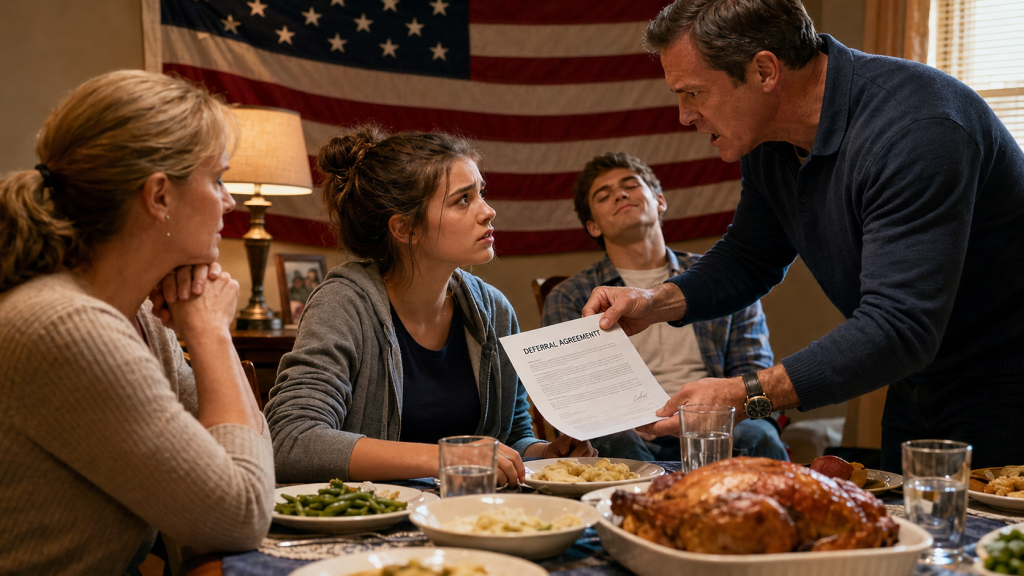
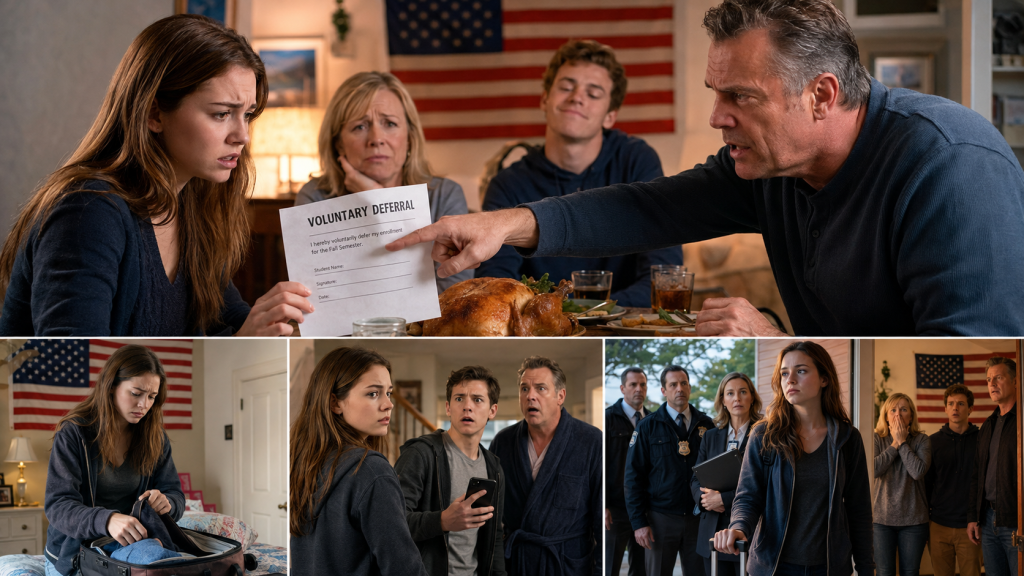
The emergency started with my father sliding a printed email across the dinner table like it was a warrant. “Sign it,” he said. My fork froze over the mashed potatoes. My mother kept smiling at the roast chicken, because in our house denial was practically a side dish.
My brother Brandon leaned back in his chair, one ankle on his knee, wearing that lazy golden-boy grin that had gotten him out of every wrecked car, bounced check, and screaming ex-girlfriend since high school.
The paper said I was voluntarily deferring my fall semester at Ellison University. Voluntarily. I had worked three jobs for that acceptance.
I had cleaned offices at night, tutored rich kids who called me “the scholarship girl,” and saved every tip from the diner in a coffee can under my bed.
Ellison was my way out of that dining room.
Out of my mother’s tight little sighs.
Out of my father’s favorite sentence.
“Why can’t you be more like Brandon?”
I looked at the paper.
Then I looked at him.
“Why would I sign this?”
Dad’s jaw moved once.
“Because family comes first.”
That meant Brandon came first.
It always had.
When Brandon crashed Dad’s truck at seventeen, I was told not to upset him because he was embarrassed.
When Brandon stole money from Mom’s purse, I was told I must have misplaced it.
When Brandon failed out of community college, Dad called it “pressure.”
When I got a scholarship interview, Dad called it “getting too big for myself.”
Mom finally lifted her eyes.
“Your brother is under enough stress. You embarrassed him at church. You accused him of something ugly.”
“He sold my laptop,” I said. “And my camera. I found the pawn slips in his truck.”
Brandon laughed softly.
“There she goes again. Always dramatic.”
Dad slapped the table so hard the glasses jumped.
“You will apologize to your brother tonight, or we cut off your education. No tuition help. No co-signed housing. No car. Nothing.”
The funny thing was, they thought I still needed them.
Six months earlier, after Brandon “borrowed” my social security card to “help with insurance paperwork,” I started scanning everything.
Bank notices.
Loan letters.
The locked file cabinet in Dad’s office.
The email Mom left open on the family iPad.
I did not understand all of it at first.
But I understood enough to make copies.
My name was on loans I had never taken.
My dead grandmother’s trust had been drained.
And Brandon’s truck, the one Dad bragged he bought with “hard work,” had been paid for with money my grandmother left for my tuition.
I folded the deferral form in half.
Then in half again.
Mom whispered, “Ava, don’t make this harder.”
Brandon leaned forward.
“Say you lied. Then we can all eat.”
I stood up.
My knees were shaking, but my voice came out calm.
“Alright.”
Dad smiled, victorious.
Brandon actually winked at me.
That wink made something inside me go very still.
I did not scream.
I did not cry.
I did not throw the plate like I wanted to.
I walked upstairs, shut my bedroom door, and locked it.
Then I opened my laptop.
For six months, I had been building a folder called “School Documents.”
That was the name they would ignore.
Inside were scans of everything.
Loan applications with my forged signature.
Emails between Dad and Brandon.
A trust statement with my grandmother’s name.
Pawn slips for my laptop and camera.
Screenshots of Brandon bragging to his friend that “Ava won’t do anything because she needs Dad.”
He was wrong.
I attached every file to one email.
I sent it to Ellison University’s financial aid office.
Then to the scholarship review board.
Then to the county fraud investigator whose card I had saved after quietly calling the courthouse two weeks earlier.
My hands shook so hard I had to type the same sentence three times.
“My family is pressuring me to defer enrollment after using my identity and tuition trust funds without consent.”
I stared at the send button.
For one second, I heard my mother’s voice.
Don’t make this harder.
Then I heard my grandmother’s voice instead.
Ava, never shrink yourself to fit inside someone else’s comfort.
I clicked send.
After that, I packed.
Not neatly.
Not romantically.
Two trash bags.
One suitcase.
A shoebox of documents.
Three photos of Grandma.
My acceptance letter.
The coffee can full of tips.
At 5:48 a.m., Brandon burst into my doorway barefoot, pale as milk, holding his phone like it had bitten him.
“Please tell me you didn’t send it,” he said.
Dad appeared behind him, still in his robe, annoyed.
“Send what?”
Then Mom screamed from downstairs.
Her scream was not grief.
It was panic.
I carried my suitcase into the hall.
Brandon blocked my way.
“Ava,” he whispered. “Listen. We can fix this.”
I looked at his white face.
“We?”
His eyes flicked toward Dad.
Dad’s expression changed slowly.
Annoyance became confusion.
Confusion became suspicion.
“What did she send?”
Before Brandon could answer, Mom screamed again.
“Robert! There are people at the door!”
Dad pushed past us and thundered down the stairs.
Brandon grabbed my wrist.
“You stupid little brat,” he hissed. “Do you know what you just did?”
I pulled my arm away.
“Yes.”
He shook his head.
“No, you don’t. Dad will lose everything.”
“Then maybe Dad shouldn’t have stolen everything.”
Brandon flinched like I had slapped him.
Downstairs, a calm woman’s voice said, “Mr. Rowan, we’re here regarding a report involving possible identity theft, education fraud, and misappropriation of trust funds.”
Dad shouted, “This is a family matter!”
A man replied, “Not anymore.”
I walked down the stairs with my suitcase bumping behind me.
Two investigators stood at the open door.
Behind them was Ms. Calder, the financial aid officer from Ellison, the same woman who had interviewed me over video and said my essay made her cry.
She looked at me first.
Not at Dad.
Not at Brandon.
At me.
“Ava,” she said gently. “Are you safe?”
No one had ever asked me that in my own house.
My throat tightened.
“I am now.”
Mom gripped the banister, her robe tied crookedly, her hair pinned on one side and wild on the other.
“What have you done?” she whispered.
I set my suitcase by the door.
“I told the truth.”
Dad turned on me.
“You sent private financial documents to strangers?”
“They had my name on them.”
“You’re a child.”
“I’m eighteen.”
“You live under my roof.”
“Not after today.”
Brandon laughed once, but it cracked in the middle.
“You think Ellison wants a girl with family drama? You think they’ll still take you?”
Ms. Calder stepped forward.
“Actually, Mr. Rowan, Ellison takes fraud against students very seriously. Ava’s scholarship is protected while this is reviewed.”
The room went silent.
Dad stared at her.
“What scholarship?”
My stomach dropped.
There it was.
The thing he was not supposed to know because I had never trusted him enough to tell him everything.
Ms. Calder’s eyes narrowed.
“You were unaware your daughter received a full merit scholarship?”
Mom slowly turned toward me.
“A full scholarship?”
I looked at the floor.
“Yes.”
Dad’s face darkened.
“You lied to us.”
I laughed, small and bitter.
“No. I protected myself.”
Brandon’s phone buzzed again.
He looked down and cursed under his breath.
The investigator noticed.
“Mr. Brandon Rowan?”
Brandon stiffened.
“Yes?”
“We’ll need to ask you some questions about several accounts opened under your sister’s name.”
Brandon pointed at Dad so fast it was almost funny.
“He handled that.”
Dad turned slowly.
“What did you just say?”
Brandon swallowed.
“I mean, you said it was fine. You said families do this all the time. You said Ava had good credit because Grandma put her name on accounts.”
Dad’s face went purple.
“You idiot.”
Mom made a strangled sound.
“Robert?”
The investigator wrote something down.
That was the moment I understood.
They were not united.
They had only seemed united when they were standing against me.
The second consequences arrived, they turned on each other.
Dad stepped toward Brandon.
“You were never supposed to touch the trust account directly.”
Brandon threw up his hands.
“How was I supposed to make the truck payment?”
Mom whispered, “The truck?”
I looked at her.
“Grandma’s money paid for it.”
Mom’s mouth opened.
No sound came out.
For years, she had told me Grandma’s trust was complicated.
Delayed.
Tied up in paperwork.
I used to believe her because believing your mother is easier than believing she is helping rob you.
Ms. Calder touched my elbow lightly.
“Ava, do you have somewhere to go?”
“Yes.”
That was not entirely true.
I had a dorm placement, but move-in was three weeks away.
Until then, I had arranged to stay with June, the diner owner, a woman with a voice like gravel and a heart bigger than our whole house.
But compared to this place, June’s tiny guest room was a palace.
Dad heard me and snapped.
“No, she doesn’t. She is not leaving.”
The male investigator turned.
“She’s an adult.”
“She is my daughter.”
I looked at him.
“You forgot that part whenever Brandon needed something.”
His mouth tightened.
“You ungrateful—”
“Robert,” Mom said weakly.
He spun on her.
“Don’t start.”
And just like that, I saw her clearly.
Not innocent.
Not powerless.
But afraid.
Afraid of Dad.
Afraid of losing the house.
Afraid of Brandon falling apart.
Afraid of me becoming the proof that she had chosen wrong every single year.
She took one step toward me.
“Ava, please. We can talk about this.”
I wanted to ask why we could not talk when I cried over my missing laptop.
Why we could not talk when I begged for Grandma’s trust statement.
Why we could not talk when Dad called me selfish for wanting college.
But I had no energy left to beg for love from people who treated it like a bill.
So I picked up my suitcase.
“I’m done talking.”
Brandon moved to block me again.
The female investigator said, “I wouldn’t do that.”
He stepped back.
I walked out of that house with two trash bags, one suitcase, and eighteen years of silence finally breaking behind me.
June was waiting at the curb in her old blue Buick.
She wore sunglasses even though the sun had barely risen.
When I opened the passenger door, she looked at the house, then at me.
“You burn it down?”
“Not literally.”
“Good. I just replaced my tires. I don’t flee crime scenes before breakfast.”
I laughed.
Then I cried.
June did not hug me right away.
She knew better.
She waited until I folded myself into the seat, shut the door, and pressed both hands over my face.
Then she reached over and squeezed my shoulder.
“Proud of you, kid.”
That broke me harder than anything.
Because my father had never said those words.
Not once.
For three weeks, I lived in June’s guest room above the diner.
The room smelled like laundry soap and old wood.
The bedspread had yellow flowers.
There was a small desk under the window where I taped my Ellison acceptance letter to the wall.
Every morning, I worked breakfast shift.
Every afternoon, I answered calls from investigators, lawyers, and school officials.
Every night, I waited for the guilt to swallow me.
It never fully did.
It came in waves.
When Mom left voicemails crying.
When Dad sent texts calling me a liar.
When Brandon messaged, “You ruined my life.”
I almost replied once.
Then June took my phone, read the message, and snorted.
“Funny. I thought stealing ruined lives.”
She blocked him for me.
The investigation moved faster than I expected.
Maybe because the evidence was clear.
Maybe because Dad had gotten careless.
Maybe because Brandon, cornered and terrified, started blaming everyone else and accidentally confirmed half the case.
I learned things I wished I never knew.
Dad had drained Grandma’s tuition trust in pieces.
First to cover Brandon’s failed business idea.
Then Brandon’s truck.
Then a private loan Dad had hidden from Mom.
Then a credit card in my name.
Mom knew some of it.
Not all.
But enough.
She knew enough.
That hurt more than Dad.
Dad had always been hard.
Mom had been soft in public and sharp in private, but sometimes, when I was little, she braided my hair gently.
Sometimes she hummed while making pancakes.
Sometimes I caught her watching me like she wanted to apologize but did not know how to begin.
I had mistaken cowardice for kindness.
Two days before I left for Ellison, Mom came to the diner.
I was wiping down table seven when the bell above the door rang.
She stood there in a beige cardigan, clutching her purse with both hands.
She looked smaller outside the house.
Less powerful.
Less certain.
June saw her and immediately leaned through the kitchen window.
“You want me to remove her?”
Mom heard.
Her face flushed.
I shook my head.
“It’s okay.”
Mom walked to the counter.
“You look tired,” she said.
I almost laughed.
“That’s what you came to say?”
Her eyes filled.
“No. I came to give you this.”
She slid an envelope across the counter.
Inside was a cashier’s check.
Not enough to replace everything.
Not even close.
But not nothing.
“Where did this come from?” I asked.
“I sold my jewelry.”
I stared at her.
“The pearls too?”
Her mouth trembled.
Grandma had given Mom those pearls.
“Yes.”
I wanted to feel nothing.
I wanted to be cold.
But grief is not clean.
Love is not clean.
Anger is not clean.
“You knew,” I said.
Mom closed her eyes.
“I knew your father used some money. I didn’t know about the loans.”
“But you knew about the trust.”
She nodded once.
“I told myself he would put it back.”
“You told yourself that because it was easier than protecting me.”
A tear slipped down her cheek.
“Yes.”
The honesty stunned me.
For once, she did not excuse it.
She did not say family comes first.
She did not say Brandon was stressed.
She just stood there with her shame in both hands.
“I am sorry, Ava.”
I looked at the check.
Then at her.
“Sorry doesn’t fix it.”
“I know.”
“Sorry doesn’t make me trust you.”
“I know.”
I pushed the envelope back.
Her face crumpled.
“I can’t take this if it means you think I owe you forgiveness.”
She shook her head quickly.
“No. No. It doesn’t. I just wanted you to have something that should have been yours.”
I studied her.
For the first time in my life, my mother looked like someone who understood she might lose me.
Not as a threat.
As a consequence.
I took the envelope.
“Thank you.”
She covered her mouth.
“Can I hug you?”
My heart twisted.
“No.”
She nodded, crying harder.
“Okay.”
I expected her to argue.
She did not.
She turned to leave, then stopped.
“Your grandmother would be proud of you.”
My throat burned.
“She would be disappointed in you.”
Mom flinched.
Then she nodded again.
“Yes,” she whispered. “She would.”
After she left, June came out with two coffees.
She set one in front of me.
“That looked painful.”
“It was.”
“You okay?”
“No.”
“Good. Okay is overrated.”
I laughed through tears.
June sat beside me.
“Listen to me. You can love someone and still not let them hold the knife anymore.”
I remembered that sentence for years.
Move-in day at Ellison felt unreal.
The campus had brick walkways, old trees, and students dragging suitcases bigger than mine.
Everyone looked like they belonged.
I felt like a visitor who had snuck in through the wrong door.
June drove me there.
She insisted.
She wore her diner apron over her clothes because she said it was her “formal emotional support garment.”
When we reached my dorm, Ms. Calder was waiting outside.
She hugged me carefully.
“Welcome home, Ava.”
Home.
The word almost knocked me over.
My room was small.
Two beds.
Two desks.
One window facing a maple tree.
My roommate, Priya, had already arrived and decorated her side with fairy lights and photos.
She looked at my trash bags and smiled like nothing about them was strange.
“Need help?”
I nodded.
Together, we unpacked my life in twenty minutes.
Three photos of Grandma went on the desk.
My coffee can went under the bed.
My acceptance letter stayed in my suitcase.
I did not need to tape it to the wall anymore.
I was there.
That night, after June left, I sat on the dorm bed and waited to feel free.
Instead, I felt scared.
Freedom is not always a song.
Sometimes it is silence.
Sometimes it is realizing no one is coming to tell you what to do next.
My phone buzzed.
Unknown number.
I almost ignored it.
Then I answered.
“Ava?”
It was Brandon.
His voice sounded wrecked.
“I know you blocked me.”
I sat up.
“How did you get this number?”
“Mom.”
Of course.
I closed my eyes.
“What do you want?”
He was quiet for a long moment.
Then he said, “Dad’s blaming me.”
I laughed once.
“That’s why you called?”
“No. I mean, yes. I mean—Ava, he’s saying I forged everything.”
“Did you?”
“Not everything.”
I stared at the wall.
That was Brandon.
Never innocent.
Only less guilty than someone else.
“You sold my laptop.”
“I needed money.”
“You sold my camera.”
“I was going to get it back.”
“You took loans in my name.”
“Dad said you wouldn’t care once you got rich.”
I almost hung up.
Then he said something quieter.
“I’m sorry.”
The words were so unfamiliar in his voice that I did not know what to do with them.
“Are you sorry because you hurt me, or because you got caught?”
He breathed shakily.
“I don’t know.”
That answer, at least, was honest.
I said, “Figure it out before you call me again.”
Then I hung up.
Classes started three days later.
I threw myself into them like drowning people grab ropes.
Economics.
Writing seminar.
Intro to public policy.
A class called Law, Power, and the Vulnerable.
On the first day, the professor asked why people obey systems that hurt them.
My hand rose before I knew I was moving.
“Because sometimes the system is your family,” I said.
The room went quiet.
The professor looked at me for a long second.
Then she said, “Exactly.”
I did not tell my story all at once.
Not to Priya.
Not to friends.
Not to teachers.
I let it come out in pieces.
A joke about forged signatures.
A comment about working three jobs.
A quiet confession that I did not go home for fall break.
Priya never pushed.
She just made space.
On Thanksgiving, when the dorm emptied and I pretended I did not care, she knocked on my door holding two paper plates from the dining hall.
“Emergency pie,” she said.
“That sounds fake.”
“All pie is emergency pie if you believe hard enough.”
We ate pumpkin pie on the floor and watched bad movies until midnight.
I did not cry until she fell asleep.
But when I did, it did not feel like weakness.
It felt like something leaving.
The legal case dragged through winter.
Dad lost his job after the company learned he was under investigation for financial fraud.
Brandon’s truck was repossessed.
Mom moved into her sister’s house for a while.
The family home went up for sale.
Every update reached me through official channels or through Mom’s occasional letters.
I did not answer most of them.
But I read them.
In January, I received one from Dad.
No apology.
Just rage dressed up as injury.
“You destroyed this family.”
I folded the letter and put it in a drawer.
Then I took it out again.
On the back, I wrote one sentence.
“No, I stopped letting this family destroy me.”
I never mailed it.
I did not need him to read it.
I needed me to read it.
Spring came.
The maple tree outside my dorm grew small green leaves.
I got an internship at a legal aid clinic.
My job was mostly filing papers and making coffee, but sometimes I sat in on intake interviews.
Women whose husbands opened credit cards in their names.
Students whose parents stole refund checks.
Elderly people whose relatives drained accounts.
Every story felt different.
Every story sounded familiar.
One afternoon, a girl named Marisol sat across from me, twisting a tissue in her hands.
“My mom says if I report my stepdad, I’ll ruin everyone’s life,” she whispered.
I heard my own mother’s voice.
Don’t make this harder.
I leaned forward.
“You are not ruining a life by telling the truth about who already did.”
She looked at me like those words were a key.
Maybe they were.
By the end of freshman year, I had made the dean’s list.
When the email came, I stared at it for ten full minutes.
Then I called June.
She screamed so loudly I had to hold the phone away.
“I knew it! I knew my overeducated pancake server was a genius!”
“I’m not a genius.”
“Too late. I already told table four.”
That summer, I stayed near campus and worked at the clinic.
Mom asked if I would come home.
I told her no.
She said she understood.
For once, I believed her.
In August, almost exactly one year after the dinner that changed everything, I received notice that part of Grandma’s stolen trust had been recovered.
Not all.
Enough.
The check arrived in a plain envelope.
I took it to the bank with shaking hands.
Afterward, I sat outside on a bench and cried.
Not because of the money.
Because Grandma had tried to build a bridge for me, and for years, my family had stood on it, blocking the way.
Now, finally, I had crossed.
That evening, Mom called.
I answered.
We had started speaking once a month.
Carefully.
With boundaries.
No Brandon updates unless I asked.
No excuses for Dad.
No requests to come home.
This time, her voice sounded different.
“Your father took a plea.”
I closed my eyes.
“Oh.”
“He’ll serve time.”
I thought I would feel victory.
I didn’t.
I felt tired.
“And Brandon?”
“Probation. Restitution. Mandatory counseling.”
I almost smiled at that.
Brandon being forced to talk about feelings sounded like a punishment designed by heaven.
Mom hesitated.
“He asked about you.”
“I’m not ready.”
“I told him that.”
Another pause.
Then she said, “I’m learning, Ava.”
I looked out at the campus lawn.
Students were laughing under the trees.
Somebody was playing guitar badly.
Life kept going in the most ordinary ways.
“I hope so,” I said.
“I love you.”
That was the hard part.
Because I believed she did.
Not well.
Not bravely.
Not enough when it mattered.
But she did.
“I love you too,” I said. “But I’m still angry.”
“I know.”
“And I’m not coming back to who I was.”
Her voice broke.
“I don’t want you to.”
Years passed.
Not quickly.
Healing never feels quick while it is happening.
I graduated from Ellison with honors.
June cried so hard at the ceremony that Priya gave her tissues.
Mom came too.
She sat three rows behind June, hands folded in her lap, eyes wet.
Brandon did not come.
Dad was not invited.
After the ceremony, Mom approached slowly.
She did not ask for a hug.
She had learned.
I gave her one anyway.
She held me like something fragile and precious.
“I’m proud of you,” she whispered.
I closed my eyes.
For years, I had wanted those words from my father.
But standing there in my cap and gown, I realized I had survived without them.
Still, hearing them from her mattered.
“Thank you,” I said.
June threw an arm around both of us.
“Alright, enough crying. I paid for a graduation lunch, and I expect emotional speeches over breadsticks.”
We laughed.
And for once, laughter did not feel like pretending.
It felt real.
A month later, I received a letter from Brandon.
I almost threw it away.
Then I opened it.
Ava,
I’ve started this letter twelve times.
The counselor says I should not ask for forgiveness.
So I won’t.
I just want to say what I did without making it smaller.
I stole from you.
I lied about you.
I let Mom and Dad treat you like the problem because it helped me stay the favorite.
I liked being the favorite.
Even when it made me cruel.
I don’t know how to fix what I broke.
I am paying back what I can.
I know money is not the same as trust.
I’m sorry.
Not because I got caught.
Because I finally understand you were my sister, and I treated you like a resource.
Brandon.
I read it twice.
Then I folded it and put it away.
I did not forgive him that day.
But I stopped carrying the hottest part of the anger.
Sometimes that is the first mercy.
Not for them.
For yourself.
Years later, I became an attorney.
Not the kind my father would have bragged about at church.
Not corporate.
Not polished.
I worked with students, elderly clients, and families who had been told to keep quiet for the sake of peace.
I kept a framed photo of Grandma on my desk.
Beside it, I kept the original deferral form Dad tried to make me sign.
Folded twice.
The creases still sharp.
People asked why I kept it.
I told them it reminded me that sometimes the most important signature is the one you refuse to give.
One rainy afternoon, a young woman came into my office with red eyes and a backpack held together by safety pins.
Her father had opened loans in her name.
Her brother had stolen her savings.
Her mother wanted her to apologize.
She sat across from me, ashamed and shaking.
“They said I’ll destroy the family if I report it,” she whispered.
I looked at her and saw myself at that dinner table.
The roast chicken.
The printed email.
Brandon’s grin.
Dad’s command.
Mom’s silence.
And then I remembered dawn.
My suitcase.
The investigators at the door.
The first breath of freedom.
I slid a box of tissues toward her.
“No,” I said gently. “You are not destroying your family.”
She looked up.
“You are telling the truth about what already destroyed it.”
Her tears spilled over.
“What if I’m scared?”
I smiled sadly.
“Then you’re human.”
“What if I lose them?”
I thought of my father.
My brother.
My mother.
The house I left.
The life I found.
“Then we make sure you don’t lose yourself too.”
That night, I went home to my small apartment.
There was a message from Mom on my phone.
Just a photo.
She had found Grandma’s old recipe card for lemon cake.
Under it, she had written, “Made this today. Thought of you.”
I smiled.
Then another message came in.
From Brandon.
A receipt for another restitution payment.
No words.
Just proof.
I set the phone down and stood by the window.
Rain slid down the glass.
The city lights blurred gold and silver.
For a long time, I had believed family was something you had to survive.
Then I believed family was something you had to escape.
Now I knew family could also be something you rebuilt carefully, slowly, with locked doors, clear boundaries, and no more pretending.
Some people never earned their way back.
Some people only got to stand at the edge of your life.
Some people surprised you by learning how to knock instead of break in.
And some family was chosen.
June.
Priya.
The people who believed me before the world had proof.
The people who asked if I was safe.
The people who stayed after the emergency was over.
I still think about that dinner sometimes.
I think about how Dad believed the threat of losing my education would make me obedient.
He did not understand that education had already taught me the most dangerous lesson of all.
My life belonged to me.
Not to him.
Not to Brandon.
Not to my mother’s fear.
Not to the word family when it was used like a chain.
By dawn, I had packed everything I owned into two trash bags and one suitcase.
It looked like nothing.
But it was enough.
Enough to leave.
Enough to begin.
Enough to become the woman they never wanted me to be.
And if I could speak to the girl at that dinner table now, the one with shaking knees and a calm voice, I would tell her this:
You are not cruel for refusing to be sacrificed.
You are not selfish for saving your own future.
You are not wrong because the people hurting you are louder than you.
Fold the paper.
Pack the bag.
Send the email.
Walk out.
The door they use to threaten you may become the first door you ever open for yourself.
💬THE END! THANK YOU FOR READING!