
A rude woman threw my ninety-year-old grandmother out of the VIP cabana I had reserved for her birthday, saying, “Old people don’t need the best view.” Fifteen minutes later, she wished she had never opened her mouth.
For eight months, I saved every extra dollar to rent that beachfront cabana for Grandma’s ninetieth birthday. I skipped morning coffee. I packed lunches instead of buying them.
I sold old baby clothes online, picked up extra weekend shifts at the dental office, and tucked every spare bill into a little envelope hidden inside my sock drawer.
It wasn’t just a cabana.
It was shade.
It was comfort.
It was a soft place for my grandmother to sit while she watched the waves roll in, something she had been dreaming about since the stroke that nearly took her from us in 2023.
Before the stroke, Grandma Evelyn had been unstoppable.
She baked pies for every neighbor on our block.
She walked two miles every morning with her sunhat pinned under her chin.
She taught my kids how to plant tomatoes, how to fold napkins into fans, and how to say thank you even when life gave them less than they hoped for.
Then one November evening, she collapsed in her kitchen.
By the time I reached the hospital, her left side was weak, her words came slowly, and her eyes were full of fear she tried to hide from me.
The doctors said we were lucky.
I hated that word at first.
Lucky sounded cruel when the woman who had raised me could no longer button her own cardigan without help.
But over time, I understood.
She was alive.
She could still smile.
She could still squeeze my hand.
She could still whisper stories to my children at bedtime when I had to work late.
But she had barely left the house since then.
Loud places overwhelmed her.
Long walks tired her.
Heat made her dizzy.
And pride, the strongest thing she had left, kept her from asking for too much.
So when I asked what she wanted for her ninetieth birthday, I expected her to say dinner at home or chocolate cake from Miller’s Bakery.
Instead, she looked out the window toward a sky she could not see beyond the rooftops and whispered, “I just want to feel the ocean air one more time.”
That sentence stayed with me.
One more time.
Not someday.
Not when things got easier.
One more time.
So I made it happen.
I booked a VIP cabana at Harbor Point Beach, the same beach where Grandma had taken me every summer after my parents divorced.
Cabana Seven sat right near the water, close enough to hear every wave, but far enough back that the tide would not reach her feet.
It had soft cushions, a ceiling fan, cold water, fruit trays, and a reserved attendant.
To most people, maybe it was just an overpriced beach rental.
To me, it was a thank-you note I could finally afford.
On the morning of her birthday, Grandma wore a pale blue blouse, white linen pants, and the pearl earrings my grandfather had bought her fifty years earlier.
Her silver hair was brushed neatly beneath a wide straw hat.
When I helped her into the passenger seat, she patted my hand.
“You did too much, Claire,” she said.
“No,” I replied, fastening her seat belt gently. “I did almost enough.”
My two children, Lily and Noah, climbed into the back seat carrying handmade cards and a small cooler full of sandwiches.
Lily was eight and had drawn Grandma as a queen standing beside the ocean.
Noah, who was five, had drawn a large blue blob and proudly announced it was “the biggest wave in America.”
Grandma laughed so hard she had to dab her eyes.
The ride to the beach took forty minutes.
The closer we got, the more she changed.
Her shoulders relaxed.
Her face turned toward the open window.
The ocean smell slipped into the car, salty and bright, and she closed her eyes like she was listening to an old song.
When we reached Harbor Point, I parked near the accessibility ramp and helped her into her wheelchair.
“Ready?” I asked.
Grandma looked at the blue line of ocean beyond the boardwalk.
Her lips trembled.
“I thought I might never see it again,” she said.
I had to look away for a moment so my kids would not see me crying.
The attendant at the cabana check-in was a young man named Marcus.
He checked my reservation, smiled warmly at Grandma, and placed the VIP bracelet around her wrist himself.
“Happy birthday, ma’am,” he said. “Ninety looks wonderful on you.”
Grandma blushed like a schoolgirl.
“Flatterer,” she said.
He laughed and led us down the path to Cabana Seven.
It was even prettier than the pictures online.
White curtains moved softly in the breeze.
There were thick cream cushions, a low wooden table, towels folded like fans, and a beautiful view of the water glowing under the late morning sun.
Grandma touched the side of the sofa before sitting down.
“Oh, Claire,” she whispered. “This is too fine for me.”
“No such thing,” I said.
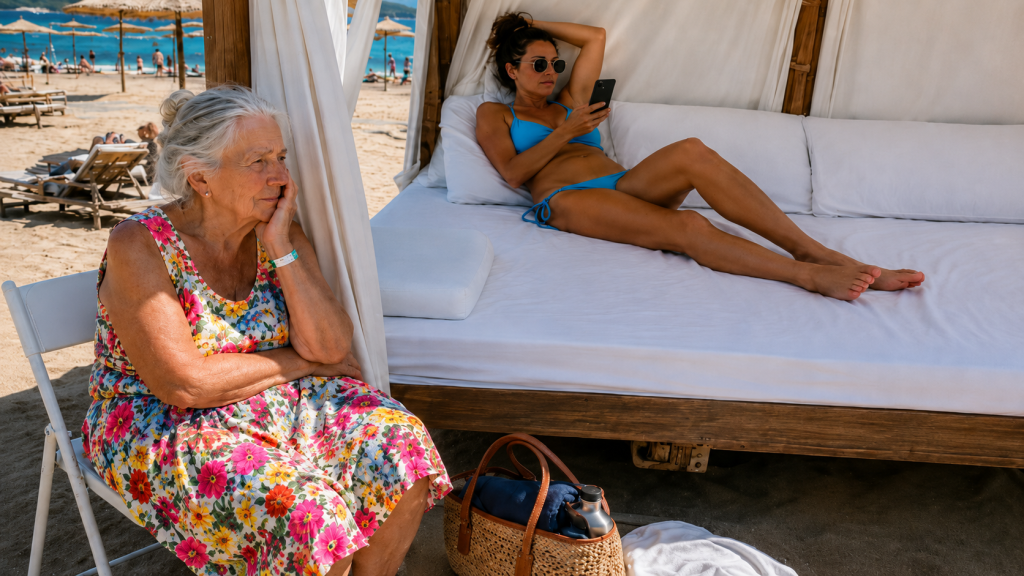
I arranged her cushion behind her back, tucked a light blanket over her knees in case the breeze bothered her, and placed her water bottle within reach.
Lily gave her the birthday card.
Noah gave her a seashell he had found in the parking lot and insisted it was rare.
Grandma held both like treasures.
For the first half hour, everything was perfect.
My grandmother watched the waves.
My children built a sandcastle near the entrance of the cabana.
I took photos of Grandma smiling, real smiling, the kind I had not seen in months.
She looked peaceful.
Not sick.
Not frail.
Not trapped inside the story of what had happened to her body.
Just peaceful.
Around noon, the kids started asking for lemonade from the boardwalk stand.
I hesitated.
The stand was visible from the cabana path, but the line was long, and I did not like leaving Grandma alone.
“I’m fine,” she said, reading my face. “Go. I have my water, my hat, and the best seat in the world.”
“I’ll be quick.”
“Claire, I raised three children, survived one husband, two floods, and a stroke. I can sit in a chair for twenty minutes.”
I laughed despite myself.
“Keep your bracelet visible,” I said.
She lifted her wrist. “Yes, boss.”
I took Lily and Noah by the hands and walked toward the boardwalk.
The lemonade line took longer than expected.
A family ahead of us could not decide what flavor everyone wanted.
Then the machine ran out of ice.
Then Noah dropped his sandal and cried like the world had ended.
I kept glancing back toward the cabanas, but the curtains blocked most of my view.
Still, I told myself everything was fine.
Grandma was safe.
She was in a reserved cabana.
She had a bracelet.
There were attendants nearby.
What could possibly happen?
When we finally returned, carrying three lemonades and a small cup of shaved ice for Grandma, my stomach dropped so hard I almost stumbled.
Our bags were not inside the cabana.
They had been thrown onto the hot sand.
Grandma was not on the sofa.
She was sitting several yards away in a cheap plastic chair beneath the blazing June sun.
Her hat had slipped sideways.
Her cheeks were flushed red.
Her hands trembled in her lap.
And she was crying quietly.
Not loudly.
Not dramatically.
Just silently, in that terrible way older people cry when they are trying not to be a burden.
“Grandma?” I called.
She looked up, and the shame in her eyes made something inside me turn cold.
I rushed to her, dropping the lemonade into the sand.
“What happened? Are you hurt?”
She shook her head, but her chin trembled.
Lily froze beside me.
Noah pressed himself against my leg.
“Grandma, talk to me,” I said, kneeling in front of her.
She lifted one shaking hand and pointed toward our cabana.
A younger woman in a designer swimsuit was stretched out on the sofa I had paid for, sipping a cocktail and laughing with three friends.
Her oversized sunglasses covered half her face.
A gold chain rested against her collarbone.
Her beach bag, bright red and expensive-looking, sat where Grandma’s sweater had been.
“She told me to leave,” Grandma whispered.
My chest tightened.
“What?”
“She said this cabana was too nice for me.” Grandma swallowed, struggling to speak clearly. “She said old people don’t need the best view.”
For a moment, the beach sounds faded.
All I could hear was my own heartbeat.
Grandma wiped her cheek with the back of her hand.
“She threw my bag out. When I showed her my bracelet, she laughed. She said I probably found it in the trash.”
Lily gasped.
Noah looked confused, but he knew enough to understand someone had hurt his great-grandmother.
“Where was the attendant?” I asked.
“She called one over,” Grandma said. “Not Marcus. A girl I didn’t know. She told her I was confused. She said my family had probably abandoned me, and I had wandered into the wrong cabana.”
My hands clenched.
Grandma’s voice cracked.
“Her friends laughed, Claire.”
Those words did it.
Not the cabana.
Not the money.
Not even the lie.
Her friends laughed.
At my grandmother.
At a ninety-year-old woman who had survived grief, illness, and more pain than that rude woman would ever understand.
I looked at the woman lounging in our cabana.
Then I looked at my grandmother’s red, shaking hands.
“Stay with the kids,” I said softly.
Grandma grabbed my wrist.
“Don’t make a scene.”
I turned back to her.
My voice was calm.
Too calm.
“I won’t make a scene, Grandma. She already did.”
Then I stood and walked straight toward the cabana.
The woman saw me coming.
She did not sit up.
She did not look embarrassed.
She lowered her sunglasses just enough to inspect me with a bored smile.
“Can I help you?” she asked.
“Yes,” I said. “You’re sitting in the cabana I reserved.”
Her friends went quiet for half a second.
Then one of them snorted.
The woman took a slow sip of her cocktail.
“This cabana is occupied.”
“I know,” I said. “By my grandmother. Until you threw her belongings onto the sand.”
Her smile sharpened.
“Oh, you’re with the old lady.”
I felt heat rise behind my eyes, but I kept my voice even.
“That old lady is my grandmother. Today is her ninetieth birthday. I reserved this cabana eight months ago.”
“How sweet,” she said, in a tone that meant the opposite.
I pulled out my phone and opened the reservation confirmation.
“Cabana Seven. Twelve p.m. to six p.m. Under Claire Bennett. VIP birthday package.”
She glanced at the screen for less than a second.
“Anyone can fake a screenshot.”
One of her friends laughed again, but it sounded weaker this time.
“I’m not asking for your opinion,” I said. “I’m telling you to leave.”
Her eyebrows rose.
“Excuse me?”
“You heard me.”
She sat up slowly, like she was finally entertained.
“Listen, sweetheart. Your grandmother was confused. She didn’t even know where she was.”
“She knew exactly where she was.”
“She was mumbling.”
“She had a stroke.”
The woman shrugged.
“That’s not my problem.”
Something in me almost snapped.
Almost.
But then I saw Grandma watching from the plastic chair, one hand pressed to her chest, terrified that I would embarrass myself for her sake.
So I breathed in.
I breathed out.
And I smiled.
Not because anything was funny.
Because sometimes a smile is what you wear when you decide not to be the kind of person someone expects you to be.
“What’s your name?” I asked.
The woman laughed.
“Why? Planning to report me to the beach police?”
“No,” I said. “To management.”
That made her pause.
Only for a heartbeat.
Then she waved one hand.
“Go ahead. The attendant already handled it. She agreed your grandmother was confused.”
“Then we’ll clear that up.”
I turned toward the nearest staff station and raised my hand.
“Excuse me! Manager, please.”
The woman leaned back again, but her smile was not as relaxed as before.
A few people from nearby cabanas had started watching.
Grandma had said her friends laughed.
Now everyone around us was quiet.
A minute later, Marcus came hurrying down the path with another man in a navy polo beside him.
The man wore a name badge that said Daniel Ross, Cabana Manager.
Marcus saw Grandma in the plastic chair and stopped dead.
His face changed.
“Mrs. Evelyn?” he said.
That small detail mattered.
He remembered her name.
The manager looked from him to me.
“What’s going on?”
I held up my phone.
“My name is Claire Bennett. I reserved Cabana Seven for my grandmother’s ninetieth birthday. This woman removed my grandmother from the cabana, threw our bags onto the sand, accused her of stealing a VIP bracelet, and told staff she was confused.”
Daniel’s face went pale.
The woman gave a bright, fake laugh.
“That is not what happened.”
I pointed toward Grandma.
“My grandmother is sitting in direct sun after having a serious stroke. She was under shade until this woman forced her out.”
Marcus turned sharply toward the woman.
“You moved Mrs. Evelyn?”
“She was in my cabana,” the woman said.
“No, ma’am,” Marcus replied. “I personally checked in this family. Cabana Seven is reserved under Claire Bennett.”
The woman’s lips tightened.
“Well, there must have been a mistake.”
“Yes,” Daniel said, his voice colder now. “Yours.”
Her friends shifted uncomfortably.
One of them picked up her phone, then seemed to think better of it.
The rude woman sat forward.
“Do you know who I am?”
Daniel did not blink.
“At the moment, ma’am, you are someone occupying another guest’s paid cabana.”
Her face flushed.
“I’m an annual club member.”
“That does not give you the right to remove a guest.”
“I didn’t remove her. I asked her to move.”
“You threw her bag into the sand,” I said.
“She was confused.”
“No,” a voice behind me said. “She wasn’t.”
We all turned.
An older man from the next cabana stood there holding his phone.
Beside him was his wife, and behind them a younger couple I had noticed earlier when we arrived.
The older man looked at Daniel.
“We saw the whole thing,” he said. “That woman told the grandmother she was ruining the view. Then she grabbed the bag and tossed it out.”
The rude woman stood.
“That is a lie.”
The older man’s wife stepped forward.
“It’s not. And I recorded part of it because I thought someone should know how she was treating that poor lady.”
For the first time, the rude woman looked scared.
Not sorry.
Scared.
There is a difference.
Daniel turned to her.
“Ma’am, I need you and your guests to leave this cabana immediately.”
She grabbed her red bag.
“This is ridiculous. I pay thousands a year to this club.”
“And today,” Daniel said, “Mrs. Bennett paid for this cabana.”
Her mouth opened.
Nothing came out.
Around us, more people had started watching.
A teenager near the walkway whispered, “That’s the woman who kicked out the grandma.”
The rude woman heard him.
Her cheeks turned darker.
She pointed at me.
“You’re making this bigger than it needs to be.”
I stepped closer, lowering my voice so only she and the staff could hear me.
“No. You made it big when you humiliated a ninety-year-old woman because you thought no one would defend her.”
For a second, she looked at Grandma.
Grandma sat beneath the sun, small and shaken, with Lily holding one of her hands and Noah patting her knee.
The woman looked away first.
Daniel motioned to two attendants.
“Please collect these guests’ belongings and escort them to the front desk.”
“Escort?” she snapped. “Are you serious?”
“Yes,” Daniel said. “Very.”
One of her friends stood quickly.
“I told you not to do it,” she muttered under her breath.
That tiny sentence traveled through the cabana like a match dropped onto dry grass.
The rude woman spun toward her.
“Excuse me?”
Her friend did not answer.
She just grabbed her sandals and walked out.
The others followed.
The rude woman remained for one dramatic second longer, as if she expected someone to beg her to stay.
Nobody did.
Finally, she snatched up her cocktail and stormed toward the path.
But the humiliation was not finished with her yet.
At the front desk, we later learned, she demanded a refund on her club membership, threatened legal action, and insisted she had been “publicly embarrassed.”
Daniel asked her whether she would like him to review the witness video with her before she continued.
She left without another word.
But in that moment, standing beside the cabana, I was not thinking about her.
I was thinking about Grandma.
Marcus and Daniel helped me move everything back into place.
They carried our bags off the hot sand.
They replaced the towels.
They brought fresh ice water, fruit, and a large umbrella to shade Grandma while we helped her back to the sofa.
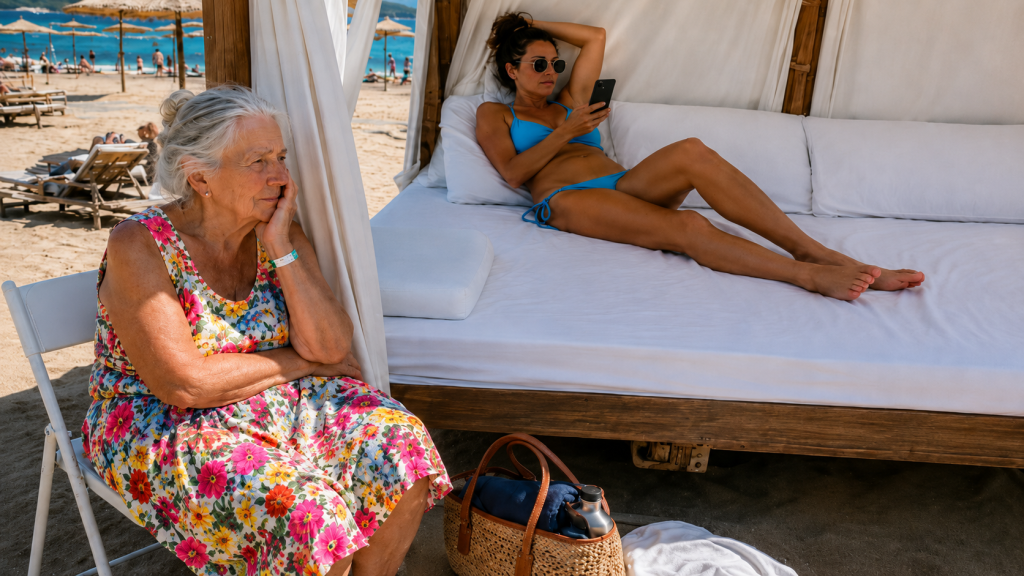
Grandma kept apologizing.
“I’m sorry,” she whispered. “I didn’t want trouble.”
I knelt beside her.
“Grandma, look at me.”
She did.
Her eyes were wet.
“You did nothing wrong.”
“She made me feel foolish.”
“She should feel foolish.”
Grandma looked toward the ocean.
“I was so embarrassed.”
Lily climbed onto the sofa beside her and wrapped both arms around her waist.
“You’re not embarrassing,” she said fiercely. “You’re the birthday queen.”
Grandma laughed through her tears.
Noah placed the rare parking lot seashell into her palm.
“For power,” he said.
That broke everyone.
Even Marcus had to turn away.
Daniel cleared his throat.
“Mrs. Bennett, Mrs. Evelyn, on behalf of Harbor Point Beach Club, I am deeply sorry. This should never have happened.”
Grandma tried to wave it off.
“I’m all right.”
“No, ma’am,” Daniel said gently. “You were mistreated here, and we allowed that misunderstanding to continue. That is not all right.”
He told me they would refund the entire cabana rental.
I opened my mouth to refuse, because pride runs in my family too, but he held up a hand.
“Please. Let us make this right.”
Then he added something I did not expect.
“We also have a private sunset dinner deck available tonight. It’s usually reserved months in advance, but the party canceled this morning. We would be honored if your family allowed us to host Mrs. Evelyn’s birthday dinner there.”
Grandma’s mouth fell open.
“Oh, no, that’s too much.”
I looked at her.
For eight months, I had worked to give her one beautiful day.
Maybe the day had been bruised.
But it was not ruined.
Not if we refused to let cruelty have the final word.
“Grandma,” I said. “Do you want to stay?”
She looked at the ocean.
The wind lifted the edge of her hat.
For a moment, she seemed younger.
Not because her body changed, but because joy came back into her face.
“Yes,” she whispered. “I do.”
So we stayed.
For the next hour, Grandma slowly came back to herself.
The redness faded from her cheeks.
Her hands stopped shaking.
She drank cold water, ate tiny pieces of watermelon, and watched Lily and Noah rebuild their sandcastle bigger than before.
People from nearby cabanas began stopping by.
Not in a nosy way.
In a kind way.
The older couple who had witnessed everything introduced themselves as Howard and Miriam.
Howard had been married to Miriam for fifty-eight years.
“My wife would have knocked that woman into next Tuesday,” he said.
Miriam slapped his arm.
“I would not.”
Then she leaned toward Grandma and whispered loudly, “I would have considered it.”
Grandma laughed again.
A family from two cabanas down sent over a slice of chocolate cake.
A little girl brought Grandma a shell she had painted with nail polish.
Someone asked if they could sing happy birthday later.
Grandma looked overwhelmed, but not in the way she had before.
This time, she was overwhelmed by kindness.
At three o’clock, Marcus returned with a bouquet of white and yellow flowers.
“These are from the staff,” he said. “Happy birthday, Mrs. Evelyn.”
Grandma held the flowers to her chest.
“You young people are going to make me cry all over again.”
“Only happy tears now,” Marcus said.
For a while, I sat beside her and watched my children play.
“Claire,” Grandma said softly.
“Yes?”
“You were very brave.”
I shook my head.
“I was angry.”
“Sometimes anger is just love standing up straight.”
I looked at her.
She was watching the ocean.
The same ocean she had brought me to when I was seven years old and my parents were fighting so badly I thought the world would split in half.
Back then, she had bought me a cherry snow cone and told me waves always return, no matter how many times they break.
I had not understood what she meant then.
I did now.
“Do you remember when you used to bring me here?” I asked.
She smiled.
“You were such a serious little thing. Always worrying.”
“I had reasons.”
“Yes,” she said. “You did.”
After my father left and my mother fell into a sadness she could not climb out of for years, Grandma became the steady place in my life.
She came to school plays.
She paid for field trips.
She kept extra socks in her purse because I always stepped in puddles.
When I was sixteen and cried over a boy who made me feel worthless, Grandma took me to this same beach and told me, “Never hand your dignity to someone who has not earned the right to hold it.”
I thought about that as I watched the waves.
Today, someone had tried to take hers.
But dignity, I realized, is not something another person can steal forever.
Sometimes they can bruise it.
Sometimes they can make you forget where you placed it.
But love can bring it back.
By sunset, the sky had turned peach and gold.
Daniel personally escorted us to the private dinner deck.
It sat above the beach, wrapped in glass railings, with lanterns glowing along the edge.
The table was set with white dishes, cloth napkins, and a small birthday centerpiece.
Grandma stared at it like she had stepped into a dream.
“I don’t know what to say,” she whispered.
Lily took her hand.
“Say you’re hungry.”
Grandma laughed.
“I am, actually.”
Dinner was simple but perfect.
Grilled fish for Grandma.
Chicken for the kids.
Salad, warm bread, and a little chocolate cake with a candle shaped like the number ninety.
As the sun lowered over the water, the staff gathered quietly near the deck.
So did Howard and Miriam.
So did the family with the little girl.
So did people I did not know, people who had witnessed only a piece of the day but somehow understood what it meant.
When Marcus carried out the cake, everyone began singing.
Grandma covered her mouth with both hands.
Her eyes filled again, but this time she did not look ashamed.
She looked loved.
The candle flame flickered in the ocean wind.
“Make a wish,” Noah said.
Grandma closed her eyes.
For a long moment, she stayed still.
Then she blew out the candle.
Everyone clapped.
“What did you wish for?” Lily asked.
Grandma smiled.
“If I tell you, it won’t come true.”
Noah leaned close.
“Was it for a dragon?”
“Something better,” Grandma said.
“What’s better than a dragon?”
She looked at me, then at the kids, then at the strangers who had become part of her birthday story.
“More days like this,” she said.
I had to turn away again.
Later, when the kids were eating cake and Grandma was sipping tea, Daniel came back to the table.
He looked serious.
“I wanted to let you know something,” he said quietly to me.
I stepped aside with him near the railing.
“The woman from earlier has been removed from the club’s membership list pending review,” he said. “And the attendant who accepted her explanation without checking the reservation has been sent home for retraining. I know that does not erase what happened, but it matters to us.”
“Thank you,” I said.
He nodded toward Grandma.
“She reminds me of my mother.”
I looked at him more carefully then.
There was something in his face I had missed before.
A private grief.
“She passed last year,” he said. “Eighty-eight. Loved the ocean.”
“I’m sorry.”
“Me too.” He smiled sadly. “When Marcus told me your grandmother’s name and age, I thought of her. Then I saw her sitting in that chair.”
His voice tightened.
“I should have been there sooner.”
“You came when it mattered.”
He nodded, but I could tell he would carry it with him.
Some people are careless with power.
Others feel the weight of even small authority and try to use it well.
Daniel was the second kind.
When we returned to the table, Grandma was telling Howard about the summer of 1957, when she and Grandpa had danced barefoot on this beach after a storm knocked out power across town.
Grandpa had been gone for eleven years.
But when she spoke of him, he felt close.
“He was a terrible dancer,” she said. “Just awful. But he held me like I was made of glass and gold.”
Miriam sighed.
Howard rolled his eyes.
“I dance better than that.”
“You do not,” Miriam said.
Everyone laughed.
For the first time in a long time, I did not feel like I was managing Grandma’s decline.
I felt like I was meeting her again.
Not as a patient.
Not as a responsibility.
As Evelyn.
A woman who had lived ninety years, loved deeply, survived loss, raised children, buried friends, baked pies, danced barefoot, and still wanted to feel ocean air on her face.
The rude woman had looked at her and seen inconvenience.
A body in the wrong place.
A person too old to matter.
But by the end of the day, strangers had looked at my grandmother and seen what I saw.
A person worthy of the best view.
After dinner, I wheeled Grandma down the ramp toward the shore.
The beach had emptied.
The air had cooled.
Lily and Noah walked ahead, chasing each other near the edge of the water.
I stopped where the sand became damp and firm.
“Close enough?” I asked.
Grandma nodded.
I locked the wheelchair brakes and sat beside her on the sand.
For a while, neither of us spoke.
The waves came in silver under the moon.
Grandma reached down and took my hand.
“I was afraid today,” she said.
“I know.”
“Not of that woman.”
I looked at her.
“Then of what?”
She watched the water.
“I was afraid she was right.”
My heart hurt.
“Grandma.”
“When your body changes, people start speaking around you instead of to you. They call you sweetie. They ask whoever is pushing the wheelchair what you want, as if your ears stopped working with your legs. Sometimes you begin to feel like maybe you are in the way.”
I squeezed her hand.
“You are not in the way.”
“I know that when I am with you,” she said. “But today, for a minute, sitting in that plastic chair, I felt so small.”
I leaned my head against her knee, just like I had when I was a child.
“You spent my whole life making me feel big when the world made me feel small,” I said. “Let me return the favor.”
Her fingers moved slowly through my hair.
“You already have.”
We sat there until the kids came running back with wet feet and sandy legs.
Noah placed another shell in Grandma’s lap.
“For more power,” he said.
“How powerful do you think I need to be?” she asked.
“A lot,” he said seriously. “You’re ninety.”
She laughed so hard that Lily started laughing too.
And then all of us were laughing, sitting under the moon, surrounded by the sound of waves.
On the drive home, Grandma fell asleep in the passenger seat with the bouquet resting across her lap.
Her face was tired, but peaceful.
Lily and Noah slept in the back, sticky with cake and salt air.
I drove slowly, not wanting the day to end.
At a red light, my phone buzzed.
It was a message from Marcus.
He had asked for my number earlier so he could send the photos the staff took during the birthday song.
The message included a picture of Grandma sitting behind her cake, candlelight glowing across her face, surrounded by people clapping.
Under it, Marcus had written:
Best view on the beach today.
I smiled through tears.
When we got home, I helped Grandma inside.
She paused in the doorway before going to her room.
“Claire?”
“Yes?”
“Thank you for taking me back to the ocean.”
I hugged her carefully.
“Thank you for teaching me how to stand up.”
She patted my back.
“You always knew how. You just needed someone rude enough to remind you.”
The next morning, the witness video appeared online.
I did not post it.
Miriam did.
She blurred Grandma’s face out of respect but left the rude woman’s voice clear enough.
Old people don’t need the best view.
The video spread faster than any of us expected.
By noon, people were commenting from all over town.
Some were angry.
Some shared stories about their own parents and grandparents being dismissed, ignored, or humiliated.
Some simply wrote, “Protect Evelyn at all costs.”
Harbor Point Beach Club released a public apology, not naming Grandma but acknowledging that an elderly guest had been mistreated and confirming new staff procedures for reservation checks and accessibility support.
The rude woman tried to defend herself in the comments from a private account.
That lasted about eight minutes.
Then one of her own friends replied, “You know exactly what you did.”
After that, she disappeared.
I thought Grandma might be upset when she found out.
Instead, she adjusted her glasses, watched the video once, and said, “That swimsuit was not flattering enough for all that arrogance.”
I nearly dropped my coffee.
A week later, a package arrived at my house.
Inside was a framed photograph from the beach club.
Grandma at sunset.
Her silver hair glowing.
Her blue blouse bright against the white tablecloth.
Her hands folded in front of the birthday cake.
Behind her, the ocean stretched wide and endless.
There was a handwritten note from Daniel.
Mrs. Evelyn reminded us what hospitality is supposed to mean. Thank you for allowing us to celebrate her.
Grandma kept the photo beside her favorite chair.
Whenever visitors came, she pointed to it and said, “That was my ninetieth birthday. I got thrown out of a cabana and upgraded to a sunset dinner.”
People always gasped.
Then she smiled.
“Don’t worry,” she added. “The other woman had a worse day than I did.”
Months passed.
Grandma still had hard mornings.
Some days, her left hand would not cooperate.
Some days, the words came slowly.
Some days, she was too tired to leave her room.
But something changed after that birthday.
She asked to sit outside more.
She let neighbors visit.
She started wearing her pearl earrings again on ordinary afternoons.
One Sunday, she asked me to drive her past the beach.
Not to get out.
Just to see it.
As we parked near the overlook, she looked at the water and sighed.
“I made another wish that day,” she admitted.
“I thought you said wishes don’t come true if you tell.”
“This one already did.”
“What was it?”
She turned to me.
“That my great-grandchildren would remember me laughing, not just recovering.”
I thought of Lily calling her the birthday queen.
I thought of Noah handing her shells for power.
I thought of her laughing under the moon with cake crumbs on her napkin and ocean wind in her hair.
“They will,” I said.
And I knew it was true.
Years from now, my children might forget the rude woman’s face.
They might forget the exact words she said.
They might forget the cabana number and the name of the beach club.
But they would remember their great-grandmother sitting by the ocean on her ninetieth birthday.
They would remember strangers singing to her.
They would remember that when someone tried to make her small, the people around her made room for her to be seen.
And they would remember what I hoped they carried forever.
That age does not make a person less worthy.
Weakness does not erase dignity.
Kindness is not weakness.
And sometimes, the best view does not belong to the loudest person in the room.
It belongs to the one who waited ninety years, survived everything life threw at her, and still had enough grace left to smile at the sea.
THE END! THANK YOU FOR READING!