
I married my best friend’s wealthy grandfather for financial security, and on our wedding night, he looked at me and said, “Now that you’re my wife… I can finally tell you the truth. It’s too late to walk away.” I was never the pretty one. Not at school. Not in family photos. Not anywhere.
I was the girl people overlooked unless they were laughing. Awkward smile, uncomfortable posture, always standing like I had entered the wrong room. By high school, I had accepted it. No one was ever going to fall in love with me.
Except Violet stayed. She never laughed at me. She saved me a seat, defended me when people whispered, and listened when I spoke. We stayed close through school, went to the same university, and shared a tiny apartment with peeling paint and a kitchen too small for both of us.
After graduation, Violet planned to return to her hometown.
I didn’t have a home to return to. My family had made that clear years earlier. So I followed her. I found a low-paying job in her city and rented a room nearby, telling myself it was practical.
The truth was, I couldn’t bear losing the only person who had ever stayed.
That was how I met her grandfather, Rick Hawthorne.
He was seventy-six, wealthy, sharp-minded, and nothing like I expected. At family dinners, he listened more than he spoke, watching everyone as if silence gave him more information than words.
Our first conversations were polite. Then they became longer. Rick asked about my work, my childhood, and my fear of being poor forever. He listened without pity.
One rainy evening, after dinner, Rick asked me to stay behind.
Violet was upstairs. The house was quiet.
Rick sat across from me and said, “Marry me.”
I stared at him, waiting for the explanation that would make it normal.
It never came.
He said it would be a legal arrangement. Respectful. Private. I would have my own room, my own freedom, and financial security. In exchange, I would be his wife in name and live at the estate.
He was incredibly wealthy.
And for the first time in my life, I saw an escape.
No more counting coins. No more terrified nights. No more pretending I wasn’t one emergency away from ruin.
When I told Violet, her face changed.
“You’re serious?” she whispered.
“I know how it sounds.”
“It doesn’t sound terrible, Mara. It is terrible.”
Shame burned in my throat, but fear spoke louder.
“You’ve never been scared the way I am,” I said. “You have somewhere to go.”
Violet looked wounded.
Then she said the words that followed me all the way to the altar.
“I didn’t think you were that kind of person.”
She cut me off that day.
The guilt stayed with me.
But not enough to make me stop.
The wedding was small. Rick’s family attended because money has gravity. His eldest son, Malcolm, smiled like a man signing a contract he intended to break. His wife, Elise, kissed my cheek with lips cold as jewelry.
Violet did not come.
No one came for me either.
When I said “I do,” I felt every eye in the room calling me a gold digger.
The worst part was that they were not entirely wrong.
Afterward, Rick and I drove to his estate, a stone mansion behind iron gates and old trees. Arriving as his wife made the halls seem longer and the portraits colder.
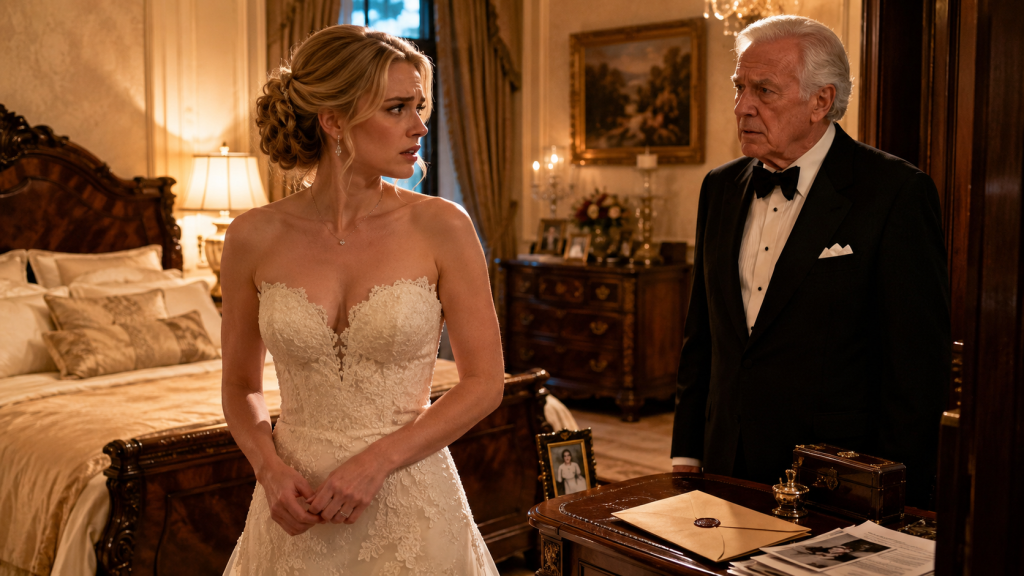
That night, I stood in the bedroom still wearing my wedding dress.
Rick walked in behind me.
He closed the door.
And said, “Now that you’re my wife… I can finally tell you the truth. It’s too late to walk away.”
My body went cold.
I turned slowly, suddenly certain I had sold myself into something darker than poverty.
But Rick only looked tired.
“I didn’t marry you because I wanted a wife,” he said. “I married you because you were the only person Violet ever trusted.”
My breath caught.
“Violet?”
He unlocked a desk drawer and removed photographs, medical reports, bank statements, and one sealed envelope with my name written in Violet’s handwriting.
“My family believes I am dying naturally,” Rick said. “I am not.”
I stared at him.
“Someone has been poisoning me.”
The room seemed to tilt.
He handed me the reports. Most of the language meant nothing, but several words were circled in red: repeated exposure, abnormal toxicity, unexplained cardiac episodes.
“Why tell me now?” I asked.
“Because as my wife, you are my legal next of kin. My doctors must speak to you. My staff must answer you. My family cannot remove you without exposing themselves.”
I looked at the envelope.
“What does Violet have to do with this?”
“She found the first evidence,” Rick said. “A pharmacy charge under a false name. Payments from Malcolm’s private account to one of my nurses. She wanted to confront him. I forbade it.”
“Why would she cut me off?”
Rick’s expression softened.
“Because I made her.”
With trembling fingers, I opened the envelope.
The first line was enough to break me.
Mara, I’m sorry. I had to make you hate me so they wouldn’t know you mattered.
Violet wrote that she had discovered something wrong months earlier. She had begged Rick to go to the police, but he wanted proof no lawyer could bury. The Hawthornes had money and friends in useful places. A suspicion could vanish. Evidence could not.
Rick needed someone inside the house whom the family would underestimate.
Me.
“They would never believe I trusted a gold digger,” he said quietly. “That is why this works.”
I should have been offended.
Instead, I laughed once, broken and bitter.
“So I was bait.”
“You were protection,” Rick said. “And I am sorry.”
For a long time, I said nothing. I thought about Violet pretending to despise me, and about myself walking down the aisle for money, only to step into a war.
Then I remembered Violet.
“What do you need me to do?” I asked.
The next morning, I became exactly what everyone thought I was.
I wore silk at breakfast. I asked about accounts, staff schedules, insurance documents, and medical access. Malcolm watched me with open disgust.
“You are comfortable quickly,” he said.
I smiled into my coffee.
“I learn fast.”
For two weeks, I played the greedy young wife. I complained, asked too many questions, and let them hate me. People are careless when they think contempt is control.
Meanwhile, Rick and I worked quietly.
His loyal driver, Tomas, delivered documents to an outside attorney. A housekeeper named Mrs. Vale helped me search the medicine cabinet. Rick switched his meals and pretended to grow weaker.
The first real break came from a bottle of heart medication.
The label was correct.
The pills inside were not.
A private lab confirmed they contained a compound that could cause dizziness, confusion, and cardiac distress. Not enough to kill immediately. Enough to make an old man look like he was fading.
I read the report and ran to the bathroom to vomit.
That night, Malcolm requested a family dinner.
Malcolm sat at the head of the table as if Rick had already died and left him the chair. Elise poured wine with a steady hand.
Malcolm raised his glass.
“To family,” he said.
Rick lifted his water.
“To what remains of it.”
The conversation turned sharp quickly.
Malcolm accused me of manipulating a vulnerable man. Elise suggested an annulment. Someone muttered that women like me always knew where to find money.
I let them speak.
Then Malcolm leaned forward.
“You have no idea what this family is, little girl.”
I smiled.
“No. But I know what poison does to bloodwork.”
The room went silent.
Rick placed the lab report on the table.
Elise’s glass slipped from her fingers and shattered.
Malcolm recovered first. “This is ridiculous.”
“Then you won’t mind explaining why your private account paid Nurse Callen eleven times in three months,” Rick said.
Malcolm stood so fast his chair hit the floor.
“You senile old fool.”
That was when the library doors opened.
Two detectives stepped inside with Rick’s attorney behind them. Tomas had recorded the conversation. Mrs. Vale had given a statement. Nurse Callen, arrested that afternoon, had confessed enough to protect herself.
Malcolm looked at me then, really looked.
For the first time, he did not see an awkward girl, a gold digger, or a mistake in an expensive dress.
He saw the trap closing.
And I realized Rick had been right.
Being underestimated was not weakness.
It was cover.
The arrests did not happen like they do in movies. There were lawyers, pale faces, clipped voices, and Elise whispering, “I told you not to use the nurse,” before realizing everyone had heard.
By dawn, the estate felt hollow.
I found Violet in the garden just after sunrise.
She looked exhausted. Her eyes were red. For a moment, we stood on opposite sides of the path like strangers.
Then she said, “I’m sorry.”
I wanted to forgive instantly. Instead, I cried so hard I could barely breathe.
“You let me think I lost you.”
“I know.”
“You said I was that kind of person.”
“I know.”
Violet crossed the path and wrapped her arms around me. I tried to stay angry, but grief had softer hands than pride.
“I was scared they’d hurt you,” she whispered.
“They did.”
“I know.”
Rick survived, but not easily. The damage to his body was real, and some mornings his hands trembled around a teacup. But the poison was gone. So were the people feeding it to him.
The scandal consumed the Hawthorne name for months. Reporters called me a schemer, then a savior. I stopped reading after one article described me as “plain but strategic.”
Rick laughed when I told him.
“Strategic is a compliment.”
“Plain is not.”
“Plain people built most of the world,” he said.
Our marriage remained what he had promised: legal, respectful, separate rooms, shared breakfasts. Some people preferred uglier stories. I learned to let them.
Rick changed his will after the trial began. He left most of his fortune to a foundation for elder abuse victims and young adults without family support. Violet received the house. I received enough money to live without fear, but not enough to disappear inside it.
A year later, Rick died in his sleep.
Peacefully, this time.
At his funeral, the hall was larger than our wedding and somehow less lonely. Violet stood beside me. Tomas cried openly. People came who had loved Rick, not his money.
After the service, Violet and I walked through the garden where we had forgiven each other badly, but honestly.
“What will you do now?” she asked.
For once, the question did not terrify me.
“I think I’ll help run the foundation.”
Violet smiled.
“Rick would like that.”
I looked back at the house glowing in the late afternoon sun. I had entered it as a desperate woman making a shameful choice. I left with scars, money, grief, and a strange kind of courage.
I still was not the pretty one.
Not in the way people mean when they say it quickly.
But I had been loyal. I had been brave. I had been useful in ways no one expected. I had been loved by my best friend, trusted by an old man, and underestimated by enemies who never understood that invisible girls see everything.
For years, I thought being overlooked meant I was nothing.
Now I know better.
Sometimes the person no one notices is the one standing closest to the truth.
THE END! THANKS FOR READING!