
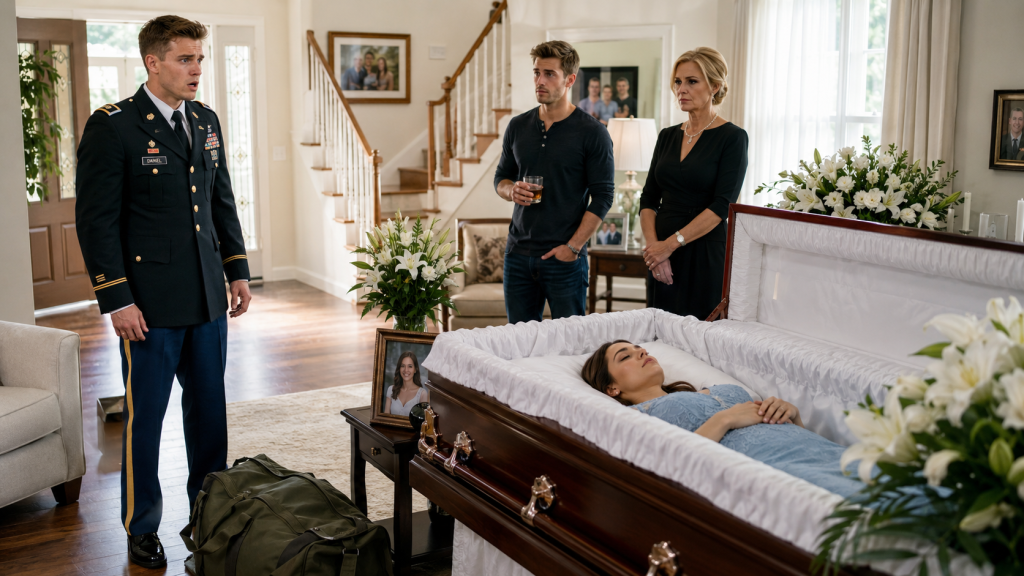
The coffin was waiting in my living room before I had even taken off my uniform. For almost eleven months, I had dreamed of that room. I had dreamed of Emily standing by the front window, one hand on her belly, the other waving at me through the glass. I had dreamed of dropping my duffel bag, crossing the porch in three steps, and holding my wife until all the dust, gunfire, and sleepless nights of deployment disappeared from my body.
Instead, the curtains were drawn. The house smelled of lilies, floor polish, and something cold. My mother, Margaret, stood beside the coffin in a black dress, dry-eyed and straight-backed, as if she were hosting a formal dinner rather than guarding my dead wife.
My younger brother, Caleb, leaned against the fireplace with a glass of whiskey in his hand. He wore no tie. His shirt collar was open. His hair was wet, like he had showered recently. There was a faint scratch along his cheek.
Neither of them moved toward me. Neither of them said, “I’m sorry.” My mother only lifted her chin and said, “Your wife died giving birth, Daniel.”
For three seconds, the world made no sound.
Then, from somewhere upstairs, I heard a newborn cry.
A thin, weak, broken cry. My duffel bag slipped from my hand and hit the floor. “What did you say?” Mother folded her hands in front of her. “Emily is gone.” The words should have shattered me immediately, but they did not. They struck something harder first. Training. Instinct. The part of me that had survived roadside bombs by noticing what did not belong.
The living room did not look like a place of grief.
It looked prepared.
The coffin had been placed in the center of the room at a perfect angle. White lilies stood in two arrangements beside it. The rug had been freshly vacuumed. The framed photograph of Emily and me from our wedding had been turned slightly toward the coffin, like a prop.
No doctor was there.
No nurse.
No minister.
No hospital bracelet on Emily’s wrist.
No discharge papers.
No explanation.
Just my mother and my brother, watching me like guards.
“Where is my son?” I asked.
Mother’s mouth tightened. “He survived. Barely.”
The baby cried again upstairs, and my body moved toward the stairs before my mind gave permission.
Caleb stepped away from the fireplace.
“Don’t,” he said.
I stopped slowly and looked at him.
He swallowed, then recovered his arrogance. “He needs rest. Mother has everything under control.”
“Everything?” I repeated.
My voice sounded unfamiliar, low and empty.
Mother gave me a look I had known since childhood. The look that said obedience would make things easier.
“Emily was careless,” she said. “She refused to listen. She insisted she knew better than everyone. Labor came quickly, and by the time help arrived—”
“Who helped her?”
Mother blinked once. “What?”
“You said by the time help arrived. Who arrived?”
She hesitated too long.
Caleb lifted his glass. “Daniel, you just got home. Maybe don’t interrogate your mother over the body of your wife.”
My eyes shifted to him.
He looked away first.
I walked toward the coffin.
The lid was open.
Emily lay inside wearing the blue dress she had chosen for my homecoming. I knew because she had sent me a picture of it three weeks earlier, laughing in the mirror, belly round beneath the soft fabric. She had written, “Your son approves. He kicked twice when I tried it on.”
Now the dress was buttoned wrong at the collar.
Emily never buttoned anything wrong.
Her dark hair had been arranged too carefully around her face. Powder had been used to soften the bruised shadows beneath her eyes. Her lips were pale. Her skin had the stillness of a person who had been abandoned before she was gone.
I gripped the edge of the coffin.
For a moment, my knees nearly buckled.
This was my wife.
My Emily.
The girl who had met me at a grocery store when I was home on leave and argued with me about which peaches were ripe. The woman who danced barefoot in our kitchen. The woman who kissed my dog tags before I deployed and promised our baby would know my voice before he knew my face.
I wanted to collapse.
I wanted to howl.
But then I saw her hand.
Emily’s right hand was clenched against her hip.
Not resting.
Clenched.
“What is she holding?” I asked.
Mother’s face changed.
It lasted less than a second, but I saw it. A flicker of fear behind the coldness.
“Nothing,” she said sharply. “Leave her dignity intact.”
I bent closer.
Mother grabbed my arm. “Daniel, stop.”
I looked at her hand on my uniform sleeve, then at her eyes.
“Take your hand off me.”
She did.
The house went still.
I reached into the coffin and touched Emily’s fingers. They were stiff, but not impossible to move. I had seen death before. Too much of it. Enough to know that stories told by the living often did not match the body left behind.
Beneath Emily’s nails were tiny crescent cuts in her own palm, as though she had fought to keep her fist closed.
My throat tightened.
“What did you do, Em?” I whispered.
I gently worked her thumb loose.
Something small and black slid into my palm.
A memory card.
Mother went white.
Caleb’s glass stopped halfway to his mouth.
“What is that?” he demanded.
I closed my fist around it. “You tell me.”
Mother recovered first. “Probably something from her phone. She recorded everything. Pregnancy made her paranoid.”
“Paranoid about what?”
Her eyes hardened. “About me. About Caleb. About the house. About money. She filled your head with lies while you were deployed.”
That was her second mistake.
Emily had not filled my head with lies.
She had sent me patterns.
For months, her messages had changed gradually. At first, they were full of nursery photos, baby names, cravings, jokes about swollen ankles. Then came questions about bank statements. Then questions about the trust. Then short messages that made my chest tighten in my barracks at 3:00 a.m.
“Your mother came by again today.”
“Caleb asked where you keep the trust documents.”
“Margaret says I’m too emotional to manage the house.”
“Can we change the locks when you come home?”
I had told Emily to document everything.
I had given her access to my encrypted evidence vault.
I had told her to hide copies somewhere physical too, because my mother understood manipulation, but she did not understand technology.
Now Emily had died with a memory card in her hand.
Upstairs, my son cried again.
A weak, hungry sound.
I slipped the card into the hidden pocket inside my uniform jacket.
Then I looked at my mother and said, “Tell me exactly how my wife died.”
Mother drew herself taller.
“She went into labor in the afternoon. She refused to let me call the hospital at first. She said she wanted to wait for you. Ridiculous, of course. By evening, she was hysterical. Caleb went for help, but the storm had started. The roads were bad.”
I looked toward the window.
There was no snow on the driveway.
It was late October.
“What storm?”
Caleb set his glass down too fast, and whiskey splashed over his fingers.
Mother’s mouth tightened. “Rain. I meant rain.”
“It hasn’t rained here in four days.”
Her eyes flashed. “Do not speak to me like I’m one of your soldiers.”
“No,” I said. “My soldiers tell the truth when lives depend on it.”
Caleb stepped forward. “That’s enough.”
I turned to him fully.
He stopped.
Caleb had always been braver when I was not in the room. As children, he broke things and let Mother blame me. As adults, he borrowed money and called it family. He had never learned what to do when someone did not flinch.
“Bring me my son,” I said.
Mother replied, “He needs rest.”
“He needs his father.”
Nobody moved.
That was my answer before the memory card ever touched a computer.
I walked past them and went upstairs.
Mother followed two steps behind me. “Daniel, you cannot simply storm through this house.”
I stopped at the top of the stairs and looked back.
“This is my house.”
She went silent.
The nursery door was closed.
I opened it.
Empty.
The crib Emily and I had assembled over video call stood against the wall, untouched. The mobile of little wooden airplanes hung perfectly still. The blue blanket my wife had knitted was folded on the rocking chair.
The baby was not there.
His crying came from Emily’s sewing room.
My chest tightened.
I opened the sewing room door and found my newborn son in a travel bassinet beside a pile of folded fabric. No baby monitor receiver nearby. No bottle warmer. No clean station. Just a newborn wrapped loosely in a white blanket, his face red from crying.
Beside the bassinet lay Emily’s phone.
Shattered.
My hands shook as I lifted him.
He was tiny. Too tiny. His head fit against my chest like something made of breath.
The moment I held him, he quieted.
I pressed my lips to his forehead.
“Hey,” I whispered. “I’m here. I’m your dad.”
He made a small sound and rooted against my uniform.
Behind me, Mother said, “Give him to me.”
I did not turn around.
“No.”
“You don’t know how to care for an infant.”
“I know how to call people who do.”
“Daniel—”
I turned then, holding my son carefully against me.
“What is his name?”
Mother looked irritated. “There was no time for that.”
My vision sharpened.
Emily and I had chosen his name months ago.
“Noah,” I said. “His name is Noah.”
Mother’s nostrils flared. “Emily chose that silly name to spite me.”
“She chose it with me.”
I picked up Emily’s broken phone and put it in my pocket. Then I carried Noah downstairs.
Caleb had moved away from the fireplace. He now stood near the front door, blocking it without looking like he was blocking it.
“Move,” I said.
“You’re not thinking clearly,” he answered.
I held my son closer.
“Caleb, I have spent the last year identifying threats under pressure. You are standing in front of my exit with a guilty face and a drink in your hand. Move.”
He moved.
I went into my office and locked the door behind me.
The room smelled like leather, dust, and Emily’s lavender candle. She must have worked in here while I was gone. There were sticky notes on my filing cabinet in her handwriting. A half-finished thank-you card for a neighbor sat on the desk.
My laptop was still in the locked drawer.
They had not found it.
I placed Noah in the padded basket Emily had kept beside the desk for laundry, lined it with a blanket from the chair, and kept one foot against it while I opened the computer.
My hands felt steady now.
That scared me more than rage would have.
The memory card held six files.
Five videos.
One text document.
I opened the first video.
Emily appeared on the screen, sitting in my office, wearing one of my old Army shirts. Her face was thinner than it should have been. Her eyes were red.
“Daniel,” she whispered. “If you’re watching this, it means I couldn’t wait anymore.”
I covered my mouth with one hand.
Noah stirred at my feet.
Emily looked toward the office door in the video, then back at the camera.
“Your mother and Caleb have been trying to force me to sign papers. They say the trust is too complicated for me, that I’m not really family unless I let Margaret manage everything while you’re away. I said no. They got angry.”
The video shook slightly as she adjusted the phone.
“Caleb took my spare key. I know he did. Things have moved around. Your mother keeps saying if anything happens to me, she’ll raise the baby properly. She says I’m weak. She says military wives break.”
The recording ended.
I sat frozen.
Then I opened the second video.
Emily was in the hallway upstairs, filming from waist height. Mother’s voice came from another room.
“You are nothing without my son,” Mother said. “Do you understand that? This house, this name, that child, all of it belongs to Daniel. And Daniel belongs to this family.”
Emily’s voice trembled. “Daniel is my husband.”
Mother laughed.
Caleb’s voice followed. “Just sign the document. It gives Mother temporary authority. Daniel won’t care. He trusts us.”
“No,” Emily said.
The video ended after a sharp sound, like the phone had been knocked from her hand.
My breathing slowed.
I opened the text document next.
Emily had written dates.
Times.
Descriptions.
Mother came at 8:15 p.m. and demanded trust access.
Caleb searched Daniel’s office while I was in the shower.
Margaret told me she could prove I was unstable if I tried to keep the baby from her.
Caleb said Daniel might not come back.
Margaret asked about the life insurance again.
At the bottom, one sentence had been typed in all caps.
CHECK THE HALLWAY CLOCK.
I looked up.
Through the office glass, I could see the hallway clock mounted above the stairs.
It was a gift from my mother.
A hideous antique-looking thing she insisted suited the house.
Emily hated it.
I had not known she had hidden a camera inside it.
A soft knock came at the office door.
“Daniel,” Mother called. Her voice had changed. Sweeter now. “Open the door. We need to be together as a family.”
I did not answer.
I removed the hard drive from the clock camera using a screwdriver from my desk drawer.
Mother kept talking on the other side of the door.
“You are grieving. You are not yourself. Let me take the baby. You need rest.”
I loaded the hard drive.
The files took several minutes to open.
While they loaded, I called the only person I trusted more than myself.
“Lieutenant Reyes,” a voice answered.
“Mateo,” I said.
There was a pause.
“Daniel? You home?”
“Yes. I need you at my house. Not as my friend. As a detective.”
His voice sharpened. “What happened?”
“My wife is dead. My mother and brother are lying. I have evidence. My newborn son is alive.”
“I’m on my way.”
Next, I called my attorney, Lisa Park, who had set up the military family trust before I deployed.
She answered on the third ring. “Daniel? Are you back?”
“Emily is dead.”
Her breath caught. “What?”
“My mother says childbirth. I don’t believe her. I need you here with copies of the trust documents, Emily’s access logs, and anything showing my mother had no authority.”
“I’ll come now.”
Then I called the base liaison officer.
By the time I ended the calls, the clock footage had opened.
The first usable clip showed Emily in the hallway two nights earlier.
She was barefoot, one hand braced against the wall, the other on her belly. Her face was twisted with pain.
Mother stood in front of her.
“You are not going anywhere,” Mother said.
“I need a hospital,” Emily gasped.
“You need discipline.”
Caleb appeared behind Mother, holding a folder.
“Sign first,” he said. “Then we call.”
Emily shook her head.
“No.”
Mother stepped closer.
“Daniel should have married a woman with backbone.”
Emily looked directly toward the clock then. Directly toward the hidden camera.
“I have backbone,” she said. “That’s why I won’t give you his house.”
I felt something in my chest tear open.
The clip jumped to another file.
Emily was on the stairs now, lower, breathing hard.
Caleb was on the phone.
Not with emergency services.
With someone named Victor.
“Yeah,” Caleb said. “She still won’t sign. Mother says wait. If she delivers here, we say it happened too fast.”
Mother snapped, “Hang up.”
Emily cried, “Please. The baby.”
Mother answered, “The baby is a Whitmore. He will survive you.”
I stopped the video.
For a few seconds, I could not move.
Noah made a tiny sound in the basket.
I looked down at him.
His eyes were closed. His mouth trembled in sleep.
The only thing that kept me from opening the door and doing something unforgivable was the weight of him. He was a life. Emily’s last fight. My son.
I copied every file onto three drives.
Then I uploaded them to the encrypted vault.
Then I called 911 myself.
“My name is Chief Warrant Officer Daniel Whitmore,” I said. “I need police and medical assistance at my residence. My wife is deceased in my living room under suspicious circumstances. My newborn son requires medical evaluation. I have video evidence that emergency care was withheld from my wife during labor.”
The dispatcher’s voice changed immediately.
“Are the suspected individuals still in the residence?”
“Yes.”
“Are you safe?”
I looked at the door.
Mother was no longer knocking.
That worried me more than the knocking had.
“I am locked in my office with my son.”
“Stay there, sir. Officers are en route.”
I opened the bottom drawer of my desk and removed the secure lockbox. Inside was my service pistol, still registered, still stored according to regulation. I did not touch it.
I did not need it unless they came through the door.
Instead, I pulled the office chair against the handle and waited.
Ten minutes later, I heard tires on gravel.
Then sirens.
Then Mother’s voice downstairs, suddenly high and trembling.
“Officers, thank God. My son has lost his mind. He came home from deployment and started accusing us. He has the baby locked away.”
I almost smiled.
She was already performing.
The first knock on the office door was firm.
“Daniel? It’s Reyes.”
I moved the chair and opened the door.
Mateo Reyes had been my friend since high school. He had joined law enforcement while I joined the Army. His face changed when he saw me holding Noah.
Then he looked past me at the laptop.
“What do you have?”
“Enough.”
Paramedics examined Noah first. The moment they checked him, their expressions hardened. Dehydrated. Underfed. Cold. Not critical, thank God, but neglected.
One paramedic asked, “Where was he born?”
I looked at Mother.
She said nothing.
Caleb stared at the floor.
The county medical examiner was called. The funeral director was questioned. He admitted Margaret had arranged the coffin privately and claimed Emily had died after a home birth attended by “family.” No official death certificate had been finalized. No doctor had pronounced her at the house. Margaret had rushed everything through a contact from church who owed her a favor.
That favor became evidence.
Lisa Park arrived before dawn wearing a coat over pajamas and carrying a leather folder. She took one look at Emily in the coffin and covered her mouth.
“I warned her,” Lisa whispered. “She called me last week. She said Margaret wanted authority over the trust. I told her not to sign anything.”
“She didn’t,” I said.
Lisa’s eyes filled. “Good girl.”
Mother heard her and snapped, “Do not speak about my daughter-in-law like you knew her.”
Lisa turned slowly.
“I did know her, Mrs. Whitmore. Better than you, apparently. She was terrified of you.”
Mother’s mask cracked.
Only for a moment.
But everyone saw it.
Detective Reyes took my statement while another officer separated Caleb and Mother.
Their stories did not match.
Mother said Emily had refused an ambulance.
Caleb said the phone lines were down.
There were no phone lines; we used cell service.
Mother said the birth happened at midnight.
The baby monitor logs showed crying from the sewing room at 9:40 p.m.
Caleb said he had gone to find a midwife.
Traffic cameras showed his truck at a liquor store.
Mother said Emily was unstable.
The videos showed Emily begging for help.
By sunrise, my living room was no longer a stage for my grief.
It was a crime scene.
The coffin was removed.
Not for burial.
For examination.
When they wheeled Emily out, I followed to the porch with Noah in my arms.
“I’m sorry,” I whispered. “I came home late.”
A hand touched my shoulder.
It was Lisa.
“No,” she said quietly. “She held on long enough to tell you the truth.”
Mother was placed in the back of a police car just after dawn.
For the first time all night, she cried.
Not for Emily.
Not for Noah.
Not for me.
She cried because people were watching.
She cried because her perfect story had been ruined.
Caleb shouted as they cuffed him. “Daniel, come on! She was going to take everything from us!”
I looked at him through the red and blue lights.
“Us?”
His face twisted.
“You think she loved you? She locked us out. She turned you against your own blood.”
I stepped closer, but kept my voice calm.
“Emily was my blood. Noah is my blood. You were just waiting for me to die in uniform so you could inherit what you never earned.”
He had no answer.
At the hospital, Noah was placed under observation. I sat beside him in the neonatal unit, still in my uniform, watching his chest rise and fall beneath a soft blanket.
A nurse asked if I wanted to hold him.
I nodded.
When she placed him in my arms, he opened his eyes.
They were Emily’s eyes.
Dark, steady, searching.
“I’m sorry,” I whispered again.
His tiny fingers curled around one of mine.
I did not cry in the living room.
I did not cry when I saw Emily in the coffin.
I did not cry when my mother was arrested.
But when my son held my finger with all the strength his little body had, I broke.
I bent over him and sobbed silently, careful not to shake him, careful not to let the grief swallow the one thing Emily had fought to leave me.
The investigation lasted months.
The official findings were worse than I imagined, though nothing surprised me anymore.
Emily had gone into labor early. She had begged for medical help for hours. Mother and Caleb had withheld her phone, blocked the door, and tried to force her signature on a document that would give Mother temporary control over the trust and access to several accounts while I was deployed.
Emily refused.
She recorded them.
She hid the memory card.
At some point, after Noah was born, Emily’s condition worsened. She needed emergency care that would likely have saved her life if called in time.
They waited.
Not because they panicked.
Because they were still trying to make her sign.
By the time Mother called the funeral director instead of an ambulance, Emily was gone.
Caleb took a plea first.
Cowards usually do.
He testified that Mother planned most of it, that she believed Emily had “stolen” me from the family, that she had convinced herself my deployment benefits, my house, and my trust should belong to her because she had “sacrificed” to raise me.
He admitted to hiding Emily’s phone.
He admitted to standing in the hallway while she begged.
He admitted they staged the living room before I arrived.
Mother refused every plea.
She went to trial in pearls.
She wore black every day and dabbed her eyes when the jury looked at her.
But the videos destroyed her.
Emily’s voice filled the courtroom.
Not loud.
Not dramatic.
Just honest.
“Daniel, if you find this, protect our son.”
I sat behind the prosecutor with Noah in my arms. He was six months old by then, healthy and round-cheeked, chewing on the corner of a soft blanket.
Mother did not look at him once.
When the jury returned guilty verdicts, she finally turned toward me.
Her face was not sad.
It was furious.
“You chose her over your family,” she said as deputies led her away.
I stood with Noah against my chest.
“No,” I answered. “I finally understood who my family was.”
After the trial, people expected me to sell the house.
For a while, I almost did.
Every room held a ghost. The kitchen where Emily danced. The nursery she never got to use. The living room where they placed her coffin as if grief could be arranged like furniture.
But then I found a note taped beneath the drawer of her sewing table.
Daniel,
If you are reading this, it means I hid things well or I got scared again.
I know this house feels heavy sometimes, but I loved it because it was ours. Not your mother’s. Not Caleb’s. Ours.
If anything happens, don’t let them turn it into a monument to pain. Fill it with noise. Fill it with toys. Fill it with bad singing and burnt pancakes.
Raise our baby here if you can.
Love him enough for both of us until I can haunt you properly for feeding him too much sugar.
I laughed while crying so hard I had to sit on the floor.
So I stayed.
I changed the living room first.
The rug was burned.
The curtains were replaced.
The fireplace wall was repainted.
Where the coffin had stood, I placed Noah’s play mat.
The first time he rolled over there, I clapped so loudly he startled and cried. Then I cried too, and somehow both of us ended up laughing.
I turned Emily’s sewing room into a memory room, but not a shrine. Her blue dress was packed away with lavender. Her journals were placed in a cedar box. Her videos stayed in the vault, except for one I watched every year on Noah’s birthday.
The nursery became his world.
Wooden airplanes.
Blue blanket.
Bookshelves.
A photo of Emily on the wall, smiling in sunlight, one hand on her pregnant belly.
As Noah grew, I told him about his mother in pieces.
When he was two, I told him she loved music.
When he was three, I told him she made terrible pancakes and excellent soup.
When he was four, I told him she was brave.
When he was five, he asked, “Was Grandma Margaret bad?”
I sat down beside him on the porch steps.
The evening was warm. Fireflies blinked across the yard. Noah held a toy airplane in one hand.
“She made choices that hurt people,” I said carefully. “Very serious choices.”
“Did she hurt Mommy?”
I closed my eyes for a moment.
“Yes.”
He looked down at his airplane.
“Did Mommy fight?”
I put my arm around him.
“With everything she had.”
He leaned against me.
“Then I’m brave too.”
I kissed the top of his head.
“Yes,” I said. “You are.”
Years passed.
The house changed because children change houses. The corners softened. The walls collected fingerprints. The kitchen table gained scratches from homework, model planes, spilled juice, and one disastrous science project involving vinegar and baking soda.
Noah grew into a boy with Emily’s eyes and my stubbornness.
He loved stories about his mother. Not the story of how she died. The real stories.
How she once tried to rescue a raccoon from the trash can and nearly got chased into the garage.
How she painted the nursery wall three different shades of blue because none of them looked “sky enough.”
How she used to sing off-key when she was nervous.
How she chose his name because she said Noah sounded like someone who could survive storms.
On his tenth birthday, I gave him the wooden airplane mobile from his nursery.
He held it carefully.
“Dad,” he said, “do you still miss her every day?”
“Yes.”
“Does it stop hurting?”
I thought about lying.
Then I thought about Emily, who had died telling the truth.
“No,” I said. “But it changes. At first, grief is like standing in a burning house. Later, it becomes a room inside you. You can visit it, but you don’t have to live there all the time.”
Noah nodded seriously, like he understood more than a ten-year-old should.
Then he said, “I think Mom would like that we stayed.”
I looked around the kitchen.
Burnt pancakes sat on the counter.
A dog slept under the table.
Sunlight moved across the floor where my coffin had once stood.
“Yes,” I said. “I think she would.”
The night before Noah turned eighteen, I opened the evidence vault for the first time in years.
Not because I wanted to relive it.
Because he had asked.
He was tall by then, broad-shouldered, quiet when thinking, with Emily’s way of looking directly at people when they spoke. He had been accepted into an engineering program and wanted to leave home with the truth behind him, not hidden like a family curse.
We sat in my office together.
The same office where I had first watched Emily’s final videos.
Noah held the memory card in his palm.
It looked impossibly small.
“All of this,” he said, “fit on this?”
“Enough of it.”
He turned it over.
“She knew you’d find it.”
“She trusted me to.”
His jaw tightened. “And you did.”
I looked at my son, alive because Emily had fought, because truth had survived in a closed fist.
“No,” I said softly. “She found me first.”
Noah looked at the wall where Emily’s photograph hung.
“Do you hate them?”
I knew who he meant.
Margaret had died in prison two years earlier. Caleb was still serving his sentence in another state. Neither had ever written a real apology. Caleb once sent a letter blaming Mother, poverty, jealousy, liquor, anything except himself.
I had burned it.
“I hated them for a long time,” I said. “Then I realized hate kept them in the room. I wanted them gone.”
“Are they?”
I looked toward the living room, where Noah’s packed college boxes stood by the door.
“Yes,” I said. “Most days.”
He placed the memory card back in its case.
“I want to keep a copy,” he said. “Not to watch. Just to know Mom’s voice didn’t disappear.”
I gave him one.
The next morning, we visited Emily’s grave before driving to campus.
Noah stood beside the stone with his hands in his pockets.
“Hi, Mom,” he said.
The wind moved through the trees.
I stepped back to give him space.
For a while, he spoke too quietly for me to hear. Then he bent and placed something in the grass.
A tiny wooden airplane from his childhood mobile.
When he returned to the car, his eyes were wet, but he was smiling.
“She raised me too,” he said.
I nodded.
“She did.”
On the drive to campus, Noah fell asleep with his head against the window, looking suddenly like the newborn I had carried from Emily’s sewing room all those years before.
I thought of the day I came home.
The coffin.
My mother’s cold voice.
Caleb’s whiskey glass.
Emily’s clenched hand.
The memory card sliding into my palm like a final heartbeat.
They had tried to bury my wife with their lie.
They had dressed her carefully, arranged flowers, rehearsed lines, and waited for grief to make me blind.
But grief did not blind me.
Love sharpened me.
Emily’s body had been still, but her hand had held the truth.
And the truth had done what truth always does when someone is brave enough to protect it.
It rose.
It spoke.
It named the guilty.
It saved the living.
When I returned home that evening after leaving Noah at college, the house was quiet in a way it had not been since before fatherhood. For a moment, standing in the living room, I felt the old shadow.
Then I looked at the spot where the coffin had waited.
There was no darkness there now.
Only a faded patch on the floor where Noah’s play mat had been for years.
A scratch from his toy truck.
A sunbeam.
A home.
I took Emily’s photograph from the mantel and sat with it by the window.
“We did it,” I said.
Outside, the flag on the porch moved gently in the evening wind. The same flag Emily had hung while I was deployed. The same flag Mother had once called “dramatic.” The same flag Noah had saluted as a toddler whenever he saw me in uniform.
I thought of all the wars I had trained for.
The ones overseas.
The ones in courtrooms.
The ones inside my own bloodline.
But the hardest war had been returning to a house full of lies and choosing not to become like the people who told them.
I chose my son.
I chose the truth.
I chose to keep living.
And somewhere in the quiet, in the soft settling sounds of the house she had loved, I could almost hear Emily laughing at me for getting sentimental.
For the first time in years, I laughed back.
THE END! THANKS FOR READING!🙏