
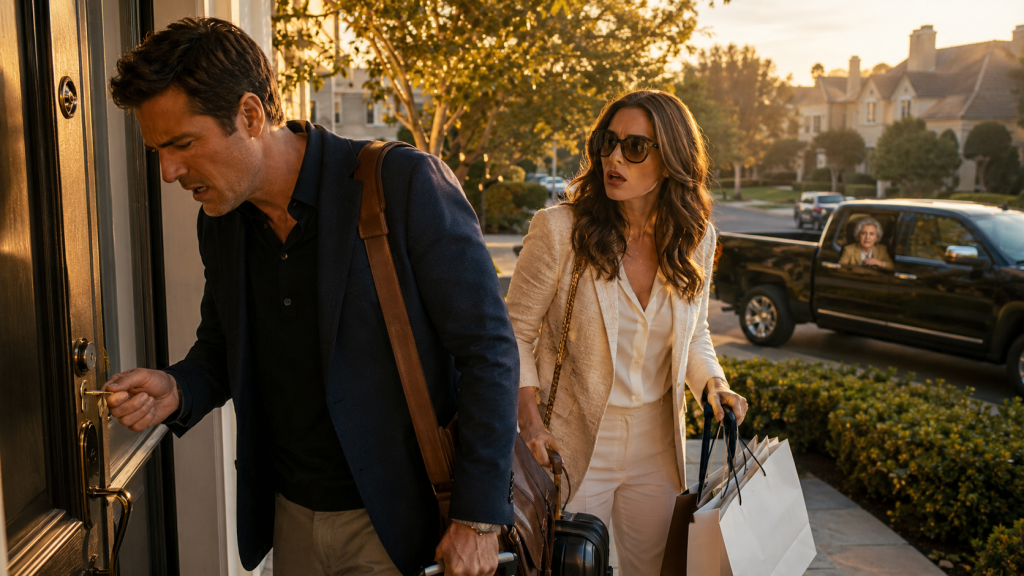
Daniel stood on the porch in his airport clothes, one hand wrapped around the handle of a hard-shell suitcase, the other twisting that silver key again and again as if the lock had somehow made a mistake.Melissa stood beside him in oversized sunglasses, a cream coat draped over one arm, shopping bags from Italy and France dangling from her wrist.
She was still smiling at first.The kind of smile people wear when they return from vacation expecting life to be exactly where they left it.Then the door refused to open.Daniel tried again.Harder.The smile vanished from Melissa’s face.He pulled the key out, stared at it, then looked at the door as if the house had betrayed him.
It had not.
I had.
From inside a parked truck across the street, I watched my only son realize he no longer had access to the home he had already begun treating like his inheritance.
Three weeks earlier, that house still looked like the life Frank and I built together.
Framed family photos lined the hallway.
Frank’s old leather chair sat by the bay window, angled toward the maple tree he loved watching in autumn.
The laundry room wall still held pencil marks from every year of Daniel’s childhood.
Five years old.
Seven.
Ten.
Thirteen.
Sixteen.
Each mark had Frank’s neat handwriting beside it.
“Growing like a weed,” he used to say.
We spent thirty-two years paying off that house.
Thirty-two years of skipped vacations, fixed appliances, careful budgeting, Sunday dinners, and mortgage payments mailed on time.
It was not just wood, brick, and shingles.
It was proof.
Proof that two ordinary people could build something stable if they loved each other enough to keep going.
After Frank died, everyone told me I was lucky Daniel visited so often.
“He’s such a good son,” the neighbors said.
“He brings groceries.”
“He checks the gutters.”
“He worries about you.”
I believed it at first.
I wanted to believe it.
Loneliness makes you grateful for footsteps on the porch, even when those footsteps start sounding more like inspection than love.
Daniel came by twice a week.
Melissa came with him, always carrying soup in tidy glass containers and speaking in a soft, careful voice that made selfishness sound like concern.
“This house is a lot for one person, Helen.”
“Stairs can be risky at your age.”
“You should start thinking ahead.”
Daniel talked about taxes, insurance, maintenance, and market timing.
Melissa sent me links to retirement communities.
Beautiful ones.
White fences.
Flower beds.
Smiling older people holding mugs in sunny courtyards.
“You wouldn’t be alone,” she said.
I told her I was not alone.
I had friends.
Neighbors.
My church.
My garden.
My memories.
Melissa smiled sadly, the way people smile when they think you are too old to understand your own life.
Daniel would sit across from me at the kitchen table and use the same voice his father once used when explaining bank statements.
“Mom, we just want you safe.”
But safety was not what I felt when they spoke.
I felt watched.
Measured.
Slowly surrounded.
I began noticing small things.
Daniel asking where I kept insurance papers.
Melissa opening cabinets when she thought I was not looking.
A brochure for assisted living placed under my mail.
A printed article about “early signs of confusion” left on my dining table.
When I asked about it, Daniel said, “I thought it might be helpful.”
I laughed.
“I misplaced my glasses once, Daniel. I didn’t lose my mind.”
He looked hurt.
That used to work on me.
The wounded son expression.
The tight sigh.
The sudden silence meant to make me feel cruel.
But after Frank died, I had spent enough nights alone with my thoughts to recognize the difference between guilt and truth.
Still, I said nothing.
Not until the voicemail.
The day before Daniel and Melissa left for Europe, he called while I was upstairs folding laundry.
I missed it.
A minute later, I saw he had left a voicemail.
I pressed play while matching towels on the bed.
I expected something ordinary.
A reminder about the trash bins.
A question about his passport.
Maybe another lecture about the furnace.
Instead, I heard a car door slam.
Then Melissa’s real laugh.
Not the gentle laugh she used in my kitchen.
This one was sharp.
Impatient.
Then my son’s voice.
“She’s a burden, Mel. She just doesn’t see it. We’ve held our lives back long enough.”
The towels slipped from my hands.
My heart seemed to stop, then restart too loudly.
Melissa said, “Once the house is sorted out, everything gets easier.”
Daniel answered, “The lawyer said if we document enough concerns, we can push the power of attorney issue. She won’t fight us if it sounds medical.”
Melissa laughed again.
“And if she does?”
“She won’t,” Daniel said. “Mom hates conflict.”
I stood there in the bedroom, looking at the phone like it had become something poisonous.
Burden.
That was the word that stayed.
Not elderly.
Not lonely.
Not grieving.
Burden.
I was not his mother in that moment.
I was not the woman who stayed awake beside his crib when he had pneumonia.
Not the woman who drove him to college with boxes packed in the backseat and cried only after leaving campus.
Not the woman who helped him with his down payment.
Not the woman who gave Melissa Frank’s mother’s bracelet as a wedding gift.
I was an obstacle.
A delay.
A problem standing between them and a future they had already planned using my house.
I cried that night.
I walked through every room in the dark.
I touched the banister Frank sanded by hand.
The piano Daniel quit playing after six months but Frank kept tuned anyway.
The kitchen counter where Frank used to stand drying dishes while I washed.
Daniel’s old bedroom door, still marked by a dent from the year he slammed it because we would not buy him a motorcycle.
I sat in Frank’s chair at three in the morning and let grief come back in a new shape.
Losing my husband had been sorrow.
Hearing my son call me a burden was betrayal.
By morning, the tears were gone.
I made coffee.
I opened Frank’s old files.
Then I opened the storage box Daniel had left in the basement years earlier, the one he never bothered to collect because our house was always free storage.
Inside were tax records, old electronics, and a folder with Melissa’s handwriting on the tab.
“Future Planning.”
I sat on the basement stairs and read until my hands went cold.
Emails.
Printed notes.
Lists of doctors.
Questions about cognitive evaluations.
Draft language about “concerns regarding independent living.”
A photocopy of my house deed.
A note in Daniel’s handwriting:
If Mom resists, frame as safety. Not money.
Another note from Melissa:
Need house value estimate before market drops.
They weren’t just waiting for me to slow down.
They were building a story around me.
A story where I was confused.
Unsafe.
Fragile.
In need of management.
A story that ended with them holding power over my medical decisions, my bank accounts, and the house Frank and I spent our lives paying for.
For a few minutes, I simply sat there.
Then I heard Frank’s voice in my memory.
Not dramatic.
Not angry.
Just practical.
“Helen, when people show you their plan, believe them.”
So I believed them.
And I made my own.
First, I called Frank’s lawyer, Mr. Alden Reeves.
He had handled our wills, our mortgage closing, and the paperwork after Frank’s death.
He was older now, but his voice remained steady.
“Helen,” he said, “are you safe?”
That question nearly broke me.
“Yes,” I said. “But I need to stay that way.”
I told him everything.
The voicemail.
The emails.
The folder.
The pressure.
The retirement brochures.
The power of attorney discussions.
He listened without interrupting.
Then he said, “Do not sign anything. Do not meet with any doctor they recommend. Bring me copies of everything.”
“I want to sell the house,” I said.
There was a pause.
“Are you sure?”
I looked around the kitchen Frank and I had painted yellow during Daniel’s senior year.
“No,” I said. “But I am sure I won’t let them take it from me.”
By noon, Mr. Reeves had connected me with a real estate agent who specialized in private sales.
Her name was Mara Lind.
She arrived that afternoon without a sign, without a photographer, without a loud sales voice.
She walked through the house respectfully, pausing near the laundry room wall.
“These marks,” she said softly.
“My son.”
She nodded.
“Do you want them photographed before anything happens?”
That kindness nearly undid me.
“Yes,” I said.
The house was worth more than I imagined.
Eight hundred seventy-five thousand dollars.
Frank would have whistled.
Then he would have asked about taxes.
Mara already had a buyer.
A young couple relocating for work, looking for a family home, not a teardown.
They loved the garden.
The built-in shelves.
The old fireplace.
The pencil marks.
“They want a home with history,” Mara said.
I cried when she told me that.
Not because I was sad to sell.
Because someone else saw what Daniel had stopped seeing.
While Daniel and Melissa posted photos under European lights, smiling with wine glasses in Rome and Paris, my life moved quietly.
Mara arranged the private sale.
Mr. Reeves updated my documents.
My bank placed new protections on my accounts.
I removed Daniel from emergency contacts.
I revoked every old authorization I had forgotten existed.
I changed beneficiaries.
I created a medical directive naming my friend Ruth and my niece Caroline, both women who had shown up after Frank died without asking what the house was worth.
The movers came on a gray Thursday morning.
They were careful.
They wrapped Frank’s chair in blankets.
They boxed the family photos.
They moved the piano last.
I stood in the hallway holding a mug I did not remember picking up and watched thirty-two years become labeled cardboard.
Mara stayed with me all day.
At one point, she asked, “Do you want to leave before they finish?”
“No,” I said. “I need to see myself survive it.”
My new place was smaller.
A two-bedroom cottage by the lake, with a screened porch, blue shutters, and enough garden space for tomatoes and roses.
No stairs except two steps to the back door.
No rooms waiting to be claimed by people who had already counted me out.
The first night there, I slept eight hours.
For the first time since Frank died, I did not wake up listening for someone else’s key in the lock.
Before leaving the old house, I placed one white envelope on the kitchen counter.
Daniel’s name was written across it in my neatest handwriting.
Then I locked the door behind me.
Not with sadness.
With decision.
The closing happened quickly.
The money moved into protected accounts.
The deed transferred.
The locks changed.
Daniel and Melissa landed three days later.
I knew because Melissa posted a photo from the airport.
Back home! Exhausted but grateful.
I almost commented:
Not as grateful as I am.
Instead, I drove with Ruth to Cedar Grove and parked across the street in her brother’s delivery truck.
“Are you sure you want to watch?” she asked.
“Yes.”
Daniel and Melissa arrived at 2:17 p.m.
Their taxi pulled away.
Daniel dragged his suitcase up the walkway.
Melissa laughed at something on her phone.
Then came the key.
The turning.
The confusion.
The harder turning.
The moment his face changed.
He called someone.
Probably a locksmith.
Then he noticed the lockbox near the side gate and used the temporary code I had left in the note he had not yet read.
He forced the door open.
Melissa stepped in behind him.
I watched through the front window as both of them froze.
The living room was empty.
No couch.
No photos.
No Frank’s chair.
No rugs.
No lamps.
Only sunlight crossing bare floors.
Melissa walked quickly from room to room.
Daniel stood in the hallway like a man inside someone else’s loss.
Then he spotted the envelope.
He picked it up.
Even from across the street, I saw his hands shake.
I had written the note in Frank’s favorite blue pen.
Daniel,
You called me a burden, so I decided to lighten your load.
The house has been sold.
The money is safe.
My accounts, medical decisions, legal documents, and future are no longer available for your plans.
Do not contact my bank.
Do not contact my doctor.
Do not contact a lawyer pretending concern.
I know everything.
On the second page, I had attached copies of the emails.
Power of attorney.
Confusion.
Safety.
Transition.
Melissa snatched the papers from him.
Her mouth fell open.
Daniel stepped backward and sat down hard on the bottom stair.
Then my phone rang.
I answered from the truck.
“Mom?”
His voice cracked.
“Where are you?”
I looked at the empty house where I had raised him.
“Somewhere you don’t have a key.”
“Mom, listen to me. That voicemail—”
“I listened already.”
“You misunderstood.”
“No, Daniel. For the first time, I understood perfectly.”
Melissa’s voice rose in the background.
“She can’t just sell it. Daniel, tell her she can’t just sell it.”
I almost smiled.
“She always did mistake confidence for law,” I said.
Daniel began breathing hard.
“Mom, we were worried. You’re alone. The house was too much. We were trying to help.”
“By building a file that made me look incompetent?”
Silence.
“By calling me a burden?”
“Melissa was upset,” he whispered. “We were both stressed.”
I closed my eyes.
There it was.
The shifting.
The shrinking.
The attempt to make cruelty sound like a moment.
But cruelty planned in folders is not a moment.
“Your father left you memories,” I said. “Not my life.”
“Mom, please. Where am I supposed to go?”
That question told me everything.
Not “Are you okay?”
Not “I hurt you.”
Not “I’m sorry.”
Where am I supposed to go?
I looked at Ruth.
She was staring straight ahead, jaw tight.
“You have your own house, Daniel.”
“We rented it out before Europe,” he snapped, panic sharpening his voice. “We were going to stay with you while we figured out next steps.”
I laughed then.
Just once.
“You mean while you figured out how to move me out.”
He said nothing.
I let the silence sit between us.
Then I said, “Goodbye, Daniel.”
“Mom, don’t hang up.”
I ended the call.
We drove away before he came outside.
That evening, my phone filled with messages.
Daniel.
Melissa.
Melissa’s mother.
A cousin I had not heard from in five years.
They called me impulsive.
Cruel.
Confused.
Manipulated.
Daniel left one voicemail crying so hard he sounded ten years old.
I deleted it.
Then another arrived.
This one was colder.
“Mom, if you don’t tell me where you are, I’ll have to request a wellness check.”
I sent one message through Mr. Reeves.
Any further attempt to access my accounts, location, medical records, or property will be treated as harassment. All communication through counsel.
Daniel stopped calling for two days.
Melissa did not.
She sent one message that proved she still did not understand.
You are punishing your only son over one private conversation.
I replied once.
No. I am protecting myself from a public plan.
Then I blocked her.
The fallout came quickly.
The rental Daniel had arranged for his own house did not allow early termination.
His European bills hit their credit card.
Melissa’s shopping bags became evidence of poor timing.
They stayed in a hotel for two weeks.
Then with her parents.
I heard pieces through neighbors, through Ruth, through people who thought they were being discreet.
Daniel was furious.
Then embarrassed.
Then quiet.
Three months passed before he wrote me a letter.
A real one.
Paper.
Handwritten.
Messy.
It arrived through Mr. Reeves, who called first.
“Do you want it?”
“Yes,” I said after a long pause.
Daniel did not ask for money.
Not directly.
He did not ask where I lived.
He did not call me confused.
He wrote about finding the pencil marks gone from his reach.
About sitting on the empty staircase.
About hearing his own voicemail played back by his lawyer, who apparently told him it sounded worse than he thought.
Then he wrote:
I thought grief made you weak. I was wrong. It made you quiet, and I mistook quiet for permission.
I read that sentence three times.
Then I folded the letter and put it in a drawer.
Not forgiven.
Not rejected.
Just waiting.
Healing is not a door you open because someone finally knocks politely.
It is a house you rebuild from the inside.
My new life by the lake became smaller in the best way.
I learned the names of ducks that visited my dock.
I planted roses in raised beds.
I bought yellow curtains.
I joined a watercolor class.
I hosted Ruth and Caroline for Sunday lunch.
I kept Frank’s chair by the window, where morning light touched the worn leather just right.
Sometimes I missed the old house so badly I had to sit down.
Not because I regretted selling it.
Because love does not disappear when ownership changes.
A home can be right to leave and still hurt to lose.
Six months after the sale, Daniel asked through Mr. Reeves if I would meet him in a public place.
I agreed.
A coffee shop.
Midday.
Ruth sat at another table with a book and no intention of reading it.
Daniel looked thinner.
Older.
He stood when I entered.
For a moment, I saw both versions of him.
The boy with grass-stained knees running through my kitchen.
The man who had planned to use concern as a weapon.
“Hi, Mom,” he said.
“Hello, Daniel.”
We sat.
He did not reach for my hand.
That was wise.
“I’m sorry,” he said.
I looked at him carefully.
“For what?”
His eyes filled.
“For calling you a burden. For planning behind your back. For letting Melissa talk about your life like it was an asset. For thinking because Dad was gone, I got to step into his place.”
I nodded slowly.
“And?”
He swallowed.
“For wanting the house more than I wanted you safe.”
That was the first honest sentence.
I felt it land.
Not enough to fix.
Enough to begin.
“Melissa?” I asked.
He looked down.
“We separated.”
I said nothing.
“I’m not blaming her,” he added quickly. “I let it happen. I agreed. I said the words.”
Good.
That mattered.
We spoke for twenty minutes.
No money.
No house.
No demands.
When he asked if he could visit me someday, I said, “Not yet.”
His face tightened with pain, but he nodded.
“I understand.”
Maybe he did.
Maybe he was learning.
A year later, Daniel knows I live by a lake, but not exactly where.
He has my mailing address through a box.
He calls once a month.
Sometimes I answer.
Sometimes I do not.
He is polite now.
Careful.
Maybe too careful.
But careful is better than entitled.
One day, perhaps, he will sit in Frank’s chair and tell me about his life without measuring mine.
One day, perhaps, I will show him the roses.
But I am not in a hurry.
My life no longer runs on his readiness.
People ask if selling the house was hard.
Yes.
It was like cutting off a braid I had grown for thirty-two years.
But keeping it would have been harder.
Keeping it would have meant waiting for my son to decide when I was too old to own my own doors.
And I refused.
The house sold for eight hundred seventy-five thousand dollars.
But what I bought with it was worth more.
Peace.
Privacy.
A locked door.
A life no one could enter with an old key and a plan.
Sometimes, at night, I sit on my screened porch and listen to the lake move in the dark.
Frank’s chair is behind me.
My tea is beside me.
My phone is silent unless I choose otherwise.
And I think about that afternoon in Cedar Grove.
Daniel on the porch.
Melissa clutching shopping bags.
The key turning uselessly in the lock.
It was not revenge that made me smile.
It was recognition.
For years, I thought the worst thing would be losing the house Frank and I built.
I was wrong.
The worst thing would have been staying inside it while people who called me family quietly built a cage around me.
So I sold the house.
I packed my memories.
I carried Frank with me.
And when my son’s key stopped working, my life finally started again.
THE END! THANKS FOR READING!