
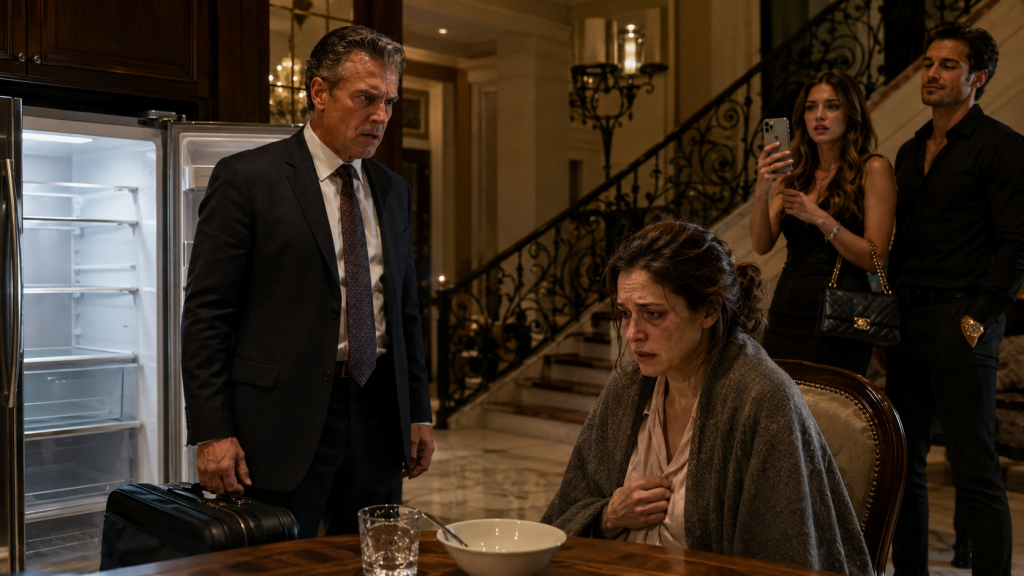
The refrigerator was empty.My wife’s hands were trembling.And upstairs, my daughter was livestreaming her new designer bag, bought with the money meant for food.I stood in the kitchen doorway for ten seconds, unable to breathe.My name is Daniel Reeves.For most of my life, I believed patience was strength.I believed a father should give second chances, even third ones.I believed a husband should work hard enough that his wife never had to worry about money.
And I believed my daughter, Mia, was spoiled but not cruel.That evening proved how wrong I had been.I had come home twelve hours early from a consulting contract in Singapore. My flight had changed, and instead of calling ahead, I decided to surprise my wife, Elena.
I imagined walking into the house, setting down my suitcase, and seeing her face light up.
I imagined holding her in the kitchen while she scolded me for not warning her.
Instead, I found her sitting in the dark.
The kitchen lights were off.
The house was silent except for laughter upstairs.
Elena sat at the small breakfast table with a blanket around her shoulders, though the house was warm. Her face looked gray. Her cheeks had hollowed. Her lips were dry and cracked.
When she saw me, she tried to stand.
Her legs failed.“Daniel?” she whispered.I dropped my suitcase and rushed to her.“What happened?”She gave me the kind of smile people use when they are already too tired to ask for help.“I didn’t want to bother you. You were working.”
Those words made my chest tighten.
Elena had always been that way.
Gentle.
Self-sacrificing.
The kind of woman who would apologize for bleeding on the floor.
I looked around the kitchen.
No dishes.
No groceries.
No smell of dinner.
Nothing.
I opened the refrigerator.
Empty.
Not low.
Not neglected.
Empty.
Even the shelves had been wiped clean.
The pantry had one box of stale crackers, half a jar of peanut butter, and a bottle of expired vitamins.
I turned back to my wife.
“When did you last eat?”
She looked away.
“Elena.”
“Yesterday morning,” she whispered. “Half a banana.”
A sound came out of my chest, low and broken.
Upstairs, music played through a phone speaker.
Then I heard Mia’s voice, bright and cruel.
“Dad’s overseas again, so the house is basically mine. And Mom? She barely notices anything anymore.”
My blood went cold.
Mia was twenty-four.
Beautiful.
Expensive.
Brilliant when she wanted something.
After her boutique skincare startup failed, I let her move back home. Elena begged me not to be too hard on her.
“She’s embarrassed,” Elena said. “She needs support.”
So I gave support.
I paid off one credit card.
Then another.
I covered her car insurance.
Her phone.
Her “business relaunch” expenses.
I gave her access to a household account for groceries, medicine, utilities, and anything Elena might need while I was traveling.
That was my mistake.
I thought giving my daughter access to money meant I trusted her.
She thought it meant I was too soft to stop her.
I helped Elena drink water, then checked her pulse the way I had learned after her blood pressure issues began two years earlier. It was weak and fast.
“Why didn’t you call me?”
She tried to smile again.
“Mia said I was being dramatic.”
My jaw tightened.
“What did she spend the grocery money on?”
Elena did not answer.
She did not have to.
From upstairs, Mia laughed.
“No, this bracelet is real. My dad has money. He just acts humble because he thinks it builds character.”
Another voice responded.
Brent.
Mia’s boyfriend.
Smug.
Lazy.
Always wearing cologne too strong and shoes too clean for a man who never worked.
I moved toward the stairs, but stopped when I heard my daughter speak again.
“Mom is fine. She eats like a bird anyway.”
Brent laughed.
“What about when your dad comes back?”
Mia’s voice dropped, but not enough.
“Dad won’t do anything. He’s too soft.”
I stopped behind the half-open door to her room.
My phone was already recording.
Mia sat on her bed, phone propped against a makeup mirror, livestreaming to strangers. Designer shopping bags were scattered across the floor. A diamond bracelet flashed on her wrist. A new leather bag sat beside her like a trophy.
Brent lounged behind her in my robe.
On his wrist was my watch.
My watch.
The one Elena gave me on our twenty-fifth anniversary.
Mia held up a receipt and laughed.
“Household account, baby. If Dad wanted limits, he should’ve married someone less sick and raised someone less pretty.”
For a moment, the world went quiet.
Not because there was no sound.
Because something inside me had gone still.
I could have burst in then.
I could have shouted.
I could have grabbed the phone, thrown Brent out, demanded Mia explain herself.
But shouting would only give her a stage.
And my daughter had already proven she loved stages.
So I stayed silent.
I recorded until she ended the livestream.
Then I went back downstairs.
Elena looked terrified.
“Daniel, please don’t fight with her tonight.”
I knelt beside her.
“I’m not going to fight.”
She searched my face.
Something in my voice must have frightened her.
“What are you going to do?”
I kissed her hand.
“I’m going to take care of you first.”
I carried Elena to the car because she was too weak to walk without shaking.
When Mia came down the stairs ten minutes later, Brent behind her, she froze.
“Oh,” she said. “You’re home.”
Behind her, Brent smirked.
“You should’ve texted,” Mia said. “We could’ve cleaned up.”
I stared at her.
“Why is your mother starving?”
Mia rolled her eyes.
“She’s not starving. She’s dramatic. She refuses delivery because she says it’s too expensive.”
Elena flinched in the passenger seat.
Brent laughed softly.
“Old people love guilt trips.”
I took one step toward him.
He stopped laughing.
Mia lifted her chin.
“Don’t start, Dad. You’re never here. You don’t know what it’s like managing this house.”
I looked at the empty kitchen behind her.
At Elena trembling in the car.
At the watch on Brent’s wrist.
Then I smiled.
Not because I was calm.
Because they had no idea what was coming.
“You’re right,” I said quietly. “I need to understand everything.”
Mia smirked.
She thought she had won.
That was her first mistake.
I drove Elena straight to the emergency clinic.
The doctor confirmed dehydration, low blood sugar, and exhaustion. He asked careful questions, the way professionals do when they suspect neglect but need the patient to feel safe enough to speak.
Elena kept saying, “It wasn’t that bad.”
I looked at her lying in the clinic bed with an IV in her arm and thought of the empty refrigerator.
It was worse than bad.
It was betrayal in domestic form.
While Elena slept, I opened my banking app.
Every transaction told the story Mia had tried to hide.
The household grocery account had been drained.
Luxury boutique.
Jewelry store.
Three nightclub charges.
Two rideshares at two in the morning.
A designer resale shop.
A spa.
Another boutique.
Then the medical account.
The one I kept for Elena’s prescriptions, appointments, and emergency needs.
Mia had accessed it through an old saved card.
Eight charges.
Nearly six thousand dollars.
My hands did not shake.
Not yet.
I downloaded everything.
Receipts.
Statements.
Transfer logs.
I sent them to my attorney, Rebecca Sloan, along with the video recording and the security footage from the kitchen.
Rebecca called me within twenty minutes.
“Daniel,” she said, “tell me Elena is safe.”
“She’s at the clinic.”
“Good. Freeze everything now.”
“I’m already doing it.”
I locked every card.
Changed every password.
Removed Mia from every authorized account.
Disabled the house smart lock access tied to her phone.
Canceled Brent’s temporary guest code.
Then I scheduled a locksmith for noon.
By morning, Mia had called thirty-seven times.
Brent called once.
I let it go to voicemail.
His message was almost funny.
“Daniel, man, you need to act like an adult. Mia is crying. You can’t cut people off like this.”
I blocked him.
At 11:45, I drove Elena home.
She was still weak, but better. Her color had returned slightly. She leaned against me as we walked up the driveway.
Two police officers met us there, along with Rebecca and the locksmith.
Elena squeezed my arm.
“Daniel…”
I whispered, “You’re safe. Let me handle this.”
Mia opened the front door wearing silk pajamas and the diamond bracelet.
Her face went pale when she saw the officers.
“Dad,” she said. “What is this?”
“Consequences.”
Brent appeared behind her, still wearing my watch.
One of the officers noticed my eyes move to it.
“Sir,” I said calmly, pointing to Brent, “that watch is mine.”
Brent raised both hands.
“Whoa, it’s not like that. Mia said I could borrow it.”
I looked at Mia.
Her confidence flickered.
“I thought you wouldn’t mind.”
“That watch was a gift from your mother.”
Elena’s face crumpled.
Mia looked away.
Rebecca stepped forward.
“Mia Reeves, you are being served notice to vacate. You are not a tenant under lease. You have been residing here by permission, and that permission is revoked.”
Mia laughed once.
But it came out thin.
“You can’t throw me out.”
I held up my phone.
“You said I was too soft.”
Her mouth opened.
Nothing came out.
The locksmith began working behind us.
Mia’s eyes widened.
“You’re changing the locks?”
“Yes.”
“Dad, this is insane. It was just money.”
I looked at Elena, who could barely stand beside me.
“No,” I said. “It was food. It was medicine. It was your mother’s life.”
Brent tried to step past us toward the driveway.
The officer stopped him.
“Not with the watch.”
Brent cursed under his breath, removed it, and placed it into the officer’s hand.
I did not look away from Mia.
For the first time in years, my daughter looked less like a woman performing confidence and more like a child who had discovered the world did not bend forever.
“Dad,” she whispered. “Where am I supposed to go?”
“You can use the money from the bracelet.”
Her face changed.
“That’s not fair.”
“Neither is starving your mother.”
“I didn’t starve her!”
Her voice cracked.
“She could have ordered food herself!”
“She did not have access to the account after you drained it.”
Mia’s eyes darted toward Brent.
That told me something.
Brent knew.
Or helped.
Rebecca spoke again.
“We are also reviewing unauthorized use of medical funds, household accounts, and personal property. Depending on restitution, Mr. Reeves will decide whether to pursue civil or criminal remedies.”
Mia started crying.
Not the soft, wounded crying of someone ashamed.
The sharp, angry crying of someone losing control.
“You’re choosing her over me?”
I stared at her in disbelief.
“Elena is your mother.”
“She’s not my real mother.”
The driveway went silent.
Elena inhaled sharply.
Mia froze as if she realized too late what had left her mouth.
Elena had raised Mia since she was four years old.
My first wife, Mia’s biological mother, had left when Mia was barely walking. Elena had been the one who packed school lunches, stayed up through fevers, bought prom dresses, sat through piano recitals, and cried quietly when Mia called her “Mom” for the first time.
And now Mia stood in our entryway, bracelet shining on her wrist, erasing twenty years of love because she was being held accountable.
Elena stepped back like she had been struck.
That was the moment I stopped seeing Mia as spoiled.
Spoiled can be corrected.
Cruelty must be contained.
“You have two hours,” I said.
Her face twisted.
“Dad—”
“Two hours to pack what belongs to you. Nothing purchased with stolen funds leaves this house unless my attorney clears it.”
Brent scoffed.
“Stolen? You gave her access.”
I turned to him.
“And you wore my robe, slept in my house, used my property, and watched my wife starve while you enjoyed the money meant to feed her. I suggest you stay quiet.”
The officer stepped slightly closer to Brent.
Brent stayed quiet.
For two hours, Mia packed.
She raged.
Then cried.
Then threatened to embarrass us online.
Then begged.
Then blamed Brent.
Then blamed Elena.
Then blamed me.
At one point she came downstairs clutching the designer bag.
Rebecca took one look at the receipt and shook her head.
“That stays.”
Mia screamed.
Neighbors watched from behind curtains.
I did not care.
For years, I had protected Mia from embarrassment. Paid debts quietly. Cleaned up mistakes. Explained her behavior as insecurity, ambition, heartbreak, pressure.
No more.
When she finally stood by the front door with two suitcases, she looked at me with red eyes.
“You’ll regret this.”
I nodded.
“I already regret too much.”
She waited, perhaps expecting me to soften.
I did not.
Brent loaded her suitcases into his car. He looked furious until the officer reminded him the watch had already been returned.
Mia turned to Elena.
For one second, I thought she might apologize.
Instead, she said, “You always made Dad pity you.”
Elena’s face went white.
I stepped forward.
“Mia. Leave.”
And for once, she obeyed.
After they drove away, the house felt enormous.
The locksmith finished.
Rebecca gathered her files.
The officers took statements and left.
Elena sat on the couch with both hands folded in her lap, staring at nothing.
I knelt in front of her.
“I’m sorry.”
She shook her head.
“You didn’t do it.”
“I allowed it.”
Her eyes filled.
“You loved your daughter.”
“I excused my daughter.”
There is a difference.
That night, I ordered groceries.
Real groceries.
Soup.
Fruit.
Bread.
Eggs.
Her favorite yogurt.
The simple things Mia had decided were less important than a bracelet.
When the delivery arrived, Elena cried as I put food in the refrigerator.
Not dramatic tears.
Small ones.
The kind that fall when someone realizes they had been accepting less than survival.
I made her soup.
She ate slowly.
Three spoonfuls at first.
Then five.
Then half the bowl.
It felt like watching life return to the room.
Over the next week, Mia posted online.
Of course she did.
She called me controlling.
She said I had thrown her out because my wife manipulated me.
She said rich fathers always choose younger wives over daughters.
Then clips from her own livestream appeared.
Not from me.
From someone who had watched it.
A follower had recorded her saying, “Dad won’t do anything. He’s too soft.”
Another clip showed the designer bag.
Another captured her laughing about Elena barely noticing anything anymore.
The internet did what it does.
It turned.
Mia deleted her account within forty-eight hours.
Brent disappeared from her posts shortly after.
Two weeks later, she sent the first text.
Dad, I need my birth certificate.
I arranged for Rebecca to send certified copies to a neutral mailing address.
No conversation.
Then another text.
Can we talk?
I showed Elena.
She looked at the message for a long time.
“Do you want to?”
“I don’t know.”
“Then don’t answer until you do.”
That was the first time I understood how deeply Elena had learned to accept pain quietly.
She was still protecting my feelings after what my daughter had done to her.
I took her hand.
“No more silence in this house.”
She squeezed my fingers.
“No more.”
A month later, Mia asked to meet at Rebecca’s office.
I agreed on three conditions: Elena would not attend, Mia would provide a written accounting of the money spent, and Brent would not be present.
She arrived looking smaller.
No designer bag.
No bracelet.
No performance.
Just tired eyes and plain clothes.
For a few minutes, she could not speak.
Then she placed an envelope on the table.
Inside was a cashier’s check.
Not enough to cover everything.
But something.
“I sold the bracelet,” she said.
I looked at her.
“Why?”
She swallowed.
“Because I keep hearing what you said. It was food. It was medicine.”
Rebecca sat quietly beside me.
Mia’s hands twisted in her lap.
“I thought Elena was weak. I thought she liked being sick because everyone cared about her. I thought you cared more about her than me.”
“That was not Elena’s fault.”
“I know.”
“Do you?”
Tears filled her eyes.
“I’m starting to.”
That was not enough.
But it was more honest than anything she had said in years.
“I want to apologize to her,” Mia whispered.
“That happens only if Elena wants it.”
She nodded.
“I understand.”
I studied my daughter.
I loved her.
That was the hardest part.
Love does not vanish just because someone behaves terribly.
But love without boundaries becomes permission.
“I am not funding your life anymore,” I said.
Her lips trembled.
“I know.”
“You will repay the medical account.”
“I know.”
“You will return or reimburse anything purchased with household funds.”
“I know.”
“And you will not contact Elena until she is ready.”
Mia closed her eyes.
“I know.”
For once, she did not argue.
That was the beginning.
Not forgiveness.
Not reconciliation.
A beginning.
Elena did not meet with Mia for three months.
During those months, our house changed.
Not outwardly.
The walls were the same.
The kitchen was the same.
The stairs where Mia used to pose for photos were the same.
But the air felt different.
Safer.
I cut back on travel.
I hired part-time help for Elena’s appointments.
I cooked more badly than well, and Elena pretended the burned toast was charming.
Sometimes she laughed again.
Softly at first.
Then more fully.
One Sunday morning, I found her standing in front of the refrigerator with the door open, staring at the stocked shelves.
“Everything okay?” I asked.
She nodded.
“I just like seeing it full.”
That broke my heart in a new place.
Three months later, Elena agreed to read a letter from Mia.
Not meet.
Just read.
Mia’s letter was six pages.
No excuses.
No blaming Brent.
No blaming childhood.
She wrote about jealousy, entitlement, and shame.
She admitted she knew Elena was getting weaker.
She admitted she ignored it because acknowledging it would have meant stopping herself.
At the end, she wrote:
You raised me when you did not have to. I repaid you by treating you like an obstacle. I am sorry. I do not expect forgiveness, but I will spend my life becoming someone who deserves to ask for it.
Elena cried quietly when she finished.
Then she folded the letter and placed it in a drawer.
“Not yet,” she said.
I nodded.
“Not yet.”
A year has passed since the night I came home early.
Mia lives in a small apartment across town. She works at a hotel front desk and takes financial responsibility classes through a counseling program. Every month, a repayment arrives.
Sometimes it is small.
But it arrives.
She and Elena have met twice.
Both times in a therapist’s office.
Both times hard.
Both times necessary.
I do not know if we will ever be whole again.
Maybe families do not become whole after this.
Maybe they become honest, and honest is better than whole.
As for me, I still travel for work, but never without making sure Elena has support she trusts.
The household account is gone.
Every card has limits.
Every password changed.
Not because I want control.
Because trust without wisdom is not kindness.
It is neglect wearing a gentle face.
That night, Mia said I was too soft.
She was right.
But softness was never the problem.
Softness without boundaries was.
I did not need to become cruel to protect my wife.
I only needed to stop confusing patience with permission.
The refrigerator is full now.
The watch is back on my wrist.
The designer bag was sold.
The bracelet became medicine money.
And sometimes, when Elena laughs in the kitchen while I ruin another dinner, I think about the half-open door, the recording on my phone, and the moment I realized my silence could either protect the truth or bury it.
For once, I chose the truth.
And the people who mistook my softness for weakness finally learned the difference.
THE END! THANKS FOR READING!