
My family forced me to sleep in a freezing garage while I was seven months pregnant, only months after my Marine husband’s funeral.Less than twelve hours later, black military SUVs rolled into the driveway.Armed soldiers greeted me by name.And the same people who had humiliated me finally realized they had ruined their own lives.
My name is Emily Carter.Nine months before that Thanksgiving morning, I buried my husband under a gray sky at Arlington.Daniel Carter was thirty-four years old.A Marine.A husband.
A man who kissed my forehead every morning before leaving the house, even when we were arguing.
A man who used to speak to my stomach before the baby was even big enough to kick.
“Morning, little soldier,” he would whisper, pressing his palm gently against me. “Take care of your mom while I’m gone.”
He did not come home from his final deployment.
The official report said his unit was lost during an extraction after communication failure in hostile territory.
Communication failure.
Two words that sounded clean on paper and unbearable in real life.
A signal dropped.A rescue helicopter lost contact.Men waited in the dark for help that never reached them.Daniel died with six others because someone, somewhere, believed “good enough” technology was good enough for soldiers in the field.After the funeral, I stopped sleeping.Grief sat in my chest like a stone.
I was pregnant, widowed, and surrounded by people who kept telling me to be strong while quietly expecting me to disappear into the background.
My parents offered me a place to stay.
At least, that was what they called it.
“Come home, Emily,” my mother said. “You shouldn’t be alone.”
I should have known better.
The house they lived in had not truly been theirs for years.
Daniel had bought it after his second deployment.
He never told them that directly because he was kind. He arranged the paperwork through a family trust, paid the mortgage, covered repairs, and let my parents keep believing they were simply “doing well.”
He also paid for my father’s heart procedure.
My mother’s dental surgery.
My sister Chloe’s law school tuition.
Chloe’s wedding deposit.
Chloe’s emergencies.
Chloe’s mistakes.
Daniel never complained.
He used to say, “They’re your family. If helping them gives you peace, then it matters.”
But helping them did not give me peace.
It gave them entitlement.
After Daniel died, I moved into the guest room upstairs with two suitcases and his old Navy sweatshirt. My belly was still small then. I wore his dog tags under my shirt because the metal against my skin made me feel like some piece of him was still close.
At first, my family performed concern.
My mother made casseroles.
My father patted my shoulder awkwardly.
Chloe posted a black-and-white photo of Daniel on Instagram and wrote, heroes never die.
She had met him maybe six times.
Then the performance faded.
The casseroles stopped.
The sympathy became impatience.
My father complained that I was too quiet at dinner.
My mother said my grief made the house heavy.
Chloe said being around me made her “feel guilty for having a normal life.”
I was seven months pregnant by Thanksgiving.
Daniel’s son moved inside me like he was already impatient to meet the world.
I spent most nights awake, coding at a small desk beside the window while everyone else slept.
No one asked what I was doing.
Not once.
They assumed I was wasting time online or “keeping myself distracted.”
In truth, I was finishing what Daniel had started.
Before his final deployment, Daniel had been building a battlefield communication shield.
Project Orion.
A system designed to reroute broken signals through encrypted emergency pathways during combat extractions.
“If this works,” he once told me, hunched over diagrams at our kitchen table, “no unit gets left blind because one tower fails or one channel dies.”
He was not a software engineer by title.
But he was brilliant.
Practical.
Obsessive in the best way.
He collected field notes from every deployment, every communication breakdown, every after-action report he could access.
I had a background in systems architecture before marriage, before pregnancy, before grief. Daniel knew enough to design the need. I knew enough to build the machine around it.
After his death, I could not save him.
So I built the thing that might save someone else.
For months, I worked silently.
While my mother complained I did not help enough with dishes, I debugged encryption layers.
While Chloe talked about Ryan’s business class flights, I ran simulations.
While my father watched football and said Daniel had left me “comfortable enough,” I negotiated with Stratix Defense Systems under a secure alias.
Then, two days before Thanksgiving, they purchased the platform.
The contract was larger than anything I had imagined.
Enough to make me wealthy overnight.
Enough to fund long-term support for families of fallen service members.
Enough to finish Daniel’s dream properly.
Stratix appointed me Chief Technology Officer as part of the acquisition.
My family knew nothing.
Because to them, I was only the pregnant widow taking up space in the house.
At 5:12 a.m. on Thanksgiving morning, my phone buzzed on the kitchen counter.
It was Chloe.
I was standing beside the sink holding cold coffee, wrapped in Daniel’s old sweatshirt. Frost coated the windows. The kitchen smelled like stale grease, old coffee, and the false warmth of a house where no one actually wanted you.
Chloe did not say hello.
“Mom and Dad need the upstairs bedrooms,” she said coldly. “Move your things into the garage tonight. Ryan needs a private office while he’s here.”
I stared at the dark window above the sink.
“The garage?”
“It’s temporary.”
“It’s below freezing outside.”
My mother sat at the breakfast table stirring sweetener into her cup. She did not look up.
My father lowered his newspaper.
“You heard your sister,” he snapped. “Stop acting like everyone owes you special treatment.”
Special treatment.
I looked down at my stomach.
Daniel’s son shifted beneath my hand.
Chloe entered the kitchen wearing satin pajamas and carrying her designer dog like a trophy. Her husband Ryan came behind her, already smirking.
Ryan had the smooth, careless confidence of a man whose greatest hardship was slow Wi-Fi at a resort.
“It’s only for a few days,” Chloe said. “Ryan has calls.”
Ryan laughed.
“And honestly, all this grief energy around here is exhausting.”
My mother finally looked at me.
“Try not to leave boxes everywhere. Ryan parks the Mercedes in there.”
Ryan laughed again.
No one else did.
No one had to.
The cruelty had already made its point.
I looked at each of them in silence.
My father holding the newspaper Daniel had paid subscription fees for.
My mother drinking coffee in the kitchen Daniel had renovated.
Chloe wearing a robe bought with money she never repaid.
Ryan standing in a house his wife’s dead brother-in-law had funded, telling me my grief was inconvenient.
I could have told them then.
I could have told them Daniel owned the trust behind the house.
I could have told them Stratix had wired the first payment.
I could have told them lawyers, colonels, and corporate security teams would be arriving by morning.
But something inside me became very calm.
“Fine,” I said.
Chloe blinked.
My mother looked relieved.
My father returned to his paper.
They thought I had surrendered.
But I was done begging people to treat me with basic decency.
I packed before dinner.
Two coats.
Maternity clothes.
My laptop.
A folder of legal documents.
Daniel’s dog tags.
A framed photo from our wedding.
Nothing else mattered.
The garage smelled of damp concrete, gasoline, and mildew. Someone had pushed an old folding bed against the back wall beside plastic storage bins and broken holiday decorations.
There was no heater.
One thin blanket.
No bathroom.
No dignity.
I lowered myself carefully onto the bed and tucked Daniel’s sweatshirt around my stomach.
The baby kicked hard.
“I know,” I whispered. “We’re leaving soon.”
At 9:43 p.m., my encrypted phone vibrated.
TRANSFER COMPLETE.
PROJECT ORION AUTHORIZED.
DEFENSE CONTRACT APPROVED.
TRANSPORT ETA: 0800.
WELCOME TO STRATIX DEFENSE SYSTEMS, MRS. CARTER.
I stared at the message until my vision blurred.
Not from sadness.
From relief.
Daniel, I thought, we did it.
The garage was freezing by midnight.
Cold crept through the concrete floor and into my bones. My back ached. My hips throbbed. I slept in broken pieces, one hand around the dog tags, the other over my belly.
At 6:00 a.m., another message arrived.
DEPARTMENT APPROVAL CONFIRMED.
COLONEL HAYES EN ROUTE.
DOCUMENTS REQUIRE WITNESSED SIGNATURE.
By then, the house had begun waking.
I heard pipes groan.
Cabinets closing.
Chloe’s dog barking.
My mother laughing lightly in the kitchen, as if the pregnant widow in the garage was not shivering ten yards away from the oven.
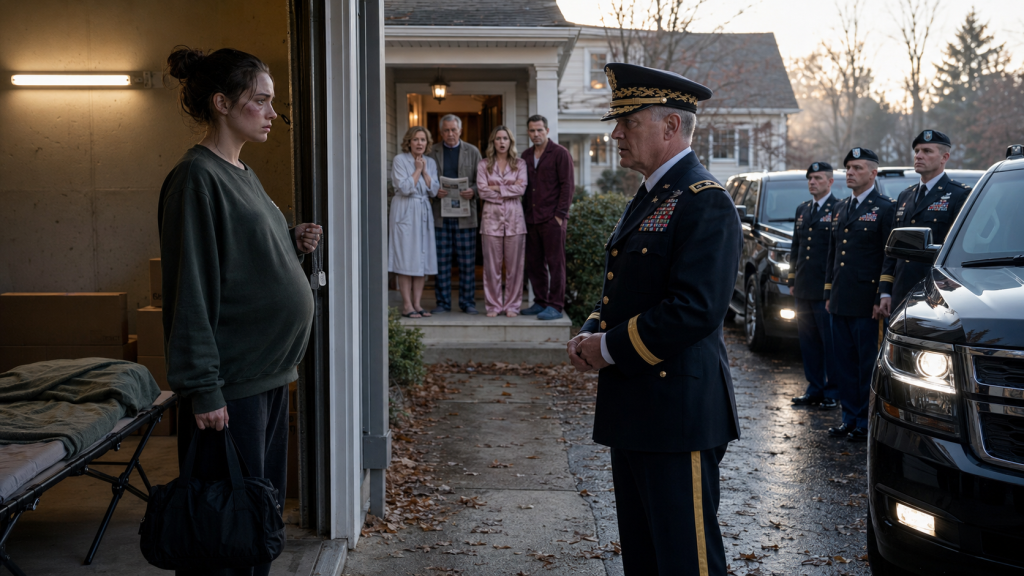
At 7:58 a.m., the garage floor began to tremble.
Heavy engines.
Several vehicles.
I stood slowly, pulling Daniel’s sweatshirt tighter around me.
The sound grew louder.
Then stopped.
I pressed the garage button.
The door rose in panels, letting in a blade of cold morning light.
Three matte-black SUVs sat in the driveway.
Behind them, another vehicle blocked the curb.
Men and women in military uniform stepped out with controlled precision.
Colonel Nathan Hayes emerged from the first SUV in full dress uniform.
He had served with Daniel years earlier. He was older now, face lined, posture rigid, eyes filled with the kind of grief that soldiers rarely show in public.
Behind him came four members of Daniel’s former special operations team.
Alert.
Silent.
Their presence alone changed the air.
Colonel Hayes walked straight toward me.
Then he saluted.
“Mrs. Carter,” he said firmly. “Department approval came through at 0600.”
My throat tightened.
I returned a shaky nod.
“Thank you, Colonel.”
The front door flew open behind him.
My mother stepped onto the porch in her robe.
Chloe followed, clutching her dog.
Ryan froze behind her.
My father appeared last, still holding his folded newspaper.
Their faces changed slowly as they took in the SUVs, the uniforms, the armed security detail, and me standing in the open garage beside the folding bed.
Colonel Hayes looked toward the garage interior.
His eyes paused on the thin blanket.
The old mattress.
The storage bins.
The lack of heat.
Something hardened in his expression.
“Mrs. Carter,” he said, louder now, “were you placed in this garage overnight?”
My mother’s face went pale.
Chloe spoke quickly.
“It was temporary. She agreed.”
Colonel Hayes did not look at her.
He looked at me.
I could have protected them.
I had done it for years.
Covered their greed.
Excused their insults.
Explained away their selfishness because they were family.
But family had made me sleep beside gasoline cans while carrying Daniel’s child.
“Yes,” I said quietly. “I was told to move here because my sister’s husband needed a private office.”
One of the soldiers muttered something under his breath.
Ryan’s face flushed.
My father stepped forward.
“Now hold on. This is a family matter.”
Colonel Hayes finally turned his head.
“No, sir. This is a matter involving the legal residence, security status, and protected spouse of a fallen Marine whose classified defense technology has just received federal approval.”
My father’s mouth opened.
No words came out.
Chloe whispered, “Classified?”
Colonel Hayes removed a black folder from his aide and held it out to me.
“Mrs. Carter, before we escort you out, there is one final signature that must be completed before witnesses.”
He placed the folder on the hood of the first SUV.
At the top of the document were the words:
DANIEL CARTER MEMORIAL OPERATIONS GRANT.
My mother took a step closer.
“Grant?”
Colonel Hayes said, “Mrs. Carter’s defense communication platform has been approved for deployment. Per Major Carter’s original research provisions and Mrs. Carter’s final development work, a portion of proceeds will fund housing, medical support, and emergency relocation for families of fallen service members.”
Chloe stared at me.
“You built something?”
I looked at her.
“Yes.”
Ryan stepped forward, greed already replacing confusion.
“How much money are we talking about?”
The driveway went silent.
I signed my name slowly.
Emily Carter.
My hand did not shake.
Then I looked at Ryan.
“Enough that none of you will ever touch it.”
My mother’s face collapsed into sudden softness.
The fake kind.
“Sweetheart,” she said, “we didn’t mean for you to feel unwanted.”
I turned to her.
“You put me in a garage.”
She swallowed.
“Only because things were crowded.”
“I am seven months pregnant.”
My father tried to recover his authority.
“Emily, don’t be dramatic. We’re still your family.”
I looked at the soldiers standing behind Colonel Hayes.
Men who had carried Daniel’s memory longer and better than the people in that house.
“No,” I said. “You were his dependents.”
That hit harder than shouting.
Chloe’s eyes narrowed.
“What does that mean?”
A black sedan pulled up behind the SUVs.
Two attorneys stepped out.
One was mine.
Marissa Grant, sharp suit, sharper eyes.
She walked to my side and opened another folder.
“It means,” Marissa said, “the residence you currently occupy is held under the Carter Family Trust, with Mrs. Carter as primary beneficiary and sole administrator after Daniel Carter’s death.”
My father went red.
“That’s impossible.”
Marissa handed him a copy.
“You have seventy-two hours to vacate.”
My mother gasped.
“Vacate? This is our home.”
“No,” Marissa said. “It is the home Daniel Carter allowed you to live in.”
Chloe’s dog began barking.
Ryan took the papers from my father and scanned them quickly.
His face went slack.
“Chloe,” he whispered.
She snatched the pages.
The color drained from her cheeks.
Marissa continued.
“Additionally, all tuition repayment agreements, medical reimbursements, and personal loans issued through Daniel Carter’s accounts are being formally reviewed. Mrs. Carter has chosen not to pursue repayment today.”
My family exhaled too soon.
Marissa looked at me.
I nodded.
She added, “However, any further harassment, threats, or attempts to access Mrs. Carter’s funds will trigger immediate civil action.”
My mother began crying.
Real tears, perhaps.
Or tears for the loss of comfort.
I could no longer tell the difference.
“Emily,” she said. “I am your mother.”
I looked at her robe.
Her warm slippers.
The steaming cup of coffee still in her hand.
“You watched me carry my bags into a freezing garage.”
“I thought you needed space.”
“No,” I said. “You thought I had no options.”
She flinched.
Chloe suddenly stepped toward me.
“Are you seriously going to kick us out on Thanksgiving?”
I almost laughed.
The audacity was breathtaking.
“You kicked me out of a bedroom on Thanksgiving.”
“That’s different.”
“Because it happened to me?”
Her mouth snapped shut.
Colonel Hayes lifted another envelope.
“Your new residence is ready. Security detail has confirmed the property.”
I took it carefully.
Inside were keys.
Photographs.
An address.
A house Daniel and I had once admired near the mountains, with wide windows and enough land for a child to run without hearing anyone call him inconvenient.
Daniel had started the purchase before deployment.
I had completed it after the Stratix contract.
A home.
Not a room.
Not a corner.
Not a garage.
A home.
My father’s voice cracked.
“You’re leaving?”
I picked up my laptop bag.
One soldier stepped forward and lifted my suitcase before I could bend.
Another carefully gathered Daniel’s photo and dog tags from the folding bed.
I looked back at my family.
For a moment, grief rose in me—not for what I was losing, but for what I had pretended existed.
A mother who would protect me.
A father who would stand up for me.
A sister who would remember that Daniel’s generosity had not been weakness.
They had never been those people.
I had simply needed them to be.
“No,” I said quietly. “I’m finally going home.”
As I walked toward the SUV, Chloe grabbed Ryan’s sleeve.
“Emily, wait.”
I stopped.
She looked panicked now.
Not sorry.
Panicked.
“What about Thanksgiving dinner?”
The question was so small, so absurd, that even Colonel Hayes looked away.
I touched my belly.
“My son and I are done eating at tables where we are treated like burdens.”
Ryan muttered, “This is insane.”
One of Daniel’s former teammates stepped closer.
He was tall, broad-shouldered, with a scar along his jaw.
“Sir,” he said coldly, “the only insane thing here is that Major Carter’s widow slept in a garage while you slept in his house.”
Ryan lowered his eyes.
The first SUV door opened for me.
Before I got in, Colonel Hayes handed me Daniel’s folded flag.
I froze.
“I thought this was in storage.”
“It was with his effects,” he said. “We believed today was the proper time to return it.”
My hands trembled as I took it.
The fabric was heavy.
Sacred.
Final.
For a second, I was back at Arlington, hearing rifles fire into the sky, feeling the baby move inside me as if Daniel had somehow answered.
Colonel Hayes lowered his voice.
“He would be proud of you, Emily.”
That broke me.
Not loudly.
Not dramatically.
Tears slipped down my face.
“He should be here,” I whispered.
“Yes,” the colonel said. “He should.”
The SUV carried me away from that house before 9:00 a.m.
I did not look back until we reached the corner.
My family still stood in the driveway, surrounded by black vehicles, legal papers, and the ruins of their own choices.
The garage door remained open.
Inside, the folding bed sat under fluorescent light like evidence.
Three days later, they received formal eviction notice.
My parents called constantly.
Chloe texted paragraphs.
Ryan sent one message asking whether there was “room for negotiation.”
I blocked him.
My mother’s final voicemail said, “You are punishing us because you are grieving.”
I deleted it.
Grief had not made me cruel.
It had simply removed my willingness to be used.
The new house was quiet.
The kind of quiet that heals instead of hurts.
The nursery faced the mountains.
I painted it soft green because Daniel had once said blue was too predictable.
Colonel Hayes visited the day the crib arrived. He brought a small wooden box from Daniel’s old team.
Inside was a patch from Daniel’s uniform, a letter sealed for the baby, and a photo of Daniel laughing with his unit in the desert sun.
On the back, someone had written:
He talked about you both every day.
I placed it on the nursery shelf.
Two months later, my son was born during a snowstorm.
I named him Daniel Nathan Carter.
When the nurse placed him in my arms, he opened his eyes and looked furious to be cold.
I laughed and cried at the same time.
“You’re your father’s son,” I whispered.
Stratix launched Project Orion six months later.
The first field reports came back clean.
Successful signal recovery.
Emergency reroute confirmed.
Extraction communication maintained.
No loss of contact.
I read the report in my office with my son asleep in a bassinet beside my desk.
Then I pressed Daniel’s dog tags to my lips.
“We did it,” I whispered.
The Daniel Carter Memorial Operations Grant began funding its first families that spring.
A widow in North Carolina received relocation support.
A father in Texas received medical aid after losing his son.
Two children in Virginia received college trust contributions.
Every approval felt like lighting a candle in a room that had once been dark.
I never pursued repayment from my family.
Not because they deserved mercy.
Because I deserved peace.
They moved into a rental three towns away.
Chloe’s husband left when the trust money vanished.
My father sold his second car.
My mother wrote me a letter once.
It began with excuses.
I did not finish it.
Some people apologize only when consequences make honesty convenient.
I will not teach my son to confuse that with love.
On Daniel Nathan’s first Thanksgiving, Colonel Hayes and three members of Daniel’s old team came to dinner.
We cooked too much food.
Burned the rolls.
Laughed when the baby grabbed mashed potatoes with both fists and smeared them across his face.
At the table, we left one chair empty.
Not in sadness.
In honor.
Before dinner, I stood beside the chair and touched Daniel’s folded flag on the mantel.
“Thank you,” I whispered.
Not only for the house.
Not only for the trust.
Not only for Project Orion.
For loving me before I remembered how to protect myself.
For believing I could finish what he started.
For leaving enough light behind that I could find my way out of the garage and into the life he wanted for me.
My family thought they were sending me into the cold because I had no power.
They were wrong.
They sent me into the quiet.
And in that quiet, I heard Daniel’s voice one last time.
You are not a burden.
You are the mission.
So I stood up.
I opened the garage door.
And when the black SUVs arrived, they did not rescue me.
They simply escorted me into the future I had already built.
THE END! THANKS FOR READING!