
Dad bought the annuity in 2008.Three hundred thousand dollars.He called it the grandkids’ money.Every Christmas, after dinner, when the house smelled like cinnamon, turkey, and pine needles, he would sit in his brown recliner with my children gathered around him and say the same thing.“When I’m gone, that annuity is for you kids.”
Then he would point at me.“Your mother knows.”I did know.I had the old paperwork in a folder.The beneficiary page listed my name.My father, Harold Mitchell, had signed it in his careful handwriting, the kind he used on birthday cards and bank checks.He was not a wealthy man, but he was careful.
He had worked thirty-eight years as an electrician.He saved coupons.Changed his own oil.Fixed neighbors’ porch lights for free.
And when he retired, he bought that annuity because he wanted to leave something clean and certain behind.
“Not for your bills,” he told me once. “For the kids. College. First cars. Whatever helps them stand.”
Then Alzheimer’s came.
At first, it looked like ordinary forgetfulness.
Lost keys.Missed appointments.The same story twice at dinner.Then it became frightening.He called me by my mother’s name.He asked if his first wife, Linda, had made coffee.Linda had died in 1988.
Some mornings, Dad thought I was sixteen.
Some afternoons, he believed it was 1997 and he needed to pick up my brother Paul from baseball practice.
By the time he was officially diagnosed, Dad could still smile, still say thank you, still sign his name if someone placed a pen in his hand.
But he no longer understood the year.
He no longer understood money.
He no longer understood who was protecting him and who was standing close enough to steal.
Dad died in January.
The funeral was small but full.
Neighbors came.
Old coworkers came.
My children placed drawings in his casket.
Paul stood beside me near the grave and cried into my shoulder.
“At least Dad knew we loved him,” he whispered.
I believed him.
That was my first mistake.
Two weeks after the funeral, I called the annuity company.
I expected paperwork.
A claim form.
Proof of death.
Maybe a delay.
Instead, the representative typed for a long moment, then said, “Mrs. Carter, I’m showing the beneficiary was changed in 2022.”
My hand tightened around the phone.
“Changed to whom?”
“Current beneficiary is Debra Mitchell.”
My stepmother.
Dad’s second wife.
The woman who had complained about his confusion, corrected him sharply when he called her Linda, and once told me caring for him was “destroying her golden years.”
“When was it changed?” I asked.
“October 2022.”
Two months after Dad’s Alzheimer’s diagnosis.
My stomach dropped.
“Who authorized it?”
“One moment.”
I heard typing.
Then the representative said, “The change was submitted through his financial advisor.”
Dad’s advisor was named Leonard Bryce.
He had managed Dad’s retirement accounts for years and sent birthday cards with his business logo printed at the bottom.
I called him immediately.
Leonard sounded uncomfortable from the first hello.
“Your father was competent when he signed,” he said before I even finished explaining.
That sentence told me he had practiced it.
“My father thought it was 1997,” I said. “He asked for his dead wife every day.”
“I understand this is emotional.”
“No,” I said. “This is documented.”
Leonard sighed.
“We followed procedure.”
“Then you won’t mind sending me the meeting notes.”
He went quiet.
I hired an attorney the next morning.
It cost me $4,200 just to begin.
Money I did not have sitting around.
Money I had saved for my daughter’s braces.
Debra called when she found out.
Her voice was sweet in the way spoiled milk can still look white.
“Lisa, I heard you’re stirring up trouble.”
“I’m asking why Dad’s beneficiary changed after his diagnosis.”
“He wanted me cared for.”
“He already left you the house.”
She scoffed.
“The house has expenses.”
“The annuity was for the grandchildren.”
“Your father changed his mind.”
“My father couldn’t remember what year it was.”
Her sweetness vanished.
“You always thought you knew him better than his wife.”
“I knew him before you learned his bank password.”
She hung up.
The subpoena went out the following week.
Leonard Bryce fought it.
Debra objected.
Paul told me I was embarrassing the family.
“Dad is gone,” he said over the phone. “Let him rest.”
“I’m trying to protect what he wanted.”
“You’re trying to take money from a widow.”
That sentence made me sit down.
“Paul, are you defending Debra?”
“I’m defending peace.”
Peace.
That word is often used by people who already got what they wanted.
The court ordered the originals.
Not copies.
Not scans.
Original forms.
Original meeting notes.
Original witness page.
When the documents arrived, my attorney called me into her office.
Her name was Evelyn Grant, and she had the calmest face I had ever seen on a person who spent her career digging through family betrayal.
She placed the first page in front of me.
Beneficiary Change Request.
Owner: Harold Mitchell.
New Beneficiary: Debra Mitchell.
Date: October 14, 2022.
Dad’s signature sat at the bottom.
It looked like his.
But weaker.
Wobblier.
As if someone had guided time and confusion into the shape of his name.
Then Evelyn slid over the meeting notes.
I read one line and felt heat rise behind my eyes.
Client confused but cooperative.
Cooperative.
That was what Leonard Bryce had written about my father.
Not competent.
Not informed.
Not clear.
Confused but cooperative.
The notes continued.
Client asked if Linda would approve.
Client required repeated explanation.
Client unable to state current year.
Client became agitated when asked about grandchildren.
I looked up slowly.
“And he still processed the change?”
Evelyn nodded.
“He did.”
Then she placed the final page in front of me.
The witness page.
My heart began to pound before I saw the name.
One witness had signed that Dad appeared willing.
One person had been in the room when my confused father supposedly agreed to remove his grandchildren from the annuity.
The witness was my brother.
Paul Mitchell.
For a full minute, I could not breathe.
Paul.
My brother who had held me at the funeral.
My brother who said Dad knew we loved him.
My brother who had told me to let it go.
His signature sat neat and confident beneath the witness statement.
I touched the page with one finger.
“No,” I whispered.
Evelyn said nothing.
Good lawyers know when silence is kinder than comfort.
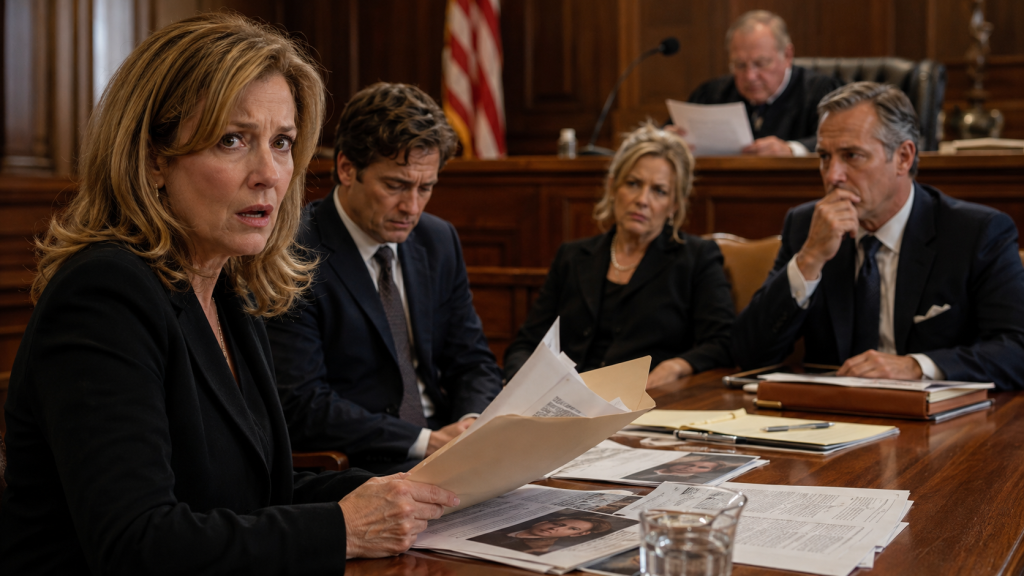
At the first probate hearing, Debra wore black.
Not funeral black.
Performance black.
A tailored dress, pearl earrings, a lace handkerchief folded in her hand.
Paul sat two rows behind her and refused to look at me.
Leonard Bryce sat beside his attorney, sweating through his collar.
The judge reviewed the file slowly.
Then he read aloud from Leonard’s own notes.
“Client confused but cooperative.”
The courtroom went still.
The judge continued.
“Client asked if his deceased wife approved.”
Leonard shifted in his chair.
“Client unable to state current year.”
The judge looked over his glasses.
“Mr. Bryce, you processed a major beneficiary change under these circumstances?”
Leonard cleared his throat.
“Your Honor, Mr. Mitchell was responsive and signed voluntarily.”
My attorney stood.
“Responsive is not the same as competent.”
Then she played the first piece of footage.
Security video from Leonard’s office lobby.
Dad was in a wheelchair.
Debra pushed him inside.
Paul walked behind them holding a folder.
Dad looked thin.
Smaller than I remembered.
He looked up at the receptionist and asked, “Is Linda here?”
My mother’s name.
My dead mother’s name.
Debra leaned down and whispered something near his ear.
The camera had no sound, but Dad flinched.
Then Paul put a hand on the wheelchair and looked around the lobby like he was afraid of being seen.
My chest ached so badly I pressed a fist against it.
Evelyn called Paul as a witness.
He walked to the stand with stiff shoulders.
At first, he stuck to the story.
Dad wanted Debra cared for.
Dad understood.
Dad signed.
Then Evelyn handed him the meeting notes.
“Did your father ask about Linda during this meeting?”
Paul swallowed.
“Yes.”
“Did he know Linda had been dead for more than thirty years?”
Paul’s jaw trembled.
“I don’t know what he knew.”
“Did he know the current year?”
“I don’t remember.”
Evelyn’s voice sharpened.
“Mr. Mitchell, your father was removing your sister and her children from a $300,000 beneficiary designation. You signed as witness. Are you telling this court you don’t remember whether he understood what year it was?”
Paul’s face went red.
Debra stared at him hard from the front row.
Then Evelyn placed a still image from the footage on the screen.
Dad in the wheelchair.
Debra leaning over him.
Paul holding the folder.
“Did Debra ask you to be there?”
Paul closed his eyes.
“Yes.”
“Why?”
He whispered, “She said it was temporary.”
Debra’s head snapped up.
Paul’s voice broke.
“She said she needed control to pay for Dad’s care. She said Lisa was too emotional and would waste time fighting instead of helping.”
I stood before I could stop myself.
“Dad’s care?”
Everyone turned.
My attorney gently touched my arm, but I could not sit yet.
“I paid for his nurses,” I said. “I paid for his medication when Debra said the pharmacy was too expensive. I paid for the wheelchair ramp. You knew that, Paul.”
Paul looked at me then.
Really looked.
His face folded.
“I’m sorry.”
Two words.
Too small.
Too late.
Debra stood abruptly.
“That money was marital property.”
The judge’s expression hardened.
“No, Mrs. Mitchell. It was an annuity with a beneficiary designation. And this court is now examining whether that designation was changed under undue influence and questionable capacity.”
Debra sat down.
For the first time, she looked afraid.
The hearing lasted three hours.
By the end, Leonard Bryce had admitted he did not request a medical capacity letter.
He did not contact Dad’s neurologist.
He did not record the meeting.
He did not ask Debra to leave the room.
He did not stop when Dad asked whether Linda approved.
He simply wrote:
Confused but cooperative.
Two weeks later, the judge issued the order.
The 2022 beneficiary change was voided.
The annuity reverted to the previous designation.
Me.
For the benefit of Dad’s grandchildren, as he had always intended.
Debra appealed.
She lost.
Leonard Bryce was reported to the licensing board and eventually lost his license.
Debra was referred for investigation into elder financial exploitation.
Paul called me the night the order became final.
I almost did not answer.
When I did, he was crying.
“Lisa, please,” he said. “Don’t cut me off. I made a mistake.”
I stood in my kitchen staring at Dad’s old Christmas mug on the shelf.
“A mistake is forgetting to bring dessert,” I said. “A mistake is missing a birthday. You sat in a room while Dad asked for our dead mother and watched him sign away his grandchildren’s future.”
“She pressured me.”
“You were forty-seven years old, Paul.”
“She said Dad wanted it.”
“You knew Dad didn’t understand.”
He sobbed.
“I didn’t think it would go this far.”
That sentence settled everything.
He had not thought about Dad.
Not really.
He had not thought about my children.
He had not thought about what was right.
He had only thought the theft would stay quiet.
“You didn’t just witness a signature,” I told him. “You witnessed Dad being stolen from us.”
Then I hung up.
The annuity money arrived months later.
I did not touch a dollar for myself.
I opened education accounts for each of my children.
I placed copies of Dad’s original paperwork inside a folder labeled exactly how he would have liked it:
For the Grandkids.
That first Christmas without him, the house felt hollow.
His recliner sat empty.
No one told the same fishing story three times.
No one asked for extra gravy.
No one slipped my youngest a peppermint and winked.
After dinner, I brought out the folder.
My children gathered around me.
They were old enough to understand some of it, not all.
I told them Grandpa had saved money for their futures.
I told them people had tried to take it.
I told them the court had returned it because truth sometimes takes a long, expensive road, but it can still arrive.
My son asked, “Did Uncle Paul help them?”
I looked at his face and decided he deserved honesty softened by mercy.
“Yes,” I said. “He made a very wrong choice.”
“Do we hate him?”
I thought about that.
“No,” I said. “But we do not pretend trust is still whole when someone breaks it.”
My daughter touched the folder.
“Grandpa really wanted us to have it?”
I smiled through tears.
“Every Christmas, he said so.”
And for a moment, I could almost hear Dad in the recliner again.
That’s for the grandkids.
Your mother knows.
I did know.
I knew enough to fight.
Enough to spend the money.
Enough to sit in court while my brother looked away and my stepmother cried false tears.
Enough to turn one cruel phrase back into evidence.
Confused but cooperative.
They thought confusion made Dad easy to use.
They forgot cooperation is not consent.
They forgot love keeps records too.
Receipts.
Letters.
Christmas promises.
Old beneficiary pages.
Memories strong enough to stand in court when a sick man no longer could.
Dad died in January.
But the promise he made every Christmas did not die with him.
It survived Debra’s greed.
It survived Leonard’s negligence.
It survived Paul’s betrayal.
And one day, when my children use that money for college, homes, or lives my father helped make possible, I will tell them again where it came from.
Not from a court order.
Not from an annuity company.
Not from a fight.
From a grandfather who knew exactly what love should do after he was gone.
Protect the children.
And that is exactly what I made sure it did.
THE END! THANKS FOR READING!