
The first thing I saw after coming home from war was my wife freezing in the snow.The second was my mother standing inside a warm house, calmly drinking wine while watching it happen.A severe Colorado blizzard had delayed my return by almost six hours.My flight landed late.The roads were half buried.The hired car could not make it up the final stretch of our long driveway, so I got out with my duffel bag and walked.
I should have been annoyed.Instead, I was smiling.After eighteen months serving overseas, I was finally home.I had imagined this moment so many times that it had become almost sacred in my mind.Giselle running into my arms.Our six-month-old daughter, Hazel, blinking up at me with the round cheeks I had only kissed through video calls.
Warm lights.
Christmas decorations.
My mother pretending not to cry.
My father clapping me on the shoulder and saying something stiff but proud.
That was the homecoming I carried through every hard night overseas.
But halfway up the driveway, I saw two suitcases near the porch.They were half covered in snow.Then I saw a shape curled beside the railing.At first, my mind refused to understand it.Then the shape moved.A hand.A woman’s hand.Bare fingers pressed protectively over a bundle beneath her coat.
My duffel dropped from my shoulder.
“Giselle!”
I ran.
The snow came up over my boots, but I barely felt it.
My wife lay against the porch steps, lips blue, hair frozen in damp strands against her face. Her coat was wrapped around Hazel, who was tucked against her chest.
Hazel let out a weak cry when I touched them.
That cry saved me from breaking.
I tore off my field jacket and wrapped it around both of them.
“Giselle, baby, look at me.”
Her eyes opened slowly.
For a moment, she stared as if I were part of a fever dream.
“Dylan?” she whispered.
“I’m here. I’m home.”
Her cracked lips trembled.
“I tried to call you.”
“What happened?”
Her gaze moved toward the house.
The windows glowed gold.
Through the front room glass, I could see the Christmas tree, the fire, crystal glasses, and my parents standing in warmth while my wife and daughter froze outside.
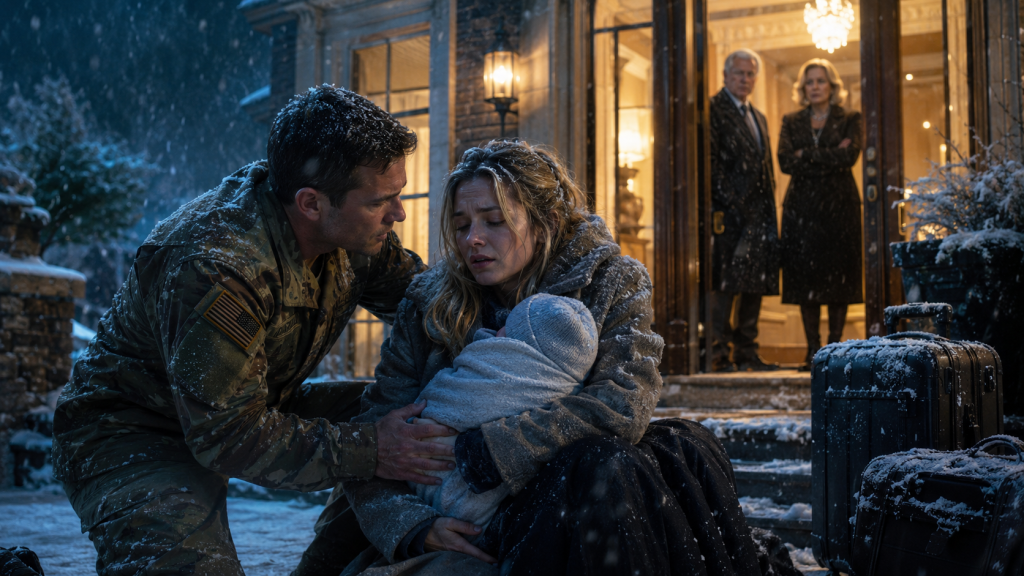
Giselle swallowed painfully.
“Your parents said we weren’t family anymore.”
The words did not make sense.
Not at first.
“They changed the locks,” she whispered. “Your father said the house belonged to him now.”
Something inside me became very still.
Combat had taught me many things.
How to listen before reacting.
How to see danger behind ordinary movement.
How to keep rage cold enough to be useful.
I lifted Hazel against my chest, then scooped Giselle into my arms.
The front door opened.
My mother, Eudora Hayes, stood beneath the chandelier in a silk robe, holding a glass of wine.
Behind her, my father, Felix, leaned near the fireplace with one hand in his pocket and my grandfather’s whiskey in the other.
“Well,” he said with a grin. “The hero finally made it home.”
I looked at him over Giselle’s head.
“Open the door.”
Mother crossed her arms.
“Dylan, before you get emotional, you need to understand what that woman has done.”
“That woman is my wife.”
“She wasted your deployment money,” Mother snapped. “She ignored the rules of this house, invited strangers here, and tried to steal company documents.”
Giselle opened her eyes.
“You emptied our accounts.”
Father chuckled.
“Our accounts. Everything you own came from this family.”
I stepped through the doorway without waiting for permission.
Father moved as if he meant to block me.
Then he saw my face.
He stepped aside.
I carried Giselle past him.
Past my mother.
Past the Christmas garland and silver ornaments and the table set for two people who had celebrated while my family suffered outside.
“You threw out my whole world,” I said quietly. “Now I’ll take back every dollar, every key, and every secret you stole from us.”
Father smirked.
“You’re a staff sergeant living on a government paycheck. Don’t threaten people who can crush you.”
That was his first mistake.
Thinking I was still the boy who used to lower his eyes when he raised his voice.
I carried Giselle upstairs to our bedroom.
Except it was not our bedroom anymore.
Someone had gone through her drawers.
Her clothes were missing from the closet.
Hazel’s crib had been shoved near the wall, stripped of blankets.
The framed photo of our wedding was turned face down on the dresser.
I laid Giselle on the bed, wrapped her in blankets, and checked Hazel’s fingers and toes.
She was cold, but breathing strong now, angry enough to cry.
Good.
Angry meant alive.
I called 911.
While we waited, Giselle clutched my sleeve.
“Dylan, they said you signed something.”
“I signed nothing.”
“They showed me papers. Your father said you transferred the house and the company authority while you were deployed.”
I looked toward the doorway.
Mother was standing there, watching us.
Her expression was not fear.
It was irritation.
As if Giselle’s suffering had created an inconvenience.
“You should have listened,” she said. “We told you she was not good for him.”
I stood slowly.
My mother took one step back.
“You locked my wife and baby outside in a blizzard.”
“She refused to leave the property quietly.”
“She lives here.”
Mother lifted her chin.
“Not anymore.”
The ambulance arrived minutes later.
Paramedics wrapped Giselle and Hazel in thermal blankets and carried them downstairs.
Mother hovered in the foyer, whispering that the neighbors would talk.
Father demanded my keys.
“Hand them over,” he said. “Until you calm down, you’re not staying here.”
I ignored him.
He stepped closer.
“You hear me, Dylan?”
I turned.
“Every word.”
He mistook that for obedience.
Another mistake.
Once the ambulance pulled away, red lights fading into the storm, I walked back into the house and shut the door.
The warmth felt obscene.
Mother stood near the staircase.
Father returned to the fireplace.
“You’re being dramatic,” he said. “She manipulated you.”
I went to my duffel bag.
Unzipped it.
Reached beneath the lining.
And pulled out the waterproof folder I had carried through two countries and three military transports.
Father watched me with mild amusement.
Until I placed the first bank statement on the table.
His smile faded.
“This is the transfer record from my deployment account,” I said.
Mother stiffened.
I placed down another document.
“This is the deed showing the house belongs to the Hayes Family Trust, not you.”
Father’s jaw tightened.
“You don’t understand what you’re looking at.”
“I understand perfectly.”
Another document.
“This is the corporate filing proving Granddad left Hayes Logistics to me when I turned thirty. You were temporary manager while I was deployed.”
Mother whispered, “Felix…”
I kept going.
“These are recorded calls between you and the bank officer who helped move funds out of Giselle’s account.”
Father’s face went gray.
“These are copies of forged authorizations using my signature.”
I placed the final file on top.
“And this is the report from Army investigators after I discovered someone had used my military power of attorney to move assets I never approved.”
Father’s arrogance cracked.
Not completely.
But enough.
“You reported your own family?”
“No,” I said. “I reported fraud. The fact that it led here is your fault.”
Mother began shaking her head.
“We were protecting you. She was spending everything.”
“On what?” I asked.
Mother blinked.
“On the baby,” I said. “On groceries. On repairs you refused to approve. On medical bills after Hazel was born early. I saw every receipt.”
Father slammed his glass down.
“You were overseas. You have no idea what went on in this house.”
“I know Giselle sent me photos of empty cabinets while you were charging wine club fees to the company account.”
Mother looked away.
“I know you cut her access to the joint card two weeks after Hazel was born.”
Father’s voice lowered.
“Careful.”
“I know you told staff she was unstable so no one would answer her calls.”
“Enough.”
“I know you sold equipment from Hayes Logistics and routed the payments through a shell vendor under Mother’s maiden name.”
The room went silent.
Mother’s face crumpled.
Father stared at me like he had finally understood I had not come home empty-handed.
The doorbell rang.
He flinched.
Through the glass, blue and red lights flashed across the snow.
Two officers stood beside a federal investigator and my attorney, Mara Vance.
Father looked at the door.
Then at me.
“You wouldn’t dare.”
“I dared six months ago.”
Mara entered first, brushing snow from her coat.
She looked at me once, then at the documents on the table.
“Sergeant Hayes.”
“Thank you for coming.”
The federal investigator showed his credentials.
Father’s mouth opened, but no sound came.
Mother began crying.
Not soft tears.
Not remorse.
Fear.
The officers entered behind them.
Mara turned to my father.
“Felix Hayes, there is a warrant authorizing seizure of business records related to suspected fraud, identity misuse, and unlawful transfer of protected military family assets.”
Father pointed at me.
“He’s lying.”
The investigator picked up one of the documents.
“Then we’ll let the records speak.”
Mother grabbed my arm.
“Dylan, please. We’re your parents.”
I looked down at her hand.
When I was little, that hand had buttoned my coat, wiped my face, held mine crossing streets.
That same hand had closed a curtain while my wife shivered outside.
I gently removed it.
“No,” I said. “Parents do not freeze their granddaughter.”
She broke then.
“Your father said Giselle was stealing from us. He said if we scared her enough, she would leave before you came home.”
Father snapped, “Eudora, shut up.”
The room changed.
Even the officers looked at him.
I looked at my mother.
“What else did he say?”
She covered her mouth.
Father lunged one step forward.
The officers stopped him immediately.
“Enough,” Mara said.
By 3:00 a.m., investigators were in my father’s office.
By 4:30, company laptops were seized.
By sunrise, Felix Hayes was in handcuffs in the foyer of the house he had called his.
He did not look at me when they led him out.
Mother remained near the staircase, mascara streaking her face, clutching the silk robe around herself as if it could still make her dignified.
“Dylan,” she whispered. “What happens to me?”
I looked past her at Hazel’s tiny mitten on the floor.
Pink.
Soft.
Half buried under snow that had blown in when they forced Giselle out.
“You can call your sister,” I said. “You’re not staying here.”
Her face collapsed.
“This is my home.”
“No,” I said. “It was a place you were allowed to live because I trusted you. That ended tonight.”
The locks were changed before noon.
Security codes were reset.
Company accounts were frozen.
My mother’s access to the family trust was suspended pending review.
At the hospital, Giselle woke beneath warm blankets.
Hazel slept in a bassinet beside her, pink-cheeked and safe.
Giselle looked at me as if she was afraid the answer might destroy her.
“Do we still have a home?”
I sat beside her and placed the new keys in her palm.
“Yes.”
Her fingers closed around them.
“And this time, no one can throw you out of it.”
She cried then.
Quietly.
Exhausted tears.
I kissed her hand and rested my forehead against it.
“I’m sorry I wasn’t here.”
Her voice cracked.
“You were serving.”
“I should have seen it sooner.”
“You did,” she whispered. “You believed me.”
That was when I nearly broke.
Because for months, she had sent me messages that sounded small at first.
Your mother took my card again.
Your father says I need permission to use the car.
They changed the safe code.
Felix says the company is having cash-flow issues.
Your mother says I’m not really a Hayes.
I had been thousands of miles away, reading between lines while carrying a weapon in a country where danger wore a different face.
So I documented.
Quietly.
I asked questions.
I forwarded messages.
I requested financial statements.
I notified the right people.
My parents thought distance made me powerless.
They forgot that distance also made me patient.
Three weeks later, the full truth unfolded.
My father had forged my signature on property documents.
He had drained deployment savings into company debts he created.
He had used my temporary military power of attorney far beyond its legal limits.
He had tried to remove Giselle from the property before I returned because she had found an old filing cabinet in the office.
Inside were documents proving Hayes Logistics had never belonged fully to him.
My grandfather had skipped him for a reason.
The company was mine.
The house was mine.
The trust protecting Hazel was mine to control.
Father had lived on borrowed authority for years.
The blizzard simply revealed the man behind it.
Mother was not charged the way Father was, but she lost nearly everything that mattered to her.
Access.
Status.
The house.
The family dinners she used as a stage.
She wrote me letters.
At first, they were full of excuses.
Then blame.
Then religion.
Then memories.
Finally, one arrived with only four words:
I should have opened.
I folded it and put it away.
Not forgiven.
Not forgotten.
Just stored somewhere I did not have to carry it every day.
Father’s case moved slower.
Lawyers.
Hearings.
Delays.
He tried to say I was vengeful.
That military service had changed me.
That Giselle had manipulated me.
Then the court saw the security footage.
Giselle on the porch.
Hazel under her coat.
My mother closing the curtain.
My father telling her through the door, “Go find your real family.”
That sentence ended whatever sympathy he had left.
Months later, I stood in the foyer holding Hazel while movers carried out the last of my parents’ furniture.
Giselle stood beside me, healthy again, wearing my field jacket over her sweater.
She had refused to throw it away.
“Silly,” she said when I mentioned it.
“It smells like snow and you coming home.”
I laughed for the first time in a while.
Hazel reached for the chandelier light, babbling like she owned the room.
She did.
In a way, she always had.
We changed the house slowly.
Not because we wanted to erase everything.
Because we wanted to make it ours.
The formal dining room became a playroom.
My father’s office became Giselle’s studio.
Mother’s wine room became storage for baby clothes, winter coats, and donated blankets for military families in crisis.
That was Giselle’s idea.
“We know what cold feels like,” she said.
On Hazel’s first birthday, we invited friends, neighbors, soldiers from my unit, and three families from the support program.
There was no crystal.
No forced elegance.
No family pretending cruelty was tradition.
Just food, laughter, children crawling under tables, and Giselle smiling beside the cake.
Near the end of the night, I stepped onto the porch alone.
Snow was falling again.
Softly this time.
Not like the storm.
I stood where I had found her.
For a moment, I could see it all again.
The suitcases.
The blue lips.
The baby bundled under her coat.
The warm house watching.
Then Giselle opened the door behind me.
“You okay?”
I turned.
She stood in the doorway, light spilling around her, Hazel on her hip.
My whole world.
Not thrown out.
Not abandoned.
Safe.
“I am now,” I said.
She stepped onto the porch beside me.
I wrapped my arm around both of them.
Behind us, the house glowed.
In front of us, snow covered the driveway clean.
People think revenge is loud.
Sometimes it is.
But sometimes revenge is a locked account, a signed warrant, a changed deed, a new key in the right hand.
Sometimes it is carrying your wife past the people who tried to erase her.
Sometimes it is making sure your daughter grows up in a house where family means shelter, not power.
My father lost the company.
He lost the house.
He lost his freedom for a while.
But what mattered most was this:
He lost the right to decide who belonged in my life.
And on the night I came home from war, cold with rage and covered in snow, I took that right back.
THE END! THANKS FOR READING!