
My nine-year-old daughter’s backpack had forty dollars in it.Not a crisp birthday card bill.Not lunch money.Not allowance.Four crumpled ten-dollar bills, folded twice and tucked into the small inside pocket where Lily usually kept stickers, lip balm, and tiny notes from her friends.I found it on a Thursday night while looking for her math folder.At first, I thought maybe my mother had slipped it to her.
Grandma did that sometimes.Five dollars for ice cream.Ten dollars for the book fair.But forty dollars felt different.Too much for a child to forget.Too strange to ignore.I walked into the living room where Lily was sitting cross-legged on the rug, brushing her doll’s hair.
“Lily,” I said gently, “where did this money come from?”
She looked up, saw the bills in my hand, and shrugged.
“A lady at the after-school program gives me money sometimes.”
My whole body went still.
“For what?”
Lily shrugged again.“For being good.”The room seemed to shrink around me.I sat down on the couch so my voice would not sound as sharp as my pulse felt.
“What lady?”
“I don’t know. Janet.”
“Is she a teacher?”
“No. She helps sometimes.”
“How many times has she given you money?”
Lily thought about it.
“Maybe four. Or five.”
I stared at my daughter’s innocent face and felt something cold open inside my chest.
The after-school program cost one hundred seventy-five dollars a month.
It ran until five-thirty.
I paid for it because I worked full-time at a dental office and could not leave early every day.
It was supposed to be safe.
Homework tables.
Snacks.
Crafts.
Supervised play.
Adults with name tags.
A locked pickup door.
I called the program immediately.
The director, Ms. Ellison, answered with a cheerful voice that irritated me before I could stop myself.
“Lily’s mother,” I said. “I need to ask about a woman named Janet.”
A pause.
“Janet?”
“She’s been giving my daughter cash.”
Another pause.
Then Ms. Ellison said, “All staff and volunteers are background-checked.”
“That was not my question.”
“I understand, but I can assure you—”
“No,” I said. “You can assure me after you tell me who Janet is.”
She promised to look into it.
She promised to call me back.
She promised everything except the thing I needed.
The truth.
That night, after Lily fell asleep, I emptied her backpack completely.
Crayons.
A library book.
A permission slip.
A purple scrunchie.
And at the bottom, under a folder, I found a small pink hairbrush I had never seen before.
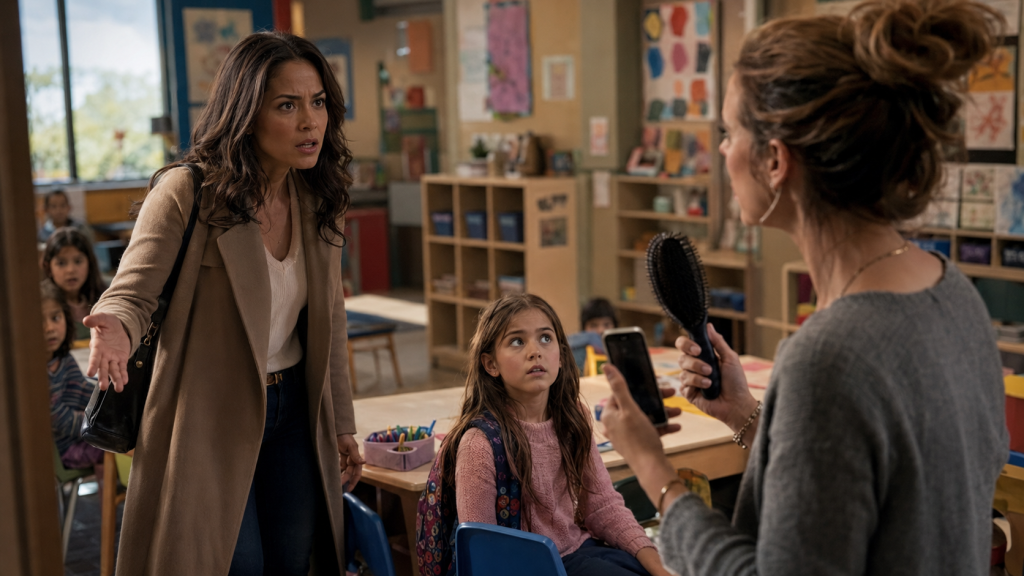
It had tiny rhinestones on the handle.
When I asked Lily about it the next morning, she smiled.
“Janet gave it to me. She says my hair is pretty when she brushes it.”
My blood ran cold.
I drove to work that morning with one hand gripping the steering wheel and the other dialing my lawyer.
Because this was not the first time something involving Lily had felt wrong.
My ex-husband, Mark, had been fighting for custody for eight months.
He wanted more time.
Then he wanted equal time.
Then he wanted primary custody, claiming I was anxious, controlling, and emotionally unstable.
In his court documents, he said I imagined dangers everywhere.
That I was “paranoid.”
That I made Lily afraid of ordinary people.
And now a woman I did not know was giving my child money and brushing her hair.
I left work early.
At 3:15, I parked across from the after-school building and walked quietly to the side window where parents usually did not stand.
Inside, children sat at tables with snacks and worksheets.
Two staff members helped near the whiteboard.
But my eyes found Lily in the corner.
She was sitting on a low blue chair.
Beside her was a woman I did not recognize.
Late thirties, maybe early forties.
Brown hair pulled into a ponytail.
No name badge.
No staff shirt.
She was brushing Lily’s hair.
Slowly.
Carefully.
Like Lily was a doll.
Then the woman took out her phone.
My heart began pounding.
She tilted Lily’s chin slightly.
Lily smiled.
The woman took a photo.
Then another.
Then she reached into her bag, pulled out something small, and handed it to Lily.
Lily tucked it into her pocket.
I was already moving.
I walked through the front door so fast the receptionist barely lifted her head before I passed her.
The woman looked up when I entered the room.
Her smile vanished.
I stopped in front of her.
“Who are you?”
She jumped to her feet.
“I’m a volunteer.”
“Volunteers don’t give children cash.”
Her face went pale.
She grabbed her bag.
“I was just helping.”
“With my daughter’s hair?”
Lily looked frightened now.
“Mom?”
I softened immediately.
“It’s okay, baby. Come here.”
Lily ran to me.
The woman stepped toward the door.
I blocked her path.
“What is your name?”
“Janet Boyle.”
“Who approved you to be alone with my child?”
She did not answer.
She pushed past a staff member and hurried out the door.
I wanted to follow her, but Lily was clinging to my waist.
So I turned to the receptionist.
“Get the director. Now.”
Ms. Ellison came out of her office with a forced calm expression that collapsed the moment she saw my face.
“I want the sign-in log,” I said.
“We need to follow procedure—”
“No,” I said. “You needed to follow procedure before an unknown woman sat alone with my daughter and took pictures of her.”
The room went silent.
Parents arriving for pickup slowed near the entrance.
Ms. Ellison led me into her office.
Her hands shook as she pulled the volunteer binder from a cabinet.
There it was.
Janet Boyle.
Started five weeks ago.
Volunteer assistant.
No completed background check.
No ID copy.
No approval signature from the district office.
Only a printed application, a phone number, and an emergency contact.
I read the emergency contact line once.
Then again.
The name listed was Mark Reynolds.
My ex-husband.
Relationship:
Fiancé.
For a moment, I could not breathe.
“My daughter does not have a stepmother,” I said.
Ms. Ellison’s face drained of color.
“She put fiancé?”
“She put my ex-husband.”
I pulled out my phone and called my lawyer before I called Mark.
Then I called the police.
Then I asked for Lily to be taken to a separate room with a female staff member while I stayed in the office.
I was not calm.
But I was controlled.
There is a difference.
Ms. Ellison printed everything.
The volunteer application.
The sign-in logs.
The dates Janet had been inside the building.
The camera footage showing Janet entering without a completed clearance.
And then we reviewed the hallway camera.
Five weeks.
Janet had come nine times.
Always on days Mark knew I worked late.
Always near Lily.
Always leaving before pickup.
Ms. Ellison kept whispering, “I don’t understand.”
But I did.
Not all of it yet.
But enough.
Mark had not been trying to help Lily.
He had been building a case.
At 4:02, Mark arrived.
He stormed into the office like an outraged father summoned into someone else’s mistake.
“What the hell is going on?” he demanded.
Then he saw me.
His anger faltered.
“Why are you here?”
I stood.
“Why is your fiancée volunteering at Lily’s after-school program under a fake name?”
His face changed for half a second.
Only half a second.
But I saw it.
“I don’t know what you’re talking about.”
The police officer who had arrived moments earlier looked at him.
“Mr. Reynolds, do you know a Janet Boyle?”
Mark shook his head too quickly.
“No.”
The office door opened.
Lily stood there with Ms. Ellison’s assistant behind her.
She had been crying.
When she saw Mark, she looked confused.
Then she said the sentence that ended his lie.
“That’s the man who told the lady what pictures to take.”
The room went dead silent.
Mark stared at her.
“Lily.”
She stepped behind me.
“He said if I smiled nice and was good, the judge would know I liked his house.”
My heart cracked.
I knelt in front of my daughter.
“What else did he say, sweetheart?”
She wiped her nose with her sleeve.
“He said Janet was going to help. She said I looked prettier when my hair was down. She gave me money and said not to tell because grown-ups don’t understand special rewards.”
I closed my eyes.
Not because I could not hear more.
Because I had to stop myself from turning toward Mark.
The officer asked gentle questions.
My lawyer arrived.
Then another officer.
Lily was taken to a child interview specialist that evening, not because she had done anything wrong, but because adults had.
The story came out piece by piece.
Janet Boyle was not Janet Boyle.
Her real name was Janet Miles.
She was Mark’s girlfriend.
Not fiancée legally, though apparently she liked the title.
She had used a fake last name on the volunteer form because she knew I might recognize her from social media.
Mark had told her to get close to Lily.
To take photos of Lily smiling with her.
To show Lily accepting gifts.
To create “proof” that Lily was happy with people connected to his home.
He wanted to show the court that I was exaggerating, that Lily was comfortable, that I was the problem.
The money was supposed to make Lily cooperative.
The hair brushing was supposed to make her look “presentable.”
The photos were supposed to become evidence.
My daughter had been turned into a prop in a custody strategy.
That night, I sat beside Lily’s bed until she fell asleep.
She held my hand tightly.
“Mom,” she whispered, “am I in trouble for taking the money?”
I bent over her and kissed her forehead.
“No, baby. You are not in trouble.”
“But I didn’t tell you.”
“You told me when I asked. That was brave.”
“She said it was our secret.”
I swallowed hard.
“Safe adults don’t ask kids to keep secrets from their parents.”
Lily nodded, though I knew she was too young to carry the weight of what had happened.
So I carried it for her.
My lawyer filed an emergency motion before midnight.
By morning, Mark’s custody petition was frozen.
Temporary orders were changed.
Unsupervised visitation was suspended.
The after-school program was under investigation for allowing an uncleared volunteer access to children.
Ms. Ellison resigned two weeks later.
The district sent formal apologies to every parent.
I moved Lily to a smaller program with stricter entry rules, but I still sat in the parking lot early every day for a month.
In court, Mark tried to look wounded.
He wore a navy suit and the expression of a misunderstood father.
His attorney claimed he had only wanted “independent confirmation” that Lily could form healthy attachments outside my control.
The judge did not smile.
My lawyer submitted the volunteer forms, camera footage, sign-in logs, photos from Janet’s phone, cash found in Lily’s backpack, and Lily’s recorded statement.
The judge looked at Mark for a long time.
“You used your child as evidence against her own mother,” she said.
Mark’s face went pale.
Then she added, “And you arranged unauthorized access to her through a school program using a false identity. That is not parenting. That is manipulation.”
Mark lost unsupervised visitation that day.
Janet was ordered to have no contact with Lily.
The after-school program was required to report the breach and revise its procedures.
And I walked out of court holding my daughter’s hand.
Outside, Mark called my name.
I stopped, but I did not turn.
“You’re ruining my life,” he said.
I looked back then.
“No, Mark. I’m protecting hers.”
Months passed before Lily stopped checking her backpack for money she did not want.
Months before she stopped asking if being “good” meant doing whatever adults said.
We worked with a child therapist who taught her about safe adults, unsafe secrets, and body boundaries in a way that did not frighten her more.
Slowly, my little girl returned to herself.
She painted rainbows.
She asked for pancakes shaped like hearts.
She sang loudly in the shower.
She wore her hair however she wanted.
One afternoon, she came home from her new after-school program with a drawing.
It showed the two of us standing beside a giant red stop sign.
Above it, in purple crayon, she had written:
My mom listens.
I cried in the car before driving home.
Because that was all I had done at first.
I listened.
To the strange money.
To the uncomfortable feeling.
To the part of me Mark had called paranoid.
People love to tell mothers they worry too much.
That we overreact.
That not everything is a danger.
And sometimes that is true.
But sometimes, a crumpled forty dollars in a backpack is not just forty dollars.
Sometimes it is the loose thread that unravels a lie.
And sometimes the difference between danger and safety is a mother willing to pull.
THE END! THANKS FOR READING!