
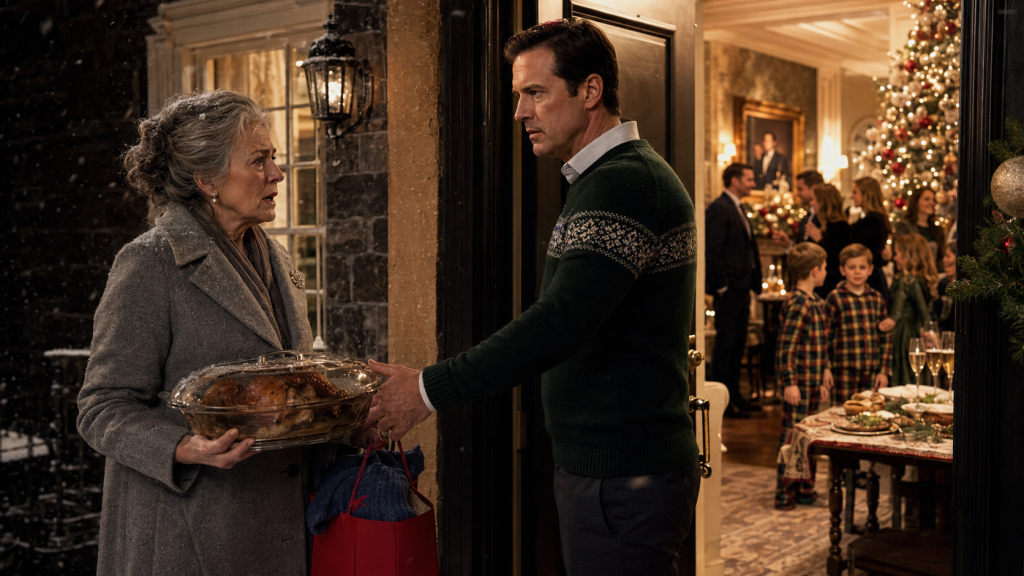
On Christmas Eve, Margaret Whitmore stood on the porch of her son’s house in Maplewood, New Jersey, holding a covered dish of roasted turkey and a red gift bag with a blue sweater folded inside.Snow gathered on her gray wool coat.The porch light glowed above her.Through the front window, she could see the Christmas tree sparkling, children running in matching pajamas, adults laughing, and champagne glasses lifting under gold ribbons….More article below👇
She saw her son, Daniel, standing beside his wife, Claire.He was laughing.Margaret smiled softly.For a moment, she forgot the cold.She had spent all afternoon cooking, wrapping gifts, and trying to convince herself that things between them were finally getting better.
Daniel had been distant for months, but he was still her son.
And Christmas, she believed, was the one night when family remembered what mattered.
She pressed the doorbell.
Inside, the music softened.
Footsteps approached.
The door opened only halfway.
Daniel looked out.
For one second, his face froze.
Then his mouth tightened.
“Mom?” he said quietly.
Margaret lifted the dish slightly.
“Merry Christmas, sweetheart. I brought dinner. And gifts for the kids.”
Behind him, Claire appeared with a glass of wine in her hand.
Her smile vanished the moment she saw Margaret.
Daniel stepped outside and pulled the door almost shut behind him.
“You shouldn’t have come,” he whispered.
Margaret blinked.
“You invited everyone. I thought—”
“I didn’t invite you.”
The words struck harder than the winter wind.
Margaret looked down at the turkey in her hands, then back at him.
“I thought maybe there was a mistake. You said Christmas would be at your house this year.”
Daniel’s jaw moved.
“It is. But not for you.”
From inside, a child shouted, “Dad, who is it?”
Daniel turned his head slightly and called back, “Wrong house.”
Margaret stared at him.
“Wrong house?”
His eyes did not meet hers.
“Please leave.”
“I’m your mother.”
“And this is my home,” he said. “Don’t make this embarrassing.”
Embarrassing.
That was what she had become.
Not the woman who worked double shifts after his father died.
Not the woman who paid his college debt.
Not the woman who helped him buy that very house.
Just an embarrassment on his porch, holding roasted turkey in the snow.
Margaret looked past his shoulder.
She saw the long dining table with silver candles.
Claire’s parents sat near the fireplace.
Wrapped presents were stacked under the tree.
Her grandchildren ran past in matching red pajamas, laughing loudly.
None of them saw her.
Or perhaps they had been taught not to look.
Daniel stepped back.
The door closed.
For almost a minute, Margaret stood there without moving.
The covered dish grew heavy in her arms.
The red gift bag swung from her wrist.
Snow landed on the blue sweater inside.
Then she turned carefully, walked down the icy steps, placed the turkey in the passenger seat, and drove home without crying.
Her house was dark when she arrived.
She set the turkey on the kitchen counter.
She placed the gift bag beside it.
Then she sat at the table still wearing her coat.
Only then did her hands begin to shake.
At 10:47 p.m., her phone rang.
Daniel’s name appeared on the screen.
For one foolish second, hope rose in her chest.
Maybe guilt had found him.
Maybe he had stepped into another room to apologize.
Maybe he would say, “Mom, I was wrong. Come back.”
Margaret answered.
Before she could speak, she heard laughter.
Claire’s voice floated in the background.
“Did she really bring a turkey?”
More laughter followed.
Then Daniel’s voice came through, loose and cruel from alcohol.
“Mom, listen,” he said. “Don’t start with the victim act tomorrow. You embarrassed yourself.”
Margaret sat very still.
“Daniel,” she whispered.
“No, seriously,” he continued. “You can’t just show up and expect to be included.”
Claire said something in the background.
Daniel laughed.
Then he said the sentence that changed everything.
“Money can’t buy her a spot here.”
Claire laughed again.
Something inside Margaret became quiet.
Not angry.
Not loud.
Quiet.
The kind of quiet that arrives when a person has finally heard enough truth.
For fourteen years, she had helped Daniel.
Mortgage shortfalls.
Private school fees.
Car insurance.
Business loans.
Emergency repairs.
Vacations Claire called “mental health resets.”
Every first of the month, money left Margaret’s account and entered Daniel’s life.
He never said thank you without asking for the next thing.
Claire never invited Margaret without checking whether a transfer had cleared.
And Margaret had allowed it because she loved her son.
Because she thought generosity could keep a family close.
Because she believed that if she helped enough, one day Daniel would look at her with tenderness instead of convenience.
But that night, sitting alone in her dark kitchen, she finally understood.
She had not been helping him stand.
She had been paying him to tolerate her.
Daniel was still talking.
“Mom? Hello? Don’t be dramatic.”
Margaret ended the call.
Then she opened her laptop.
The glow filled the kitchen.
One by one, she logged into every account.
Mortgage assistance: canceled.
Private school payment: canceled.
Business account support: canceled.
Car insurance transfer: canceled.
Emergency family fund: closed.
Credit card backup authorization: removed.
At 12:16 a.m., Margaret shut the laptop.
She looked at the untouched turkey.
Then at the red gift bag.
Then she removed the blue sweater, folded it neatly, and placed it in the hall closet.
For the first time in years, Christmas Eve ended in silence.
And Margaret slept.
The next morning, she woke to twenty-five missed calls.
Daniel.
Claire.
Daniel again.
Claire again.
A voicemail waited.
Margaret pressed play.
Daniel’s voice shook.
“Mom. Please call me. The bank declined everything. Claire’s losing her mind. The mortgage payment bounced. What did you do?”
Margaret listened once.
Then she deleted it.
By 8:30, Daniel was at her door.
His hair was messy, his coat unbuttoned, his face pale with panic.
Behind him, Claire sat in the car with sunglasses on, arms crossed, refusing to get out.
Margaret opened the door.
Daniel stepped forward.
“Mom, please.”
She did not move aside.
“Merry Christmas, Daniel.”
His eyes flicked past her into the house.
“You can’t just cut us off.”
“I can.”
“The kids’ tuition, the mortgage, my business account—everything is connected to your payments.”
Margaret looked at him calmly.
“No, Daniel. Everything was connected to my silence.”
His face tightened.
“I was drunk last night. Claire was joking.”
“Were you joking when you shut the door in my face?”
He looked away.
“That was complicated.”
“Was it complicated when you told your children I was at the wrong house?”
Daniel rubbed his forehead.
“Mom, Claire’s parents were there. It would’ve been awkward.”
Margaret nodded slowly.
“And I was useful when I paid for the house, but awkward when I stood at the door.”
He flinched.
“That’s not fair.”
“No,” she said softly. “What happened last night was not fair.”
Daniel’s voice dropped.
“You’re punishing your grandchildren.”
Margaret had expected that.
She had used the same sentence against herself for years.
But this time, it did not work.
“I have accounts for the children,” she said. “College savings in their names. Protected. Untouched. They will not suffer because their parents lived beyond their means.”
Daniel stared at her.
“What accounts?”
“The ones Claire never needed to know about.”
His face changed.
For a moment, Margaret saw not fear, but calculation.
“How much is in them?”
There it was.
Even on Christmas morning, even standing before the mother he had humiliated, his first instinct was still money.
Margaret stepped back and reached for the red gift bag from the table behind her.
She opened it and showed him the blue sweater.
“This was for you,” she said. “I saw it in a shop window last month and thought it matched your eyes. Your father had a sweater this color.”
Daniel swallowed.
“Mom…”
“I stood on your porch with this in my hand,” she continued. “And you called me the wrong house.”
His eyes filled with tears, but Margaret no longer trusted tears that arrived after canceled payments.
“Please,” he whispered. “We’ll lose everything.”
Margaret looked at the son she had saved for fourteen years.
“No, Daniel. You are only losing what was never yours.”
Then she closed the door gently.
Claire came next.
At noon, Margaret received a long message filled with apologies that sounded like accusations.
She wrote that Margaret had misunderstood.
That family arguments happened.
That Daniel was under stress.
That taking money away suddenly was cruel.
Then came the line Margaret expected.
Think of the children.
Margaret replied with only one sentence.
I am thinking of them, which is why I will no longer teach them that love is something you invoice.
Claire did not answer.
Two days later, Daniel returned alone.
This time he knocked instead of ringing the bell.
Margaret saw him through the curtain.
He looked smaller.
Tired.
Ashamed, perhaps.
She opened the door.
“May I come in?” he asked.
Margaret hesitated, then stepped aside.
He entered the living room where family photos still lined the mantel.
There was Daniel at eight, missing front teeth.
Daniel at graduation.
Daniel holding his first baby.
Daniel and Claire in front of the house Margaret had helped them keep.
He stared at the photos for a long time.
“I forgot,” he said quietly.
Margaret remained standing.
“Forgot what?”
“How much you did.”
She said nothing.
He turned around.
“I got used to it.”
“Yes.”
“And Claire got used to it too.”
“Yes.”
His face twisted.
“I don’t know how we became these people.”
Margaret’s voice was gentle but firm.
“You became them one accepted favor at a time.”
Daniel sat on the edge of the sofa.
“I’m sorry.”
Margaret wanted to run to him.
A mother’s heart does not stop being a mother’s heart just because it has been broken.
But she had learned something on Christmas Eve.
Forgiveness without boundaries is only permission for the next wound.
“I believe you are scared,” she said. “I don’t yet know if you are sorry.”
Daniel looked up, hurt.
“That’s harsh.”
“So was ‘wrong house.’”
He closed his eyes.
For the first time, he did not defend himself.
Margaret sat across from him.
“I will not restart the transfers.”
His shoulders slumped.
“But I will help you meet with a financial counselor. I will help you make a plan. I will help you sell what you cannot afford. I will help you explain to the children that life is changing.”
Daniel wiped his face.
“And Claire?”
“That is your marriage.”
He nodded slowly.
“What about Christmas?”
Margaret looked at the tree she had decorated alone.
“There will be a meal here next Sunday. You may bring the children. Claire may come if she can be respectful. There will be no discussion of money.”
Daniel gave a broken laugh.
“She won’t like that.”
“Then she may stay home.”
For the first time in years, Daniel looked at his mother not as a bank account, but as a person who could walk away.
And that frightened him more than any declined payment.
The following Sunday, Daniel brought the children.
Claire did not come.
The grandchildren ran into Margaret’s arms, full of questions.
“Grandma, why didn’t you come Christmas Eve?”
Margaret looked at Daniel.
His face reddened.
Then he knelt beside them and said, “Because Dad made a bad choice. Grandma came to see us, and I hurt her feelings. That was wrong.”
The oldest child frowned.
“You said wrong house.”
Daniel’s eyes filled.
“I know. I lied. And I’m sorry.”
Margaret turned away so the children would not see her tears.
Later, they ate turkey, reheated from Christmas Eve.
The children opened their gifts.
Daniel helped wash dishes.
No one mentioned bank transfers.
No one mentioned mortgage payments.
When Daniel left, he hugged Margaret at the door.
Not quickly.
Not carelessly.
He held her like he remembered she was flesh and blood.
“I don’t deserve this chance,” he whispered.
Margaret touched his cheek.
“No. But your children deserve to see you try.”
Months passed.
The house in Maplewood went up for sale.
Claire was furious.
Daniel downsized.
His business closed.
He found steady work with a company he did not own and could not bankrupt.
He took the children to public school, where they made friends and survived just fine.
Claire left for a while.
Then returned different.
Quieter.
Margaret did not ask whether it would last.
Some changes need time before they can be trusted.
The automatic transfers never resumed.
But Sunday dinners did.
At first, Daniel arrived stiff and embarrassed.
Then slowly, he began showing up with groceries.
Then flowers.
Then nothing but himself.
That was when Margaret knew something had truly changed.
The first Christmas after that terrible night, Daniel called three weeks early.
“Mom,” he said, “Christmas is at your house this year, if you’ll have us.”
Margaret stood in her kitchen, looking out at the first snow of December.
“Will Claire be comfortable with that?”
Daniel exhaled.
“She understands. And if she forgets, I’ll remind her.”
Margaret smiled faintly.
“And what should I bring?”
Daniel’s voice broke a little.
“Nothing. Just open the door.”
On Christmas Eve, the doorbell rang at Margaret’s house.
When she opened it, Daniel stood on the porch holding a covered dish.
Claire stood beside him with a gift bag.
The children crowded behind them, shouting, “Grandma!”
Daniel’s eyes were wet.
“Merry Christmas, Mom.”
Margaret looked at him for a long moment.
Then she opened the door wider.
“Right house,” she said.
Daniel laughed through tears.
The children rushed inside.
Claire quietly handed Margaret the gift bag.
Inside was a blue sweater.
Soft.
Beautiful.
Almost the same shade as the one Margaret had bought the year before.
Claire’s voice trembled.
“I’m sorry,” she said. “For more than Christmas.”
Margaret nodded.
“I hope you mean that.”
“I do.”
“We’ll see.”
It was not cruel.
It was honest.
That night, Margaret sat at the head of her own table.
Not as a wallet.
Not as an obligation.
Not as a woman begging for a place.
As a mother.
As a grandmother.
As herself.
Daniel lifted his glass.
“To Mom,” he said. “For teaching me that love is not a payment plan.”
Margaret looked around the table.
The children smiled.
Claire lowered her eyes.
Daniel held Margaret’s gaze.
This time, she did not feel bought.
She felt seen.
And when the snow began falling outside, Margaret finally understood something she wished she had known years earlier.
Money can help a family survive.
But it cannot make them love you.
And the day you stop paying for a place at the table is the day you discover whether you ever had one.
That Christmas, Margaret did.
Not because she bought it.
Because she finally stopped paying for it.
THE END! THANKS FOR READING!🙏