
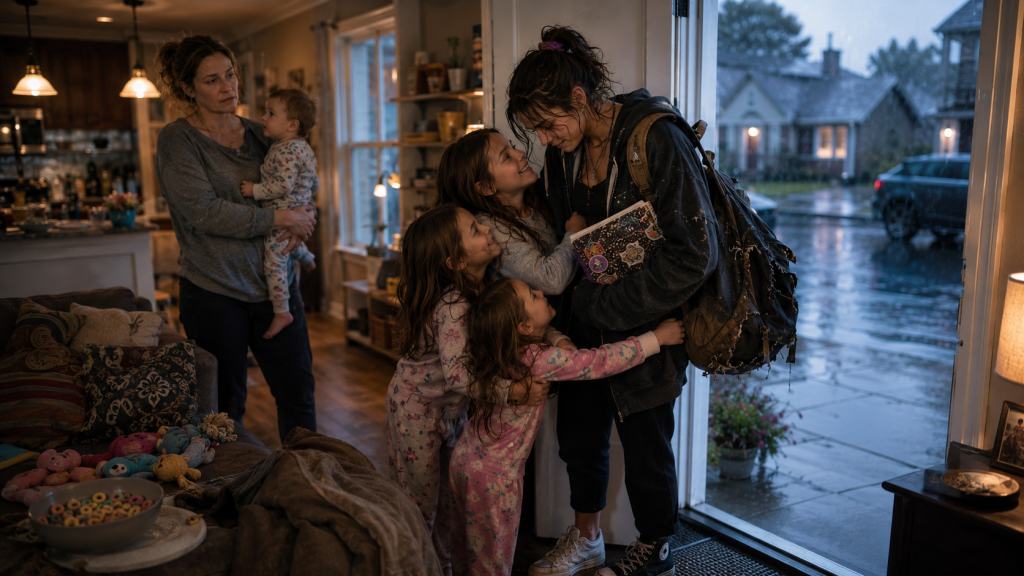
I hired a sixteen-year-old babysitter, and on her first day, she arrived late, soaked from the rain, disheveled, and wearing two different shoes.One sneaker was white.The other was black.Her hair was tied back with a purple hair tie, her backpack was torn at the bottom, and she clutched a notebook covered in stickers as if it were the only thing keeping her from falling apart.I remember opening the front door with my baby on my hip, my oldest daughter crying over math homework,
And my middle child scattering cereal across the sofa.The girl looked at me and said, breathlessly, “I’m so sorry, ma’am. I missed my bus. Well… I didn’t exactly miss it. I got on the wrong one. Then I got off at a convenience store that looked like the one near here, except it wasn’t.”
I stared at her.
“You’re the babysitter?”
She nodded quickly.
“Yes, ma’am. But I learn fast.”
My first thought was simple.
This girl is going to burn my house down.
Her name was Lucy.
And I should have closed the door.
But desperation does strange things to a mother.
My husband, Raul, worked long hours. My mother’s knees were too weak to help. I had three daughters under one roof, all of them loud, stubborn, beautiful, and exhausting.
Two babysitters had already quit.
One lasted three days.
The other left in tears after my daughters used washable markers on the dog.
So I let Lucy inside.
Five minutes later, she spilled water across the table.
Ten minutes later, she burned a quesadilla.
Fifteen minutes later, my youngest, Sophie, climbed onto Lucy’s lap and showed her a headless doll as if it were a royal treasure.
Lucy did not laugh at her.
She gasped.
“Oh my goodness,” she whispered. “A brave queen who survived a battle.”
Sophie’s eyes widened.
“She’s not broken?”
Lucy shook her head.
“No. She’s legendary.”
That was the first moment I saw something in Lucy that I had almost missed.
She was chaotic, yes.
Forgetful.
Messy.
Late.
But she had a way of looking at my daughters as if every strange little thing they carried was worth loving.
That night, as I tucked Sophie into bed, she whispered, “Can Luci come back tomorrow?”
Valerie, my oldest, called from the next room, “Please, Mom!”
Emma, my middle daughter, added, “She makes better stories than TV.”
I sighed.
“We’ll see if she can arrive on time tomorrow.”
She did not arrive on time.
But she came with pastries from a corner bakery and an invented story about a princess who lived in a street market and fought dragons that smelled like onions.
My daughters were lost after that.
Lucy became Luci.
Then sister.
Then our Luci.
I could not understand it at first.
She misplaced keys, forgot where she put her phone, started dishes and ended up braiding hair, turned on cartoons and performed every voice herself until the girls laughed so hard they rolled on the carpet.
But my daughters saw what I had been too tired to notice.
Lucy gave love like someone who had received very little of it.
Freely.
Desperately.
As if she were afraid every hug might be the last one offered to her.
One night, I found her crying in my kitchen.
It was almost eleven. The girls were asleep. I came downstairs for water and found Lucy sitting by the refrigerator, knees pulled to her chest.
“What’s wrong?” I asked.
She wiped her face quickly.
“Nothing, ma’am.”
“Don’t tell me nothing with that face.”
For a long moment, she said nothing.
Then she reached into her hoodie pocket and pulled out a crumpled pregnancy test.
I did not need to ask what it meant.
My chest tightened.
“How far along?”
“I don’t know,” she whispered. “Maybe two months.”
“And your parents?”
Her laugh was small and bitter.
“They kicked me out yesterday. My dad said I was a disgrace. My mom wouldn’t even look at me.”
I leaned against the counter, feeling the weight of the house around me.
The sleeping children.
The unpaid bills.
The dishes in the sink.
The life already stretched thin.
“And the baby’s father?” I asked gently.
Lucy dropped her eyes.
“He says it isn’t his.”
For one honest second, fear spoke louder than kindness.
A pregnant teenager in my home.
My three little girls.
A husband who already worried too much.
A household barely staying above water.
Then Sophie’s sleepy voice floated from the staircase.
“Mom? Is Luci going to leave?”
Lucy closed her eyes, as if the question had broken something inside her.
I took a breath.
“No,” I said.
Lucy looked up.
“What?”
“You’re staying here.”
Her mouth parted.
“Ma’am, I can’t—”
“You can. There’s an empty room next to the girls’. You’ll keep helping me, and I’ll keep paying you. But now we’re going to do things right. Doctor appointments. School if possible. A real schedule. Calm.”
She began shaking her head.
“I’m a mess.”
“You’re a child,” I said. “A scared child. Not a disgrace.”
Lucy covered her mouth and sobbed.
Not softly.
Not prettily.
She sobbed like someone who had been holding the world on her back and had finally been allowed to set it down.
Raul did not agree at first.
That night, after Lucy went to bed, he stood in our bedroom with his arms crossed.
“Patricia, are you crazy?” he whispered. “We can’t carry everyone’s problems.”
“She’s not everyone.”
“She’s our babysitter.”
“She’s sixteen.”
“She’s an employee.”
The word stung.
I stared at him.
“No. She’s a child who had nowhere to sleep.”
Raul looked away.
He slept on the couch that night.
I stayed awake listening to the rain and watching the hallway outside Lucy’s room.
Months changed us.
Lucy remained Lucy.
She lost her medical ID twice.
She mixed white laundry with red socks.
Once, she put salt in coffee because, in her words, “the jars looked the same.”
But she also learned.
She kept a notebook with schedules and reminders.
She wrote down meal times, school pickups, homework lists, doctor appointments.
At a clinic nearby, a psychologist evaluated her after I noticed how hard she fought to organize simple things.
After one session, Lucy walked out with wet eyes.
“She said I might have ADHD,” she told me on the sidewalk. “That’s why I forget things. That’s why my brain feels noisy all the time. I thought I was just stupid.”
I pulled her into my arms.
“You were never stupid. No one stopped long enough to understand you.”
When her son Mateo was born, my daughters treated him like a prince.
Valerie made a welcome banner.
Emma drew a crooked blue heart.
Sophie tied a tiny bow around his teddy bear.
Lucy cried when she saw it.
“My baby has cousins,” she whispered.
“No,” Sophie corrected. “He has sisters.”
And somehow, she was right.
Lucy was no longer just the babysitter.
She belonged at our table.
In our photos.
In the noise of our home.
Four years passed like that.
Messy.
Loud.
Imperfect.
Full.
Then one morning, Sophie woke with a fever that would not leave.
At first, I thought it was a virus.
Then came the bruises.
Then exhaustion.
Then the hospital.
Children’s Hospital smelled like antiseptic, coffee, and fear.
Doctors said words no mother should hear.
Labs.
Oncology.
Treatment.
Urgent.
Cancer.
Raul broke first.
He sat in a hallway chair with his face in his hands, shaking silently.
I broke later, alone in a bathroom, pressing a towel over my mouth so Sophie would not hear me.
Treatment swallowed everything.
Our savings.
The car.
My jewelry.
Loans.
Favors.
Pride.
Every time I thought we had given all we could, another bill arrived.
Finally, there was only one thing left.
The house.
The house where my daughters had learned to ride bikes in the driveway.
The house where Lucy arrived late in two different shoes.
The house where Mateo took his first steps.
The house where we had become a family in a way I never planned.
I signed the papers with trembling hands.
“What matters is Sophie,” I kept saying.
And it was true.
It had to be true.
Sophie survived.
But survival does not always return everything.
We moved into a small apartment my cousin lent us.
Boxes lined the walls. The girls tried to be brave. Lucy brought meals on Sundays, Mateo carrying plastic flowers from the grocery store.
Raul and I did not survive as easily as Sophie did.
The fear had changed us.
The bills had changed us.
The house had changed us.
Then Raul left.
He said he needed work out of state.
He said he could make more money that way.
But after a while, the calls became fewer.
The silence became longer.
I told myself not to hate him.
Then I hated him anyway.
Three months passed without hearing his voice.
Until one Friday evening, Lucy appeared at my apartment holding a yellow envelope.
She looked unusually serious.
“Patty,” she said, “I need you to come with me tomorrow to a notary’s office.”
I frowned.
“A notary? What did you do now?”
She did not smile.
Instead, she handed me the envelope.
Inside was a copy of a deed.
I recognized the address before I saw the name.
My house.
My old house.
The one I had sold to save Sophie.
Air left my lungs.
“Lucy,” I whispered. “What is this?”
Her eyes filled with tears.
“I didn’t buy it alone.”
I stared at her.
“You bought my house?”
“I used every dollar I saved,” she said. “From the café. From cleaning offices. From the bookkeeping jobs I started doing online. But it wasn’t enough.”
My hands shook around the paper.
“Who helped you?”
Lucy swallowed hard.
“Someone you think abandoned you when you needed him most.”
Before I could speak, my phone rang.
Raul.
Three months of silence, and there was his name glowing on my screen.
I answered with a cold hand.
“Patricia,” he said, voice rough, “don’t sign anything tomorrow.”
My heart hardened.
“Why? Because you suddenly care?”
“I never stopped caring.”
A bitter laugh escaped me.
“You disappeared.”
“I left because I was ashamed,” he said. “And because I thought money would fix what I had broken.”
“What you had broken?”
Silence.
Then Raul inhaled shakily.
“When Sophie got sick, I felt useless. You were strong. Lucy was strong. Even the girls were trying to be strong. And I… I was terrified. I took the out-of-state work because it paid more, but every time I called, I heard how tired you were, and I hated myself for not being there.”
Tears burned my eyes.
“So you stayed away?”
“I sent money to Lucy,” he whispered. “Every month. I asked her not to tell you.”
I turned toward Lucy.
She was crying now.
“He wanted to buy the house back,” she said. “He said you would refuse if you knew it came from him.”
Raul’s voice cracked through the phone.
“I found the buyer. He had bought it as an investment. I begged him for time. Lucy handled the papers because she was the only one you still trusted.”
I pressed the deed against my chest.
“You let me believe you abandoned us.”
“I know,” he said. “And that is on me. I thought bringing the house back would prove I still loved you. But Lucy told me love without truth is just another kind of harm.”
Lucy wiped her cheeks.
“I should have told you sooner, Patty. But I promised him I would wait until everything was ready.”
I looked around the apartment.
At the boxes that had never fully been unpacked.
At Sophie’s school drawing on the fridge.
At Mateo’s toy truck by the door.
At Lucy, the girl I once thought would burn my house down, now standing before me as the keeper of a secret too heavy for her young shoulders.
The next morning, I went to the notary’s office.
Raul was waiting outside.
He looked older.
Thinner.
Ashamed.
For a long moment, neither of us moved.
Then Sophie stepped around me.
She had insisted on coming.
Her hair had grown back soft and uneven, her body still thin from what she had survived, but her eyes were bright.
“Dad?” she whispered.
Raul fell to his knees and opened his arms.
Sophie ran into them.
That was the moment my anger cracked.
Not disappeared.
Cracked.
Because some wounds do not vanish just because someone returns.
But some people return carrying proof that they tried, even badly, to come home.
Inside the office, Lucy signed first.
Then Raul.
Then me.
The deed was placed in my name.
My house.
Our house.
Returned.
Not as charity.
Not as apology.
As a promise.
Weeks later, we walked through the front door again.
The walls were bare.
The rooms echoed.
The garden was wild.
But Sophie ran straight to the stairs and laughed.
Emma cried in the kitchen.
Valerie touched the doorway where her height marks still remained in pencil.
Mateo, now four years old, spun in circles and shouted, “We’re home!”
Lucy stood beside me, wearing mismatched socks this time, her hair still tied with that same purple hair tie.
I looked at her and remembered the rainy afternoon she first arrived.
Late.
Disheveled.
Wearing two different shoes.
I had thought she would burn my house down.
Instead, she helped hold it together.
Then, years later, she helped bring it back.
I took her hand.
“You saved more than you know,” I whispered.
Lucy smiled through tears.
“No, Patty,” she said. “You saved me first.”
And maybe that was the truth of it.
Sometimes family does not arrive on time.
Sometimes it shows up soaked from the rain, carrying a torn backpack, a messy heart, and a life no one else wanted to hold.
Sometimes it makes mistakes.
Burns quesadillas.
Forgets appointments.
Keeps secrets too long.
But sometimes, that same family becomes the bridge back to everything you thought you had lost.
I lost my house while saving my daughter.
But because of Lucy, Raul, and the strange, stubborn love that survived inside all of us…
I came home.
THE END! THANKS FOR READING!