
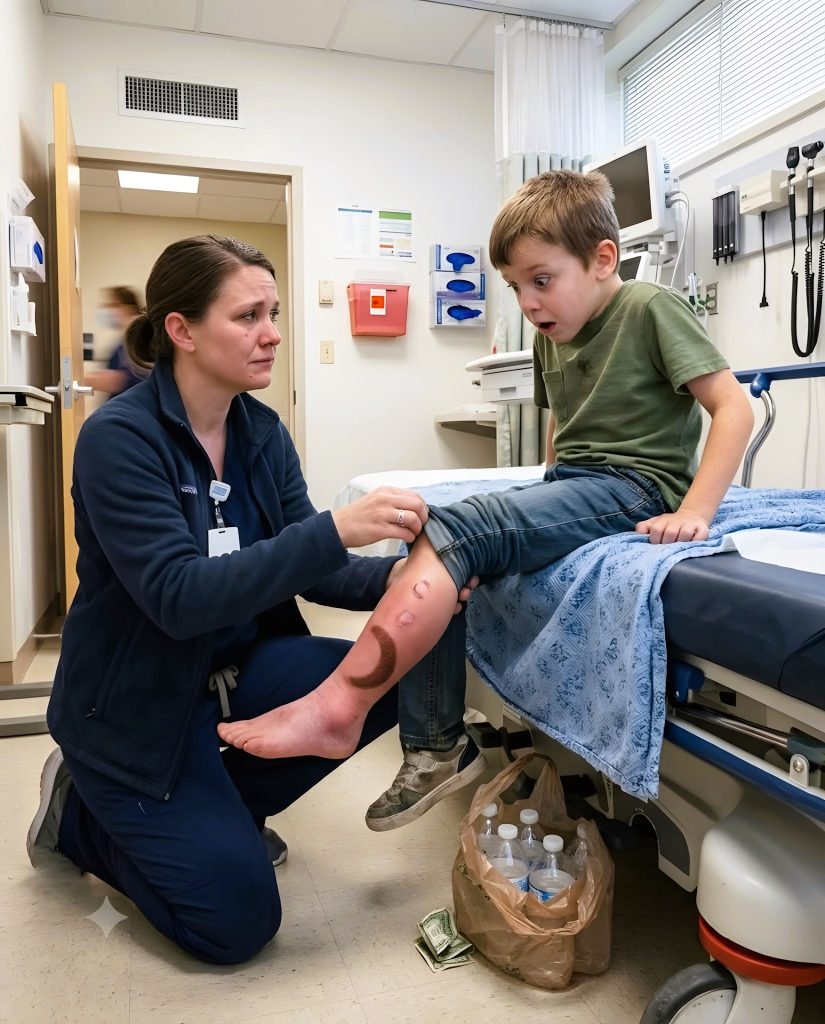
“Please don’t hurt me—I’ll be good,” the little boy whispered when I lifted his torn pant leg, revealing an untreated fracture and the crescent-shaped birthmark of the son stolen from me five years earlier.
For a moment, every sound in the hospital room seemed to move farther away.
The monitor beside the gurney continued its steady beeping. Rubber soles squeaked somewhere beyond the closed door. A cart rattled down the corridor, followed by the low murmur of nurses changing shifts.
But all I could see was that birthmark.
A pale crescent curved above the boy’s ankle, exactly where I remembered it. I had traced that mark with my thumb while rocking my son to sleep. I had kissed it after his bath and joked that the moon had left a piece of itself on him.
My son’s name was Owen.
He had been two years old when he disappeared from a neighborhood playground.
The child in front of me looked about seven now.
He was thin beneath an oversized sweatshirt, and one sleeve had been pulled down over his hand. Dirt darkened the knees of his jeans. His hair had been cut unevenly, as though someone had used household scissors and stopped caring halfway through.
At his feet sat a grocery bag containing six empty plastic bottles.
In his fist were twelve crumpled dollars.
He had walked into the hospital alone carrying everything he believed he needed to purchase medical care.
He had no idea that the woman standing beside him directed the hospital’s child-protection unit.
He had no idea that she might be his mother.
I forced myself to lower his pant leg carefully. The movement made him flinch, and the fear in his face pulled me back into the room.
Whatever that mark meant, I could not turn him into evidence while he was still asking permission to exist.
“You’re not in trouble,” I said.
His fingers tightened around the money.
“I didn’t steal it.”
“I believe you.”
“I brought enough.”
Before I could answer, the door opened.
Police Chief Mark stepped inside, closed it behind him, and gave me a sharp nod. He had come without an announcement and without the cluster of uniforms that usually followed a police chief into an emergency department.
He looked first at the boy, then at the swollen leg, and finally at me.
He recognized my expression.
Mark had been there five years earlier when my life split into before and after.
He had led the search for Owen. He had stood beside me under parking-lot lights while volunteers unfolded maps across the hood of a patrol car. He had watched me hand out flyers until the ink stained my fingers and the paper edges cut the skin beneath my nails.
Now he waited for instructions because he understood that one careless move could send this frightened child running—or warn whoever had brought him here.
“Which exits do you want sealed first?” he asked.
“Parking garage first,” I said. “Then the ambulance lobby. Quietly. No uniforms near this room unless I ask.”
Mark nodded once and stepped into the hallway.
The boy watched the door close.
“Am I arrested?”
“No.”
“Is it because of the bottles?”
His voice was so small that I had to lean closer to hear him, but I stopped myself before entering his space.
“No one is going to arrest you for bringing bottles,” I said. “What is your name?”
He hesitated.
“Ben.”
“Okay, Ben. My name is Claire.”
His eyes moved to the identification badge clipped to my jacket and then returned to my face.
He did not trust names merely because adults offered them.
That was understandable.
A nurse entered carrying pain medication and supplies for an IV. She knew me well enough to notice that something was wrong, but she did not ask questions in front of him.
Instead, she crouched where Ben could see her hands.
“I’m going to explain everything before I touch you,” she said. “First, I’ll put this soft band around your arm. It may feel tight, but it won’t hurt you.”
Ben glanced at me.
I stayed beside the wall rather than crowding him.
“You’re in charge of your body,” I told him. “You can ask her to stop.”
His brow furrowed, as though the idea itself made no sense.
The nurse reached toward the grocery bag to move it away from the gurney.
Ben lunged for it.
“No. Those are mine.”
The sudden movement pulled at his injured leg. He gasped and folded over, clutching the bag against his chest.
The empty bottles crackled loudly inside it.
“Leave the bag,” I said.
The nurse withdrew her hand immediately.
Ben watched both of us, waiting for anger.
When none came, he loosened his grip just enough to look inside. He counted the bottles under his breath, touching each cap with one finger.
Then he flattened the bills against his thigh.
Two fives and two ones.
Twelve dollars exactly.
“Who gave you the money?” I asked.
“No one.”
“Did you earn it?”
He nodded toward the bag.
“Deposits.”
“You collected the bottles?”
“Some were by the trash cans. Some were behind the gas station.”
He said it without pride or complaint. It was simply the work he had done to reach this room.
“Why did you think you needed money?”
His shoulders rose defensively.
“You have to pay first.”
“Not for emergency care.”
“That’s not what she said.”
“Who said that?”
His mouth closed.
I could see the instant regret in his face. He had revealed more than he intended.
I did not press him.
The X-ray images were already displayed on a screen near the foot of the bed. The fracture was impossible to dismiss. The bone had been broken for several days, and the swelling showed what happened when a child was forced to keep walking on an injury that should have been treated immediately.
He had been sleeping on it.
Standing on it.
Being told that pain was a consequence he had earned.
Every instinct in me screamed to gather him into my arms.
Instead, I pointed to the blanket bunched near his hip.
“Can I move this closer to you?”
He considered the question and nodded once.
I pulled the blanket over his legs without touching his skin.
That nod mattered more than every title printed on my office door.
I had spent years teaching doctors, nurses, social workers, and police officers that frightened children needed choices, especially after adults had taken every other choice away from them.
Now I had to follow my own rules while looking at the birthmark I had dreamed about for five years.
“Is twelve enough?” Ben asked.
The question nearly broke me.
I turned my face toward the window for one breath, then looked back at him.
“You don’t have to buy help here,” I said. “The doctors are going to take care of your leg whether you have twelve dollars, one dollar, or nothing.”
He studied me with the careful suspicion of a child who had learned that adults could change the rules halfway through a sentence.
“What happens to the money?”
“It stays yours.”
He looked down at it again.
For five years, I had imagined finding Owen in a hundred impossible ways.
Sometimes I pictured him running toward me through an airport while strangers moved aside. Sometimes I heard him calling me Mom from the end of a grocery-store aisle. Sometimes I dreamed that I woke during a thunderstorm and found him sleeping beside me as though he had never been gone.
I had imagined tears, recognition, and the fierce relief of holding him again.
I had never imagined my son apologizing for needing medical care.
Mark returned to the room and remained near the door.
His eyes moved from the crescent-shaped mark above Ben’s ankle to my face.
“Claire,” he said quietly, “are you certain?”
I understood what he was asking.
Was I certain enough to call this child Owen?
Was I certain enough to begin a criminal investigation?
Was I certain enough to risk frightening him with a truth he might not recognize?
“I’m certain enough to protect him,” I said. “I’m not certain enough to make him carry my certainty. Start a lawful identity check. Until then, he is a hurt child who asked us for help.”
Mark’s expression softened for half a second.
Then he nodded.
Ben looked between us.
“My name is Ben,” he whispered.
“Then Ben is what I’ll call you,” I said.
His shoulders loosened by less than an inch.
The nurse continued preparing his medication, explaining each movement before making it. Ben asked whether the medicine would make him sleep. She told him it might make him tired but that no one would do anything without telling him first.
He looked at me again.
“Will you stay?”
My throat tightened.
“Yes.”
I did not add forever.
I did not call him Owen.
I simply moved a chair near the gurney and sat where he could see me.
After the medication began to ease the worst of his pain, his hands stopped shaking. He still held the twelve dollars, but the bills were no longer crushed inside his fist.
“Who told you to come here?” I asked gently.
“No one.”
“You came by yourself?”
He nodded.
“How did you get inside?”
“I walked.”
“From home?”
Another hesitation.
“I left when Aunt Diane was asleep.”
My body went cold.
The name did not merely surprise me. It opened a door inside my memory that I had spent years trying to keep shut.
Diane was my younger sister.
She was also the last adult known to have seen Owen before he disappeared.
That afternoon, five years earlier, she had offered to watch him at the playground while I answered a work call from my car. According to Diane, she had looked away for less than a minute when another child fell near the swings.
When she turned back, Owen was gone.
There had been no scream.
No clear witness.
No vehicle anyone could identify with confidence.
Diane had called me sobbing. By the time I reached the playground, she was running between the slides and picnic tables, shouting his name until her voice cracked.
For weeks afterward, she stayed beside me.
She answered phones at the volunteer search center. She carried boxes of flyers into diners and grocery stores. She sat through interviews and repeated the same timeline until both of us could recite it from memory.
At candlelight vigils, she stood with one arm around my shoulders and told anyone who asked that she would never forgive herself for looking away.
I believed her.
Grief can make trust feel like oxygen. When you are drowning, you do not question the hand holding you above the surface.
Three months after Owen vanished, Diane moved across the state.
She said the guilt had destroyed her marriage and damaged her health. She stopped attending family gatherings because she could not bear seeing children near Owen’s age. Our phone calls grew shorter. Then they became occasional text messages sent on birthdays and the anniversary of his disappearance.
I had mistaken distance for shame.
Sitting beside Ben, I began to wonder whether distance had been protection.
Not protection for him.
Protection for her.
I kept my voice steady.
“What does Aunt Diane look like?”
Ben stared at the blanket.
“She gets mad when I talk about her.”
“You’re not in trouble.”
“She says people take kids away if they complain.”
The nurse’s hands paused for a fraction of a second before she resumed checking the medication line.
“What happened to your leg?” I asked.
Ben’s breathing changed.
“I fell.”
“Where?”
“At home.”
“Did someone see you fall?”
He pulled the blanket higher.
“I was bad.”
“That isn’t what I asked.”
His eyes filled, but he did not cry.
“She said not to make trouble.”
I wanted answers, but answers could wait. His safety could not.
I glanced at Mark.
He understood and stepped into the hallway to speak quietly into his radio.
Ben watched him leave.
“Are you calling her?”
“No,” I said. “We’re making sure no one comes into this room without your permission.”
“She’ll be mad.”
“She is allowed to have feelings. She is not allowed to hurt you.”
He looked at me as though I had spoken in another language.
A few minutes later, Mark’s radio clicked once.
He listened to the voice on the other end, asked a brief question, and returned with the controlled expression I remembered from the original search—the look he wore when the worst information still had to be spoken aloud.
“Security found the woman who followed him inside,” he said.
Ben stopped moving.
Mark continued carefully.
“She used a visitor sticker and tried the garage door after we locked it.”
The bills slipped from Ben’s fingers onto the blanket.
A woman’s voice rose beyond the double doors.
“You can’t keep him from me!”
Ben folded over his injured leg and covered both ears with his hands.
The movement sent a flash of pain across his face, but he seemed more afraid of the voice than of the fracture.
I stood and placed myself between him and the door.
“Ben, look at me.”
He could not.
His eyes were squeezed shut.
“She’ll say I lied,” he whispered.
“You don’t have to speak to her.”
“She said she’d leave me somewhere if I told.”
“You are not leaving with her.”
I did not raise my voice. I did not make a promise I lacked the authority to keep alone.
But I knew the procedures. I knew the documentation already in that room. I knew what an untreated fracture, a fearful disclosure, and an attempted unauthorized removal meant for immediate protection.
Most of all, I knew that I would not surrender him because someone demanded access loudly enough.
Mark turned his phone toward me.
A still image from hospital security filled the screen.
The woman in the picture wore a visitor sticker on her coat. Her face was older and thinner than I remembered. Her hair was pulled back severely, and anger had sharpened the familiar lines around her mouth.
But there was no possibility of mistake.
It was Diane.
My sister had not merely been the last person to see my son before he disappeared.
She had brought him into my hospital under another name.
She had allowed him to walk for days on a broken leg.
She had taught him to collect bottles because she wanted him to believe that medical care had to be purchased before anyone would help him.
And now she was standing inside the child-protection unit I directed, demanding that we let her speak to him alone.
For five years, Diane had cried beside me at vigils.
She had watched me search drainage ditches, parking lots, and backyards.
She had listened while I blamed myself for answering one phone call.
She had let me believe a stranger had taken Owen.
All the while, she had known exactly where he was.
The woman beyond the doors shouted again.
“Ben, tell them I’m your mother!”
Ben’s hands pressed harder against his ears.
I looked at the child on the gurney, at the crescent-shaped mark above his injured ankle, at the twelve dollars lying on the blanket, and at the bag of empty bottles he still refused to release.
Then I looked at Mark.
“Do not bring her into this room,” I said.
His nod was immediate.
Outside, Diane’s voice dropped from shouting to something softer and more dangerous.
“Claire,” she called through the doors. “You don’t understand what happened.”
She knew I was there.
She knew I had seen him.
And after five years of lies, my sister was finally going to have to explain how the son stolen from me had grown up calling her Aunt Diane.
THE END! THANKS FOR READING!