
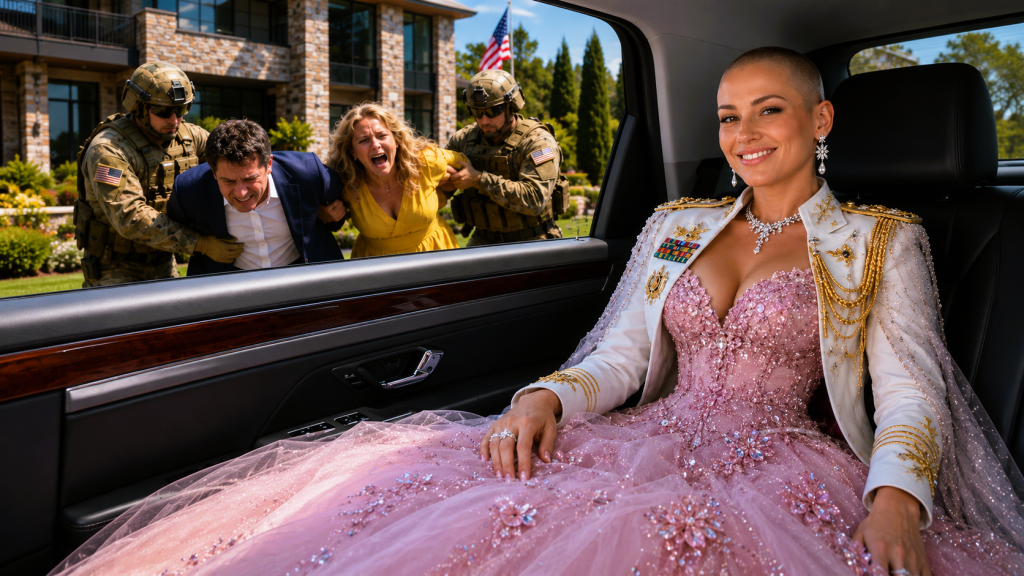
The message from my attorney was brief, but every word carried weight. “Do not confront them until we finish verifying the documents. Ryan appears to have used your identity, military income, and electronic signature to obtain several loans. Linda is listed as a co-applicant on at least two of them.”
For a long moment, I sat motionless at the kitchen table.
The house around me was silent. The refrigerator hummed. The clock above the stove clicked forward one second at a time. Down the hallway, my husband and his mother slept peacefully, believing they had finally broken my resistance.
They had no idea I was staring at evidence that could destroy both of them.
I opened the attachments.
The first document was an application for a personal loan of $48,000. My name appeared at the top beside Ryan’s. The application listed my rank as lieutenant colonel, my years of service, my monthly military income, and the estimated value of my retirement benefits.
The signature at the bottom looked almost exactly like mine.
Almost.
Ryan had copied the long upward stroke I used on the first letter of my last name. He had imitated the small curve beneath my initials. But the pressure marks were wrong, and he had made the final line too straight.
I had signed thousands of official documents during my career.
That was not my signature.
The second attachment showed a home-equity application I had never seen. The third contained records from a private investment company. The fourth was a credit request connected to a business called Marshall Automotive Consulting.
Ryan had never told me he owned a consulting company.
According to the papers, the company had existed for eleven months.
Its registered address was our house.
Its listed president was Ryan.
Its financial guarantor was me.
I scrolled through page after page, my mind becoming colder and clearer with each discovery.
There were equipment leases, commercial credit lines, insurance documents, and a contract for a warehouse outside Alexandria. One loan had already entered default. Another had missed two payments. The combined liability was more than $230,000.
My attorney had highlighted several sections.
Ryan had claimed I was actively involved in the business.
He had represented me as a silent partner.
He had submitted copies of my military pay statements.
He had even attached a letter describing my “guaranteed promotion and increased compensation.”
That sentence disturbed me more than the amount of money.
The promotion had been closely held.
Only a small number of people knew before the official announcement. Ryan knew I was being considered, but I had never told him the date, the exact position, or the level of command.
Yet one of the applications had been submitted six weeks before the promotion ceremony.
Someone had given him information he should not have possessed.
I forwarded everything to the military legal office, then sent a secure message to the security officer assigned to my new command.
I did not accuse anyone.
I simply reported facts.
Possible identity theft.
Unauthorized access to personal financial records.
Possible disclosure of protected personnel information.
Potential vulnerability involving the incoming commander of a strategic intelligence unit.
Within seven minutes, my phone rang.
The name on the screen belonged to Major General Arthur Bennett, the two-star general who had congratulated me hours earlier.
I stepped quietly onto the back patio before answering.
“Colonel Marshall,” he said. “Are you safe?”
“Yes, sir.”
“Are you alone?”
“At the moment.”
“Can anyone in the residence hear this conversation?”
“No, sir.”
His voice remained calm, but the warmth from the promotion ceremony was gone.
“Your security officer contacted me. I’ve reviewed the initial report. Do not discuss the documents with your husband or his mother. Do not access any additional files from that laptop unless instructed. Preserve everything exactly as it is.”
“Yes, sir.”
“Do you believe either individual has access to your military devices, identification, building credentials, or classified materials?”
“No classified materials are kept in the residence. My official devices remain secured according to protocol. My identification card was in the locked compartment of my travel case, but I will verify it immediately.”
“Do that. Then leave the residence.”
I looked through the patio door.
The kitchen light reflected off the dark glass. Beyond it, the hallway led toward the bedroom where Ryan and Linda were sleeping.
“Sir, I was planning to leave before they woke.”
“Good. A security team will meet you at the north entrance of Fort Belvoir. Do not take your normal route. Your attorney is coordinating with civilian authorities regarding the financial fraud. We’ll handle the security concerns.”
“Yes, sir.”
There was a short silence.
Then General Bennett’s voice softened.
“I also read the portion of your report concerning the physical assault.”
My hand moved instinctively toward my shaved head.
“Understood, sir.”
“You are not required to minimize what happened simply because the injury was not life-threatening.”
“I know.”
“Do you?”
The question landed harder than I expected.
For twenty-two years, I had entered dangerous environments, briefed senior leaders, and made decisions that affected people across continents. I had learned to control fear, anger, exhaustion, and grief.
But inside my own home, I had slowly accepted behavior I would never have tolerated from a subordinate, colleague, or stranger.
Ryan had mocked my work.
Linda had insulted my service.
They had used my money while resenting the career that earned it.
And only hours earlier, Linda had stood over me while I slept and cut away my hair to teach me obedience.
“I do now,” I said.
“Report to the north entrance. We’ll speak in person.”
The call ended.
I went back inside and checked the locked compartment of my travel case.
My military identification card was there.
My passport was not.
I searched the remaining compartments.
Nothing.
My personal passport had been stored beside the identification card three days earlier. I remembered placing it there after returning from an official trip.
Ryan knew where I kept the case.
I added the missing passport to my report.
Then I packed two civilian outfits, basic toiletries, medications, my personal documents, and the external drive containing copies of our household financial records. I took photographs of the bedroom, the hair scattered across the pillow, the clippers on the dresser, and the uneven sections Linda had shaved before I finished the job myself.
I placed several strands of hair in a clean plastic bag.
It felt strange preserving pieces of myself as evidence.
Before leaving, I walked through the house one last time.
The framed wedding photograph above the fireplace showed Ryan and me smiling beneath an arch of white flowers. I had been thirty-nine, already a major, still foolish enough to believe that love could survive without respect.
Ryan had seemed proud of me then.
He told everyone he admired strong women.
What he meant was that he admired the appearance of strength when it benefited him.
He liked telling people his wife was an Army officer. He liked the steady income, the health coverage, the invitations to formal events, and the respect strangers offered when they learned about my service.
But every promotion had made him more resentful.
Every time someone saluted me, something inside him seemed to shrink.
Instead of building a life beside me, he had tried to make me smaller.
Linda had simply said aloud what Ryan had spent years implying.
A wife belonged beneath her husband.
A woman’s success was acceptable only until it made a man feel ordinary.
I removed the wedding photograph from the wall and laid it facedown on the mantel.
Then I carried my uniform, luggage, and laptop to the car.
As I reached the front door, I heard footsteps behind me.
Ryan stood at the end of the hallway in sweatpants and a T-shirt.
His eyes moved from my luggage to the garment bag over my shoulder.
“Where are you going?”
I looked at him without emotion.
“To work.”
His face tightened.
“You said you were going to devote yourself to this family.”
“I am.”
“Then why are you carrying your uniform?”
“Because my understanding of family has changed.”
He walked toward me.
“Don’t start this dramatic military nonsense. Mom cut your hair. It was wrong, maybe, but you embarrassed her. You came home acting like some kind of queen because you got promoted.”
“I came home and told my husband I had achieved the greatest professional honor of my life.”
“You expected us to celebrate while you announced you’d be even less available.”
“I expected you not to let your mother assault me in my sleep.”
He stopped a few feet away.
The certainty in his expression flickered.
“You’re calling it assault now?”
“That is what it was.”
“My mother is sixty-two years old.”
“And fully capable of understanding that she did not have permission to touch me.”
Ryan glanced toward the hallway, probably checking whether Linda had awakened.
Then he lowered his voice.
“Let’s talk about this after you calm down.”
“I am calm.”
“That’s what worries me.”
He reached for the garment bag.
I stepped back before his hand touched it.
“Do not touch me or my belongings.”
His eyes widened.
“Are you threatening me?”
“No. I’m establishing a boundary. You are simply unfamiliar with hearing one.”
The bedroom door opened.
Linda appeared wearing her robe.
When she saw my shaved head, luggage, and uniform, her mouth hardened.
“You lied to us.”
“No,” I said. “You made assumptions.”
“You said you were going to put this family first.”
“I did. I removed two people who were damaging it.”
Ryan stared at me.
“What does that mean?”
My phone vibrated.
A message from the security team confirmed they were waiting.
I opened the front door.
“You’ll understand soon.”
Ryan moved into the doorway.
“You’re not leaving until we finish this conversation.”
For years, he had used that tone whenever he wanted to turn a request into a command.
Usually, I had chosen peace.
That morning, I chose clarity.
“Move.”
Something in my voice made him obey.
He stepped aside.
Linda pointed at me.
“If you walk out that door, don’t expect my son to take you back.”
I looked at Ryan.
He was no longer angry.
He was frightened.
Perhaps he had remembered the forged documents. Perhaps he had realized that the cards in his wallet would no longer work. Perhaps he was finally beginning to understand that my silence was not surrender.
“I won’t,” I said.
Then I left.
The sky was pale gray as I drove away.
For the first time in years, the road ahead felt open.
At Fort Belvoir, two security officers met me at the designated entrance. They escorted me to a private conference room where General Bennett, a military attorney, a counterintelligence officer, and my incoming deputy commander were waiting.
No one stared at my shaved head.
No one asked why I had not hidden it beneath a scarf.
They looked at me as soldiers look at another soldier who has arrived for duty.
General Bennett stood.
“Colonel.”
“Sir.”
He gestured toward the table.
“Sit down. We have several issues to address.”
For the next three hours, I answered questions.
When had Ryan first learned I was being considered for promotion?
Who had access to my home?
Had he ever asked about my assignments?
Did Linda know any military personnel?
Had either of them traveled recently?
Did Ryan have friends at the Pentagon, Fort Belvoir, or within the defense-contracting community?
At first, my answers seemed ordinary.
Ryan knew the general nature of my work but not operational details. Linda had attended a few formal military events. Ryan had sometimes complained that I was secretive. He frequently asked when I would be traveling, when I would return, and whether my new command came with a larger housing allowance.
Then the counterintelligence officer, Special Agent Elena Ruiz, placed a photograph on the table.
“Do you know this man?”
The image showed a tall man leaving a restaurant. He wore an expensive suit and carried a leather briefcase.
I recognized him immediately.
“His name is Victor Hale. Ryan introduced him as an investor from the dealership.”
“When?”
“Approximately eight months ago.”
“How often have you seen him?”
“Three times. Once at our house, once at a restaurant, and once at a holiday gathering hosted by the dealership.”
“What did you discuss?”
“Nothing significant. Ryan said Mr. Hale invested in automotive businesses. He asked general questions about my career.”
“What kind of questions?”
I searched my memory.
“At dinner, he asked whether promotions in military intelligence required special background investigations. He asked whether senior commanders traveled with security teams. He asked if I planned to remain in the Washington area.”
Agent Ruiz leaned forward.
“How did you respond?”
“I told him personnel procedures were not appropriate dinner conversation.”
“Did Ryan react?”
“He laughed and said I treated everything like a classified briefing.”
General Bennett and Agent Ruiz exchanged a look.
“Victor Hale is not an automotive investor,” she said. “He works as an intermediary for several foreign-owned companies currently under federal investigation.”
The room became very still.
“What kind of intermediary?”
“He identifies people with access, debt, resentment, or personal vulnerabilities. Then he builds relationships.”
I thought of Ryan’s bitterness, his unstable employment, and his obsession with appearing successful.
“You believe he targeted my husband.”
“We believe that possibility must be investigated.”
Agent Ruiz opened another folder.
“Two months ago, Hale transferred $75,000 into an account controlled by Marshall Automotive Consulting.”
The amount matched one of the business filings.
“What was the payment described as?”
“Advisory services.”
“Ryan has no expertise that would justify that payment.”
“We agree.”
My deputy commander, Lieutenant Colonel James Holloway, had remained silent until then.
“Ma’am,” he said carefully, “did your husband ever have access to your calendar?”
“My personal calendar, yes. Not my secure schedule.”
“Could he infer your travel from conversations, luggage, or household planning?”
“Yes.”
“Could he identify people you worked with socially?”
“Some of them.”
A cold realization settled over me.
Ryan did not need access to classified documents to create danger.
A spouse could notice patterns.
When I left early.
When I packed formal uniforms.
When senior officers called.
When an unexpected trip was postponed.
Small details could become valuable when collected over time.
Agent Ruiz seemed to read the thought on my face.
“This does not mean your husband obtained classified information,” she said. “At present, we have no evidence he did. But his financial relationship with Hale, combined with the forged documents and unauthorized access to your personnel information, creates serious concerns.”
“What happens next?”
“We secure your accounts, devices, and residence. Civilian authorities execute the appropriate legal process. You do not contact Ryan, Linda, or Hale. You do not warn them. You continue reporting anything you remember.”
General Bennett folded his hands on the table.
“There is another question.”
I looked at him.
“Are you prepared to assume command under these circumstances?”
No one in the room moved.
The answer mattered.
Not because anyone believed I had caused the situation, but because command required judgment. My personal crisis could not be allowed to endanger the unit.
I thought of the night behind me.
The humiliation.
The forged signatures.
The missing passport.
The possibility that my husband had allowed greed and resentment to place national security at risk.
Then I thought of the soldiers and civilians waiting for their new commander.
“Yes, sir,” I said. “I am.”
General Bennett studied me.
“What support do you require?”
“Temporary secure housing. Assistance separating my personal financial exposure from the investigation. Permission to disclose enough to my deputy and senior staff to explain any schedule disruptions. And a direct assessment if investigators believe I have become a liability.”
Holloway straightened.
“Ma’am, you’re not a liability.”
I looked at him.
“That determination belongs to the investigation, not my pride.”
General Bennett nodded slowly.
“That answer is why you were selected.”
At 0900 hours, I entered the command auditorium.
Nearly two hundred soldiers, intelligence analysts, civilian specialists, and support personnel stood when I walked onto the stage.
I wore my dress uniform.
The silver eagle insignia rested on my shoulders.
My head was completely shaved.
A few people noticed. Their eyes briefly widened. Then their attention returned to the ceremony.
The outgoing commander read the transfer orders.
General Bennett spoke about readiness, integrity, and trust.
Then I stepped forward and accepted the unit colors.
The fabric felt heavy in my hands.
Command was not authority alone.
It was responsibility.
It was the promise that every person beneath that flag would be protected, prepared, and led with honesty.
I faced the formation.
“Good morning.”
“Good morning, ma’am,” they answered.
“My appearance may be different from what some of you expected today.”
A faint tension moved through the room.
I continued.
“Last night, I was reminded that control and leadership are not the same thing. Control is taken through fear, pressure, or humiliation. Leadership is earned through competence, discipline, and trust.”
The auditorium became completely silent.
“This command will not confuse the two. We will protect one another. We will report concerns early. We will never mistake silence for strength. And we will never allow personal pride to become a threat to the mission.”
I paused.
“I am honored to serve as your commander.”
The applause began in the front row and spread through the auditorium.
It was not polite applause.
It was steady and powerful.
For the first time since waking, emotion tightened my throat.
I did not cry.
But I allowed myself to feel it.
After the ceremony, my new command sergeant major, Denise Carter, approached me.
She had served twenty-six years and possessed the calm expression of someone who had seen every kind of crisis.
“Ma’am,” she said, “your office is ready.”
“Thank you, Sergeant Major.”
She hesitated.
“I don’t need details. But I want you to know the team has your back.”
I met her eyes.
“I appreciate that.”
“And for what it’s worth, the haircut looks strong.”
A small laugh escaped me.
It was the first genuine laugh of the day.
“Thank you.”
By noon, Ryan had called forty-three times.
Linda had called nineteen.
There were messages from both of them.
At first, Ryan sounded angry.
“What did you do to the cards?”
Then confused.
“The truck payment didn’t go through. Call me.”
Then demanding.
“You cannot shut down household money without discussing it with me.”
Then frightened.
“Two men came to the house asking questions. What did you tell people?”
Linda’s messages were less controlled.
“You are punishing us over hair.”
“You are abandoning your responsibilities.”
“The electricity notice says the automatic payment was removed.”
“Ryan says the business account is frozen.”
“Come home and fix this.”
I saved every message and forwarded them to my attorney.
I did not respond.
That afternoon, civilian investigators executed warrants connected to the fraud allegations. They recovered my passport from a locked drawer in Ryan’s home office.
They also found copies of my military travel records.
Not official travel orders.
Photographs.
Someone had photographed pages from a notebook I kept in my personal desk. The notebook contained no classified information, but it included dates, names, reminders, and abbreviations from unclassified meetings.
In the wrong hands, even harmless information could become part of a larger pattern.
The investigators also recovered a second phone registered under Linda’s name.
The device contained messages between Linda, Ryan, and Victor Hale.
Agent Ruiz showed me selected portions two days later.
Linda had not merely known about the loans.
She had encouraged them.
In one message, she wrote, “She owes Ryan after making him live like a dependent all these years.”
In another, she said, “Once she gets the promotion, the bank will increase the limit.”
Ryan complained that I might refuse to guarantee the warehouse lease.
Linda replied, “Then remind her what happens to women who choose work over family.”
The hair attack had not been spontaneous.
Three days before my promotion ceremony, Linda had searched online for ways to humiliate a woman without causing serious injury.
The phrase made my stomach turn.
She had planned it.
Ryan knew she intended to “teach me a lesson,” although investigators could not initially prove that he knew she planned to use clippers while I slept.
However, the messages revealed something worse.
Ryan had given Victor Hale information about my likely promotion in exchange for money.
He claimed he had only shared “public career details,” but the payments increased whenever he provided dates, names, or travel patterns.
He had told Hale when I attended a strategic planning conference.
He had identified a senior analyst who visited our home during a holiday dinner.
He had described the general timing of my background reinvestigation.
None of the information was classified by itself.
Together, it created a serious security concern.
When Agent Ruiz finished explaining, I stared at the folder in front of me.
“Did Ryan understand who Hale was working for?”
“We don’t know yet.”
“Did he understand the information could be used against me?”
“He says he believed Hale was evaluating defense-related investments.”
I almost laughed.
Not because it was funny.
Because the excuse was so weak.
Ryan had spent years telling me I treated him like he was unintelligent. Now he wanted everyone to believe he had accepted tens of thousands of dollars without asking why a supposed automotive investor cared about military personnel.
“Will he be charged?”
“The financial crimes are already moving forward. Additional charges depend on evidence, intent, and the federal investigation.”
“And Linda?”
“She has been arrested for the assault and for her role in the fraud. Her attorney is requesting release pending trial.”
I looked down at the photographs from the bedroom.
For days, I had avoided thinking about Linda as an attacker.
Part of me still pictured her as an older woman in a robe, complaining about groceries and television programs.
But age did not erase responsibility.
Family did not erase intent.
And humiliation did not become harmless simply because the weapon had been a pair of clippers.
My attorney, Sarah Collins, met me outside the secure building afterward.
She had represented me for several years in estate and financial matters. She was practical, sharp, and never wasted words.
“The divorce petition is ready,” she said.
“File it.”
“You’re certain?”
“I was certain before I knew about Hale.”
She nodded.
“The court has approved temporary exclusive use of the residence to you, but given the investigation, I recommend you remain in secure housing.”
“I agree.”
“The joint property issues will be complicated. The house is in your name, but Ryan may claim marital interest.”
“He can make whatever claim the law permits.”
Sarah watched me carefully.
“You don’t want revenge?”
“I want separation, accountability, and protection.”
“That distinction will help you.”
Ryan was released under strict conditions while the financial case developed. He was prohibited from contacting me directly, entering the house, accessing our accounts, or approaching my workplace.
He violated the spirit of the order immediately, though not the exact language.
He contacted my sister.
He called old friends.
He told people I had used military power to destroy him over a family disagreement.
For years, he had enjoyed presenting himself as the patient husband of a difficult career woman. Now he expanded the story.
According to Ryan, I had become unstable after my promotion.
I had shaved my own head during an emotional breakdown.
Linda had tried to stop me.
I had frozen the accounts to punish them for questioning my mental health.
The lies spread quickly.
Several relatives believed him.
One of his cousins posted online that “some women get one little promotion and think they can ruin everyone beneath them.”
I did not respond publicly.
My command’s legal team issued a brief statement confirming that my private family matter had no effect on operations and that appropriate authorities were handling it.
Then the bedroom photographs became part of the public court filing.
The messages appeared.
The forged signatures appeared.
The loan documents appeared.
The photographs of my stolen passport appeared.
Ryan’s story collapsed within forty-eight hours.
My sister called me after reading the filings.
Her voice shook.
“Why didn’t you tell me how bad it was?”
“I didn’t understand how bad it was.”
“Did he ever hurt you before?”
The question was difficult because the answer depended on what counted as harm.
Ryan had never struck me.
But he had hidden my car keys before important meetings.
He had deliberately scheduled household emergencies when I traveled.
He had mocked me in front of friends.
He had pressured me to place his mother on my insurance.
He had opened my mail.
He had criticized my clothes, my hours, my friendships, and my loyalty.
He had made me explain every expense while spending freely from my income.
He had treated my achievements like betrayals.
“No,” I said at first.
Then I corrected myself.
“Not like this. But yes. In other ways.”
My sister was silent.
“I’m sorry,” she whispered.
“So am I.”
Three weeks after taking command, I stood in my bathroom at temporary housing and examined the first shadow of new hair growing across my scalp.
It was soft and almost invisible.
I ran my hand over it.
The woman in the mirror looked unfamiliar.
Not weaker.
Not damaged.
Simply changed.
My uniform hung on the door behind me. My nameplate, ribbons, and colonel insignia caught the morning light.
I had spent most of my life believing resilience meant returning to exactly who I had been before hardship.
Now I understood that resilience could mean becoming someone new.
At work, the investigation created challenges.
Every access point connected to my personal life had to be reviewed.
My accounts were monitored.
My schedule was adjusted.
Certain personnel were re-interviewed.
I offered to step aside temporarily.
General Bennett refused.
“Your willingness to report the problem immediately protected the mission,” he said. “Removing you for being targeted would teach the wrong lesson.”
“Some people may question my judgment in marrying him.”
“People can conceal who they are.”
“I missed signs.”
“Yes.”
His honesty surprised me.
He continued.
“You missed signs in your marriage. Then you recognized the threat, reported it, preserved evidence, and acted decisively. Commanders are not selected because they never face deception. They are selected because of what they do when deception is discovered.”
I carried those words with me.
The unit required focus.
A major readiness review was approaching. Several departments were behind schedule, and morale had suffered under the previous command’s constant reorganizations.
I met with team leaders, listened to concerns, and established clear priorities.
No unnecessary changes.
No punishment for reporting problems.
No hiding bad news to protect senior leaders.
Within two months, performance improved.
The same principles that allowed me to rebuild the unit helped me rebuild my life.
Identify facts.
Secure resources.
Remove unnecessary risks.
Establish boundaries.
Act consistently.
But personal recovery was not a military operation.
It could not be completed through checklists alone.
Some nights, I woke believing I heard clippers beside my bed.
Sometimes I reached for hair that was not there.
Sometimes I felt embarrassed that an Army colonel had remained in a marriage where she was treated like a wallet and a servant.
A counselor helped me understand that professional competence did not make anyone immune to manipulation.
Abusive relationships rarely begin with obvious cruelty.
They begin with small exceptions.
A joke you forgive.
A boundary you move.
An expense you cover.
An insult explained as stress.
A controlling demand reframed as love.
Over time, the unacceptable becomes familiar.
And familiar things are difficult to recognize as dangerous.
Linda accepted a plea agreement on the assault charge but denied participating knowingly in the larger security concerns. The financial evidence proved otherwise.
She had helped prepare false business documents.
She had impersonated me during at least one telephone verification call.
She had used my personal information to open an insurance account.
The recording from that call was played in court.
Her voice was calm as she claimed to be me.
She gave my date of birth, home address, Social Security information, and military employer details.
When asked whether she understood the financial obligations, she said, “Yes, I approve everything my husband has arranged.”
My husband.
She had erased me so completely that she spoke as though she were the wife in my marriage.
Ryan’s case took longer.
His attorneys argued that he had been manipulated by Victor Hale, that he did not understand the broader implications, and that he believed he had informal permission to use our financial information because we were married.
The forged signatures disproved that claim.
People do not forge permission they believe they already possess.
During a recorded interview, Ryan finally admitted the truth.
He had wanted to build a business before I became a colonel.
He was tired of being introduced as “Colonel Marshall’s husband.”
He believed that if he became wealthy, people would respect him.
Hale offered money and connections.
At first, Ryan shared only details he considered harmless.
Then Hale requested more.
Each payment made the next request easier.
When Ryan realized the situation might be dangerous, he did not report it.
He kept accepting money.
He hoped my promotion would allow him to refinance the failing business and repay everything before I noticed.
Linda believed forcing me to resign would solve two problems.
I would no longer have access to information Hale wanted.
And I would remain home to help repair Ryan’s business.
That was why she shaved my hair.
She believed public humiliation would make me too ashamed to report for duty.
She thought I would call the Pentagon, decline the command, and disappear from military life.
She had mistaken my dignity for something she could cut away.
The divorce hearing occurred seven months after I left the house.
Ryan looked older when he entered the courtroom.
His suit hung loosely on him. His face had lost the confident fullness it once carried. He avoided looking at me until the judge asked whether reconciliation was possible.
“No,” I said.
Ryan finally raised his eyes.
“Your Honor, I still love my wife.”
The words produced no feeling in me.
The judge looked at him.
“Colonel Marshall has filed extensive evidence of fraud, coercive behavior, and unauthorized financial activity. On what basis do you believe reconciliation is realistic?”
Ryan swallowed.
“We were under pressure.”
The judge waited.
Ryan continued.
“My mother interfered too much. I should have defended my wife.”
It was the closest he had come to admitting personal responsibility.
But even then, he placed his mother between us.
The judge turned to me.
“Colonel Marshall, do you wish to respond?”
I stood.
“For years, I believed marriage required me to keep repairing damage I did not cause. I believed patience would create respect. I believed providing more would eventually make them grateful.”
Ryan lowered his head.
“I was wrong. My husband did not fail to defend me in a single moment. He made a series of choices. He used my identity, income, career, and trust. He watched his mother humiliate me because he believed the humiliation would make me easier to control.”
I looked directly at him.
“I do not hate him. But I will never build another life with him.”
The judge granted the divorce.
The financial settlement recognized the fraudulent debts as Ryan’s responsibility to the extent permitted by law. The house remained mine, though I chose not to live there again.
I sold it four months later.
Before the sale, I returned once to collect the last of my belongings.
The rooms were empty.
Without furniture, the house looked smaller than I remembered.
My footsteps echoed through the hallway.
In the bedroom, faint marks remained on the wall where the headboard had rested.
I stood beside the place where I had awakened that night.
For a moment, I could almost see the hair scattered across the pillow.
I could hear Linda’s voice.
“I fixed your priorities.”
She had been right about one thing.
My priorities had changed.
I no longer placed peace above truth.
I no longer placed marriage above safety.
I no longer believed sacrifice was noble when demanded by people who offered nothing in return.
I walked into the bathroom.
The mirror reflected a woman with short dark hair growing evenly around her head.
I had considered keeping it shaved.
In the end, I allowed it to grow naturally.
Not because Ryan had said hair grew back.
Not because Linda had wanted it gone.
Because it was mine.
The choice was mine.
Every inch of it belonged to me.
I locked the front door and handed the keys to the real-estate agent.
As I walked away, I did not look back.
A year after assuming command, our unit received one of the highest readiness ratings in its history.
The official review praised improved reporting, stronger internal safeguards, and a leadership culture built on trust.
At the ceremony, General Bennett stood beside me while the unit colors were decorated.
“You rebuilt this organization during the most difficult year of your personal life,” he said quietly.
“The unit rebuilt itself, sir. I just gave people room to tell the truth.”
“That may be the most important thing a commander can do.”
Afterward, Sergeant Major Carter invited me to speak at a professional-development event for senior female soldiers.
I almost declined.
I did not want my private pain turned into a motivational story.
But Carter said something that changed my mind.
“You don’t have to tell them everything. Tell them what you wish someone had told you.”
So I stood before a room filled with majors, colonels, senior noncommissioned officers, analysts, attorneys, and military spouses.
I told them success did not protect anyone from control.
I told them financial abuse could exist in wealthy households.
I told them humiliation was not a family disagreement.
I told them that reporting a threat inside your home was not disloyal.
I told them that strength did not require silence.
After the speech, a captain waited until the room emptied.
She approached slowly.
“Ma’am, may I ask you something personal?”
“Yes.”
“My husband controls all our accounts. My paycheck goes into an account I can’t access without asking him. He says he manages money better.”
I felt the weight of the moment.
I did not tell her to leave him.
I did not tell her what decision to make.
I gave her the number for confidential legal support and financial counseling.
“You deserve to understand and access your own finances,” I said.
Tears filled her eyes.
“No one has ever said that to me.”
That conversation mattered more than the readiness award.
Two months later, she sent me a short message.
She was safe.
She had opened her own account.
She was working with an attorney.
She thanked me for speaking honestly.
I saved the message.
Ryan eventually pleaded guilty to multiple financial crimes. The broader investigation concluded that he had provided sensitive personal and scheduling information to Victor Hale but had not gained access to classified intelligence.
That distinction mattered legally.
It did not matter emotionally.
He had sold pieces of my life because he resented the value others placed on my service.
Before sentencing, Ryan requested permission to write me a letter.
My attorney asked whether I wanted to receive it.
At first, I said no.
Then I changed my mind.
Not because I wanted an apology.
Because I wanted to know whether he had finally learned to tell the truth.
The letter was six pages long.
He wrote about shame.
He admitted he had been jealous from the beginning.
He said he loved my confidence when we met but later hated the way it made him feel beside me.
He admitted taking my passport.
He admitted photographing my notebook.
He admitted knowing his mother planned to humiliate me, though he claimed he did not know she would shave my hair while I slept.
He wrote that the moment I walked out carrying my uniform, he understood I would never return.
Near the end, he said, “I kept telling myself you made me feel small. The truth is that I felt small because I kept choosing small actions.”
That sentence was honest.
I folded the letter and placed it back in the envelope.
I did not reply.
Forgiveness, I had learned, did not require renewed access.
I could release anger without reopening the door.
Linda sent no apology.
Through her attorney, she continued insisting that I had destroyed the family.
Perhaps she truly believed it.
Some people cannot accept responsibility because their entire identity depends on being the injured party.
I stopped needing her to understand.
Three years after the night my hair was cut, I stood inside the Pentagon again.
This time, I was not receiving a promotion.
I had been asked to brief senior leaders on insider-threat prevention and family-access vulnerabilities.
My presentation included no names.
No personal photographs.
No details that could identify Ryan or Linda.
But the lessons were shaped by everything I had lived through.
Threats did not always arrive through locked gates.
Sometimes they shared your address.
Sometimes they knew your routines.
Sometimes they called themselves family.
The briefing led to improved education for service members and spouses regarding identity protection, financial coercion, and reporting requirements.
When it ended, a civilian official approached me.
“Colonel, your recommendations were unusually practical.”
“They came from experience.”
He nodded, perhaps understanding there was more behind the answer.
That evening, I walked outside beneath a clear autumn sky.
My hair had grown to my shoulders again.
The wind moved it across my face.
I smiled and tucked it behind one ear.
For years, I had imagined the greatest moment of my career would be receiving the silver eagle insignia.
It was important.
But the rank itself was not what changed my life.
The defining moment came hours later, in a quiet bathroom, when I looked at what had been done to me and refused to let humiliation decide who I would become.
Linda had taken the clippers to my hair because she believed obedience could be forced.
Ryan had watched because he believed marriage gave him ownership over my future.
They expected tears.
They expected fear.
They expected me to resign, return home, and spend the rest of my life repairing their failures.
Instead, I secured my accounts.
I reported the truth.
I walked into command.
I rebuilt my life.
And in doing so, I learned that taking command is not always about leading soldiers, directing operations, or standing before a flag.
Sometimes taking command means opening a bank account no one else can access.
Sometimes it means calling an attorney.
Sometimes it means documenting what happened even while your hands are shaking.
Sometimes it means walking away from a house you paid for because remaining inside it would cost too much.
Sometimes it means accepting that the people you love are not entitled to destroy you.
On the anniversary of my promotion, I visited Arlington National Cemetery before sunrise.
I often went there to remember friends who had not returned from deployments.
The rows of white stones stretched across the quiet hills.
I stood before the grave of Major Rebecca Shaw, my closest friend from officer training.
Rebecca had once told me that courage was rarely dramatic.
“Most of the time,” she said, “courage is just the next honest decision.”
She had died twelve years earlier during an overseas assignment.
I placed a small bouquet beside her headstone.
“You were right,” I whispered.
The sun rose slowly behind the trees.
Light moved across the grass and touched the carved names one row at a time.
I thought about the woman I had been when Rebecca knew me.
Ambitious.
Disciplined.
Certain I could solve every problem through effort.
I wished I could tell her that some problems were not meant to be solved.
Some doors were meant to be closed.
Some relationships were meant to end.
Some losses created space for a life that had been waiting beneath fear.
My phone vibrated.
It was a message from Sergeant Major Carter.
“Happy command anniversary, ma’am. The team has a surprise waiting, and no, you are not allowed to cancel it.”
I smiled.
When I returned to headquarters, the conference room was filled with soldiers and civilian employees.
A cake sat on the table.
Someone had placed a small plastic eagle on top.
Holloway, now promoted and preparing for his own command, handed me a framed photograph from my assumption-of-command ceremony.
It showed me standing beneath the unit colors with my head shaved, shoulders straight, and eyes fixed forward.
A silver plaque beneath the photograph read:
CONTROL IS TAKEN.
LEADERSHIP IS EARNED.
I ran my fingers over the words.
For a few seconds, I could not speak.
The people in that room did not know every detail of what had happened the night before the photograph was taken.
They did not need to.
They knew I had arrived.
They knew I had stayed.
They knew we had built something strong together.
“Thank you,” I said.
Sergeant Major Carter smiled.
“You taught us to report the bad news early. So I should inform you that the cake was selected by committee and may represent a serious failure of judgment.”
Everyone laughed.
I looked around the room.
This was family too.
Not because we shared blood or a house.
Because respect moved in both directions.
Because no one demanded that another person become smaller.
Because leadership was not obedience.
It was trust.
Years later, when I finally retired from the Army, I placed my uniform inside a glass display case in my study.
The silver eagle insignia rested above the ribbons.
Beside it, I displayed the photograph from my first day of command.
Visitors sometimes asked why I had shaved my head before such an important ceremony.
I never gave everyone the full story.
Sometimes I simply said, “It was a difficult night.”
Other times, when the person asking needed to hear the truth, I told them.
I told them that my mother-in-law had cut my hair while I slept.
I told them my husband had said it would teach me to obey.
I told them they expected me to surrender my career.
Then I pointed to the photograph.
“But I reported for duty.”
That was the part I wanted remembered.
Not what they did.
What I did next.
Because people who try to control us often want their actions to become the center of our identity.
They want us to remain forever defined as the person they humiliated, betrayed, frightened, or abandoned.
I refused.
My story was not about a woman whose hair was shaved.
It was about a woman who stood up afterward.
It was about a commander who recognized a threat inside her own home.
It was about a wife who stopped confusing endurance with devotion.
It was about a soldier who finally applied the principles of security, accountability, and courage to her personal life.
Ryan and Linda believed they were stripping away my power.
In reality, they exposed the last weakness in the life I had built.
Once I saw it clearly, I removed it.
My hair grew back.
My finances recovered.
My career continued.
My reputation remained intact.
The unit thrived.
And the home they believed I could never live without became nothing more than an address on an old legal document.
The final time I heard Ryan’s voice was almost eight years after our divorce.
He called from an unfamiliar number and left a voicemail.
He said he had completed his sentence and was working again.
He said Linda’s health had declined.
He said he hoped enough time had passed for us to speak.
I listened once.
Then I deleted the message.
Not out of cruelty.
Out of peace.
The life I had built no longer contained a place for him.
That evening, I sat on the porch of my new home overlooking a quiet stretch of the Potomac.
The house was smaller than the old one.
Every payment came from my account.
Every key belonged to me.
Every room felt safe.
A framed American flag from my retirement ceremony hung inside the study. My books filled the shelves. Photographs of friends, soldiers, and colleagues covered the walls.
There were no portraits of Ryan.
No reminders of Linda.
Only the lessons remained.
The wind lifted my hair from my shoulders.
I closed my eyes and listened to the water.
For the first time in my adult life, silence did not feel like something I had to maintain for someone else’s comfort.
It felt like freedom.
That night had begun with a sharp burning pain and the sound of clippers beside my bed.
It had ended with a message from my attorney and the discovery of a betrayal larger than I had imagined.
But the most important thing had happened between those moments.
I had looked into a mirror.
I had seen what they had tried to take from me.
And I had understood that my dignity had never been in my hair, my marriage, my house, or even my rank.
It was in my choices.
They could cut my hair.
They could forge my name.
They could steal my passport.
They could lie to relatives, banks, investigators, and themselves.
But they could not make my final decision for me.
I had taken the clippers from the dresser and finished the haircut with my own hands.
Then I had taken apart the life they believed they controlled.
And piece by piece, decision by decision, I built a better one.
THE END! THANK YOU FOR READING!