
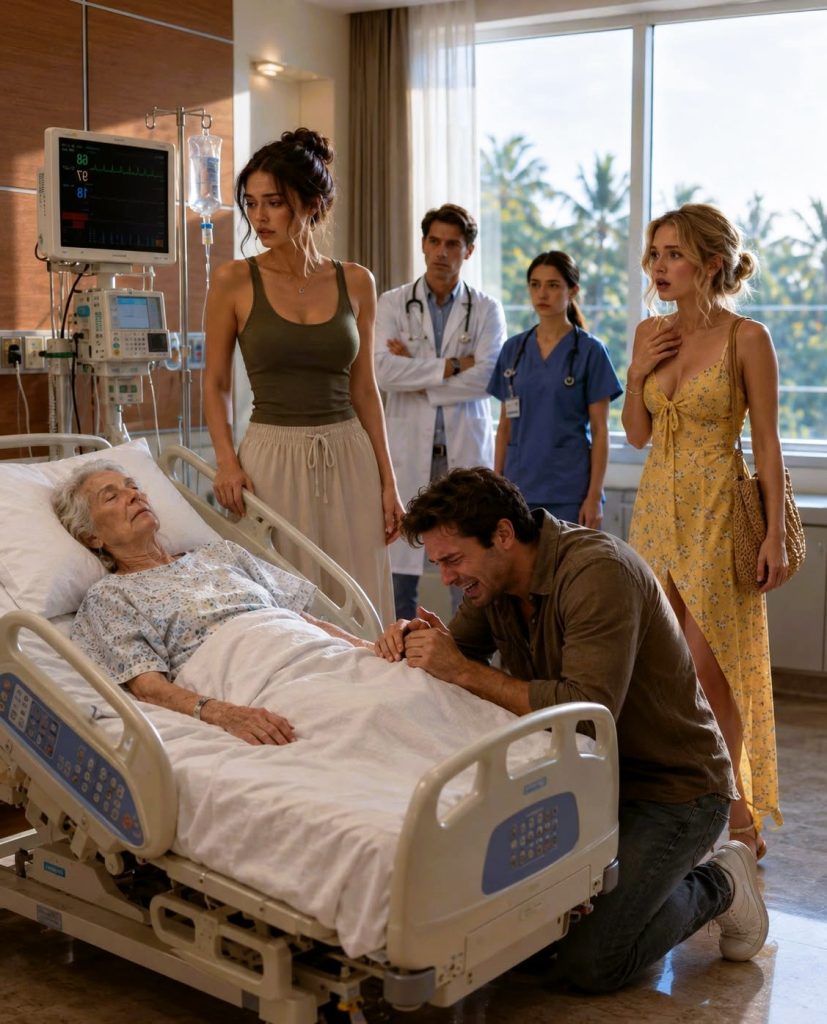
Part 1 — The thirtieth call went to voicemail like the twenty-nine before it. I was sitting on the edge of Margaret’s hospital bed with her hand in mine and the monitor making the sounds that monitors make when they are working very hard and the news is not good, and I had been calling Marcus for four hours.
The one time he had answered, I had heard ocean waves. A woman’s laugh. His voice manufacturing rritation. He said: stop calling me like a lunatic, Elena. I am drowning in critical negotiations. I said: Marcus, your mother—
He said: I’ll call you back.
He did not call back.
My name is Elena and I had been married to Marcus for eleven years and I had been caring for his mother Margaret for twenty — since before we were married, since I was twenty-two years old and had come to her as a housekeeper and had stayed as something that did not have a clean name but was closer to daughter than anything else.
Margaret had been seventy-eight years old.
She had been declining for two years.
I had been managing her medications and her appointments and her good days and her bad days and the specific texture of caring for someone who is moving toward the end of their life with full awareness of where they are going.
Marcus had visited twice in the last year.
Both times he had stayed for dinner and left before the dishes were done.
I held her hand through the night.
At four-seventeen in the morning the monitor changed.
I said: Margaret, please stay with me.
She could not speak.
She had not been able to speak clearly for three weeks.
But her paralyzed fingers moved.
They found my hand.
They held it with a strength that surprised me — the specific strength of someone using everything they have left for one final thing.
Her lips moved under the oxygen mask.
No sound came out.
But I had known Margaret for twenty years.
I read her lips.
She said: no more crying. It’s time.
Then she pressed something into my palm.
Cold. Small. Jagged.
A key.
Her eyes held mine for one more moment.
The monitor flatlined.
I sat with her until the nurses came.
Then I opened my hand.
Part 2 — The Four Days
I handled the cremation alone.
I made the phone calls alone.
I arranged the small service — just Margaret’s two oldest friends and the priest from her parish who had known her for forty years — and I stood at the front and I said the things that needed to be said about a woman who had been more family to me than most of my family.
Marcus’s phone had gone from voicemail to a message saying the mailbox was full.
I texted him: your mother passed away Monday morning at 4:17. I have handled the arrangements. The service was Wednesday. When you are ready to come home, let me know.
He did not respond.
I spent the four days doing what needed to be done.
I also spent them with the key.
It was small and silver and old — the kind of key that opens a specific kind of box, the kind with a simple lock that was made before security became sophisticated.
I went through Margaret’s room systematically.
She had been organized in her habits even as her health had declined, and I knew her room the way I knew my own — every drawer, every shelf, the specific location of the things she kept close.
I found the box on the third day.
It was in the back of the closet, behind winter coats she had not worn in years, inside a hat box with a pattern of roses that I had always assumed contained hats.
It did not contain hats.
The key fit.
I opened it.
I sat on the floor of Margaret’s closet and I read what was inside.
Part 3 — What Margaret Had Kept
The box contained documents.
Not dramatic documents — not a secret will or evidence of a crime.
Something quieter and more significant.
Twenty years of letters.
Letters Margaret had written but never sent.
To Marcus, beginning when he was a child and continuing through his adulthood.
She had written them in the periods when she could not say the things that needed to be said — when Marcus had made choices she could not support, when he had behaved in ways that hurt people she loved, when she had watched him become something she had not raised him to be and had not known how to address directly.
She had written the letters instead.
And she had kept them.
The most recent was dated three months ago.
It was addressed to me.
Not to Marcus.
To me.
It said: Elena. If you are reading this, then the key has done what I saved it to do. I have been trying to find the right moment to give it to you for two years. The right moment never came, which I think means this was the right moment after all.
She wrote: I want you to know that I have seen everything. I am not confused and I am not unaware. I know where Marcus is when he says he is somewhere else. I know what he has been doing and for how long. I know what you have been carrying and how quietly you have carried it.
She wrote: the letters are for you, not for him. Not because they would hurt him — though some of them would — but because I want you to know what I could not say out loud. I want you to know that I saw you. I want you to know that what you gave me was the great gift of my last years. And I want you to know that you do not owe this family anything more than you have already given.
She wrote: the ring in the bottom of the box was my mother’s. I had meant to give it to you years ago. It does not belong to Marcus. It belongs to you. Do with it what you like.
She wrote: no more crying, Elena. It’s time.
I sat on the floor of her closet for a long time.
Then I went to the kitchen and I made tea and I sat at the table and I read every letter she had written.
It took three hours.
When I finished I understood Margaret completely for the first time.
Not differently from how I had understood her before.
More fully.
Part 4 — The Morning Marcus Came Home
He came home on a Friday.
Four days after his mother died.
He came in tanned and carrying a gift bag from somewhere that had the specific look of an airport purchase designed to suggest consideration.
The white urn was on the mantle.
He looked at it.
He set the gift bag down.
He said: Elena.
I said: the service was Wednesday. Her friends were there. Father Thomas spoke.
He said: I got here as fast as I could.
I looked at him.
I did not say what I was thinking about thirty calls and voicemail and ocean waves in the background.
I said: sit down, Marcus.
He sat.
I put the divorce papers on the table.
I had called Patricia Webb on Tuesday and she had filed on Wednesday and the papers had arrived Thursday morning and I had them ready.
I also put the ring on top of the papers.
Margaret’s mother’s ring, which she had left in the box for me.
I was not keeping it as a trophy.
I was returning it to the table because it belonged in the accounting of what was being settled here, and because Marcus needed to see that his mother had made a choice about where it went, and that choice was not him.
He looked at the papers.
He looked at the ring.
He said: Elena—
I said: Patricia’s office will be in contact with your attorney.
He said: you can’t just—
I said: Marcus, your mother pressed a key into my hand as she died. The key opened a box. The box contained twenty years of letters she had written and never sent, including one to me that she had been waiting for the right moment to give me for two years.
He said nothing.
I said: she knew. About Hawaii. About the woman in Hawaii. About how long it had been going on.
He said: my mother didn’t—
I said: she wrote it down. Three months ago. In a letter she kept in a box in the back of her closet with a key pinned to her undergarments.
He said: Elena.
I said: she said I didn’t owe this family anything more than I had already given.
He said: you’re going to throw away eleven years because—
I said: I’m not throwing anything away. I’m setting it down.
I picked up my bag.
I had packed it on Thursday.
I said: the ring is from her mother. She left it for me. It’s in the papers as a separate item that predates the marriage and is not subject to division.
He said: you went through her things.
I said: she gave me the key.
He said: Elena, please—
I said: goodbye, Marcus.
I left.
Part 5 — After The Urn
I went to my sister’s.
Not dramatically — I had called her on Tuesday and she had said come whenever you’re ready and I had been ready on Friday morning.
She made dinner.
We sat at her kitchen table and I told her the parts of it I was ready to tell and she listened and didn’t ask for the parts I wasn’t.
After dinner she said: are you going to be okay?
I said: yes.
She said: are you going to be more than okay eventually?
I said: I think so.
She said: Margaret sounds like she was something.
I said: she was.
She said: she kept those letters for twenty years.
I said: yes.
She said: why do you think she never sent them?
I thought about it.
I said: I think she was always hoping she wouldn’t have to. That he would become who she had raised him to be without needing to be confronted with the letters.
She said: and instead she gave them to you.
I said: yes.
She said: that’s a strange gift.
I said: it was the right gift. I needed to know that she saw it. That she saw me.
My sister said: I see you too.
I said: I know.
The divorce was finalized seven months later.
Patricia handled it with the thoroughness I had come to expect from her.
Marcus did not contest most of it.
There was a period in month three where his attorney made arguments about the ring, which Patricia resolved quickly by producing Margaret’s letter, which established clearly that the ring had been left specifically to me and was not a marital asset.
His attorney withdrew the argument.
I kept the ring.
Not because of its value.
Because Margaret had kept it for me for twenty years in the bottom of a box with a key pinned to her undergarments.
That is not a small thing.
That is the kind of thing you keep.
I found an apartment in the spring.
It had a window seat in the bedroom that got morning light, and I had always wanted a window seat, and buying furniture for a space that was entirely mine felt like something worth taking time over.
I took time.
I visited Margaret’s grave on the six-month anniversary.
I brought the flowers she had always preferred — simple ones, nothing elaborate, the kind that looked like they had come from a garden rather than a shop.
I stood for a while.
I said: I read all the letters.
The wind moved the flowers.
I said: you were a better mother than he deserved. You were a better friend than I knew how to receive for a long time.
I said: no more crying. I know. I’m working on it.
I put the flowers down.
I drove home to the apartment with the window seat.
Some people love you in the ways that are visible.
Some people love you in letters they write for twenty years and keep in a box with a key pinned to their undergarments.
Both kinds are real.
The second kind is sometimes more.
See the people who see you.
Receive what they try to give you.
And when they press a key into your palm as they go —
open the box.
THE END! THANKS FOR READING!