
My husband went fishing with his brother and never came home. For one year, I lived inside that sentence. It followed me into the kitchen when I packed school lunches for our daughters. It sat beside me in church while everyone bowed their heads and prayed for peace I could not feel.
It slept in the empty space beside me in bed, cold and heavy, pressing against my ribs every night until breathing felt like something I had to remember how to do. My husband, Gabriel, was not the kind of man who vanished.
He was careful.
Steady.
Predictable in the comforting way good men often are.
He checked the weather before mowing the lawn.
He tested the smoke detectors every first Saturday of the month.
He kept emergency blankets in both cars, even though we lived in a quiet town where the worst traffic delay was usually caused by geese crossing the road.
That was Gabriel.
He planned.
He protected.
He came home.
So when his younger brother, Nick, suggested a fishing weekend at Lake Mercer, I did not worry.
Nick had always been more restless than Gabriel, more impulsive, more charming in a way that made people forgive him before he even apologized.
He was the kind of man who could show up late, empty-handed, and still leave with everyone laughing.
Gabriel was different.
Gabriel showed up early.
Gabriel brought extra.
Gabriel remembered what everyone else forgot.
They had not taken a brothers’ trip in years.
Nick said they needed it.
“Just two nights,” he told me, leaning against my kitchen counter while Gabriel searched for his tackle box in the garage. “A little fishing, a little beer, some peace and quiet. I’ll bring him back in one piece, Sarah.”
I remember smiling.
I remember saying, “You better.”
I remember Gabriel walking in at that exact moment, carrying his old brown jacket over one arm.
It was the jacket he wore for camping, yard work, cold mornings, and every fishing trip since before we were married.
There was a tiny burn mark near the cuff from the first apartment we rented, when he tried to make me breakfast and set a potholder too close to the stove.
There was a stitched patch inside the collar where I had repaired a tear after Olivia, our oldest, was little and had grabbed onto it with chocolate-covered hands.
That jacket was part of him.
He kissed me before he left.
Not quickly.
Not the distracted kiss of a man thinking about roads and boat ramps and bait.
He kissed me like he was storing the moment.
Then he knelt and hugged our daughters.
Olivia was fourteen then, old enough to pretend she was too grown for her father’s forehead kisses, but she leaned into him anyway.
Maddie was ten and asked if he would bring back a fish bigger than her backpack.
Sophie was six and cried because she thought “guys’ weekend” meant she would never see him again.
Gabriel laughed and scooped her into his arms.
“Two sleeps,” he promised her. “That’s all. Daddy will be home after two sleeps.”
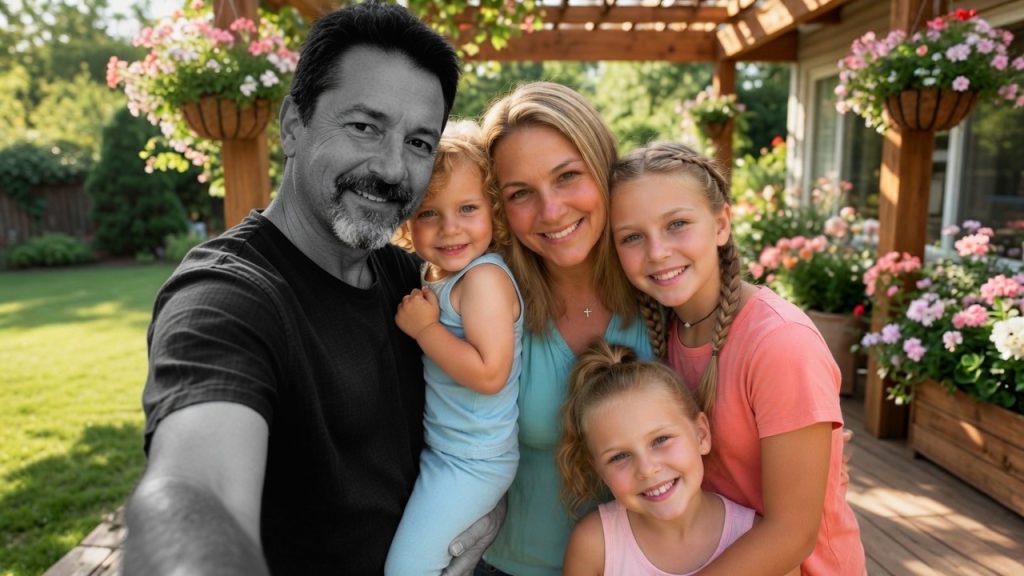
He looked back once from the driveway.
I was standing on the porch with Sophie on my hip, Maddie waving both arms, and Olivia trying not to look emotional.
Gabriel lifted his hand.
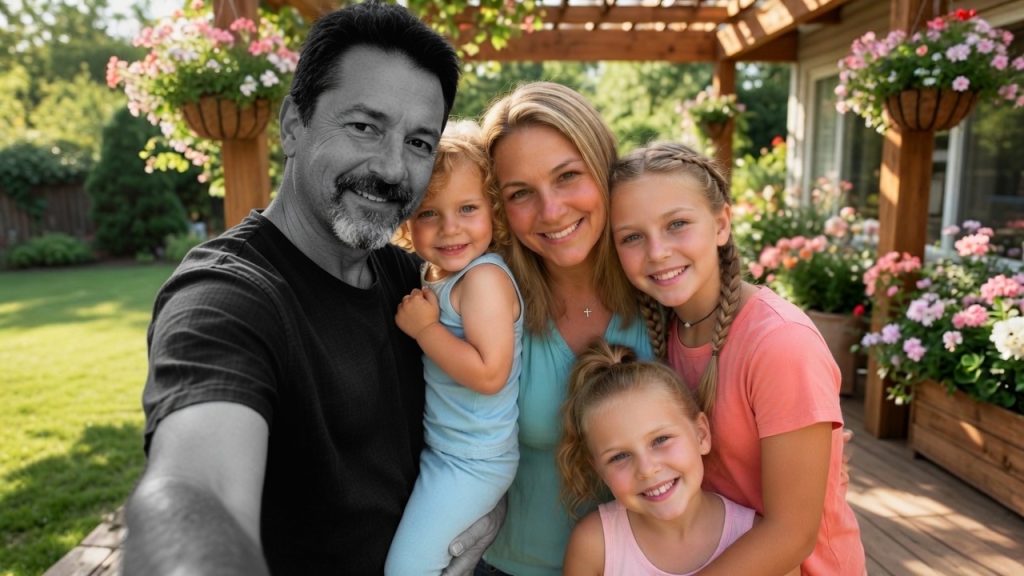
Then Nick honked the horn, shouted something about fish waiting to be caught, and they drove away.
Two days later, Nick came back without him.
He did not come alone.
He came with two police officers.
I knew before anyone said a word.
There is a certain way people look at you when your life is about to be divided into before and after.
Nick stood on my porch in muddy boots and a rain-darkened shirt, his face gray, his eyes red.
The officers were behind him.
One of them held his hat in both hands.
“Sarah,” Nick said, and his voice broke perfectly. “Gabriel disappeared.”
My body became ice.
“What do you mean disappeared?”
Nick swallowed.
“He got up early to fish. I was still asleep. There was a storm. A bad one. When I woke up and went to check on him, he was gone.”
“No.”
That was the only word I could say.
No.
No, because Gabriel checked forecasts.
No, because Gabriel would never go out alone during a storm.
No, because Gabriel promised Sophie two sleeps.
No, because Gabriel loved us.
No, because men like him did not vanish into water and leave nothing behind.
The police searched the forest.
They searched the cabin.
They searched the trail down to the lake, the dock, the shoreline, and the muddy banks where the storm had churned everything into brown, ruined earth.
Divers went into the water.
Dogs followed scents until the rain erased them.
Volunteers walked in lines through the trees calling his name.
I called it too.
I screamed it until my throat tore.
Gabriel!
Gabriel!
Gabriel!
But the forest only gave back echoes.
They found his tackle box.
They found one boot near the dock.
They found a broken fishing rod.
They did not find Gabriel.
They did not find his jacket either.
That detail stayed with me.
The officers said he must have been wearing it when he fell.
Nick said the same thing.
“He had it on when we got there,” he told them. “I remember because I joked he looked like an old man.”
I wanted to ask why Gabriel would wear a jacket onto a slick dock during a storm.
I wanted to ask why he would go at all.
I wanted to ask why Nick’s story changed in tiny ways every time he told it.
At first, Nick said he woke because thunder shook the cabin.
Then he said he woke because Gabriel had not come back for coffee.
Then he said he slept until almost nine.
Then he said maybe it was eight-thirty.
Every change was small enough for people to excuse.
Shock, they said.
Trauma, they said.
Grief makes memory unreliable.
I knew grief.
Grief had moved into my house and rearranged the furniture.
Grief had taught my children to whisper.
But grief did not make Gabriel careless.
The official theory became simple.
Gabriel woke early.
Gabriel went fishing alone.
A storm came suddenly.
He slipped, fell into the swollen water, and was swept away.
No body.
No proof.
No goodbye.
After a year, Gabriel was declared legally dead.
I signed papers with numb fingers.
The lawyer spoke gently.
The judge looked sorry.
The clerk avoided my eyes.
Everyone treated the declaration like a mercy, as though a stamped document could end what uncertainty had begun.
Nick stood beside me outside the courthouse that day.
He wore a black shirt and sunglasses even though the sky was cloudy.
“You need to accept it now,” he said.
I looked at him.
His jaw was tight.
His hands were in his pockets.
Something about him had changed after Gabriel disappeared.
At first, he came around often.
Too often.
He fixed things that were not broken.
He brought groceries I had not asked for.
He sat at the kitchen table and talked about how Gabriel would want me to move forward.
Then, slowly, his kindness became pressure.
He wanted me to sell the house.
He wanted me to let him help with the insurance money.
He wanted me to stop asking questions.
“You’re hurting the girls by holding on,” he told me one evening.
I was washing dishes.
He was sitting at the table where Gabriel used to help Sophie with spelling words.
“You think they don’t feel it?” he continued. “Every time you say maybe he’s alive, you’re confusing them.”
I turned off the faucet.
“I never said that to them.”
“You don’t have to. They see it in your face.”
I looked at him then.
Really looked.
“You want me to stop wondering.”
“I want you to heal.”
“No,” I said quietly. “You want me to be quiet.”
His expression flickered.
Only for a second.
Then the wounded-brother mask returned.
“That’s not fair, Sarah.”
Maybe it wasn’t.
But something inside me had stopped trusting him long ago.
Still, life demanded motion.
Children needed breakfast.
Bills needed paying.
School projects needed poster board.
Maddie needed braces.
Sophie needed night-lights in three corners of her room.
Olivia became serious in a way that broke my heart.
She started watching doors.
Listening to adult conversations.
Holding Sophie’s hand in parking lots.
At fifteen, she looked too much like Gabriel when she was thinking.
Same dark brows.
Same quiet patience.
Same habit of noticing things no one else did.
A year and two months after Gabriel disappeared, I had to attend a meeting at Sophie’s school about her reading support.
It ran late.
Then the pharmacy line was long.
Then my car battery needed a jump in the parking lot.
I had left the girls at Nick’s house because he had offered to watch them.
I almost said no.
I should have said no.
But Maddie wanted to see his new puppy, and Sophie still loved Uncle Nick because no one had told her not to.
Olivia did not want to go.
She stood by the front door with her backpack on one shoulder and gave me that careful look she had developed.
“We can stay home,” she said.
“You’re not staying alone with your sisters,” I told her.
“I can.”
“I know you can. But I don’t want you to.”
She did not argue.
That was the first warning.
Olivia always argued when she thought she was right.
When I picked them up two hours later, Nick was too cheerful.
He met me at the door before I even knocked.
“Everything good?” he asked.
His body blocked the hallway behind him.
Maddie and Sophie ran past him, laughing about the puppy chewing a sock.
Olivia came last.
Her face was pale.
Her backpack looked heavier than before.
She would not meet Nick’s eyes.
“Thanks,” I said.
“No problem,” Nick replied. “Anytime.”
Then he put a hand on Olivia’s shoulder.
She flinched.
It was small.
Almost nothing.
But I saw it.
So did he.
His fingers tightened for half a second before he let go.
“You girls behave for your mom,” he said.
Olivia nodded without looking at him.
The moment we got home, Maddie and Sophie ran upstairs.
Olivia did not.
She stood in the entryway, breathing quickly.
“Mom,” she said.
“What happened?”
She glanced toward the stairs.
“Are they upstairs?”
“Yes.”
She slipped off her backpack and unzipped it with trembling hands.
Then she pulled out a jacket.
For a second, my mind refused to understand what I was seeing.
Brown canvas.
Worn cuff.
Burn mark.
The repaired patch inside the collar.
Gabriel’s jacket.
I made a sound I had never heard come from my own body.
Olivia started crying.
“I found it in Uncle Nick’s house,” she whispered. “In the locked room by the garage. The door wasn’t closed all the way, and the puppy pushed it open. I saw it on a shelf.”
I reached for the jacket like it might vanish.
It smelled faintly of dust and old wood.
Not lake water.
Not mud.
Not a storm.
Dust.
“How?” I whispered.
“I knew it was Dad’s,” Olivia said. “I remembered the patch. So I took it.”
My knees nearly gave out.
Olivia reached into one of the pockets.
“There was something inside.”
She pulled out an old phone.
Black.
Cracked corner.
A faded sticker on the back from a brewery Nick used to visit.
I knew that phone.
Nick had claimed he lost it five years earlier.
He had made a huge scene about it at a Fourth of July barbecue, accusing half the family of moving it.
“Did you turn it on?” I asked.
“No. I was scared.”
I was scared too.
More scared than I had been in the courthouse.
More scared than I had been beside the lake.
Because a missing man can be mourned.
A hidden jacket cannot.
I plugged the phone into a charger.
For ten minutes, nothing happened.
Then the screen flickered.
A battery symbol appeared.
Olivia stood beside me gripping my arm.
When the phone finally powered on, there was no passcode.
That felt like fate.
There were no messages.
No contacts.
No call history.
No apps except the old ones installed by default.
It looked wiped.
Then something told me to open the gallery.
There was one photo.
Just one.
It had been taken on the day Gabriel disappeared.
The timestamp was 6:42 in the morning.
The world tilted.
The photo showed Gabriel standing beside Nick’s truck on a narrow road lined with pine trees.
Rain blurred the edges, but Gabriel was unmistakable.
His hair was wet.
His face was bruised.
His hands were lifted in front of him, palms out, as if telling someone to stop.
Behind him was not the lake.
It was an abandoned storage building.
I knew it because I had driven past it before on the old county road, miles away from Lake Mercer.
In the truck window, reflected like a ghost, was Nick.
His arm was raised.
In his hand was something dark.
I screamed.
Olivia clapped her hands over her mouth.
“No,” I said. “No, no, no. I knew it wasn’t an accident.”
My first instinct was to call Nick.
To demand answers.
To ask him what he had done to my husband.
But Olivia grabbed my wrist.
“Mom, don’t.”
Her voice sounded older than mine.
I looked at her.
She was shaking, but her eyes were clear.
“Call the detective,” she said.
Detective Harris had been assigned to Gabriel’s case during the search.
He was a tired-looking man with silver hair, patient eyes, and a voice that never rose.
He had never treated me like I was crazy.
Even when the case went cold, even when everyone else started telling me to move on, he always said, “Call me if you remember anything.”
So I called.
When I told him what Olivia had found, his silence changed the air.
“Sarah,” he said carefully, “do not confront Nick.”
“He has Gabriel’s jacket.”
“I understand.”
“He lied.”
“I understand. Listen to me. Put the phone and jacket somewhere safe. Bring them to the station immediately.”
“I have the girls.”
“Bring them too. Leave now.”
His urgency frightened me more than the photo.
I hung up and turned toward the stairs.
Before I could call Maddie and Sophie, headlights swept across the living room curtains.
A car had pulled into my driveway.
Olivia froze.
My phone buzzed.
A text appeared from Nick.
I know Olivia took it. Open the door, Sarah. We need to talk before the police hear a story they won’t understand.
For one long second, I could not move.
Then someone knocked.
Not hard.
Not loud.
Three calm knocks.
Like family.
Olivia whispered, “Mom?”
I put a finger to my lips and motioned for her to go upstairs.
She shook her head.
I pointed again, harder.
This time she ran.
The knock came again.
“Sarah,” Nick called through the door. “I know you’re home.”
My hands were ice as I grabbed Gabriel’s jacket and the phone.
I shoved both into the drawer beneath the entry table, then thought better of it.
Too obvious.
I pulled them out again and ran to the laundry room.
There was an old vent cover near the dryer that Gabriel had once said needed replacing.
I slid the phone inside, wrapped the jacket in a towel, and pushed it behind a basket of cleaning rags.
Then I returned to the front door.
I did not open it.
“What do you want, Nick?”
His silhouette shifted behind the frosted glass.
“I want to talk.”
“It’s late.”
“It’s important.”
“Then call me tomorrow.”
A pause.
“I saw Olivia take something that belongs to me.”
My heart hammered so loudly I was sure he could hear it.
“What?”
“Don’t do that.”
“Do what?”
“Pretend.”
I swallowed.
“Leave.”
His voice softened.
That was always his trick.
“Sarah, I am trying to protect you.”
I almost laughed.
The sound died in my throat.
“From what?”
“From making a mistake you can’t undo.”
Upstairs, a floorboard creaked.
Nick’s head tilted.
“Are the girls scared?”
“They will be if you don’t leave.”
“I loved my brother.”
The words were quiet.
But something rotten lived underneath them.
I looked through the glass at the shape of him.
For a moment, I remembered Nick at our wedding, giving a sloppy toast about how Gabriel had always gotten everything first.
The better bike.
The better room.
The better grades.
Then he had laughed and said, “And now the better wife.”
Everyone had laughed too.
Including me.
Gabriel had not.
He had squeezed my hand under the table.
“Nick,” I said, “I’m calling the police.”
“You already did.”
My blood ran cold.
He knew.
“How?”
He sighed.
“You think I didn’t know you would run to Harris?”
I backed away from the door.
Then I saw it.
Nick’s car was not the only vehicle outside.
A second car sat at the curb with its lights off.
Detective Harris stepped out of it.
Behind him, two patrol cars rolled silently into place.
Nick turned his head.
For the first time since I had known him, his confidence cracked.
“Nick Benson,” Harris called, “step away from the door.”
Nick raised both hands immediately.
He smiled.
Even then, he smiled.
“Detective,” he said. “This is a misunderstanding.”
“Step away from the door.”
“I came to check on my nieces.”
“With your headlights off?”
“My headlights are on.”
“Not the ones on the back road earlier.”
Nick’s smile faded.
I opened the door just enough to see.
Harris’s eyes flicked to me.
“Sarah, are you and the girls okay?”
“Yes.”
“Where are the items?”
Nick looked sharply at me.
I said nothing.
Harris stepped closer.
Nick suddenly moved.
Not toward the detective.
Toward the side gate.
The officers reacted instantly.
“Nick!”
He ran.
He made it three steps before one officer caught him by the arm and another blocked the gate.
There was a struggle, but not much of one.
Nick had always been better at threatening than fighting.
As they put him in handcuffs, he looked at me with such hatred that I stepped back.
“You have no idea what he did,” he said.
Harris turned.
“What who did?”
Nick’s mouth twisted.
“Gabriel.”
I felt Olivia behind me.
She had come downstairs despite everything.
“What is he talking about?” she whispered.
I did not know.
At the station, Detective Harris placed Gabriel’s jacket and Nick’s old phone into evidence bags.
Olivia gave her statement.
She sat straight in the chair, hands folded, telling adults exactly how she had found the locked room, how the puppy pushed the door open, how she recognized the patch inside the collar.
When she finished, Harris said, “You were very brave.”
Olivia looked at me.
“No,” she said. “I was angry.”
I held her hand.
I was angry too.
But anger was easier than fear.
Fear asked questions.
Anger only wanted answers.
Nick refused to speak without a lawyer.
His house was searched that night.
By morning, the story had widened into something darker than I could have imagined.
Behind the locked room near Nick’s garage, police found more than Gabriel’s jacket.
They found a sealed plastic container with Gabriel’s wallet, his wedding ring, and a key to a storage unit.
They found old documents.
Bank papers.
Insurance forms.
Copies of my signature.
Copies of Gabriel’s signature.
Some real.
Some forged.
They found a second phone hidden inside an air vent.
Not Nick’s old one.
A newer one.
On it were messages between Nick and a man named Everett Shaw.
I did not know the name.
Detective Harris did.
Everett Shaw owned several properties outside town, including the abandoned storage building in the photo.
The same building where Gabriel had been photographed alive on the morning he supposedly fell into the lake.
The discovery reopened everything.
The lake accident.
The storm.
The missing body.
The life insurance claim Nick had pushed me to settle quickly.
The money Gabriel had loaned Nick years earlier.
The business deal Nick had begged Gabriel to join, then resented him for refusing.
Every small thing I had dismissed became a thread.
And when pulled together, those threads formed a rope around Nick’s lies.
Harris called me two days later.
“We need you to come in.”
His voice was careful again.
I had learned to fear that tone.
“Did Nick confess?”
“Not exactly.”
“What does that mean?”
“It means we found Gabriel.”
The phone slid from my hand.
For a second, I thought the room had gone silent.
Then I realized I was the one who had stopped breathing.
I picked up the phone.
“What do you mean found?”
“He’s alive, Sarah.”
My knees gave out.
I sank onto the kitchen floor.
For thirteen months, I had imagined every terrible version of death.
I had imagined Gabriel cold in water.
Lost in mud.
Buried by strangers.
Gone beyond reach.
But alive?
Alive was too large a word.
It broke me worse than death had.
“Where?” I whispered.
“County hospital. He’s stable.”
“Hospital?”
“We’ll explain everything when you arrive.”
I do not remember driving.
I remember Olivia in the passenger seat, crying silently.
I remember Maddie asking if this was a dream.
I remember Sophie repeating, “Daddy is alive?” over and over until her voice became a prayer.
At the hospital, Detective Harris met us near the entrance.
He looked older than he had two days before.
“There are things you need to know before you see him,” he said.
“No,” I said. “I need to see him first.”
“Sarah—”
“First.”
He studied me.
Then he nodded.
Gabriel was in a private room on the fourth floor.
The hallway smelled like antiseptic and coffee.
A nurse opened the door.
For one heartbeat, I saw only the bed.
The white blanket.
The machines.
Then I saw his face.
Thinner.
Paler.
A scar near his temple.
Beard grown in unevenly.
Eyes closed.
But Gabriel.
My Gabriel.
I made a sound.
His eyes opened.
Slowly.
Confused at first.
Then he saw me.
His lips parted.
“Sarah?”
I crossed the room and collapsed beside him.
His hand lifted with effort.
I pressed it to my face.
It was warm.
He was warm.
“You came home,” I sobbed.
His eyes filled.
“I tried.”
The girls rushed in after me.
Olivia reached him first.
She stopped at the side of the bed like she was afraid touching him would make him disappear.
Gabriel looked at her.
“My Livvy,” he whispered.
That broke her.
She folded over him, crying into his shoulder.
Maddie clung to his arm.
Sophie climbed onto the bed despite the nurse’s protest and wrapped herself around him like she could anchor him there.
Gabriel cried too.
I had seen my husband cry only three times before.
At our wedding.
At Olivia’s birth.
And when his father died.
This was different.
This was a man returning from a place no one had known how to reach.
After the first storm of tears passed, Harris explained what they knew.
Nick had not killed Gabriel.
Not directly.
But he had planned to make him disappear.
Nick had owed dangerous people money after a failed investment scheme.
One of those people was Everett Shaw.
Nick had forged Gabriel’s name onto documents tied to Shaw’s illegal property dealings.
When Gabriel discovered it, he confronted Nick.
That was what the fishing trip had truly been about.
Nick told Gabriel they needed to talk privately.
Gabriel went because he still loved his brother.
Because good men often believe love can make dishonest people honest.
At the cabin, the argument became worse.
Nick admitted he needed Gabriel to help him cover the debt.
Gabriel refused.
He said he was going to the police.
Nick panicked.
With Shaw’s help, he staged the accident.
The boot.
The rod.
The tackle box.
The story about the storm.
But something went wrong.
Gabriel escaped from the cabin before dawn.
Nick and Shaw caught up with him near the abandoned storage building.
That was when Nick’s old phone, tossed years before into a drawer in the truck, somehow activated.
Maybe Gabriel grabbed it.
Maybe Nick dropped it.
Maybe fate, stubborn and patient, took the picture itself.
The photo captured the moment before everything changed.
Shaw attacked Gabriel.
Nick claimed he tried to stop him.
I did not believe that.
Gabriel was injured badly enough to lose consciousness.
Instead of taking him to a hospital, Shaw moved him.
Nick helped cover it up.
For months, Gabriel was kept hidden in a rural property under a false name, moved whenever questions came too close.
Shaw had connections.
Nick had fear.
Gabriel had injuries that affected his memory and speech.
He remembered me.
The girls.
Fragments of the lake.
Nick’s face in the rain.
But he could not tell anyone who he was clearly enough to be believed.
Eventually, Shaw abandoned him when police pressure around the reopened case increased.
Gabriel was found wandering near a highway by a truck driver who called emergency services.
He had no identification.
But after Harris circulated the evidence from Nick’s phone, a nurse recognized Gabriel from the missing person bulletin.
That was how my husband came back to me.
Not whole.
Not untouched.
But alive.
Nick’s lawyer tried to build a story around fear.
He said Nick was threatened.
He said Shaw forced him.
He said Nick had believed Gabriel was alive somewhere and would eventually be released.
But the evidence told a different truth.
Nick had stood beside me at the lake.
He had watched my daughters cry.
He had attended the memorial service.
He had accepted casseroles from neighbors.
He had hugged Sophie while she asked when Daddy was coming back.
He had told me to accept Gabriel’s death while Gabriel was somewhere in the world trying to remember his own name.
The trial lasted three weeks.
I attended every day.
Gabriel was not strong enough to sit through all of it, but he testified once.
He walked into the courtroom slowly, with a cane in his right hand and Olivia holding his left arm.
The room went silent.
Nick would not look at him.
Gabriel sat down, raised his hand, and swore to tell the truth.
His voice was rough, but steady.
He told the jury about the fishing trip.
About Nick’s confession.
About the forged papers.
About the argument.
About running through the rain.
About seeing Nick near the truck.
About waking in darkness.
When the prosecutor asked if he saw his brother in the courtroom, Gabriel turned his head.
Nick stared at the table.
“Yes,” Gabriel said. “He is sitting there.”
“Do you believe your brother tried to help you?”
Gabriel was quiet for a long moment.
Then he said, “No. I believe my brother chose himself.”
That sentence ended something.
Maybe not the trial.
Maybe not the pain.
But the last fragile thread of family Nick had used to bind us to silence.
Everett Shaw took a plea deal and testified against Nick.
Nick was convicted of kidnapping, conspiracy, fraud, obstruction, and evidence tampering.
When the sentence was read, he finally looked at me.
Not at Gabriel.
Not at the daughters whose childhood he had poisoned.
At me.
As if I were the one who had betrayed him.
I did not look away.
For a year, I had lowered my eyes to grief.
I would not lower them to guilt that did not belong to me.
Afterward, reporters waited outside.
Neighbors wanted details.
Relatives called with apologies that sounded too much like excuses.
People said things like, “At least he’s alive.”
At least.
As if alive erased thirteen months of bedtime tears.
As if alive gave Gabriel back the strength in his left hand.
As if alive returned Olivia’s trust, Maddie’s laughter, Sophie’s innocence, or the nights I spent pressing my face into Gabriel’s pillow just to remember his smell.
Alive was a miracle.
But miracles still leave scars.
Gabriel came home on a Tuesday.
Not to music.
Not to a crowd.
Just to us.
I had cleaned the house until my hands ached.
Maddie made a welcome-home sign with uneven letters and too many hearts.
Sophie placed every stuffed animal she owned on his side of the bed to “guard him.”
Olivia stood at the window watching for the car.
When Gabriel stepped through the front door, he stopped.
His eyes moved over the entryway, the framed school pictures, the scratch on the wall where Sophie had once dragged a chair, the basket of shoes by the stairs.
Home.
He touched the wall like he needed proof.
Then he looked at me.
“I thought about this door every day,” he said.
I went to him.
This time I did not collapse.
I stood.
I wrapped my arms around him carefully.
And he held me back.
For months, healing was slow.
Some days were good.
Some days Gabriel woke from dreams sweating and unable to speak.
Some days he forgot simple things and hated himself for it.
Some days Sophie followed him from room to room because she was afraid he would vanish if she looked away.
Maddie became angry at odd moments.
A broken pencil.
A missed appointment.
A thunderstorm.
She would slam doors and then cry because she did not know where the anger belonged.
Olivia was the hardest.
She acted fine.
That was how I knew she was not.
She checked locks three times.
She watched Gabriel’s face for signs of pain.
She refused to go to Nick’s street, even after his house was sold.
One evening, I found her sitting on the back steps with Gabriel’s old jacket across her knees.
The police had returned it after the trial.
I almost put it away.
But Olivia asked for it.
She traced the patch inside the collar.
“I should have found it sooner,” she said.
I sat beside her.
“You were fifteen.”
“I knew Uncle Nick was lying.”
“So did I.”
“Then why didn’t anyone listen?”
There are questions mothers want to answer beautifully.
This was not one of them.
“Because people prefer simple tragedies,” I said. “Storms are easier to believe than betrayal.”
Olivia’s mouth trembled.
“I hate him.”
I took her hand.
“I know.”
“Is that bad?”
“No.”
“Dad wouldn’t hate him.”
I looked through the kitchen window.
Gabriel was inside helping Sophie with a puzzle, his brow furrowed in concentration, his cane leaning against the table.
“Your father is a good man,” I said. “But being good doesn’t mean pretending evil didn’t happen.”
Olivia leaned against me.
For a while, we sat in silence.
Then she whispered, “When I found the jacket, I thought Dad was dead. I thought I was bringing home proof.”
I kissed her hair.
“You brought home the truth.”
A year after Gabriel came home, we returned to Lake Mercer.
Not the cabin.
Never the cabin.
We went to the public dock on the opposite side, where families rented paddle boats and children fed ducks from paper bags.
Gabriel wanted to go.
I did not.
But he said the lake had become a monster in his memory, and he needed to see water be only water again.
So we went together.
The girls walked ahead.
Sophie threw pebbles.
Maddie took pictures of clouds.
Olivia stayed close to Gabriel but did not hold his arm unless he reached first.
The sky was clear.
The water moved softly against the shore.
Gabriel stood at the edge of the dock for a long time.
I stood beside him.
“Are you okay?” I asked.
He nodded.
Then shook his head.
Then laughed quietly.
“I don’t know.”
“That’s okay.”
He reached into his pocket and pulled out his wedding ring.
The police had found it in Nick’s locked room.
Gabriel had not been ready to wear it at first.
Not because he doubted us.
Because it reminded him of how easily identity could be taken, hidden in a box, and used as evidence after everyone had already mourned.
Now he held it between two fingers.
“I kept thinking,” he said, “when I was gone, that I had to remember something important.”
I waited.
“Not my name. Not where I lived. Something bigger.”
He looked at me.
“It was you.”
My eyes filled.
He slid the ring onto his finger.
It fit looser than before.
But it fit.
The girls came running when they saw.
Sophie cheered.
Maddie cried and pretended she wasn’t.
Olivia hugged him carefully.
For the first time in a long time, Gabriel smiled without pain behind it.
Not completely.
But enough.
That night, after the girls went to bed, Gabriel and I sat on the porch.
The same porch where he had waved goodbye before the fishing trip.
The same porch where Nick had stood with police and lies.
The same porch where he had returned, changed but living.
I rested my head on Gabriel’s shoulder.
He covered my hand with his.
“Do you ever wish you hadn’t found out?” he asked.
I lifted my head.
“What?”
“If you had believed the accident story, maybe it would have hurt less than knowing.”
I looked at the yard.
The maple tree Gabriel planted when Olivia was born had grown tall enough to shade half the lawn.
Its branches moved softly in the night breeze.
“No,” I said.
“Why?”
“Because lies don’t hurt less. They just hurt longer.”
He was quiet.
Then he nodded.
Inside the house, Olivia laughed at something Maddie whispered.
Sophie’s night-light glowed faintly through the upstairs curtain.
Life had not gone back to what it was.
It never would.
There was no returning to the morning before the fishing trip.
No undoing the year of missing.
No version of justice that could give us back every stolen day.
But Gabriel was home.
The truth was out.
And my daughters knew something I hoped would carry them through every hard thing life might place in front of them.
Love is not blind loyalty.
Family is not a free pass.
And sometimes the smallest act of courage is a girl opening a backpack, pulling out an old jacket, and refusing to ignore what everyone else wanted buried.
People still ask how I knew Gabriel’s disappearance was not an accident.
I tell them I knew because I knew my husband.
I knew the man who checked the weather before grocery runs.
The man who promised his little girl two sleeps.
The man who kissed me like he planned to come home.
But the truth is, knowing was not enough.
For a year, knowing lived inside me with nowhere to go.
It took Olivia to give it hands.
It took Gabriel’s jacket to give it shape.
It took one forgotten phone and one impossible photo to turn grief into evidence.
Sometimes justice does not arrive loudly.
Sometimes it comes hidden in a pocket.
Sometimes it waits on a dusty shelf in the house of the person who thinks he got away with everything.
And sometimes, when the truth finally comes home, it is wearing the same old jacket you thought had been lost forever.
THE END! THANK YOU FOR READING!