
In the second month of our marriage, my mother-in-law said, “Since you live in the family house, you should pay all the bills.” I smiled and replied, “Then I’ll move back to the house I bought before we got married.”
My husband turned pale. “What house?” The spoon stopped first. Not the conversation. Not the air. Not Daniel, standing in the kitchen doorway with one hand still resting on the trim, pretending he had only come in for coffee.
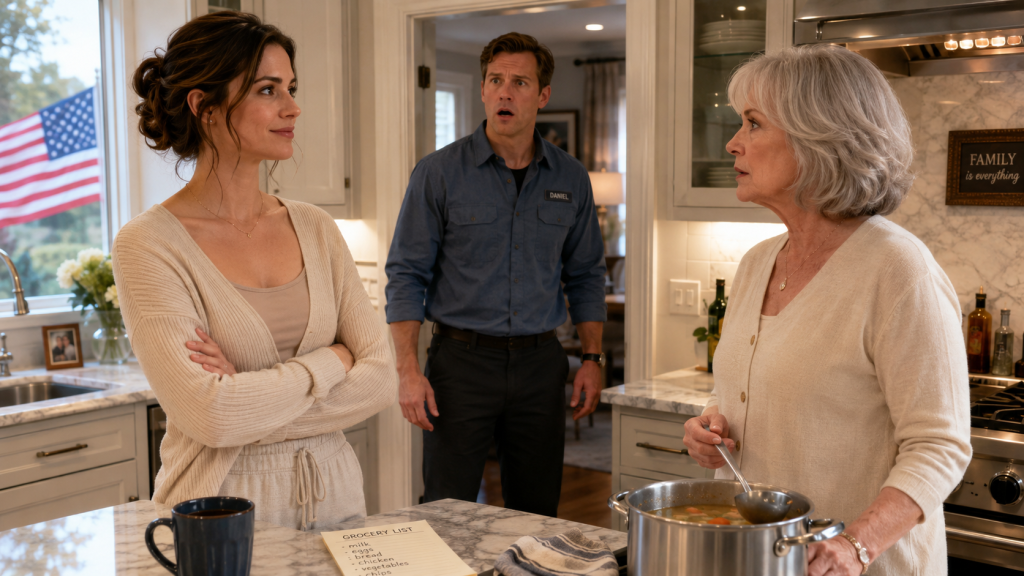
The spoon stopped against the bottom of Norma Mercer’s soup pot with a tiny metal scrape that sounded far too sharp for that spotless suburban kitchen.
Morning light spilled across the marble counter, bright and cold. The whole room smelled like black coffee, laundry detergent, and the chicken soup Norma had started before I came downstairs.
She had said it without even turning around.
“Since you live in the family house, Elena, you should start covering all the bills.”
Water. Electricity. Gas. Groceries. Maintenance. The lawn service she insisted on because, according to her, “a house like this has standards.” The Costco runs. The repairman she called before anyone asked me. The quiet little costs that had been sliding toward me for weeks like plates pushed across a table.
Daniel said nothing.
That was the part I noticed.
My husband of fifty-three days stood there in his blue work shirt and expensive watch, watching his mother place a financial burden at my feet as if she were handing down an old family rule.
Norma finally turned from the stove. Her silver bob was perfect. Her cream cardigan was buttoned exactly right. Her face carried the polite calm people use when they know they are not really asking.
“It only seems fair,” she added. “You’re living here now.”
Here.
Not our home.
Not your home.
Here.
I was holding a dish towel that still smelled like her detergent, because even the laundry in that house seemed to belong to someone else. Daniel’s coffee mug sat near the sink. Norma’s grocery list lay beside it, written in neat retired-school-office handwriting, with paper towels, half-and-half, and lawn bags underlined twice.
I looked from the list to her face.
Then I looked at Daniel.
He looked away first.
That told me more than any confession could have.
For weeks, I had felt something being arranged around me.
Norma had moved out of the house shortly before our wedding, supposedly to live with her sister in Arizona. Daniel had described it as a fresh start for everyone.
“This can be our home,” he had told me, standing in the empty living room after the wedding. “Mom wants us to build our own life here.”
I had believed him.
Then, three weeks after the honeymoon, Norma returned with two suitcases.
Daniel told me ten minutes before she arrived.
“She just needs somewhere to stay for a little while,” he said. “Family helps family.”
The spare bedroom became “Mom’s room” again.
Her framed photographs returned to the hallway. Her porcelain birds reappeared on the mantel. Her sweaters filled half the laundry room. Her favorite chair was placed beside the front window.
Within days, the house no longer felt borrowed from her.
It felt occupied by her.
Bills started appearing beside my keys.
Comments about family sacrifice drifted across dinner.
Every favor came with a tiny hook in it.
Some families do not ask you to disappear all at once.
They hand you a broom, then a bill, then a reason to be grateful for both.
By day eight of Norma being back, I had started documenting everything.
Not loudly.
Not dramatically.
I took photographs of envelopes left on the counter. I saved Daniel’s 7:14 a.m. text that said, “Mom just needs stability right now.” I kept copies of utility statements, grocery receipts, maintenance invoices, and the county property record for the house I had bought two years before Daniel ever placed a ring on my finger.
The house they did not know about.
The house with only my name on the deed.
The house I had not mentioned because, at first, I thought marriage meant building trust before displaying leverage.
I was wrong about the order.
That morning, Norma expected me to argue.
She expected me to ask Daniel for help.
She expected me to become embarrassed enough to make myself look unreasonable in her kitchen.
Instead, I smiled.
Not sweetly.
Not warmly.
It was the kind of smile that comes when someone hands you the final piece of a puzzle and does not realize what they have done.
Daniel noticed it first.
His mouth tightened.
Norma did not. She was still watching me with that measured expression, waiting for me to accept the role they had written for me.
A wife with no claim.
A guest with responsibilities.
A woman expected to pour her paycheck into a house that would never carry her name.
I folded the dish towel once.
Then again.
The refrigerator hummed. The coffee machine clicked. Somewhere outside, a delivery truck rolled past the mailbox, and the small American flag on the porch lifted once in the morning wind.
I set the towel flat on the counter.
“Then I’ll move back,” I said, “to the house I bought before we got married.”
Norma blinked.
Just once.
But her face changed.
It was small. A flicker beneath the skin. A quick recalculation she tried to bury before it reached her eyes.
Across the room, Daniel went completely still.
Not surprised in the normal way.
Still.
Like a man watching a number disappear from an equation he thought he had already solved.
Norma’s fingers rested on the edge of the stove. Daniel’s coffee sat untouched beside the sink. Nobody moved.
The soup spoon lay across the counter, dripping broth onto the white surface while all three of us stared at the truth sitting between us.
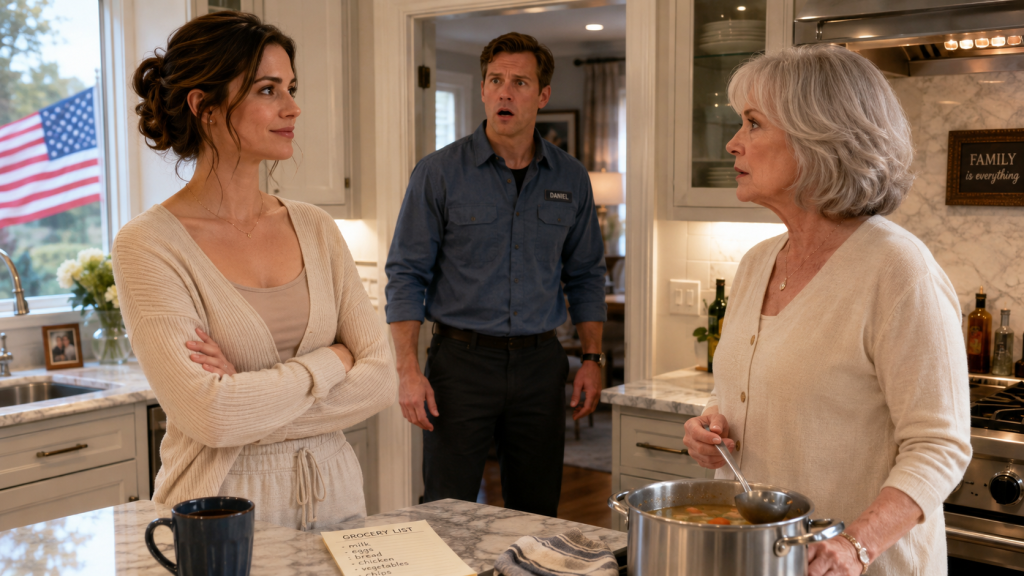
Then Daniel looked at me like I had become someone he had never actually met.
His mouth opened.
“What house?”
His voice came out thin.
“The house on Willow Crest,” I replied.
Norma’s hand slipped from the stove.
Daniel swallowed.
“The one near the country club?”
“Yes.”
“That house is worth almost six hundred thousand dollars.”
I tilted my head.
“Interesting.”
His face tightened.
“I never told you its value.”
Silence pressed down on the kitchen.
Norma looked sharply at her son.
Daniel’s eyes darted toward her and then back to me.
“I just know the neighborhood,” he said too quickly. “Anyone knows those houses are expensive.”
“Anyone?”
I reached for my purse, opened it, and removed a thick folder.
I placed it on the counter between us.
Daniel stared at it.
“What’s that?”
“Something I hoped I would never need.”
Norma folded her arms.
“Elena, I don’t appreciate this dramatic behavior.”
I looked at her.
“No. You prefer quiet behavior. Quiet payments. Quiet obedience. Quiet women.”
Her face hardened.
Daniel stepped forward.
“Elena, let’s just slow down.”
I opened the folder.
The first page was a printout of an email.
Daniel’s name appeared at the top.
The recipient was a real-estate attorney named Frank Mullins.
The subject line read: HIDDEN PROPERTY STRATEGY.
Daniel’s face lost the last of its color.
I turned the paper so both of them could see it.
The email had been sent three weeks before our wedding.
Daniel had written:
Once we are legally married and she is settled into Mom’s house, I think we can pressure her to sell the Willow Crest property. She is emotionally dependent and has no close family. The proceeds could clear the outstanding mortgage and tax liens. Please advise whether marital pressure or a refinance plan would be more effective.
Norma’s mouth opened.
No sound came out.
Daniel stared at me.
“Where did you get that?”
“That is your first concern?”
“That email is private.”
“So was my property.”
He stepped closer.
“Elena, you’re misunderstanding the context.”
I laughed once, but there was no humor in it.
“What context makes this better?”
Norma recovered first.
She reached for the page.
I moved the folder away.
“This is absurd,” she said. “Daniel was planning for the future.”
“My future?”
“Our future,” Daniel insisted. “The family’s future.”
I pulled out another email.
This one had been sent by Norma to Daniel.
Once she feels secure in the marriage, remind her that she owes you for bringing her into a respectable family. Do not tell her about the foreclosure until after she agrees to sell. If she knows too soon, she may protect the property.
Norma’s face changed.
For the first time since I had met her, her perfect composure cracked.
Her lips parted.
“Elena—”
“You knew.”
She lowered her voice.
“It was complicated.”
“No. It was calculated.”
Daniel ran both hands through his hair.
“Listen to me. We were in trouble.”
“We?”
“The house. The business. Mom’s medical bills. Everything.”
I reached deeper into the folder and placed a foreclosure notice on the counter.
The bank had scheduled the auction for six weeks later.
Norma stared down at it as if she had never seen it before, though her signature appeared on the final page.
“You were going to lose this house,” I said.
Daniel looked at the floor.
“And you thought my house would save it.”
“No,” he said. “I thought we could combine assets.”
“You thought you could trap me into selling.”
“That’s not what I meant.”
“You wrote the word pressure.”
He moved toward me again.
“Elena, please. I love you.”
The words landed badly.
Not because they were cruel.
Because they were late.
I remembered the first time Daniel had said them.
We had been sitting in a small Italian restaurant during a thunderstorm. He had taken my hand across the table and told me I made him feel peaceful.
At the time, I thought he meant safe.
Now I understood he meant useful.
I closed the folder.
“I’m leaving today.”
Norma stepped between me and the doorway.
“You cannot just walk out of a marriage because of a few emails.”
“A few emails?”
“You made vows.”
“So did Daniel.”
Her voice rose.
“And what will people think?”
There it was.
Not heartbreak.
Not family.
Appearance.
“What will people think when the bank puts an auction sign on the lawn?” I asked.
Norma’s face went white.
Daniel touched my arm.
I pulled away.
“Don’t.”
He lowered his hand.
“I made mistakes,” he said. “But we can fix this.”
“You had a plan before the wedding.”
“I was scared.”
“You were deceptive.”
“I didn’t know how to tell you.”
“You knew how to marry me.”
His eyes filled with something that looked like desperation.
“You’re my wife.”
“I was your financial solution.”
“That isn’t true.”
“Then why didn’t you tell me you knew about Willow Crest?”
He hesitated.
That hesitation answered everything.
I picked up my purse.
Daniel followed me into the hallway.
“Elena, wait.”
I stopped beside the wedding photograph hanging on the wall.
Norma had placed it there the week she moved back.
In the photograph, Daniel stood behind me with his hands on my waist. Norma smiled beside us, dressed in pale blue. We looked like a family formed through love.
Now I saw strategy in every face.
“How did you find out about the house?” I asked.
Daniel looked toward the kitchen.
Norma remained silent.
Finally, he said, “I saw a tax document in your desk.”
“When?”
“A few months before the wedding.”
“You went through my private papers?”
“I was looking for a charger.”
“In a sealed file box?”
He said nothing.
I nodded slowly.
“So you discovered the house, researched its value, contacted an attorney, planned to pressure me into selling it, and still stood at the altar promising honesty.”
Tears appeared in his eyes.
“Elena, I did love you.”
“Maybe.”
I looked at him.
“But love without respect becomes appetite.”
I walked upstairs and packed one suitcase.
Norma stood at the bottom of the stairs, calling me selfish.
Daniel followed me from room to room, apologizing, explaining, bargaining.
He said the foreclosure had pushed him into panic.
He said his business was struggling.
He said Norma had influenced him.
Norma shouted that Daniel was blaming her.
Their united front began breaking before I even left the bedroom.
By the time I carried my suitcase downstairs, they were arguing with each other.
“You told me she would never find out,” Daniel snapped.
“You were the one who accessed her documents,” Norma replied.
“You pushed me to marry quickly.”
“I told you to secure the family.”
I stopped near the front door.
They both went silent.
“Thank you,” I said.
Daniel stared at me.
“For what?”
“For finally speaking honestly.”
I walked outside.
The morning air was cool and bright. The small American flag beside the porch moved gently above the flowerbed. I placed my suitcase in the trunk of my car and drove away without looking back.
Willow Crest stood thirty minutes across town.
It was a two-story brick house with white shutters, a deep front porch, and a maple tree in the yard. I had bought it after working seven years in financial compliance and saving nearly every bonus I received.
My father had died when I was twelve. My mother raised me alone until cancer took her when I was twenty-three.
Before she died, she made me promise never to depend completely on anyone.
“Love people,” she told me. “But keep your feet under you.”
Willow Crest was how I kept that promise.
I had rented it to my cousin Rachel and her husband while they rebuilt their lives after a medical crisis. They knew everything about Daniel’s growing interest in my finances.
Rachel had been the one who found the emails.
Six weeks earlier, she called me and said someone had attempted to access the county property file under Daniel’s name.
Her husband worked in cybersecurity. With legal help, they traced the requests and found documents Daniel had accidentally synced to a shared tablet.
That was how I discovered the plan.
I did not confront him immediately.
I wanted to know how far he would go.
Now I knew.
When I arrived at Willow Crest, Rachel opened the door before I reached the porch.
She took one look at my suitcase and pulled me into her arms.
“You’re done?” she asked.
“I’m done.”
For the first time all morning, I cried.
Not because I missed Daniel.
Because I had wanted him to be someone else.
Over the next several days, the truth grew larger.
My attorney found that Daniel had attempted to list my house as a potential asset during a private loan application. He had forged my initials on a preliminary financial statement.
Norma had opened two credit cards using Daniel’s business address and planned to transfer the debt into a family refinancing package.
The “family house” was not a symbol of stability.
It was a sinking ship.
And I had been invited aboard because they believed I owned the life raft.
Daniel called twenty-three times in three days.
His messages changed quickly.
First came apologies.
Then promises.
Then accusations.
“You never trusted me.”
“You hid a house from your husband.”
“You embarrassed my mother.”
“You’re destroying our marriage over money.”
That final message made me stop.
I replied only once.
You planned our marriage around my money before I knew you had found it. I am not destroying the marriage. I am refusing to finance the deception.
Then I blocked his number.
Two weeks later, I filed for annulment based on fraud.
Daniel fought it.
He claimed the emails were taken out of context. He said he had only been exploring options. Norma submitted a statement describing me as secretive and emotionally unstable.
But they had underestimated how carefully I documented everything.
My attorney presented the email chain, the property searches, the loan application, and Daniel’s messages after I left.
The judge read them in silence.
When the annulment hearing began, Daniel sat across from me in a gray suit that no longer looked expensive. Norma sat behind him, holding her handbag with both hands.
The judge asked Daniel a simple question.
“Did you know about Ms. Alvarez’s property before the marriage?”
Daniel hesitated.
“Yes.”
“Did you disclose that knowledge to her?”
“No.”
“Did you consult an attorney about obtaining access to the property?”
Daniel looked down.
“Yes.”
“Before the wedding?”
“Yes.”
The courtroom became very quiet.
The judge granted the annulment.
He also referred the forged financial documents for further investigation.
Outside the courthouse, Daniel hurried after me.
“Elena.”
I stopped.
He looked thinner than he had two months earlier.
“Mom’s house is going to auction next week,” he said.
I said nothing.
“She has nowhere to go.”
“That isn’t my responsibility.”
“She’s still my mother.”
“Yes.”
“And I’m still—”
He stopped himself.
“You’re still what?” I asked.
He looked at me for a long moment.
Then he said, “I thought once we were married, everything would become ours.”
“No. You thought everything of mine would become yours.”
He flinched.
“I was desperate.”
“Desperation explains behavior. It does not excuse betrayal.”
His eyes filled with tears.
“Did you ever love me?”
“Yes,” I said.
That answer hurt him more than anger would have.
“I loved who I believed you were.”
He looked away.
“I could become that person.”
“Maybe.”
Hope flickered across his face.
“But not with me.”
I walked down the courthouse steps and did not turn back.
Norma’s house was sold at auction.
She moved into a small apartment near her sister. Daniel’s business closed three months later after lenders discovered the forged documents.
I heard through mutual friends that he found work at another firm and began paying back part of the debt.
For a while, I felt guilty.
Not because I believed I had done the wrong thing.
Because women are often trained to feel cruel when they stop rescuing people who were willing to drown them.
But guilt passed.
Peace stayed.
I moved fully into Willow Crest after Rachel and her husband relocated to a new place.
I repainted the kitchen warm white. I replaced the old curtains. I planted lavender along the front walk.
For the first time in months, every object around me felt chosen.
Every bill came in my name.
Every room belonged to a life I had built honestly.
One Sunday afternoon, almost a year later, I stood on the front porch holding a cup of coffee.
A small American flag moved beside the steps in the spring breeze.
A car slowed near the curb.
For one uneasy second, I thought it might be Daniel.
It was not.
It was a delivery driver carrying a package from the local bookstore.
Inside was a journal I had ordered.
On the first page, I wrote:
A home is not the place where someone allows you to stay.
It is the place where you do not have to disappear to remain welcome.
Then I sat by the window and thought about that kitchen at Norma’s house.
The spoon.
The soup.
Daniel’s pale face.
The question that changed everything.
“What house?”
He had asked it because he thought he knew every useful part of me.
He knew my salary.
My credit score.
My childhood losses.
My habit of avoiding confrontation.
He knew I loved quietly and forgave quickly.
But he did not know the strongest thing about me.
I had built a life before him.
And I was strong enough to return to it after him.
The house on Willow Crest was never my greatest secret.
My greatest secret was that I did not need anyone’s permission to leave.
THE END! THANKS FOR READING❤️