
Tiffany laughed when I said I would pack. Not a real laugh. A sharp little sound, thin and nervous, like she was waiting for me to smile and admit I had gone too far. Harry laughed too, but his was different. His laugh came from confidence.
He truly believed I was too old, too tired, too afraid of loneliness to walk out of that house. Maybe, a week earlier, he would have been right. But grief had taught me something. Loneliness inside your own home is worse than loneliness anywhere else.
I walked down the hall without another word. Behind me, Tiffany called, “Dad, stop it. You’re embarrassing yourself.” I did not turn around.
My bedroom was at the end of the hall, the same room Martha and I had shared for thirty-six years. Her side of the closet still held three dresses I had never found the strength to give away. Her perfume bottle still sat on the dresser, empty for years, but impossible for me to throw out.
I placed my suitcase on the bed and opened it.
For a moment, I stood still.
The house was quiet except for the basketball game roaring in the living room and Harry muttering something under his breath.
Then I began packing.
Three shirts.
Two pairs of pants. My shaving kit. Medicine. The brown leather Bible Martha had carried every Sunday. And then, from the bottom drawer of my dresser, I removed the blue folder. Inside that folder were the papers Tiffany had never cared to read.
The deed.
The mortgage release.
The insurance policy.
Bank statements.
Receipts for property taxes.
Copies of every transfer I had made to keep my daughter and her husband comfortable after Harry lost one job, then another, then claimed every boss in Montana was jealous of him.
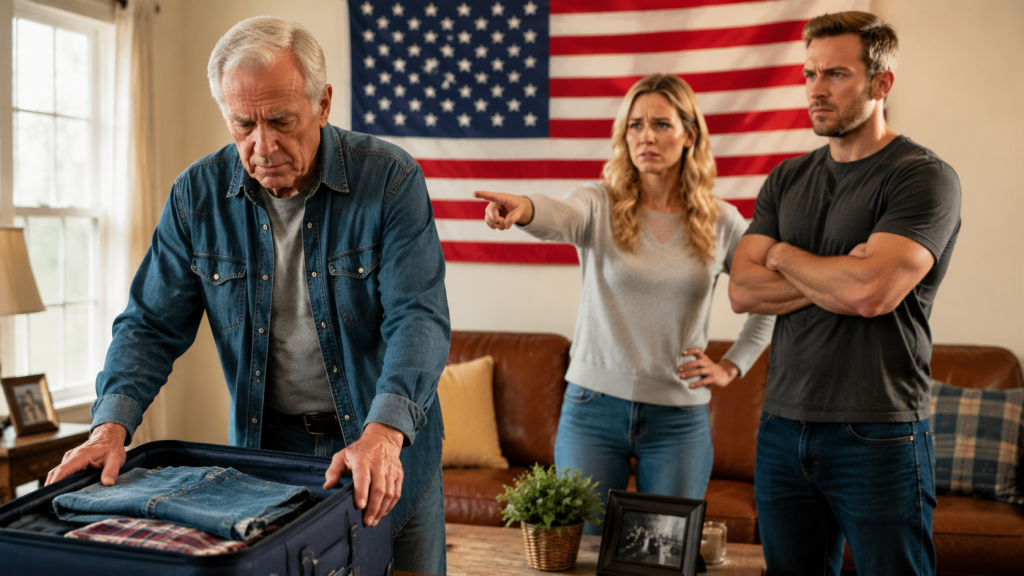
I put the folder into the suitcase.
Then I lifted Martha’s photograph from the dresser.
She was standing by Flathead Lake in the picture, wearing a yellow cardigan and squinting into the sun. Her smile was soft, but her eyes were strong.
“You were right,” I whispered.
Because Martha had warned me.
Not about Tiffany.
Never Tiffany.
She loved our daughter fiercely.
But she had warned me about giving too much.
“Clark,” she once told me near the end, when cancer had thinned her voice but not her wisdom, “love her, but don’t disappear for her.”
I had disappeared anyway.
After Martha died, Tiffany became the only family I had left.
When she cried over bills, I paid them.
When she said rent was killing them, I invited them home.
When Harry said he needed time to get on his feet, I gave him months.
When months became years, I gave him excuses.
And when Tiffany stopped asking and started expecting, I pretended not to notice.
That afternoon, I noticed everything.
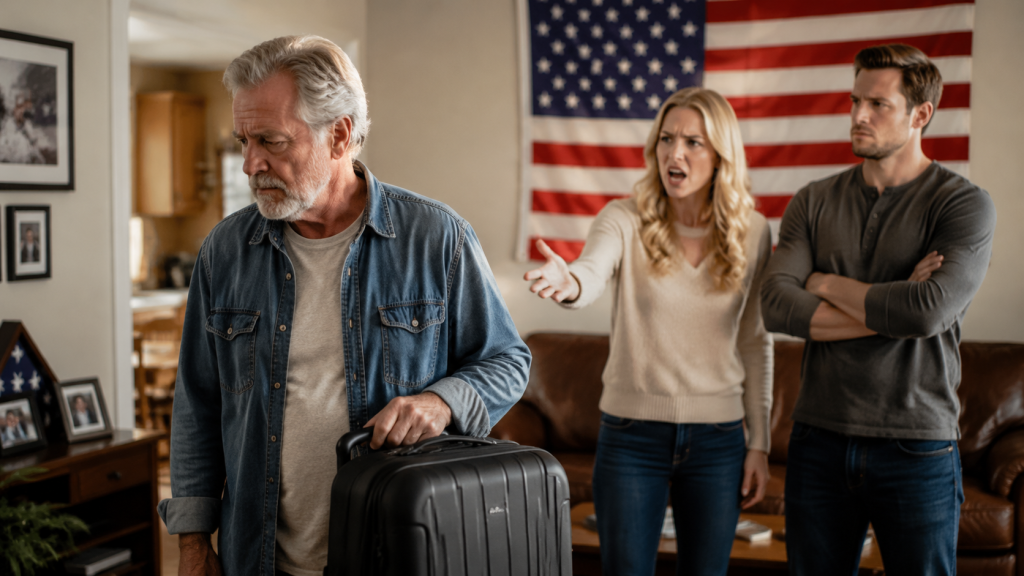
I zipped the suitcase and carried it into the hallway.
Tiffany stood near the kitchen entrance with her arms folded.
Her eyes dropped to the suitcase.
“You’re really doing this?”
“You told me to choose.”
“I was angry.”
“No,” I said. “You were honest.”
Her face changed.
For half a second, I saw fear.
Then Harry stepped beside her, and her chin lifted again.
“You’re being dramatic,” Harry said. “Where are you even going?”
“A motel.”
“With what money?”
I looked at him.
“My money.”
His jaw tightened.
Tiffany shook her head. “Dad, don’t make this ugly.”
“It became ugly when you told me to serve your husband in my own home.”
Harry pointed toward the door. “Then go.”
So I did.
I walked out carrying one suitcase, one folder, and one photograph.
I did not slam the door.
That would have given them too much satisfaction.
Outside, the Montana air was cool and clean.
The mountains stood in the distance, blue and steady, like they had seen men lose everything before and knew most of it could be survived.
I put my suitcase in the trunk of my old Buick.
As I opened the driver’s door, Tiffany appeared on the porch.
For one moment, I thought she might call me back.
Not to win.
Not to argue.
Just to say, “Dad, I’m sorry.”
But she only said, “You’ll regret this.”
I nodded once.
“No, sweetheart,” I said quietly. “I already regret staying this long.”
Then I drove away.
I checked into a motel near the highway.
The room smelled faintly of bleach and old carpet, and the heater clicked every few minutes like it was trying to remember its job.
I placed Martha’s photograph on the nightstand.
Then I sat on the edge of the bed and stared at the wall.
For the first time in years, nobody demanded anything from me.
Nobody asked for money.
Nobody told me I was too sensitive.
Nobody treated my kindness like a debt I owed.
The silence felt strange.
Then it felt peaceful.
That first night, Tiffany called six times.
I did not answer.
Harry called once.
I blocked his number.
The next morning, I drove to my bank.
The manager, Denise, had worked under me years earlier when I was still regional supervisor. She was in her fifties now, polished and careful, but when she saw me, her expression softened.
“Clark,” she said. “What can I do for you?”
“I need to review my accounts and stop all automatic transfers connected to my daughter or her husband.”
She did not ask questions.
Good bankers know when a man has reached the end of a private humiliation.
She printed documents.
I signed forms.
The monthly transfer to Tiffany’s checking account ended.
The utility payments I had quietly covered stopped.
The credit card I had allowed Harry to use for “emergencies” was canceled.
Then Denise looked over the property documents I had brought.
Her eyebrows lifted slightly.
“Your home is solely in your name.”
“Yes.”
“No transfer? No trust arrangement naming Tiffany as current owner?”
“No.”
“She may be listed as beneficiary on some older documents, but she has no ownership rights while you’re living.”
“I know.”
Denise looked at me carefully.
“Does she know?”
I folded my hands.
“I think she assumed.”
Denise nodded slowly.
“Assumptions can be expensive.”
That afternoon, I visited an attorney named Paul Whitaker.
Paul was older than me by five years and still wore suspenders like it was 1978. He had handled Martha’s estate after she died.
When I explained what happened, he listened without interrupting.
Then he leaned back and removed his glasses.
“Clark, let me be direct. They are living in your house with your permission. That permission can be revoked.”
“I do not want to hurt my daughter.”
“You are not hurting her by refusing to be abused.”
The words landed harder than I expected.
Abused.
I would not have used that word.
Not for myself.
I was a father.
A widower.
A man who should have known better.
But abuse does not always arrive with bruises.
Sometimes it arrives as entitlement.
Sometimes it sits in your chair, drinks beer you bought, and tells you to fetch another.
Paul prepared a notice.
Legal.
Firm.
Clear.
Tiffany and Harry had thirty days to vacate the property unless they agreed to a written rental arrangement, background terms, and financial responsibility.
Paul also advised me to change the locks after they left, secure valuables, and document everything.
“Do not go back alone,” he said.
I nodded.
“And Clark?”
“Yes?”
“Do not let guilt negotiate on your behalf.”
That sentence stayed with me.
For seven days, I lived from that motel room.
I ate breakfast at the diner across the road.
I walked around Woodland Park in the mornings.
I read Martha’s Bible at night, though sometimes I only held it because the words blurred.
Tiffany left voicemails.
At first, they were angry.
Day one: “Dad, you’re acting childish.”
Day two: “Harry says you canceled the card. That was humiliating.”
Day three: “The electric company called. Why would you stop payments without telling me?”
Day four: “You need to come home. We can talk if you apologize for overreacting.”
I saved every message.
Not because I wanted revenge.
Because I had spent years doubting my memory.
People like Harry are skilled at making you question whether the knife was really a knife.
By day five, the tone changed.
Tiffany called twice in the morning and once at night.
No voicemail.
On day six, Paul told me the notice had been delivered.
That evening, Tiffany left a message that was only seven seconds long.
I could hear Harry shouting in the background.
Then she hung up.
On day seven, I woke to sunlight cutting through the motel curtains.
My back ached.
My mouth was dry.
For one brief, confused second, I thought I was home.
Then I saw Martha’s photo on the nightstand and remembered everything.
My phone was dead.
I plugged it in.
A minute later, the screen lit up.
Twenty-two missed calls.
Most from Tiffany.
Three from a number I did not recognize.
One from my neighbor, George.
Then a text message appeared.
Dad, please call me. Harry found out the house was never in my name. He’s furious. I’m scared.
I stared at the message for a long time.
The first feeling was not triumph.
It was sorrow.
Deep, old sorrow.
Because no father wants to be right about the man his daughter married.
I called George first.
He answered immediately.
“Clark?”
“Yes.”
“You need to know, there was shouting over there last night. I almost called the sheriff.”
“What happened?”
“Harry was on the porch yelling about the house. Said you tricked him. Said Tiffany ruined everything.”
My hand tightened around the phone.
“Did he touch her?”
“I don’t know. I didn’t see that. But I saw him kick one of your planters off the porch.”
Martha’s planters.
She had painted them blue.
I closed my eyes.
“Thank you, George.”
“You want me to go over?”
“No. Stay out of it. I’m calling the sheriff.”
Then I called Paul.
He gave me one instruction.
“Do not go alone.”
Thirty minutes later, I was in the passenger seat of a sheriff’s cruiser, following another deputy toward my own house.
I had never felt so old.
Or so awake.
When we pulled up, the front yard looked wrong.
One planter lay shattered near the steps.
A trash bag sat open on the porch, clothes spilling from it.
The living room curtains were crooked.
Tiffany opened the door before we knocked.
Her face was pale.
Her eyes were swollen.
For a moment, she looked like my little girl again.
“Dad,” she whispered.
I wanted to hug her.
I wanted to ask if she was hurt.
I wanted to forget everything.
But behind her, Harry shouted, “You brought cops? You coward!”
The deputy stepped forward.
“Sir, come outside.”
Harry appeared in the hallway, red-faced and wild-eyed.
He pointed at me.
“This is a family matter.”
The deputy did not blink.
“Then you can discuss it calmly outside.”
Harry laughed, but there was panic in it.
“You know what he did? He manipulated us. Let us believe this was our house.”
I spoke for the first time.
“I never told you it was yours.”
“You let Tiffany think it would be.”
“I told Tiffany she would always have a home with me. I did not tell her she could give it to you.”
His mouth twisted.
“You think you’re smart, old man?”
“No,” I said. “I think I was foolish for too long.”
The deputy asked Harry to step onto the porch.
Harry refused.
That was his second mistake.
His first had been assuming I had nowhere else to go.
Within minutes, the deputies had him outside, still shouting, still blaming Tiffany, still calling me weak from the yard of a house he had never paid for.
Tiffany stood in the doorway shaking.
I looked at her hands.
No bruises that I could see.
But fear leaves marks before skin does.
“Did he hurt you?” I asked.
She looked down.
“No.”
I did not fully believe her.
But I did not push.
The deputy spoke with her privately.
Harry was told to leave the property for the day while the civil notice proceeded. He cursed, threatened to sue, and demanded his beer from the fridge.
Nobody moved to get it.
That almost made me laugh.
After he finally drove away in his dented truck, the house became quiet.
Tiffany and I stood in the living room.
My recliner faced the television.
A beer stain marked one arm.
The coffee table was cluttered with takeout containers.
One of Martha’s framed cross-stitches had been taken off the wall and placed behind a stack of boxes.
I walked over and picked it up.
Home is where love is patient.
Martha had stitched that during a winter storm in 1999.
I brushed dust from the frame.
Tiffany began crying.
Not softly.
Not prettily.
She broke open.
“I’m sorry,” she said. “Dad, I’m so sorry.”
I did not answer right away.
I had imagined that apology for years.
I thought it would heal me instantly.
It did not.
Some wounds do not close just because the person who made them finally notices the blood.
“I don’t know what happened to me,” she said. “I kept thinking if I made him happy, things would get better. And then you were always there, and I started acting like your help was normal. Like it was owed to me.”
I looked at her.
“It was normal for me to love you. It was not normal for you to let him humiliate me.”
She covered her face.
“I know.”
“Do you?”
She nodded.
“Because that day, Tiffany, you did not choose peace. You chose him. Against me. In my own house.”
“I was afraid of him.”
That sentence changed the room.
It did not erase what she had done.
But it made the shape of it clearer.
I set the cross-stitch on the mantel.
“Then you should have told me.”
“I was ashamed.”
“So was I.”
She looked at me then.
I had never said that to her before.
“I was ashamed that my daughter could watch me be treated that way,” I said. “Ashamed that I allowed it. Ashamed that your mother would not recognize the man I became after she died.”
Tiffany stepped toward me.
“Dad—”
I raised a hand.
“Not yet.”
She stopped.
“I love you,” I said. “That has never changed. But love is not permission.”
Her lips trembled.
“What happens now?”
“Now you decide who you are without Harry standing beside you.”
“And the house?”
“The house is mine.”
She nodded quickly. “I know.”
“No,” I said. “You need to understand. The house is mine. My money is mine. My remaining years are mine. I will not spend them being ordered around by a man who mistakes kindness for weakness.”
“I don’t want you to.”
“I hope that’s true.”
She wiped her face.
“Can I stay?”
That was the question I had feared.
Because the father in me wanted to say yes immediately.
The man Martha had loved knew better.
“For now,” I said. “But with conditions.”
She nodded.
“Harry does not live here. He does not sleep here. He does not have a key. If you choose to go back to him, you do that somewhere else.”
Her face crumpled, but she nodded again.
“You will get a job or show me a plan for one.”
“Yes.”
“You will pay something toward household expenses. It does not have to be much at first, but it has to be honest.”
“Yes.”
“And we will go to counseling.”
She looked surprised.
“You and me?”
“Yes. Because sorry is a start. It is not repair.”
For the first time, she looked at me with something like respect.
“All right,” she whispered.
That evening, I returned to the motel for my things.
I stood in that small room and looked around.
For seven days, it had been a shelter.
Plain walls.
Thin blankets.
Burnt coffee in the lobby.
But it had given me back to myself.
Before leaving, I picked up Martha’s photograph.
“You would have handled it better,” I told her.
Then I smiled.
“No. Maybe you would have handled it sooner.”
When I got home, Tiffany had cleaned the living room.
My recliner was empty.
The beer bottles were gone.
Martha’s cross-stitch hung back on the wall.
Tiffany stood in the kitchen, uncertain.
“I made coffee,” she said. “I didn’t know if you wanted dinner.”
I placed my suitcase down.
“Coffee is fine.”
We sat at the kitchen table.
For a while, neither of us spoke.
Outside, the sun slipped behind the mountains, turning the sky purple and gold.
This had always been my favorite hour in that house.
Martha used to call it the mercy hour.
The time of day when even hard things looked softer.
Tiffany wrapped both hands around her mug.
“I thought you’d always stay,” she said.
“I know.”
“I thought no matter what I said, you’d forgive me.”
“I probably will forgive you,” I said. “But I will not forget myself again.”
She cried quietly then.
This time, I reached across the table and covered her hand with mine.
She held on like she was afraid I would vanish.
But I was not the one who had vanished.
Not anymore.
The next month was not simple.
Harry came back twice.
The first time, he pounded on the door and shouted Tiffany’s name until George called the sheriff.
The second time, he left a letter in the mailbox saying I had destroyed his marriage.
I gave it to Paul.
Tiffany filed for separation.
She found work at a dental office three days a week.
Then five.
She started paying me rent, small at first, then more.
Every Friday, we went to counseling in an office that smelled like peppermint tea.
Some sessions were quiet.
Some were ugly.
She admitted things I had not known.
I admitted things she had never understood.
She told me she had felt lost after Martha died too, and Harry had seemed strong when both of us were weak.
I told her strength does not need an audience.
Control does.
Slowly, the house changed.
Not back to what it was.
Nothing goes backward cleanly.
But forward.
Tiffany repainted Martha’s planters blue and planted marigolds in them.
I replaced the lock on the front door.
We donated the old beer-stained recliner to the dump, and I bought a new chair with my own money, not because I needed one, but because I wanted to choose something for myself.
On the first warm Sunday of summer, Tiffany and I drove to Flathead Lake.
She brought sandwiches.
I brought Martha’s old picnic blanket.
We sat near the water while families laughed around us.
For a long time, we watched sunlight scatter across the lake.
Then Tiffany said, “I don’t deserve this.”
I knew what she meant.
The sandwich.
The lake.
My company.
Another chance.
“No,” I said. “You don’t deserve it.”
She looked down.
“But neither did I deserve what happened,” I continued. “Families are not built on deserving. They are built on what people do after the truth arrives.”
She was quiet.
Then she said, “I want to do better.”
“That matters only if you do.”
She nodded.
“I know.”
Months later, Harry signed the divorce papers after discovering there was nothing to gain by fighting. No house. No hidden account. No old man desperate enough to buy peace from him anymore.
Tiffany did not celebrate.
Neither did I.
Freedom can feel like grief when it arrives late.
That fall, she moved into a small apartment across town.
The day she left, she stood in the doorway with two boxes at her feet.
“I’m scared,” she admitted.
“Good,” I said.
She gave me a wounded look.
I smiled.
“Scared means you understand this matters.”
She laughed through tears.
Then she hugged me.
For the first time in years, it felt like my daughter was hugging me, not reaching for something.
After she drove away, I walked through my quiet house.
The rooms felt larger.
Not empty.
Just mine.
I made coffee and sat by the window in my new chair.
The mountains were capped with early snow.
Martha’s photograph stood on the side table.
I lifted my mug toward it.
“She’s going to be all right,” I said.
Then, after a pause, I added, “So am I.”
A week later, Tiffany called.
Only once.
When I answered, she said, “Hi, Dad. I just wanted to hear your voice.”
No emergency.
No demand.
No crisis.
Just my daughter, learning how to love without taking.
I leaned back in my chair and watched the evening light move across the floor Martha and I had refinished together.
“Hi, sweetheart,” I said.
And this time, when silence filled the house, it did not feel lonely.
It felt like peace.
THE END! THANKS FOR READING!