
Tuesday mornings in our neighborhood were normally peaceful.The mail truck rolled quietly down the street.Sprinklers clicked across green lawns.Sunlight poured through the stained-glass window above the staircase landing and scattered blue and amber shapes across the old hardwood floor.
I was standing in the kitchen with a warm cup of coffee when my stepmother, Eleanor, called to casually announce that she had sold the house where I grew up.She sounded proud of herself.Confident.
Like she truly believed she had finally won.
What almost made me laugh was not what she said.
It was everything she didn’t know.
“Hello, Eleanor,” I answered calmly.
“I sold the house,” she declared, skipping any greeting. “The contracts are signed. The new owners move in next week.”
I turned toward the kitchen window.
Outside, the climbing roses my father had planted years ago were beginning to bloom along the cedar fence.
Pink petals moved softly in the morning breeze.“The house?” I repeated.“You know exactly which house,” she snapped. “Don’t play stupid, Harper.”I placed my coffee mug on the oak counter.“This house?”
“Yes. Your father’s house. My house now. Maybe this will finally remind you of your place.”
My place.
Eleanor loved that phrase.
She had used it after my father’s funeral.
She had used it when she told me not to sit in his chair.
She had used it when she locked his study and said his papers were “too complicated” for me to understand.
She intended the words to sting.
Instead, they drifted through the kitchen like dust in sunlight.
“That’s a bold decision,” I said lightly. “Hopefully everyone reviewed the deed carefully.”
Silence filled the line.
“What exactly is that supposed to mean?”
“Nothing at all,” I replied. “Just wishing you good luck.”
Eleanor let out a sharp, mocking laugh.
“You have until Friday to leave. The buyers are excited to begin demolition immediately.”
Demolition.
That single word confirmed she still understood absolutely nothing about the house.
And even less about the man who built it.
“Thanks for letting me know,” I said.
Then I ended the call before she could continue enjoying herself.
For a long moment, the kitchen was silent except for the low hum of the refrigerator and the faint ticking of the wall clock.
I looked around the room.
The blue cabinets my mother had painted before she died.
The oak counter my father had sanded himself after I spilled nail polish on it at thirteen.
The brick fireplace in the adjoining family room, where every Christmas stocking had hung from the same brass hooks.
Eleanor had always hated that fireplace.
She called it old-fashioned.
My father called it honest.
Just days after his funeral, I had sat across from his attorney, Benjamin Vance, in a tall downtown office building with gray windows and quiet carpets.
I had expected a simple will reading.
I had expected grief, paperwork, maybe a few bank forms.
Instead, Benjamin slid a sealed envelope across his desk and said, “Your father prepared for this.”
My hands had trembled as I opened it.
Inside was a letter in Dad’s handwriting.
My dearest Harper,
If Benjamin is giving you this, then I am gone, and Eleanor has likely begun behaving exactly as I feared she would.
Do not panic.
Do not argue with her.
Do not try to convince her to be decent.
The house is protected.
The truth is protected.
And so are you.
Ask Benjamin about the Ashford Preservation Trust.
Then check the fireplace.
I read the last line twice.
Then I looked up.
Benjamin’s face remained calm, but his eyes were full of sympathy.
“Your father created a trust three years ago,” he said. “The house does not belong to Eleanor. It does not even belong to his estate in the way she believes. It belongs to the Ashford Preservation Trust. You are the sole trustee.”
I could barely breathe.
“But Eleanor said Dad left her control of everything.”
“Your father allowed her temporary occupancy rights,” Benjamin replied. “Not ownership. Not authority to sell. Not authority to alter the structure. And certainly not authority to demolish.”
That was when I understood why Dad had smiled so quietly in the final year of his life.
Eleanor had thought she was overpowering him.
She had distanced him from friends, questioned his doctors, intercepted his mail, and tried to convince everyone that I was only interested in inheritance.
Dad never fought loudly.
He simply watched.
And prepared.
After Eleanor’s call, I picked up my phone and dialed Benjamin.
He answered almost immediately.
“Harper,” he said in his calm, measured voice. “I was wondering when she’d finally lose patience.”
“She went through with it,” I told him. “She actually signed sale papers.”
There was a brief pause.
Then I heard the faintest trace of satisfaction in his tone.
“Then it begins.”
“I don’t want innocent buyers caught in her disaster,” I said. “Please warn their attorney before they lose anything.”
“Already handled.”
That answer settled something deep inside me.
My father had always trusted people who worked quietly, carefully, and thoroughly.
Benjamin was exactly that kind of man.
After the call ended, I walked through the house slowly.
The hallway still smelled faintly of cedarwood and old books.
Morning light stretched across my father’s study.
Every room held memories.
Every repair had a story attached to it.
Dad had bought the house before I was born.
Back then, it had been nearly ruined.
Peeling paint.
Sagging porch.
Broken windows.
A cracked chimney.
My mother wanted something newer, but Dad had stood in the doorway and said, “This house is waiting for someone to love it properly.”
So they loved it.
They rebuilt the porch together.
They planted roses.
They restored the stained glass.
After my mother died, Dad kept caring for the house like caring for it was one way of keeping her close.
Then Eleanor entered our lives five years ago with polished manners and flawless timing.
At first, she played the role perfectly.
Warm smiles.
Soft concern.
Thoughtful compliments.
She brought casseroles when Dad was recovering from surgery.
She remembered the names of my coworkers.
She called me sweetheart.
But after they married, the cracks appeared.
She complained that Dad’s friends were too intrusive.
She suggested he change accountants.
She asked why I still had a key.
She said the house needed “modernizing,” which apparently meant removing everything my parents had ever touched.
Dad never raised his voice.
He simply smiled.
At the time, I thought he was exhausted.
Sick.
Maybe even defeated.
Now I knew the truth.
He had been building a trap around every greedy step Eleanor took.
Shortly after noon, another message from Eleanor appeared on my phone.
Be ready to hand over the keys.
I stared at it for a moment before setting the phone face down on Dad’s mahogany desk.
My eyes drifted toward the brick fireplace.
Two nights after meeting Benjamin, I had followed Dad’s letter and searched there.
At first, I found nothing.
Then I noticed one brick near the left side had a hairline gap around it.
I pressed gently.
It shifted.
Behind it was a small metal box wrapped in fireproof cloth.
Inside was my father’s final letter, a USB drive, a stack of printed bank records, and photographs of documents Eleanor had sworn did not exist.
The evidence proved Eleanor’s crimes went far beyond a fraudulent home sale.
She had forged Dad’s signature on renovation loans.
Moved money from his medical account into a private account.
Deleted emails from his attorney.
Attempted to change insurance beneficiaries after his diagnosis.
And worst of all, she had tried to pressure him into signing away the house weeks before his final hospitalization.
Dad had recorded some of it.
His voice on those recordings had nearly broken me.
Weak, tired, but clear.
“Eleanor,” he said in one file, “I know what you’re trying to do.”
She laughed.
“You’re confused, Thomas.”
“No,” Dad replied. “I am disappointed.”
That sentence haunted me.
Later that afternoon, Benjamin called again.
“The buyers’ lawyer has been informed,” he said. “They’re withdrawing from the deal. The trust cannot be challenged.”
“And Eleanor?”
“She’ll know soon enough.”
I thanked him, picked up my coffee, and stepped outside into the garden.
If Eleanor wanted a confrontation, I preferred to face her surrounded by my father’s roses.
She arrived before sunset.
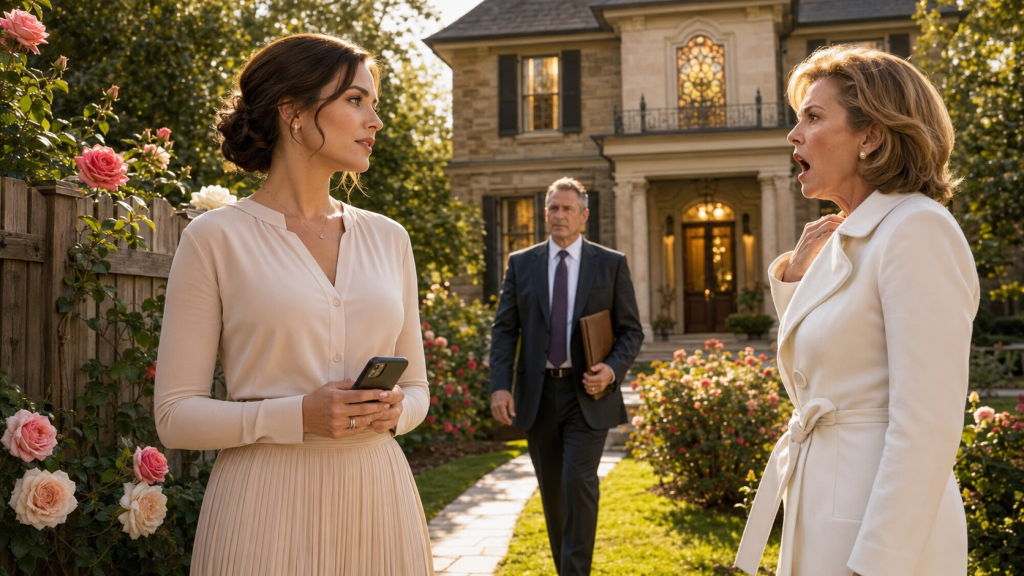
A white SUV pulled sharply against the curb, and Eleanor stepped out wearing a white coat, oversized sunglasses, and anger polished into a smile.
She pushed through the garden gate like she owned the ground beneath her shoes.
“Still here?” she said.
I stood beside the roses.
“The buyers withdrew.”
Her smile vanished.
“That’s impossible.”
“Not when the property was never yours to sell.”
Her lips tightened.
“What did Benjamin tell you?”
“Enough.”
At that moment, Benjamin walked up the path from the sidewalk carrying a sealed folder.
Behind him were two officers and a woman from the county property office.
Eleanor looked from them to me.
“What is this?”
Benjamin stopped beside me.
“Eleanor Vale,” he said calmly, “this house belongs to the Ashford Preservation Trust, created by Thomas Ashford three years before his death. Harper Ashford is the sole trustee. You had temporary residency rights only, which were dependent on good-faith conduct and preservation of the property.”
Eleanor’s face drained of color.
“He couldn’t have done that.”
“He did,” Benjamin said. “And your attempted sale triggered an automatic fraud review.”
Her gaze snapped to me.
“You little snake.”
I almost smiled.
“There she is.”
The mask slipped fully then.
No soft widow.
No grieving wife.
Just rage.
“That house should be mine,” she hissed. “I gave up five years of my life for your father.”
“You married him,” I said. “You didn’t purchase him.”
Benjamin opened the folder and removed copies of bank transfers, forged forms, emails, and still images from the recordings Dad had hidden inside the fireplace.
Eleanor took one step backward.
“What is that?”
“My father’s insurance,” I said.
Benjamin handed the documents to one of the officers.
“These records suggest forgery, attempted fraud, misuse of protected funds, and unauthorized sale of trust property.”
Eleanor looked toward the house.
For the first time, she seemed to understand the fireplace had not simply been decoration.
It had been a witness.
“You searched my home,” she snapped.
I shook my head.
“No. I searched mine.”
The words landed exactly where I wanted them to.
Her eyes flashed.
“I was his wife.”
“You were his mistake,” I said quietly. “The trust was his correction.”
One officer stepped forward.
“Mrs. Vale, we need you to come with us to answer some questions.”
She began laughing.
A brittle, panicked laugh.
“You can’t arrest me over a house sale.”
Benjamin’s voice stayed level.
“No one said this was only about the house.”
That was when Eleanor stopped laughing.
The investigation moved quickly after that.
The buyers withdrew without penalty.
Their attorney sent me a kind note saying they were grateful to have been warned before demolition plans began.
Eleanor tried to claim confusion.
Then grief.
Then stress.
Then that Dad had “verbally promised” her everything.
But Benjamin had recordings.
Dates.
Bank records.
Doctor’s notes.
Email recoveries.
Trust documents.
And my father’s own written instructions.
Eleanor’s attorney advised settlement within three weeks.
By then, the police investigation had widened.
The renovation loan she forged had used Dad’s medical account as collateral.
The private account she opened contained transfers made while Dad was hospitalized.
The insurance changes she attempted were blocked only because Dad had pre-alerted Benjamin months earlier.
Every time Eleanor had thought she was winning, Dad had already placed another lock behind her.
I found one final letter from him in the study desk after the first hearing.
It was addressed simply:
For when the house is quiet again.
My dear Harper,
I am sorry I brought a storm into our home.
I wanted companionship, and I ignored signs I should have seen.
That is my regret, not yours.
Do not let Eleanor make you hard.
Let her make you careful.
Keep the roses.
Keep the fireplace.
Keep the window your mother loved.
But change anything that hurts too much.
A house should protect memory, not trap you inside it.
I cried for nearly an hour after reading it.
Not because of Eleanor.
Because Dad had known me so well.
After months of legal filings, Eleanor pleaded guilty to lesser charges to avoid a trial on the full fraud case.
She lost all residency rights.
She repaid a portion of the stolen funds.
Her name was removed from every account connected to Dad’s estate.
The attempted sale became evidence, not victory.
The day she came to collect her remaining belongings, she arrived without sunglasses.
Without the white coat.
Without the polished smile.
She looked smaller.
Angrier.
“Are you happy now?” she asked as movers carried boxes from the guest room.
I stood in the hallway beneath the stained-glass window.
“No.”
That seemed to surprise her.
“I’m relieved.”
She looked past me toward the family room.
“He loved me once.”
I did not answer immediately.
Maybe he had.
Maybe he had loved who she pretended to be.
Maybe loneliness had made him forgiving.
Maybe she had offered him comfort before she reached for control.
Finally, I said, “Then you should have loved him more than his things.”
Her face hardened.
The brief glimpse of humanity disappeared.
She walked out without another word.
That evening, I stood alone in the family room.
The brick fireplace glowed in the lamplight.
For months, I had been afraid the house would feel haunted by betrayal.
But it did not.
It felt tired.
Like me.
Like it had survived something.
I placed Dad’s letters in a new fireproof box and returned the silver brass hooks to the mantel.
Then I opened the back door and walked into the garden.
The roses were in full bloom now.
Pink, white, and deep red.
The kind my father used to cut and place in a chipped blue vase for my mother.
I touched one carefully.
“You were right, Dad,” I whispered. “She finally taught herself the lesson.”
A year later, the house looked different, but not erased.
I restored the study.
Repaired the porch.
Removed the cold gray flooring Eleanor had installed in the dining room and uncovered the original wood beneath it.
I kept the fireplace exactly as it was.
Not because of the secret.
Because of what it represented.
My father had hidden proof there, yes.
But long before that, he had built fires there.
Hung stockings there.
Told stories there.
Taught me that old things are worth preserving when they are built with love.
On the anniversary of his death, Benjamin visited with a small stack of final documents.
“The trust is fully settled,” he said. “No remaining claims.”
I looked around the kitchen.
“So it’s over?”
He smiled gently.
“The legal part is.”
That was the truth.
The legal part ended with signatures.
The emotional part ended more slowly.
It ended when I stopped expecting Eleanor’s shadow around corners.
It ended when I planted new roses beside Dad’s old ones.
It ended when I hosted Sunday dinner and laughter filled the dining room again.
It ended when the house stopped feeling like something I had to defend and became simply home.
Sometimes people ask why I did not panic when Eleanor said she sold the house.
The answer is simple.
Because my father knew her better than she knew him.
She thought love had made him weak.
It had made him prepared.
She thought the house was an asset.
He knew it was a promise.
She thought demolition meant tearing down walls.
But in the end, the only thing demolished was her lie.
And the house still stands.
Sunlight still pours through the stained glass every morning.
The refrigerator still hums in the quiet kitchen.
The roses still bloom along the cedar fence.
And every time I pass the fireplace, I think of my father’s final lesson.
People who build with greed eventually expose themselves.
People who build with love leave protection behind.
THE END! THANKS FOR READING!