
My new wife’s seven-year-old daughter burst into tears every time we were left alone together.At first, I thought she was afraid of me.Then I realized she was afraid of what would happen if she trusted me.My name is Ethan Walker.I am thirty-nine years old, and I work as an ER nurse in the trauma unit at University of Colorado Hospital. After years in emergency medicine, I have learned to read pain the way other people read weather.
A bruise tells a story.A tremor reveals fear.A silence can carry more truth than a scream.But nothing in my training prepared me for living inside Clara Monroe’s house.Clara was my wife.
We had met at a hospital fundraiser eight months earlier. She was elegant, charming, and quick with the kind of smile that made people feel specially chosen. She owned a small interior design business and lived in a restored Victorian house on 219 Hawthorne Avenue, the kind of place with stained-glass windows, polished banisters, and rooms that looked too beautiful to touch.
She had a daughter named Harper.
Seven years old.
Big brown eyes.
Dark curls.
Always clutching a stuffed fox named Scout.
The first time I met Harper, she did not speak. She only stood behind Clara’s skirt and watched me with the careful stare of a child trying to predict danger.
“She’s shy,” Clara said, laughing softly. “A little dramatic sometimes, but sweet.”
I knelt so I would not tower over Harper.
“Hi,” I said. “I’m Ethan.”
Harper squeezed Scout tighter.
I smiled.
“No pressure. You can say hi whenever you’re ready.”
Her eyes flicked to Clara.
Then she whispered, “Hi.”
Clara looked pleased, as if Harper had passed a test.
I should have noticed that.
At the time, I only saw a nervous little girl and a mother who seemed patient with her. I had never had children of my own, but I wanted a family. I wanted quiet dinners, school drawings on the fridge, Saturday pancakes, and someone small calling my name from another room.
When Clara and I married, she insisted I move into her house immediately.
“It will help Harper adjust,” she said.
So I packed my apartment into boxes and crossed the threshold of that beautiful old home with hope in my chest.
Harper stood in the hallway the day I moved in.
She wore pink socks, a gray sweater, and held Scout against her ribs.
“Are you staying?” she asked.
I set down a box.
“Yes.”
“Or are you leaving soon?”
The question was too serious for a child.
I smiled gently.
“I’m staying. I’m your stepdad now.”
Her face did not change.
She stared at me for several long seconds.
Then she nodded once and walked away.
Three weeks passed.
Clara was perfect.
Perfect wife.
Perfect hostess.
Perfect mother when anyone was watching.
She packed Harper’s lunches with little notes tucked inside. She brushed Harper’s hair carefully before school. She posted pictures online captioned my whole heart and my brave girl.
But when the camera was gone, the air changed.
Harper became smaller around Clara.
Not quieter exactly.
Contained.
As if she had learned the safest way to exist was to take up no space.
At dinner, she waited for Clara to start eating.
If a fork fell, Harper flinched.
If Clara sighed, Harper’s shoulders tightened.
If I reached to hand Harper a napkin, tears would fill her eyes.
The first time we were alone in the living room, Clara had gone upstairs to take a call. Harper and I sat on opposite ends of the couch while cartoons played.
I asked, “Do you like this show?”
She nodded.
“Do you want popcorn?”
Her bottom lip trembled.
I leaned back, confused.
“Harper, what’s wrong?”
Tears spilled down her cheeks without a sound.
She shook her head violently.
“It’s okay,” I said. “You’re not in trouble.”
That made her cry harder.
When Clara came down and saw her, she laughed.
“Oh, for heaven’s sake. Harper, really?”
Harper wiped her face quickly.
Clara looked at me with an apologetic smile.
“She does this. She simply doesn’t like you yet.”
The words stung, but not as much as Harper’s expression.
She looked ashamed.
Like she had failed at hiding something.
Over the next month, it happened again and again.
If Clara left us alone in the kitchen, Harper cried.
If I offered to help with homework, her hands shook.
If I said, “Good job,” she looked toward the door as if waiting for punishment.
Every time I asked, she would only shake her head.
Every time Clara noticed, she dismissed it.
“She’s manipulative when she wants attention.”
“She gets dramatic.”
“Don’t reward the tears.”
I wanted to believe Clara knew her own child better than I did.
That was my first mistake.
Then Clara left for a three-day business conference in Salt Lake City.
She kissed me goodbye in the foyer, perfume and confidence surrounding her like armor.
“Try not to spoil her,” she said, nodding toward Harper.
Harper stood by the stairs, clutching Scout.
Clara crouched and adjusted the child’s collar with fingers that looked gentle from across the room.
“Be good,” she said.
Harper nodded.
“Use your words.”
Harper nodded again.
“And no emotional scenes.”
A strange chill moved through me.
Clara smiled at me.
“Call if you need anything.”
Then she left.
The house seemed to exhale after the door closed.
That evening, Harper sat on the couch while I made grilled cheese and tomato soup. She watched me from behind Scout.
“Do you want triangle sandwiches or squares?” I asked.
She blinked.
“What?”
“Some people like triangles. Some people like squares. It’s a serious dinner decision.”
A tiny crease appeared between her brows.
“Triangles?”
“Excellent choice.”
I cut them into triangles and set the plate in front of her.
She stared at the food.
“Is it okay?”
She nodded.
Then she whispered, “Mommy says butter makes me needy.”
I paused.
“Butter?”
“She says if I ask for things, people leave.”
I sat across from her slowly.
“Harper, eating dinner is not asking too much.”
She looked at me like I had spoken a language she did not know.
After dinner, we watched a movie. Halfway through, I noticed silent tears sliding down her face.
I turned the volume down.
“What’s wrong?”
She stared straight at the screen.
“Mommy says you’ll leave.”
My stomach tightened.
“Why would she say that?”
“She says all men leave because I’m too much trouble.”
I kept my voice soft.
“Do you think you’re too much trouble?”
Harper shrugged, but tears kept falling.
“She says once you see who I really am, you’ll leave too.”
Something inside me went still.
In the ER, when children repeated adult phrases, we listened carefully. Children rarely invented cruelty with that level of precision.
I shifted so I faced her fully.
“Harper, listen to me. I work with hurt people every day. I’ve seen people scared, angry, loud, quiet, messy, confused, and in pain. I have never walked away from someone because they needed help.”
She looked at me.
For one second, hope flickered in her expression.
Then it disappeared.
That night, after I put her to bed, I stayed downstairs reviewing charts from work.
A little after midnight, I heard sobbing through the walls.
Soft.
Muffled.
Desperate.
I followed the sound to Harper’s room.
She was curled under the blankets, Scout crushed against her chest.
I knocked softly.
“Harper?”
She froze.
“It’s just me. Can I come in?”
After a long pause, she whispered, “Okay.”
I sat on the floor beside her bed, not too close.
“Do you want to tell me what’s hurting you?”
Her eyes widened.
“I can’t.”
“Why not?”
She started shaking.
“Mommy says if I tell, the fire will come.”
The words moved through me like ice water.
“What fire, Harper?”
Her mouth closed.
She stared at Scout.
I did not push.
Pushing scared children often makes them bury truth deeper.
So I said, “You don’t have to tell me tonight. But I want you to know something. If something is scary, you can tell me. My job is to help keep people safe.”
Her little fingers dug into the blanket.
“Safe means quiet.”
I swallowed hard.
“No. Safe means protected.”
She did not answer.
But she listened.
The next two days were delicate.
I cooked simple food.
I asked before touching her shoulder.
I gave her choices whenever I could.
Blue cup or green cup.
Braids or ponytail.
Book or movie.
Small choices matter when a child has been trained to feel powerless.
By the time Clara came home, Harper had begun sitting closer to me. Not touching me. Not fully trusting me. But closer.
Clara entered the house with rolling luggage and a bright smile.
“Did everyone survive?”
Harper stiffened immediately.
I saw it clearly now.
The way her spine locked.
The way her breathing changed.
The way she glanced down before answering.
“Yes, Mommy.”
At dinner, Clara’s knife clicked against her plate.
“Did everything go smoothly?”
“Yes.”
“No emotional scenes?”
Harper’s fork trembled.
“No, Mommy.”
The lie settled between us like smoke.
Clara looked satisfied.
But I was no longer fooled.
The next morning, I helped Harper into her sweater before school. She had trouble with one sleeve because Scout was tucked under her arm.
“Here,” I said gently. “I’ve got it.”
She flinched backward before I touched her.
I froze.
“I won’t hurt you.”
She looked embarrassed.
“I know.”
I carefully guided the sleeve over her wrist, but the fabric caught near her elbow. When I rolled it higher, the world stopped.
Four dark oval bruises stained her upper arm.
A fifth, larger mark pressed into the opposite side.
Fingers.
A thumb.
The unmistakable imprint of an adult hand gripping a child with brutal force.
I have seen thousands of bruises.
Falls have patterns.
Doorways have patterns.
Playground accidents have patterns.
This was a hand.
I forced my face to remain calm.
If I reacted with shock, Harper would shut down.
“Harper,” I said softly. “Who grabbed your arm?”
Her eyes filled instantly.
“I fell.”
“That is not a falling bruise.”
She looked toward the hallway.
“Mommy says nurses ask too many questions.”
My chest tightened.
I rolled the sleeve down carefully.
“You are safe with me.”
She shook her head.
“Not if the fire comes.”
Before I could say more, Clara called from downstairs.
“Harper! We’re late!”
Harper grabbed Scout and ran.
I stood in her room, breathing through anger so strong it made my hands shake.
As a nurse, I was a mandated reporter.
As Harper’s stepfather, I was suddenly standing at the edge of a truth I could not ignore.
I called my charge nurse from the hospital and asked for the direct number to our social work liaison.
Then I called child protective services.
I reported what I had seen.
I reported Harper’s statements.
I reported my concerns.
The woman on the phone told me to document everything and avoid confronting Clara directly until professionals could assess the situation.
That was the hardest thing I had ever done.
Because Clara came home that evening smiling.
She kissed my cheek.
She asked about my day.
She poured wine as if the house did not hold a terrified child upstairs.
I watched her move through the kitchen and wondered how many monsters learned to wear perfume.
Two days later, Clara left for a salon appointment and lunch with a client.
Harper and I were alone again.
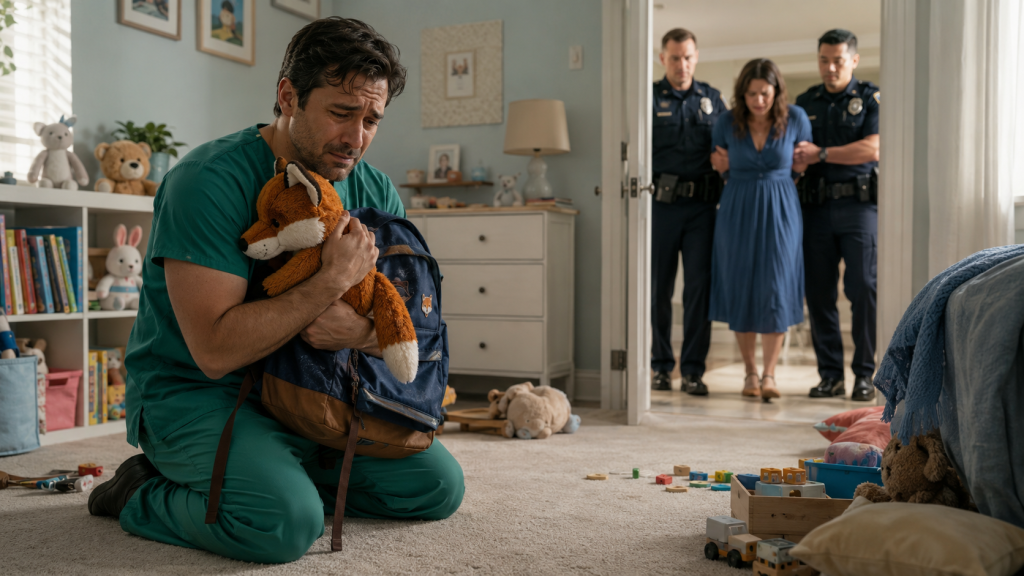
She came downstairs carrying her backpack against her chest.
Not casually.
Like it contained something alive.
“Ethan?” she whispered.
I looked up from the table.
“Yes?”
Her lips trembled.
Then she said a word that stopped my heart.
“Daddy.”
She had never called me that before.
I stood slowly.
“What is it, sweetheart?”
She flinched at sweetheart, then seemed to decide it was safe.
She climbed onto a chair and placed her backpack on the table.
Her little hands shook so badly she could barely unzip it.
“Look at this.”
From inside, she pulled Scout the fox.
Then she reached into a torn seam along the stuffed animal’s belly and removed a small cracked phone wrapped in cotton.
A hidden phone.
I did not touch it.
“Is this yours?”
She nodded.
“Daddy gave it to me.”
“Your real dad?”
She nodded again.
“He said if Mommy got scary, I could record and call Aunt Lila. But Mommy took my charger. I only save the battery for proof.”
Proof.
Seven years old.
Using words like proof.
I sat down across from her.
“May I look?”
She pushed the phone toward me.
There were videos.
Dozens of them.
Short clips.
Some dark.
Some shaky.
Some only audio.
I pressed play on one.
Clara’s voice filled the kitchen.
Cold.
Controlled.
Cruel.
“Say it.”
Harper’s tiny voice answered, trembling.
“I am bad.”
“Again.”
“I am bad.”
“And?”
“I make people leave.”
My throat tightened.
Another video.
Clara gripping Harper’s arm.
Not enough to show the whole room, but enough.
Enough to see the fingers.
Enough to see Harper crying.
Enough to hear Clara whisper, “Stop making me ugly.”
Another video.
Clara holding a lighter near Harper’s drawings spread across the fireplace hearth.
“If you tell him,” Clara said, “everything you love burns. Scout burns first.”
Harper made a small sound beside me.
I paused the video.
The kitchen was silent except for the refrigerator hum.
I wanted to break something.
I wanted to shout.
I wanted to run through the house and rip every lie from the walls.
But Harper was watching me.
Children remember adult reactions. Sometimes our reaction becomes part of the wound.
So I knelt in front of her.
“You were very brave to show me this.”
She began sobbing.
“Are you leaving now?”
“No.”
“Mommy says everyone leaves when they see.”
I held my hands open on my knees.
“I am staying. But your mother is leaving.”
Her eyes widened.
“The fire—”
“No fire,” I said firmly. “No one is burning anything today.”
Then I made the calls.
Child protective services.
The police.
My hospital’s mandated reporter line.
My supervisor.
I explained clearly.
I used professional words because if I used personal ones, I would fall apart.
Suspected child abuse.
Documented physical injury.
Threats.
Coercion.
Video evidence.
Immediate safety concern.
Harper sat at the kitchen table holding Scout, watching me with terrified hope.
Within an hour, two officers arrived with a child welfare investigator named Maren Brooks.
Maren had kind eyes and the tired steadiness of someone who had spent years walking into broken homes.
She knelt near Harper but did not crowd her.
“Hi, Harper. I’m Maren. I’m here to help.”
Harper looked at me.
I nodded.
“She’s safe.”
Harper whispered, “Do I have to go away?”
Maren’s face softened.
“We’re going to make sure you are safe. We will explain everything before anything happens.”
For the first time, Harper did not cry when a stranger spoke to her.
When Clara returned two hours later, she came in laughing into her phone, carrying shopping bags and fresh lipstick.
Then she saw the officers.
Her smile faltered.
Then she saw the cracked phone on the table.
Her face changed completely.
It was not fear at first.
It was rage.
She covered it quickly, but not quickly enough.
“What is this?” she asked.
Maren stood.
“Clara Monroe?”
“Yes.”
“I’m Maren Brooks with child protective services. We need to speak with you.”
Clara looked at me.
Her eyes were no longer warm.
“Ethan, what have you done?”
I stepped in front of Harper without thinking.
“I listened.”
Clara laughed sharply.
“You have no idea what you’re doing. She lies. She has behavioral problems. She manipulates men because her father abandoned us.”
Harper whimpered.
I turned slightly.
“You don’t need to answer her.”
Clara’s mask slipped further.
“Don’t talk to my daughter like she belongs to you.”
An officer said, “Ma’am, please sit down.”
“I will not sit down in my own house.”
Maren opened a folder.
“We have video evidence and a visible injury report.”
Clara’s gaze snapped toward Harper.
“You little—”
The officer moved closer.
“Careful.”
Clara stopped.
That was when I understood she could control it.
She was not overwhelmed.
She was not “stressed.”
She chose when to be cruel.
And she chose when to hide it.
The investigation moved fast after that.
Harper was taken for a forensic medical exam by professionals trained to work with children. I stayed only where they allowed me. I asked permission for everything.
Can I hold your hand?
Do you want me in the room?
Do you want Maren instead?
Harper chose me for some parts and Maren for others.
That mattered.
Her choices mattered now.
Clara was removed from the home that night under an emergency protective order. She screamed threats from the front walk while officers watched her pack a bag.
“You think you’re saving her?” she shouted at me. “She ruins everyone. Wait and see.”
Harper stood upstairs behind the curtain, watching.
I closed the curtain gently.
“You do not have to listen to that anymore.”
She whispered, “Is she coming back?”
“Not tonight.”
“Tomorrow?”
“I don’t know everything yet. But I promise there are people helping now, and I will not leave you alone with her.”
That night, Harper slept on the couch because she was afraid of her room. I slept in the armchair across from her.
At 3:12 in the morning, she woke up.
“Daddy?”
I opened my eyes instantly.
“I’m here.”
“Are you still staying?”
“Yes.”
She nodded and went back to sleep.
I sat awake until sunrise.
The weeks that followed were complicated.
There were interviews.
Hearings.
Emergency custody arrangements.
Police reports.
Medical documentation.
Phone evidence.
Clara hired a lawyer and claimed I had manipulated Harper because I wanted control of the house. She claimed I was unstable from working trauma medicine. She claimed Harper was “fantasy-prone” and “attention-seeking.”
But the videos spoke.
The bruises spoke.
Harper spoke too.
Quietly at first.
Then more clearly.
Her biological father, Adam, had died in a construction accident three years earlier. Before his death, he had suspected Clara’s temper was worse than she showed. He had given Harper the small emergency phone and taught her how to record.
“He said I was smart,” Harper told Maren. “He said if grown-ups don’t believe me, the phone would help.”
I wished I had known Adam.
I wished I could tell him his plan worked.
Clara eventually accepted a deal that kept her away from Harper while the case moved forward. There were supervised visitation discussions, mental health evaluations, parenting assessments. I learned that justice, especially for children, rarely feels like thunder. More often it is paperwork, waiting rooms, signatures, and adults trying not to fail again.
I filed for divorce.
Clara sent one message before the protective order tightened.
You ruined my life.
I stared at the words for a long time.
Then I deleted them.
She had ruined her own life in rooms where she thought no one was watching.
Three months later, the court granted temporary guardianship to Harper’s maternal aunt, Lila, who lived only twenty minutes away. I supported that because Harper knew Lila and trusted her.
But Harper asked one question that nearly broke me.
“Can Ethan still come?”
Lila smiled through tears.
“If Ethan wants to.”
I looked at Harper.
“I want to.”
So I came every Tuesday and Saturday.
We built routines.
Tuesday was homework and grilled cheese.
Saturday was park day if weather allowed, library day if it snowed.
Harper began therapy with a child trauma specialist. She learned words no seven-year-old should need, but also words every healing child deserves.
Boundaries.
Safety plan.
Feelings.
Consent.
Truth.
Some days she was angry.
Some days she would not speak.
Some days she laughed so suddenly that everyone in the room froze, not because laughter was strange, but because we had missed it so much.
One Saturday, six months after the night with the phone, Harper and I sat on a park bench while she ate ice cream.
She looked different.
Not fixed.
Children are not broken toys.
But brighter.
Her shoulders no longer lived near her ears. Her eyes did not search every doorway. Scout had been repaired with new orange fabric patches sewn by Aunt Lila.
Harper licked melting chocolate from her thumb.
“Ethan?”
“Yeah?”
“Do I still have to call you stepdad?”
I smiled gently.
“You can call me whatever feels right.”
She thought about that.
“Daddy is okay?”
My throat tightened.
“Only if it feels okay to you.”
She nodded.
“It does.”
I looked away for a second because I did not want her to think my tears were her responsibility.
She noticed anyway.
“Are you crying?”
“A little.”
“Why?”
“Because I’m happy you trust me.”
She leaned against my arm.
Not fearfully.
Not because she needed protection from a threat in the room.
Just because she wanted to.
That was the first time I understood that healing sometimes arrives quietly.
Not with a dramatic rescue.
Not with one perfect speech.
But with a child leaning against you on a park bench because her body has finally learned it is safe.
A year later, I stood in court while Clara’s final custody restrictions were read. Her contact with Harper remained limited and supervised under strict conditions. Clara sat at the far table, perfectly dressed, eyes cold, jaw tight.
She did not look at Harper.
Not once.
Harper sat beside Lila, holding Scout.
I sat behind them.
When the judge finished, Harper turned around and reached for my hand.
I took it.
Outside the courthouse, snow fell lightly over Denver.
Harper looked up at it.
“Can we get pancakes?”
Lila laughed.
“It’s almost dinner.”
Harper shrugged.
“Pancakes can be dinner.”
I said, “That is a medically supported fact.”
She giggled.
That sound was worth everything.
People sometimes ask me if I regret marrying Clara.
The honest answer is complicated.
I regret ignoring the signs.
I regret believing charm was character.
I regret every moment Harper cried near me and I wondered whether she simply disliked me.
But I do not regret being there when she finally reached into her backpack.
I do not regret answering when she called me Daddy.
I do not regret staying.
The house on Hawthorne Avenue was eventually sold. I did not want it. Lila did not want Harper tied to it. The stained glass, the polished banister, the perfect rooms—all of it belonged to the life Clara had staged.
Harper chose what to keep.
Scout.
A box of drawings.
Her father’s old baseball cap.
The cracked phone.
“Do you still need it?” I asked once.
She shook her head.
“No. But it believed me first.”
So we kept it.
Not as a weapon.
As proof that even when adults fail, truth can survive in small hidden places.
Now Harper is nine.
She likes science kits, blueberry pancakes, and telling me when my scrambled eggs are “too hospital.”
She still has hard nights.
Sometimes she wakes from dreams about fire.
Sometimes she asks if people can stop loving you because you are difficult.
When she asks that, I tell her the truth every time.
“Real love does not leave because you have feelings.”
She always asks, “Promise?”
And I always answer, “Promise.”
Then I stay until she falls asleep.
Because the most important thing I have learned is this:
Children do not always need heroes.
They need adults who notice.
Adults who listen the first time.
Adults who do not laugh off tears as drama.
Adults who understand that silence can be a locked room, and trust is the key a child may only offer once.
Harper offered me that key when she opened her backpack.
A cracked phone.
A torn stuffed fox.
A trembling whisper.
“Daddy, look at this.”
The moment I saw it, I understood everything.
Not just what Clara had done.
But what Harper had survived.
And from that day on, I made one promise stronger than any vow I had spoken at my wedding.
No one would ever make that little girl beg to be believed again.
THE END! THANKS FOR READING!