
It was minus ten degrees Celsius on Christmas Eve when my father threw me into the snow.Not metaphorically.Not in one of those dramatic family arguments people exaggerate years later.He opened the back door, grabbed my arm, pushed me onto the frozen porch, and locked the door behind me.“You want to act like an adult?” he said through the glass. “Then figure out how to survive like one.”The lock clicked.Inside, the Christmas music continued.Outside, I stood in dinner shoes, a thin velvet dress, and no coat…..More article below👇
My name is Elara Whitcomb, and I turned eighteen at midnight that night.But at 10:52 p.m., I was still seventeen, still cold, still standing outside the house my father loved calling his, while snow collected in my hair and my hands shook so badly I could barely feel them.
Through the frosted kitchen window, I could see my family.
My stepmother, Keisha, was filling crystal glasses with wine.
My half-brother Lucas was tearing open a brand-new gaming console.
My father, Grant Whitcomb, was unwrapping a gold watch from a velvet box and laughing like he had not just thrown his daughter into a winter night.
I knocked once.
Keisha turned her head.For one second, our eyes met.Then she smiled and slowly pulled the curtain halfway closed.That hurt more than the wind.Not because I expected love from her.I had stopped expecting that years ago.But cruelty becomes something else when people decorate it with Christmas lights.
Earlier that evening, all I had done was ask about a letter.
A simple envelope from my school counselor.
For weeks, I had been waiting to hear from Hawthorne Preparatory Academy, a prestigious arts program in Vermont.
I had applied in secret with my counselor’s help.
Full scholarship.
Boarding included.
A way out.
A future that did not involve babysitting Keisha’s twins, cleaning Lucas’s mess, and being told I should be grateful for “a roof over my head.”
The letter arrived three days before Christmas.
Then it disappeared.
At dinner, Lucas laughed with mashed potatoes still on his fork and waved the envelope over the table.
“Looking for this?”
My heart jumped.
“Give it to me.”
He grinned.
“Dad already handled it.”
I looked at my father.
“What does that mean?”
Dad kept cutting his steak.
“It means I declined.”
For a moment, the room made no sound.
“You what?”
Keisha sighed.
“Don’t be dramatic, Elara.”
“It was my scholarship.”
“It was unrealistic,” Dad said. “Vermont? Art school? You think money grows on trees?”
“It was paid for.”
Lucas snorted.
“Someone has to stay home and watch the twins next year.”
My chair scraped backward.
“No.”
Dad’s knife paused.
“What did you say?”
“I said no. I am not giving up my future because you need free childcare.”
The room froze.
Keisha’s eyes narrowed.
Lucas whispered, “Ooooh.”
Dad stood slowly.
“You do not embarrass me in my house.”
His house.
That was always his favorite phrase.
His house.
His rules.
His money.
His name.
Except there was one thing he never knew I knew.
Before my mother died, she gave me a small silver key.
I was nine years old.
She was already sick, already thin, already speaking like every word cost her strength.
She pressed the key into my palm and closed my fingers around it.
“When you turn eighteen,” she whispered, “call your grandmother. Not before.”
I had stared at her, confused.
“Grandma Vivienne?”
She nodded.
“Your father fears her for a reason.”
I did not understand then.
After she died, Dad told me Grandma Vivienne was selfish, cruel, and too rich to care about anyone.
He said she had abandoned us.
He said she blamed him for Mom’s illness.
He said if she ever contacted me, I was to tell him immediately.
So I said nothing about the key.
I wore it on a chain beneath my clothes.
Year after year.
Waiting.
Wondering.
That Christmas Eve, as snow soaked through my shoes, the key lay frozen against my chest.
My phone was inside.
My coat was inside.
My acceptance letter was inside.
And my family was inside, celebrating without me.
The minutes crawled by.
I knocked twice more.
No one opened.
My teeth chattered so hard my jaw hurt.
At some point, my anger became something quieter.
Sharper.
I stopped knocking.
I refused to beg.
If they wanted me outside like a stray animal, I would stand there and remember every face through that window.
Keisha laughing.
Lucas playing his new console.
Dad showing off his watch.
The twins asleep upstairs, innocent in a house full of people who were not.
At 11:47 p.m., headlights appeared at the end of the private road.
Not a truck.
Not a neighbor.
Not the police.
A black limousine glided through the snow like a moving shadow.
Behind it came two dark SUVs.
The vehicles stopped in front of the house.
The driver stepped out first.
Then the back door opened.
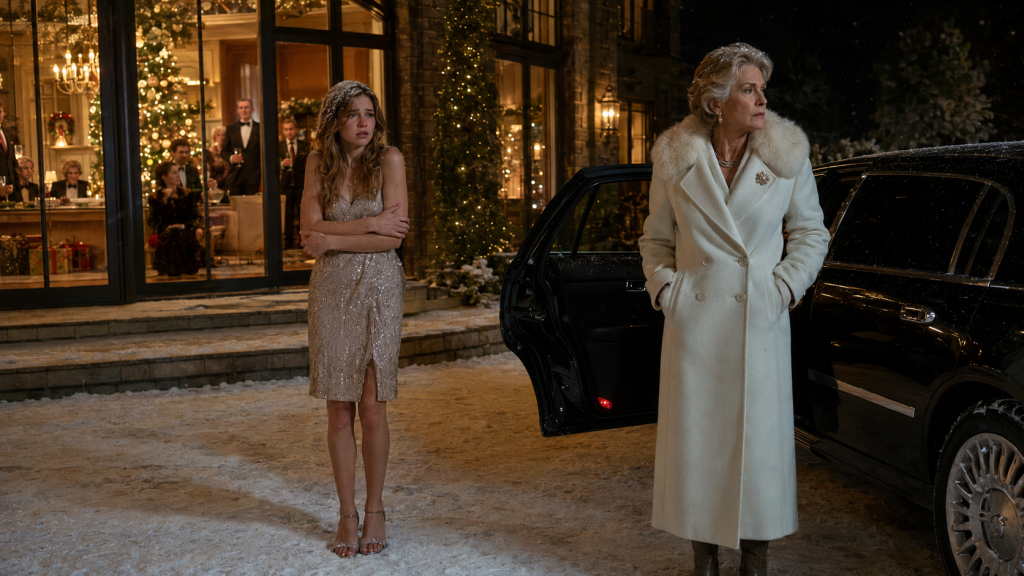
An older woman emerged in a white cashmere coat, polished black boots, and diamonds that caught the moonlight like ice.
She looked like the kind of woman people lowered their voices around.
Vivienne Whitcomb.
My grandmother.
I had seen her only in old photographs hidden in my mother’s jewelry box.
But I knew her instantly.
She walked toward me.
Her face did not change until she saw my blue fingers, my shaking shoulders, my bare arms.
Then something cold moved through her eyes.
Not panic.
Not pity.
Power.
“Who did this?” she asked.
My lips barely moved.
“Dad.”
Her gaze shifted to the glowing house.
Inside, my father had finally noticed the cars.
The curtain moved.
Grandmother looked at the house for a long, silent moment.
Then she spoke one word.
“Demolish.”
A tall man stepped from one of the SUVs and lifted a phone to his ear.
“Yes, Mrs. Whitcomb,” he said.
The driver wrapped a wool blanket around me.
Another woman, maybe a nurse, maybe an assistant, took my hands between hers and guided me toward the limousine.
“Easy,” she said. “You’re dangerously cold.”
I looked back.
The back door opened.
Dad came out wearing his expensive Christmas sweater and a smile so fake it trembled at the corners.
“Mother,” he said. “This is a misunderstanding.”
Grandmother did not answer him.
She climbed into the limousine beside me and pulled the blanket tighter around my shoulders.
Only then did she look at him through the open door.
“Grant.”
That one word made him go pale.
Keisha appeared behind him, silk dress glowing under the porch light.
Lucas stood near the window, still holding my acceptance letter.
Grandmother saw it.
Her eyes sharpened.
“Bring me that letter.”
Lucas looked at Dad.
Dad snapped, “Go inside.”
Two security officers stepped forward.
Dad’s voice rose.
“You cannot come onto my property and issue orders.”
Grandmother’s expression remained calm.
“Your property?”
The tall man with the phone approached and handed her a leather folder.
She opened it, removed several pages, and held them up.
“This house is owned by the Whitcomb Family Trust,” she said. “You were granted conditional residency after my daughter’s death. Conditions included the care, education, protection, and financial preservation of Elara Marie Whitcomb.”
My father’s face drained of color.
“You wouldn’t.”
“I already have.”
Keisha’s voice trembled.
“Grant, what is she talking about?”
Grandmother looked at her.
“Your husband has been living in a trust property for nine years while misusing funds intended for my granddaughter.”
I stared at her.
“What funds?”
Dad’s head snapped toward me.
Grandmother’s voice softened for the first time.
“Your mother left you more than a key, my dear.”
My chest tightened.
The nurse placed warm packs around my fingers.
I could barely feel them.
Grandmother continued, looking at Dad again.
“My daughter knew exactly who she married. She could not leave immediately, not while she was sick, but she prepared. The trust was supposed to pay for Elara’s education, clothing, medical care, and eventual independence.”
Keisha turned slowly toward Dad.
“Grant?”
He pointed at Grandmother.
“She’s lying.”
Grandmother did not blink.
“Then you won’t mind the audit.”
The word audit landed harder than any shout.
Dad stepped backward.
Lucas tried to slide the letter behind his back.
Grandmother noticed.
“Lucas,” she said. “If you destroy that document, you will be named personally in the report.”
Lucas froze.
He held the envelope out with shaking fingers.
One of the security officers took it and brought it to me.
My name was on the front.
Unopened now, though bent at the corner.
I tore it open with numb hands.
The words blurred before I could read them.
But one line stood clear.
Congratulations. Full scholarship awarded.
I began to cry.
Not loudly.
Not dramatically.
Just tears falling onto the paper while warmth returned painfully to my fingers.
Dad came closer to the limousine.
“Elara,” he said, changing his voice. “Sweetheart, don’t listen to her. She’s trying to turn you against your family.”
I looked at him.
“My family is inside opening gifts while I’m freezing outside.”
His mouth opened.
No answer came.
Grandmother gave a small nod to the tall man.
“Proceed.”
Within minutes, the private road filled with more vehicles.
Attorneys.
Property managers.
Security contractors.
A county official.
I did not understand how she had summoned them so quickly until I realized they had already been waiting nearby.
She had not come to surprise us.
She had come because midnight was approaching.
Because my mother’s instructions had finally reached the hour when they mattered.
At exactly 12:00 a.m., Grandmother took the silver key from around my neck and fitted it into a small black lockbox she had brought with her.
Inside were papers.
My birth certificate.
Trust documents.
My mother’s final letter.
And a phone with one saved number.
“Happy eighteenth birthday,” Grandmother said quietly.
I opened my mother’s letter first.
My darling Elara,
If you are reading this, I am gone, and you are finally old enough to be free.
I stayed too long because I was afraid.
Do not make my mistake.
Your father believes fear is ownership.
It is not.
Your grandmother will help you claim what was always yours.
Use it to build a life no one can lock you out of.
I pressed the letter to my chest.
Outside, Dad was shouting now.
Keisha was crying.
Lucas stood pale and silent in the snow.
Grandmother turned to the property manager.
“Locks changed tonight. Inventory tomorrow. Illegal structures removed immediately.”
Dad shouted, “Illegal structures?”
Grandmother’s voice became ice.
“The guest wing you built with trust funds marked for Elara’s education.”
Keisha gasped.
The guest wing.
The one with the private gym, wine room, and Lucas’s gaming suite.
The one Dad bragged about to neighbors.
The one he said proved he was “successful.”
It had been built with my future.
Grandmother leaned toward the open limousine door and looked at him.
“When I said demolish, Grant, I did not mean the home my daughter loved. I meant every lie you built with her child’s money.”
By morning, the guest wing had been sealed.
By noon, contractors arrived.
Not with wrecking balls.
With permits, cameras, inspectors, and court orders.
Piece by piece, the illegal addition came down.
The wine room.
The private gym.
The gaming suite.
The marble hallway Keisha loved photographing for social media.
My father stood in the driveway wearing yesterday’s clothes, watching workers remove the evidence of what he had stolen.
Keisha had packed three designer suitcases and left before breakfast with the twins.
Lucas avoided my eyes.
Dad tried to speak to me once.
“Elara, I made mistakes.”
I looked at the broken structure behind him.
“You made choices.”
He flinched.
I turned away.
Grandmother took me to her townhouse in Chicago that afternoon.
It was warm.
Quiet.
Full of old books, white orchids, and framed photos of my mother from before illness and marriage had dimmed her.
For the first time in years, no one ordered me to be smaller.
No one told me I was dramatic.
No one made my dreams sound expensive and inconvenient.
Grandmother sat across from me in the library and told me everything.
My mother had inherited part of the Whitcomb estate before marrying Dad.
Dad had loved the lifestyle, not the woman.
When Mom got sick, he pushed for control.
Grandmother fought him.
Mom compromised, hoping to protect me without triggering a war while she was dying.
The trust allowed Dad to remain in the house only because I was a child.
But if he neglected my care, blocked my education, misused funds, or endangered me, the protections could activate on my eighteenth birthday.
“The key was proof,” Grandmother said. “Your mother wanted the choice to come from you.”
I touched the chain at my neck, now empty.
“She told me to call you.”
“And you did,” she said.
“I didn’t have a phone.”
Grandmother smiled faintly.
“No. But you survived until midnight. That was enough.”
The next week, Dad tried to fight.
He claimed Grandmother had manipulated me.
He claimed I had been outside for only a few minutes.
He claimed the trust money had been used for “family stability.”
Then the security footage was produced.
The locked door.
The temperature.
The time stamps.
Keisha closing the curtain.
Lucas holding my letter.
Dad’s own voice through the kitchen camera, saying, “Then figure out how to survive like one.”
His attorney stopped arguing after that.
I enrolled at Hawthorne.
Grandmother bought me a real winter coat, two suitcases, and art supplies I was afraid to touch because they were nicer than anything I had ever owned.
When I arrived in Vermont, snow covered the hills.
But this time, I was dressed for it.
On my first night in the dorm, I placed my mother’s letter inside my desk drawer.
Beside it, I placed the silver key.
I did not need it anymore.
But I kept it because it reminded me of something important.
Sometimes protection does not look like rescue at first.
Sometimes it looks like waiting.
A hidden key.
A final letter.
A grandmother feared for reasons you do not yet understand.
And sometimes freedom arrives in a black limousine on the coldest night of your life and says one word that tears down everything that was never meant to stand.
Years later, people still ask if my grandmother really demolished the house.
I tell them no.
She demolished the guest wing.
She demolished my father’s control.
She demolished the lie that I was unwanted, powerless, and alone.
The house still stands.
But it is no longer his.
It belongs to the trust now.
One day, it may belong to me.
But I do not think of it as the place where my father locked me out.
I think of it as the place where my mother’s love finally opened the door.
And every Christmas Eve, I light a candle at midnight.
Not for revenge.
Not for anger.
For the girl in the snow who refused to beg.
For the mother who planned beyond death.
And for the grandmother who arrived just in time, looked at the life built on my suffering, and calmly ordered it torn down.
THE END! THANKS FOR READING!🙏