
My mother died at eighty-nine years old.Her name was Ruth Miller, and for most of my life, I believed there had never been a woman more honest than her.She was quiet, careful, and strong in the way old houses are strong.She did not say much, but when she loved you, she made sure you never doubted it.She packed my lunches until I was old enough to pretend I did not need them.She waited up when I came home late….More article below👇
She kept every birthday card I ever gave her, even the ugly ones from kindergarten with glue dried in crooked lumps.So when she passed away in her sleep, three days after my forty-first birthday, I thought grief would be simple.Painful, yes.But simple.I had lost my mother.
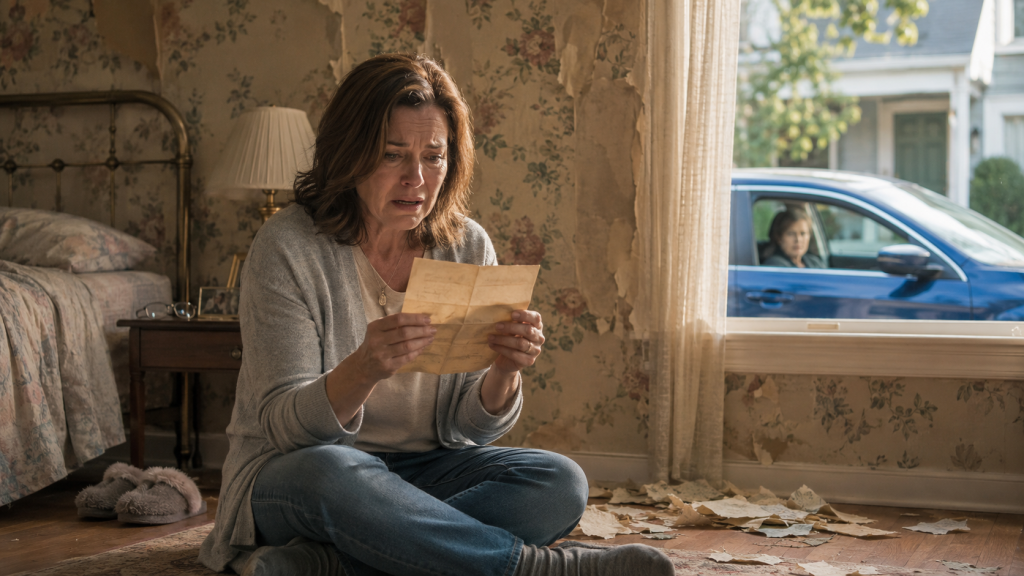
That was the story.Then I found the letter behind the wallpaper.It happened two weeks after the funeral.I was renovating her bedroom because I could not bear to leave it exactly as she had left it.
The curtains still smelled like lavender.Her slippers still waited beside the bed.
Her reading glasses sat on the nightstand, open to a mystery novel she would never finish.
I told myself I was cleaning.
Really, I was trying to survive.
When I pulled back a faded strip of wallpaper near the closet, something brown and flat slipped down behind the loose plaster.
An envelope.
Sealed.
Yellowed with age.
My name was written across the front in my mother’s handwriting.
For Emily.
Underneath, smaller:
Open after I am gone.
My hands began shaking before I even tore it open.
Inside were four pages, folded neatly.
The date at the top was forty-one years old.
Three months after I was born.
I sat on the bare floor, surrounded by torn wallpaper, and began to read.
My darling Emily,
If you are reading this, then I am gone, and I have carried this truth as far as I could.
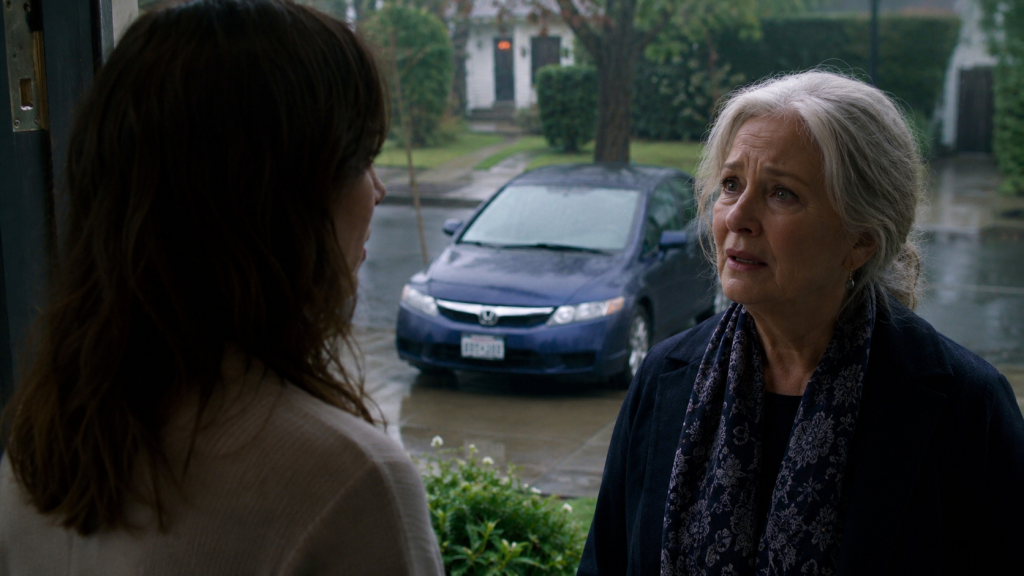
When you were six weeks old, a woman came to our door in the rain.
She was soaked through, bleeding at the lip, holding you under her coat.
She begged me to take you.
She said your father was dangerous.
She said if he found you, he would use you to make her return.
Your father and I had lost our baby the year before.
I thought I would never hold a child again.
Then this young woman placed you in my arms and said, “Please. Save my daughter.”
I stopped breathing.
The room blurred.
I read the paragraph again.
Then again.
I was not Ruth’s biological daughter.
The woman I had buried last week had not given birth to me.
She had saved me.
The letter continued.
Her name was Clara Bennett. She was only twenty-two. She loved you more than any mother I have ever seen, but she was terrified. I promised her you would be safe. I promised her I would raise you as my own.
Your father, the man Clara feared, came looking twice. The second time, he threatened your adoptive father. After that, Clara agreed to stay away. But she never stopped loving you.
She visits every birthday.
She parks across the street in a blue Honda.
She never knocks.
She only watches long enough to know you are alive, loved, and safe.
My breath caught in my throat.
My birthday had been three days ago.
Three days.
I dropped the letter and crawled toward the hallway like the room had no air.
In the kitchen, my Ring camera tablet sat charging by the fruit bowl.
My fingers barely worked as I opened the app.
I checked the footage from my birthday.
There it was.
A blue Honda.
Parked across the street beneath the sycamore tree.
For two hours.
The driver’s face was hard to see, but I could make out gray hair, small hands gripping the steering wheel, and a woman’s profile turned toward my house.
My heart pounded so hard I could hear it in my ears.
I checked the year before.
Same car.
Same place.
The year before that.
Same car.
Again and again.
Every birthday.
Always watching.
Always leaving.
Then I remembered the bracelet.
Last year, on the morning of my fortieth birthday, I had found a small box on the porch.
Inside was a gold bracelet.
No card.
No name.
Just a delicate chain with a tiny heart charm.
I had thought it was a mistake.
Now I ran upstairs, opened my jewelry drawer, and pulled it out.
The bracelet gleamed in my palm.
A stranger had left it for me.
No.
Not a stranger.
My mother.
Not Ruth.
Clara.
The name felt impossible in my mouth.
I went back downstairs and read the final page of Ruth’s letter.
Emily, I know this may hurt you. Please do not think I lied because I did not love you. I lied because I was afraid truth would put you in danger.
Clara asked for one thing.
She asked me to tell you, when it was safe, that she did not abandon you.
I waited too long.
Forgive me.
And if you ever see the blue Honda, do not be afraid.
She has loved you from across the street for forty-one years.
I did not sleep that night.
At dawn, I sat by the window with coffee gone cold in my hands, staring at the empty curb.
By noon, I had convinced myself the woman would not return.
Why would she?
My birthday had passed.
Ruth was gone.
The secret was out, but only to me.
Then at 3:14 p.m., the blue Honda turned the corner.
It slowed near my house.
It parked under the sycamore tree.
For a few seconds, I could not move.
Then I stood.
My legs felt hollow.
I walked to the front door, opened it, and stepped onto the porch.
The woman in the car looked up.
Even from across the street, I saw the shock on her face.
She knew.
She knew I knew.
I crossed the lawn slowly.
Every step felt like walking through forty-one years of someone else’s silence.
The driver’s window rolled down halfway.
The woman inside was older, with silver hair tucked beneath a navy scarf.
Her face was lined.
Her lips trembled.
But her eyes—
My eyes.
She whispered, “I’m your mother.”
The world went silent around me.
No birds.
No cars.
No wind.
Just that sentence.
I gripped the car door to keep myself upright.
“Why didn’t you come to me?” I asked.
Her tears came immediately.
“Because your father found me once.”
The word father made my stomach twist.
“He said if I ever tried to take you back, he would make sure no one found either of us. Ruth believed him. So did I.”
“You watched me for forty-one years?”
“Every birthday,” she said. “Sometimes from this street. Sometimes farther away when I thought someone might notice.”
I laughed once, but it broke in the middle.
“You left gifts?”
“When I could afford them.”
“The bracelet?”
She nodded.
“I saved for eight months.”
My throat burned.
“Why now?”
Clara looked toward my house.
“Because Ruth is gone. Because your father died six months ago. And because three days ago, I watched you sit on your porch after the funeral, holding that bracelet, and I knew I could not survive another birthday as a shadow.”
She reached to the passenger seat and lifted a worn wooden box.
“I brought this in case I ever found courage.”
She handed it to me through the window.
Inside were photographs.
A hospital bracelet.
A tiny pink hat.
Birthday cards never mailed.
Receipts for small gifts.
A newspaper clipping from my high school graduation.
A printed photo from a charity event where I had spoken at thirty-two.
She had collected proof of my life from a distance.
My hands shook as I lifted one photograph.
It showed Clara at twenty-two, holding a newborn against her chest.
Me.
On the back, in faded ink, she had written:
My Emily. Six weeks. The last morning.
The pain came then.
Not gentle tears.
Not a soft cry.
A sound tore out of me, ugly and deep.
Clara opened her car door and stepped out.
She did not touch me at first.
She waited, as if she still believed she had no right.
That broke me more than anything.
I moved first.
I stepped into her arms.
She was smaller than I expected.
Fragile.
Warm.
Real.
She held me like someone afraid I might disappear.
“I didn’t abandon you,” she sobbed against my hair. “I swear to God, Emily, I didn’t. I gave you to the only woman brave enough to protect you.”
“I know,” I cried. “I read the letter.”
“Ruth was good?”
“She was everything.”
Clara closed her eyes.
“Thank God.”
We stood there on the curb for a long time, two women attached by blood, separated by fear, reunited by a dead woman’s hidden confession.
Finally, I invited her inside.
She hesitated at the door.
“I used to imagine this house,” she whispered.
“You’ve never been in?”
“Never past the porch. Ruth said it was safer.”
I opened the door wider.
“Come in.”
She stepped inside like she was entering a church.
Her eyes moved over the photographs on the wall.
Me at seven with missing teeth.
Me at prom.
Me in college.
Me with Ruth at my wedding.
Clara stopped before one photo of Ruth holding me as a baby.
“She loved you,” Clara whispered.
“She did.”
“I hated her for years,” she admitted. “Not because she took you. Because she got to keep you.”
I looked at the photo again.
For the first time, I saw it differently.
Not a lie.
A sacrifice.
Ruth had raised another woman’s child while carrying the weight of that woman’s grief.
Clara had surrendered her baby and then spent a lifetime watching from across the street.
And I had been loved by both.
That afternoon, we sat at my kitchen table.
She told me everything.
My biological father’s name was Victor.
He had been charming at first, then controlling, then violent.
When she became pregnant, he treated me like property before I was even born.
After I arrived, he threatened to take me whenever Clara tried to leave.
One night, after he struck her while she was holding me, she ran.
She went to Ruth because Ruth had once been her school librarian.
Ruth had helped her apply for a job years earlier.
“She was the only kind adult I remembered,” Clara said.
Ruth and my adoptive father, Henry, took me in quietly.
Papers were arranged through a small private attorney.
Not everything was clean.
Not everything was legal in the way people would understand now.
But everything was done to keep me alive.
“Did Ruth tell Henry?” I asked.
“Of course,” Clara said. “He held you while Ruth held me. He said, ‘A child in danger is never a burden.’”
I began crying again.
Henry had died when I was twelve.
I remembered him as gentle and funny, a man who smelled like pipe tobacco and peppermint.
Now I understood the depth of what he had done.
For days after that, Clara and I talked.
Awkwardly at first.
Then with hunger.
There was too much to say.
Forty-one years could not be repaired with one conversation.
Sometimes I felt angry.
At Ruth.
At Clara.
At a dead man named Victor.
At myself for not knowing what could not have been known.
Sometimes Clara cried when I asked simple questions.
Sometimes I had to leave the room because her answers hurt too much.
But she kept coming back.
And I kept opening the door.
A month later, we visited Ruth’s grave together.
Clara brought white lilies.
I brought the hidden letter.
We stood side by side beneath a gray sky.
Clara touched the headstone.
“Thank you,” she whispered. “For keeping our daughter safe.”
Our daughter.
The words should have felt strange.
Instead, they felt like truth making room for itself.
I placed the letter at the base of the stone, sealed inside a plastic sleeve.
“I’m angry you waited so long,” I said to Ruth’s name. “But I know why you did it. And I love you.”
The wind moved through the cemetery trees.
For one brief second, I imagined Ruth standing behind us, arms folded, relieved that the two pieces of her secret had finally found each other.
That year, my birthday came again.
For the first time in my life, the blue Honda did not park across the street.
Instead, it pulled into my driveway.
Clara walked up the front steps carrying a cake with slightly crooked frosting.
I opened the door before she could knock.
She smiled nervously.
“Happy birthday, Emily.”
I smiled back.
“Come in, Mom.”
The word startled both of us.
It did not erase Ruth.
It did not replace her.
Love is not a room with only one chair.
It is a house that somehow expands when truth enters it.
Clara cried.
I took the cake from her hands before she dropped it.
And together, we walked inside.
For forty-one years, she had watched my life through glass, across streets, from parked cars, behind fear.
But not anymore.
That year, she sat at my table.
That year, she helped light the candles.
That year, when I made my wish, I did not ask for the past to change.
I asked only for enough time to know the woman who had loved me in silence.
And when I blew out the candles, Clara reached for my hand.
Her fingers trembled.
Exactly like mine.
And for the first time since Ruth died, I did not feel motherless.
I felt surrounded.
THE END! THANKS FOR READING!