
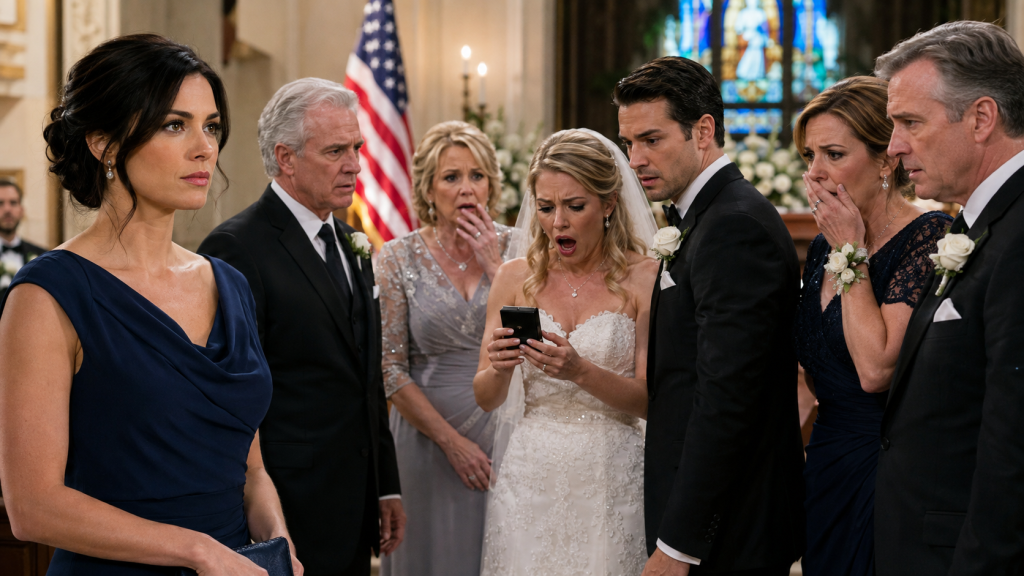
Just days before my younger sister’s wedding, my parents gave me an ultimatum.“If you walk into that ceremony,” my mother warned, “don’t ever call us your family again.”I never showed up.
Instead, I mailed the bride a small black gift box. The instant she opened it, the celebration came to a halt—and the perfect future everyone had planned began to unravel.
The package reached St. Jude’s Church just as Sienna was preparing to walk down the aisle, wearing the satisfied smile of someone convinced she had finally won.
Miles away, I sat quietly in my apartment, staring at the delivery notification that had appeared on my phone. Delivered at 2:17 p.m. I placed the phone facedown beside my coffee and listened to the silence around me.
Three days earlier, my mother had visited me dressed in pearls and a cream-colored coat. She wore the same composed expression she always used when disguising cruelty as dignity.
She didn’t sit down. She stood in the middle of my modest living room, looked around as though poverty might be contagious, and delivered her verdict.
“If you come to that wedding,” she said calmly, “consider yourself no longer part of this family.” My father remained a few steps behind her, saying nothing.
That was nothing new.
Whenever standing up for me required backbone, silence was always his preferred choice.
I looked from him to my mother.
“Why would my presence be such a problem?”
My mother’s lips tightened.
“You know perfectly well why.”
“No, Mother. Say it.”
She glanced toward my father, but he continued studying the floor.
“Sienna deserves one day without your bitterness,” she said. “She has spent months planning this wedding. We will not allow you to create a scene because Arthur chose her.”
Arthur.
The man I had once planned to marry.
The man who had proposed to me beneath the oak trees at my parents’ country house.
The man who had later claimed that he had simply realized Sienna understood him better.
My sister never bothered calling to invite me personally.
She didn’t need to.
She had already taken almost everything that mattered.
She stole Arthur, although she insisted that a person could not be stolen.
She inherited my position at the family company I had helped build.
Even my seat at the dinner table became hers, while my opinions slowly stopped existing in everyone else’s eyes.
People assumed I skipped the wedding because I couldn’t face the humiliation.
They couldn’t have been more wrong.
I skipped it because I had spent six months preparing something far more powerful than a public argument.
I had prepared the truth.
Two years earlier, I introduced Arthur Vance to my family.
Back then, he was my fiancé.
Arthur was polished, charming and remarkably skilled at saying exactly what people wanted to hear. He worked in luxury real estate and claimed to have developed properties in three states. He wore tailored suits, remembered birthdays and never arrived at dinner without flowers for my mother.
Within weeks, she adored him.
My father admired Arthur’s confidence and the way he talked about expansion, investment and aggressive growth.
Sienna watched him differently.
At first, I told myself she was simply impressed.
She was twenty-seven then, four years younger than me, and had spent most of her life being protected from consequences.
Growing up, Sienna was the fragile one.
If she failed a class, the teacher was unfair.
If she lost a friend, the friend was jealous.
If she borrowed my clothes without permission, I was selfish for objecting.
My mother called her sensitive.
My father called her special.
I was expected to be understanding.
I had always been the responsible daughter.
When my father’s small construction office nearly collapsed after a bad investment, I left graduate school for a year to help him reorganize the accounts.
I negotiated payment plans with suppliers.
I found two new investors.
I created the financial controls that kept the company alive.
Eventually, Vance Crest Holdings grew from a struggling regional business into a respected property development firm.
The name Vance came from my father’s side of the family. Crest was my suggestion, added when we expanded into commercial projects.
My father gave me twelve percent ownership in recognition of the years I had invested.
At least, that was what the paperwork said.
I worked twelve-hour days while Sienna traveled, changed careers twice and posted photographs from expensive resorts.
No one resented her for it.
“She is still finding herself,” my mother would say.
Apparently, I had found myself too early, and my reward was carrying everyone else.
When Arthur entered our lives, he immediately took an interest in the company.
He asked intelligent questions about our properties and listened closely when I discussed the firm’s weaknesses.
At the time, I found his interest romantic.
I thought he wanted to understand my world.
Now I know he was studying it.
My mother began making subtle comments a few months after our engagement.
“Sienna and Arthur have such similar taste.”
“Arthur needs someone who enjoys entertaining.”
“You’ve always been so focused on work, Eleanor. Some men need more warmth.”
I laughed off the remarks.
Arthur did too.
He would kiss my forehead and tell me my mother was old-fashioned.
Then he began staying late at the office with Sienna.
My sister had recently accepted a vague role in marketing, despite having no experience.
Arthur told me he was helping her understand the business.
I wanted to trust them.
Trust, I later learned, is not the same as refusing to see.
The first major betrayal occurred while I was hospitalized with pneumonia.
I had been sick for over a week and heavily medicated. My mother visited twice. My father stopped by once to bring papers he claimed were related to insurance coverage.
He placed several pages on the table beside my hospital bed.
“Nothing important,” he said. “Administrative forms.”
I was too weak to read them carefully.
But I did not sign them.
I remember that clearly.
My hands were trembling so badly that I could barely hold a cup.
Two months later, I discovered that my ownership shares had been transferred into a family trust controlled by my father.
The transfer documents carried my signature.
It looked convincing.
It was also forged.
When I confronted him, he didn’t deny benefiting from it.
He only denied knowing the signature was false.
“You must have signed while you were ill,” he said.
“I didn’t.”
“You were on medication. You probably don’t remember.”
“I remember.”
My mother accused me of creating drama.
Sienna sat beside Arthur, twisting a silver bracelet around her wrist.
Arthur didn’t look at me.
Three weeks after that conversation, he ended our engagement.
He arrived at my apartment with a prepared speech about compatibility and different paths.
He claimed there was no one else.
Four months later, he proposed to Sienna at my parents’ anniversary party.
My mother cried tears of joy.
My father opened champagne.
I stood near the terrace doors, feeling as though I had become invisible inside my own life.
Sienna approached me later that evening.
“I never meant for this to happen,” she said.
She was wearing the diamond earrings I had given her for college graduation.
“You could have said no.”
She lowered her voice.
“You and Arthur were already having problems.”
“We were planning a wedding.”
“He said you made him feel small.”
I almost laughed.
Arthur was six feet two, owned three luxury watches and could dominate any room he entered.
Nothing about him had ever been small except his loyalty.
“What do you want me to say, Sienna?”
“That you’re happy for me.”
I stared at her.
She genuinely believed she deserved my blessing.
“I hope you receive everything you have earned,” I said.
She smiled, misunderstanding me.
“So we’re okay?”
“No. But someday you’ll understand what I meant.”
After Arthur left me, my position in the company disappeared almost as quickly as my engagement.
My father announced a restructuring.
Sienna became director of strategic development.
Arthur received an executive role and an office larger than mine had ever been.
I was offered a consulting title with no authority, no voting power and a salary less than half of what I had earned.
When I refused, my father accused me of abandoning the family.
“You’ve always let emotions interfere with business,” he said. “Sienna understands how the real world works.”
What he overlooked was one important detail.
I understood forensic accounting.
For years, I had been the person who found mistakes others missed.
I could follow money through layers of accounts, identify fabricated invoices and recognize when numbers had been arranged to hide a crime.
So I stopped arguing.
I moved out of the townhouse owned by the company and rented a modest apartment across the city.
I accepted consulting work under my own name.
I changed my phone number and allowed everyone to believe they had beaten me.
While my family obsessed over wedding plans, I quietly followed every suspicious financial trail connected to Vance Crest Holdings.
At first, I was searching only for evidence of the forged share transfer.
I found much more.
The company had begun paying consulting fees to businesses with no employees, no physical offices and no history of legitimate work.
One of those companies was registered to a post-office box Arthur controlled.
Another belonged to a former college roommate of his.
Millions of dollars passed through those entities in carefully divided amounts.
Arthur was stealing from the company.
But he wasn’t working alone.
Several fake board resolutions had authorized the transfers.
My father’s signature appeared on them.
Whether he signed knowingly or allowed Arthur to manipulate him, I couldn’t tell.
Either possibility revealed how little judgment remained behind his authority.
I uncovered wedding expenses paid from corporate accounts.
The florist had been listed as a landscaping contractor.
The luxury cars for the bridal party appeared in the books as transportation for visiting investors.
Even Sienna’s custom wedding dress had been disguised as protective uniforms for construction workers.
The theft that enraged me most involved the employee retirement fund.
Vance Crest had postponed mandatory contributions while spending nearly four hundred thousand dollars on the wedding.
Some of our employees had worked for the company longer than Sienna had been alive.
They had trusted my family with their futures.
Arthur and my parents were using their retirement money to purchase imported flowers and crystal tableware.
I gathered copies of everything.
Forged signatures.
Hidden wire transfers.
False invoices.
Fake board minutes.
Insurance documents valuing my mother’s jewelry at nearly three times its actual worth.
The evidence filled hundreds of digital files.
But none of those discoveries compared to the biggest secret of all.
I found it because of a mortgage application Arthur had submitted years earlier under a slightly different version of his name.
Arthur James Vance had once been Arthur James Vaughn.
The application listed a spouse.
Brooke Vaughn.
I searched marriage records and found a certificate issued in Washington State eleven years earlier.
I searched divorce records next.
There weren’t any.
At first, I assumed the database was incomplete.
Then I found a school fundraiser photograph showing Brooke beside an eight-year-old boy named Caleb Vaughn.
Arthur had a wife.
He also had a son.
And he had never legally divorced.
I contacted Brooke using an email address connected to the fundraiser.
My first message was brief.
My name is Eleanor Crest. I believe we need to speak about Arthur.
She responded ten minutes later.
Which story did he tell you?
We arranged a video call that evening.
Brooke appeared on the screen wearing a blue sweater, her dark hair tied loosely behind her head. She looked exhausted before I said a word.
When I showed her a photograph of Arthur and Sienna’s engagement announcement, she closed her eyes.
“I knew there would be another woman,” she whispered. “I didn’t know he would try to marry her.”
Arthur had abandoned Brooke four years earlier.
He told her he needed to travel for work.
Then he drained their joint account, stopped paying the mortgage and disappeared.
He contacted Caleb twice during the first year and then stopped completely.
Brooke filed for divorce, but Arthur avoided service and used false addresses. Because the proceedings were never completed, the marriage remained legally intact.
“He told me he would destroy me if I went after him publicly,” Brooke said. “He claimed he had powerful friends.”
“He has wealthy people who believe he is powerful,” I replied. “That isn’t the same thing.”
I showed her the financial evidence.
By the end of our first conversation, she was crying.
By the second, we were laughing over how badly Arthur had underestimated both of us.
Brooke still had original emails, bank statements and documents connecting Arthur to earlier fraud.
Together, our evidence showed a pattern stretching back more than a decade.
I contacted a federal investigator through an attorney I trusted.
I also reported the forged ownership transfer and misuse of retirement funds to the appropriate state agencies.
The investigators warned me not to confront Arthur.
They needed time to review the evidence and coordinate their next steps.
The wedding was scheduled for six weeks later.
My invitation arrived in a thick ivory envelope.
There was no personal note from Sienna.
My name appeared without a guest.
I placed the invitation in a drawer.
Two weeks before the ceremony, my mother called.
“You will behave appropriately,” she said.
“I always do.”
“No speeches. No private conversations with Arthur. No upsetting your sister.”
“Why would I want a private conversation with Arthur?”
“You know how emotional you can become.”
I nearly admired her talent for rewriting reality.
Arthur had cheated.
My father had stolen my shares.
Sienna had accepted my fiancé and my career.
Yet I was the emotional one.
Three days before the wedding, my parents came to my apartment and delivered their ultimatum.
They did not know that my attorney had already recovered access to internal company records.
They did not know investigators had interviewed two former employees.
They did not know Brooke had purchased a ticket to our city.
And they certainly did not know what I planned to send to St. Jude’s Church.
After my parents left, I placed three items inside a small black box.
The first was a certified copy of Arthur and Brooke’s marriage certificate.
The second was a flash drive containing selected evidence of the fraud, along with a video file and instructions for opening it.
The third was a handwritten note.
Congratulations, Sienna.
You finally got everything you wanted from me.
Now open the folder marked “Play Me.”
I arranged for a courier to deliver the box directly to the bridal preparation room at 2:15 p.m., just before the ceremony.
I did not want to humiliate Sienna in front of the congregation merely for being foolish.
But the investigators needed Arthur prevented from leaving before they arrived.
The video folder contained a live link to Brooke, who was waiting in a private room inside the church with her attorney and two investigators.
I had not known whether Sienna would open the box immediately.
She did.
At 2:17 p.m., Brooke sent me one word.
Delivered.
What happened next was later described to me by several people.
Sienna was standing near the church entrance when the gift arrived.
The organist had already begun playing.
My father was waiting to escort her down the aisle.
My mother noticed the black box and told Sienna to leave it for later.
But Sienna recognized my handwriting.
Perhaps she expected jewelry.
Perhaps she believed I had finally surrendered.
She opened it.
The marriage certificate lay on top.
Witnesses said the color disappeared from her face as she read Brooke’s name.
Arthur, waiting near the altar, saw the commotion and started walking toward her.
Sienna removed the flash drive and handed it to her cousin Liam, who had a laptop connected to the church’s projector for the wedding slideshow.
“Open this,” she ordered.
My mother tried to stop him.
“This is not the time.”
Sienna turned on her.
“If Eleanor sent this today, there’s a reason.”
Liam inserted the drive.
The folder marked “Play Me” appeared on the screen.
When he clicked it, Brooke’s face filled the large white display above the altar.
The guests fell silent.
Brooke looked directly into the camera.
“My name is Brooke Vaughn,” she began. “Arthur Vance is my husband.”
Arthur shouted for Liam to turn off the projector.
Two men near the side entrance stood up.
Investigators.
The church doors closed behind them.
Brooke held up the original marriage certificate.
“We were married eleven years ago in Seattle. We have an eight-year-old son. Our divorce was never finalized because Arthur repeatedly used false addresses and avoided legal service.”
Sienna slowly turned toward him.
“Tell me she’s lying.”
Arthur lifted his hands.
“This is complicated.”
“Are you married?”
“I can explain.”
“Are you married?”
He looked toward my parents as though expecting them to rescue him.
My father’s face had turned gray.
My mother clutched her pearls.
Arthur finally said, “Technically.”
The word traveled through the church like a spark through dry grass.
Sienna’s bouquet slipped from her hands.
Brooke continued speaking.
“Arthur abandoned our son, drained our accounts and used false identities to obtain loans. The files on the drive contain evidence gathered by Eleanor and me.”
The projector screen changed.
Bank records appeared.
Then shell-company registrations.
Then forged board resolutions.
Then photographs of checks and wire transfers.
Each document carried dates, account numbers and Arthur’s authorization.
One file showed nearly forty thousand dollars paid to the bridal florist from an employee retirement account.
Another showed the wedding venue deposit disguised as an engineering inspection.
My father stumbled toward the laptop.
“Turn this off.”
One of the investigators stepped between him and the table.
“Mr. Crest, please return to your seat.”
The entire church heard him.
My father obeyed.
For perhaps the first time in his life, he had no control over the room.
My mother demanded to know why her jewelry policy appeared among the files.
The screen displayed appraisals showing that several pieces had been intentionally overvalued.
The insurance premiums had been paid by the company.
One necklace had already been reported missing, though witnesses had seen my mother wearing it at a charity dinner after the supposed loss.
She reached up and touched the pearls around her throat.
They were the same necklace.
Sienna looked from the screen to our mother.
“You knew?”
“I knew nothing about this.”
Arthur attempted to walk toward a side door.
The second investigator blocked his path.
“Mr. Vance, we need you to remain here.”
“I’m at my wedding.”
“No,” Sienna said from behind him. “You’re at the wedding you tried to commit bigamy at.”
Arthur turned toward her.
“Sienna, listen to me. Eleanor is doing this because she hates us.”
That was his final mistake.
Sienna had spent years dismissing my warnings, but she understood evidence when it appeared ten feet high on a church wall.
She walked to the laptop and opened another folder.
Inside were copies of the documents transferring my ownership shares.
A forensic handwriting report showed that my signature had been traced.
The metadata connected the document’s creation to Arthur’s computer.
Emails between Arthur and my father discussed removing me before the company’s planned expansion.
One message from Arthur read:
Once Eleanor is out, Sienna will be easier to manage.
Sienna read it twice.
Then she removed her engagement ring.
Arthur took a step toward her.
“Those emails are out of context.”
“You said you loved me.”
“I do.”
“You called me easy to manage.”
“I was trying to reassure your father.”
“You married me for the company.”
“We aren’t married yet.”
For the first time that afternoon, Sienna laughed.
It was a bitter, broken sound.
“No, Arthur. We never will be.”
She placed the ring on the altar.
The investigators escorted Arthur into a private room for questioning.
The guests began leaving in confused groups.
Some whispered.
Some pretended not to stare.
Others took photographs until the priest asked them to show respect.
My mother found enough strength to blame me.
“This is Eleanor’s revenge,” she announced. “She planned this humiliation.”
Sienna looked at her.
“Did Dad forge Eleanor’s signature?”
My mother’s mouth opened, but no answer came.
“Did you know her shares were stolen?”
“We were protecting the company.”
“From the person who saved it?”
“Sienna, this is not the place.”
“It was the place when you planned to marry me to a criminal.”
My father sat alone in the front pew, staring at his hands.
Sienna removed her veil and placed it beside Arthur’s ring.
Then she walked out of the church without speaking to either parent.
At 3:06 p.m., my phone rang.
Sienna’s name appeared on the screen.
I let it ring until it stopped.
She called again.
Then again.
On the fourth call, I answered.
For several seconds, neither of us spoke.
Finally, she whispered, “Did you know everything?”
“Yes.”
“How long?”
“Long enough to give you the truth before you made the biggest mistake of your life.”
“You could have told me privately.”
“Would you have believed me?”
Silence.
We both knew the answer.
“Why did you send it during the wedding?”
“Because Arthur planned to leave the country tomorrow using company money. Investigators needed him in one location. The ceremony was the only event he would not miss.”
“You destroyed me in front of everyone.”
“No, Sienna. Arthur did that. I sent proof.”
She began crying.
My sister rarely cried from pain.
Growing up, her tears had usually been tools.
That afternoon, they sounded different.
“I loved him.”
“So did I.”
“I thought he chose me because I was better for him.”
“He chose you because you had access to the company and because he believed you would not question him.”
Her breathing caught.
“That isn’t fair.”
“No. It isn’t.”
She waited, perhaps expecting comfort.
I had comforted her after every childhood disappointment, every breakup and every failure.
This time, I remained silent.
“What happens now?” she asked.
“That depends on what you do next.”
“Are you going to take the company?”
“I’m going to recover what was stolen from me and protect the employees whose retirement money paid for your wedding.”
“You want to punish us.”
“I want accountability. You’ve spent your entire life confusing those two things.”
She ended the call.
Over the following weeks, Vance Crest Holdings became the subject of multiple investigations.
Arthur was charged with financial crimes connected to the shell companies, falsified loan applications and misuse of corporate funds.
His attempted marriage to Sienna became another part of the case, though it was the money trail that created the greatest legal danger for him.
Brooke filed new claims for unpaid child support and marital assets.
With Arthur unable to hide behind false addresses, her long-delayed divorce finally moved forward.
My father resigned from the company.
He insisted that Arthur had manipulated him, but emails showed that he had knowingly approved the forged transfer of my shares.
He avoided prison by cooperating with investigators and accepting responsibility for several financial violations.
The cost was enormous.
He lost his authority, his reputation and most of his ownership.
My mother faced an insurance-fraud investigation involving her jewelry.
For months, she told anyone willing to listen that I had destroyed the family.
She never acknowledged that the family had been destroyed long before the black box arrived.
The box merely turned on the light.
My shares were restored.
A court-appointed financial monitor supervised the company while its board was reorganized.
The stolen retirement funds were repaid through the sale of several properties, including my parents’ country house.
My mother called me the day she learned the house would be sold.
“You’ve taken everything from us,” she said.
I stood at my apartment window, looking down at people crossing the street below.
“No, Mother. I took back what belonged to me.”
“You were always jealous of Sienna.”
“I spent my entire childhood making myself smaller so she could feel special.”
“She is your sister.”
“And I was your daughter.”
My mother had no response.
For once, silence belonged to her.
Sienna disappeared from public life for several months.
She resigned from the company and moved into a rented apartment.
The society pages that had celebrated her engagement now treated her as a scandal.
Some of her friends stopped answering calls.
Others sold stories about her relationship with Arthur.
I knew what humiliation felt like.
I did not celebrate hers.
But I also did not rescue her.
Consequences lose their meaning when someone else always carries them for you.
Nearly eight months after the wedding, Sienna appeared outside my office.
By then, I had launched an independent financial-consulting firm.
Brooke worked with us as a client-relations specialist while completing a business certification program.
She had moved to our city with Caleb after receiving temporary financial support from assets recovered during Arthur’s case.
Caleb was shy, intelligent and obsessed with model airplanes.
The first time he visited the office, he thanked me for finding his father.
I told him Brooke had found the courage to fight long before she met me.
When Sienna arrived, she looked different.
Her expensive blond highlights had grown out.
She wore a simple gray coat and carried no designer handbag.
“I don’t expect you to forgive me,” she said.
“That’s good.”
She accepted the answer.
“I found something while packing Mom’s house.”
She handed me a folder.
Inside were old company records, including the original agreement granting me my ownership shares.
There were also emails showing that my father had planned the illegal transfer before I became ill.
My hospital stay had simply provided the opportunity.
“This can help your case,” Sienna said.
“Why are you giving it to me?”
“Because it’s yours.”
I studied her face.
For the first time, she did not appear to be performing.
“I spent my whole life believing that if I had what you had, I would become you,” she said. “Your job. Your confidence. Arthur.”
“You didn’t want my life, Sienna. You wanted the version of it that looked easy.”
“I know that now.”
She looked toward the office window.
“Arthur said you didn’t appreciate him. Mom said you cared more about work than family. Dad said the company needed someone loyal. I believed all of it because it made taking your place feel justified.”
“And now?”
“Now I know they called you disloyal because you were the only person who might stop them.”
I closed the folder.
“What do you want from me?”
“Nothing.”
It was perhaps the first honest answer she had ever given me.
She stood to leave.
Before reaching the door, she turned back.
“I’m sorry, Eleanor.”
I didn’t tell her everything was fine.
It wasn’t.
I didn’t hug her.
Forgiveness is not a performance offered because someone finally says the correct words.
But I thanked her for the documents.
It was a beginning.
A year after the wedding that never happened, Arthur accepted a plea agreement that required restitution and a lengthy prison sentence.
Brooke finalized her divorce.
My father moved into a small condominium and began working with investigators to untangle the remaining company accounts.
My mother moved in with an aunt and continued telling relatives that she was the victim of an ungrateful daughter.
Some people believed her.
I learned not to care.
Vance Crest survived under new leadership, but I chose not to return permanently.
I sold part of my restored ownership and placed the rest in a trust that gave employees representation on the board.
The people whose retirement savings had nearly been stolen deserved a voice.
My own firm grew faster than I expected.
We specialized in helping family-owned businesses identify fraud, protect minority shareholders and create systems that prevented personal relationships from overriding financial responsibility.
Brooke became my business partner.
She had an instinct for people that balanced my instinct for numbers.
Sienna eventually found entry-level work at a nonprofit housing organization.
For the first time in her life, she earned a position without our parents arranging it.
We began meeting for coffee once a month.
The conversations were awkward.
Sometimes they were painful.
We spoke about childhood, Arthur and the many ways our parents had encouraged us to compete.
Sienna admitted that she had always envied me.
I admitted that I had resented her.
Neither confession erased the past.
But honesty gave us a future that pretending never could.
On the first anniversary of the interrupted wedding, I received a package at my office.
It was a small black box.
For one terrible second, my body went cold.
Then I saw Sienna’s handwriting.
Inside was a handwritten card and the diamond earrings I had given her years earlier.
The card read:
You gave me the truth when everyone else gave me what I wanted.
I hated you for it.
Now I understand it saved my life.
These were always a gift from my sister.
I hope someday I can deserve them again.
I held the earrings in my palm for a long time.
Then I called her.
“Meet me for dinner,” I said.
“Are you sure?”
“No. But come anyway.”
That evening, we ate at a quiet restaurant far from the places our parents preferred.
Sienna wore the earrings.
We did not talk about Arthur.
We did not talk about the church.
We talked about Brooke’s son, my new office and the terrible apartment Sienna had rented because she did not know how to inspect plumbing.
For the first time in years, we laughed together without either of us trying to win.
I once believed the black gift box would end my family.
In reality, it ended only the lie that had been pretending to be a family.
The people who loved control called it betrayal.
The people who profited from silence called it cruelty.
But the truth was neither cruel nor kind.
It was simply overdue.
My parents told me that attending Sienna’s wedding would make me no longer part of their family.
They expected those words to frighten me.
They did not understand that they had stopped treating me like family years earlier.
I didn’t walk into St. Jude’s Church that afternoon.
I didn’t stand up during the ceremony.
I didn’t scream, threaten anyone or beg Arthur to choose me.
I sat in my apartment, drank my coffee and allowed the evidence to speak.
By sunset, Arthur had lost the future he planned to steal.
My father had lost the company he believed he could control through deception.
My mother had lost the perfect image she valued more than her daughters.
Sienna had lost a wedding, a title and the illusion that winning someone else’s life would make her happy.
And I?
I recovered my name.
I recovered my work.
I recovered the truth.
More importantly, I stopped asking people who had betrayed me to confirm my worth.
Sometimes justice does not arrive with shouting.
Sometimes it comes quietly, inside a small black box, delivered at exactly the right moment.
THE END.THANK YOU FOR READING.