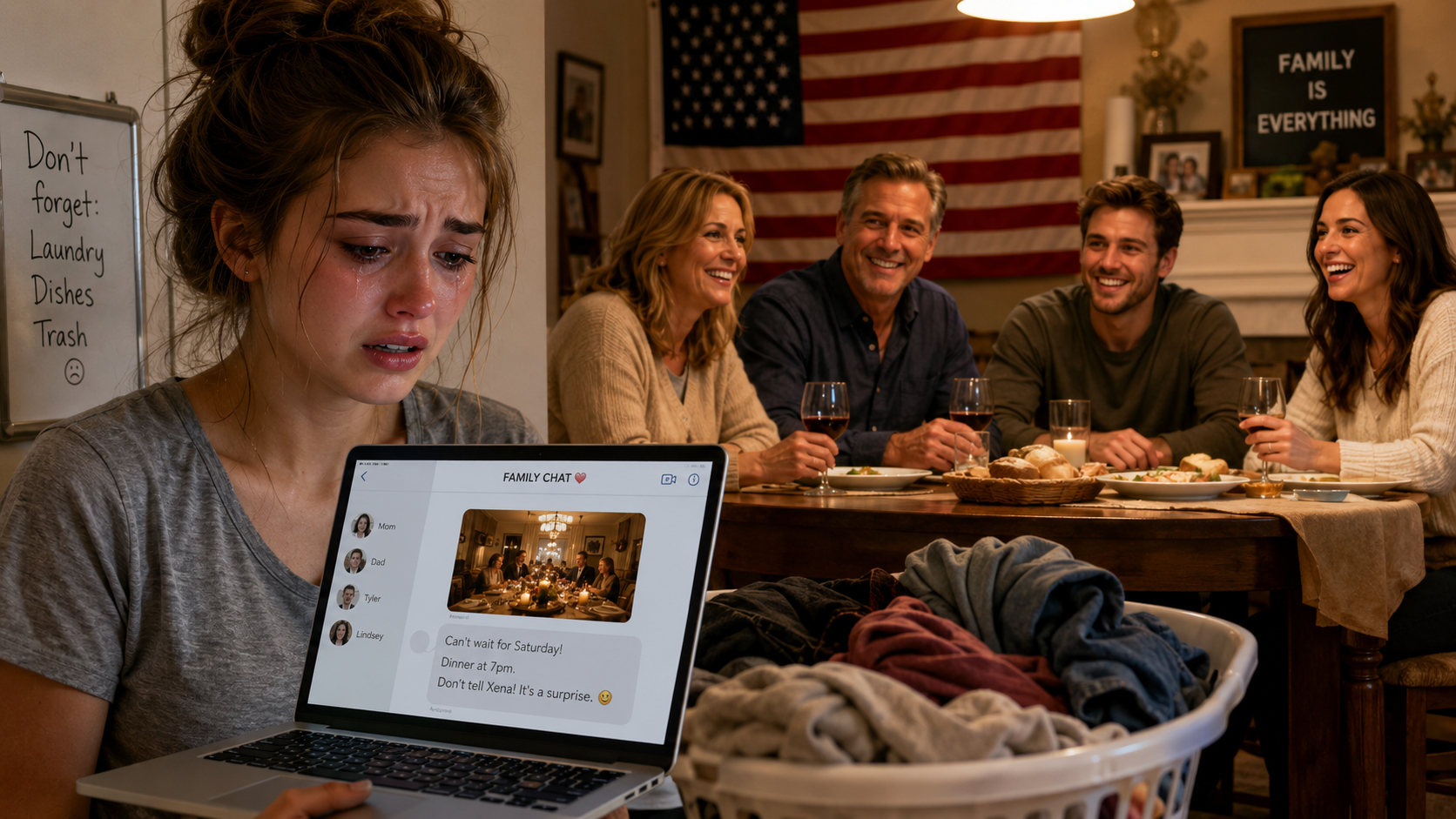
My cousin used my laptop and forgot to log out of her WhatsApp. Two seconds later, a message showed me that my own family had been having dinner without me for a long time.
The worst part was not seeing the secret group with my mother, my father, my brother, and my cousin.It was reading the sentence that finally pushed me out of that house forever. It all happened on an ordinary afternoon in Austin.
I was just going to log Marla out because she had used my laptop to access her account. But as I reached for the mouse, a notification appeared in the corner of the screen.
“To celebrate Leo doing better in school, we’re having a big dinner tonight.”
Curiosity got the better of me.
I clicked.
There were only four people in the chat: my father, my mother, my younger brother, and Marla.
They had not added me.
At first, I tried to invent explanations for them. Maybe it was a surprise. Maybe I was supposed to join later. Maybe the group had been created for something temporary.
Then I saw my brother’s message.
“It’s just the four of us going. Don’t invite Xena.”
A second message followed.
“She’s always running her mouth, and she picks fights with Marla over something as small as an apple.”
My blood ran cold.
In a single instant, I understood something I had been denying for years.
I was the stranger in my own home.
Right then, my mother called me.
“Xena, your father and I are going to be late tonight,” she said.
Her voice was casual, almost cheerful.
“Pick up the laundry from the yard and fold it, okay? Leo and Marla are busy too. Don’t wait for us for dinner. Just fix yourself whatever.”
She did not even let me answer.
The call ended.
I stood in the backyard staring at my brother’s shirts and Marla’s dresses hanging from the clothesline.
That laundry had been telling me the truth for months.
I simply had not wanted to hear it.
Everything leaves a trace.
The thing is, sometimes you cling so tightly to the idea of family that you would rather play the fool than admit they have already let you go.
I opened the refrigerator and found the last apple.
I almost laughed.
Months earlier, Marla had said she wanted an apple. I had cut the last one in half so we could share it.
My mother had stared at me as though I had committed a crime.
“Don’t be miserable over half an apple,” she snapped.
Then she took Marla’s half, threw it into the trash, and announced that the fruit was no longer good enough for her.
An hour later, she took Marla out for ice cream.
My brother looked at me with disgust.
My father pretended not to notice.
At the time, I told myself they were being extra kind to Marla because her mother had died. Aunt Linda had passed away after a long illness, and Marla had come to live with us while she finished college.
I believed she needed affection.
I believed I had to be patient.
I believed she was the guest.
But she had never been the guest.
I was.
I gathered the laundry, folded everything carefully, and carried each pile to its room.
My parents’ bed was neatly made.
Leo’s room had clean sheets and new curtains.
Marla’s room—my old room—had a soft comforter, framed photographs, and the little desk my father had promised to buy me when I started college.
My own folding cot was still on the sunporch.
Yes, the sunporch.
On Marla’s second morning in our house, she came into the kitchen with dark circles under her eyes and said she could not sleep while sharing a room.
My mother did not hesitate.
She moved me out that same afternoon.
“She has been through enough,” she said. “You can sleep on the porch for a few days.”
I agreed because I was trying to be compassionate.
A few days became a week.
A week became a month.
A month became nearly a year.
Because I “understood,” I adapted.
Because I “understood,” my mother washed Marla’s and Leo’s clothes but left mine in a basket.
Because I “understood,” the cooking and cleaning slowly became my responsibility.
Because I “understood,” they stopped asking whether I was comfortable.
And because I “understood,” they got used to treating me as if I were in the way.
I sat on the folding cot and opened Facebook.
That was when I found the post that finally broke me.
Marla had a private account under another name. She had forgotten that she once logged into it from my computer.
The photographs showed them sitting inside an expensive restaurant.
My mother was smiling beside Marla.
My father was raising a glass.
Leo had his arm around her shoulders.
The four of them looked like a perfect family.
The caption read:
“This ‘Mom’ arrived late in my life, but I finally got to say it. Thank you for giving me a second home.”
My vision blurred.
I pressed the like button.
Then I wrote a comment.
“What a beautiful family. I hope you’re happy forever.”
The post disappeared a few minutes later.
Then my phone rang.
“Xena, don’t take it the wrong way,” Marla said.
Her voice trembled with the kind of softness she used whenever other people were listening.
“I only posted it as a joke.”
I let out a dry laugh.
In front of my family, Marla behaved like a saint.
When we were alone, she borrowed my clothes without asking, searched through my drawers, used my cosmetics, and denied everything.
Whenever I confronted her, she cried before I could finish a sentence.
In that house, tears were stronger than truth.
“Xena,” she continued, “are you mad at me? I’m sorry. I just wanted to feel loved.”
Then I heard Leo’s voice in the background.
“Stop bothering Marla!”
He grabbed the phone.
“It’s just a Facebook post,” he shouted. “Don’t overreact. You already made her cry. Apologize to her.”
Something hard closed inside my chest.
“Apologize for what?”
“Because if she’s upset, it’s your fault. You always ruin everything.”
My mother took the phone next.
“Ximena, don’t overthink this,” she said. She only used my full name when she wanted to sound reasonable. “We just went to dinner. That’s all.”
“You lied to me.”
“We didn’t lie. We simply didn’t mention it.”
“You told me everyone was busy.”
“Well, if you wanted to go out, you should have told me. I’ll send you some money, and that will be the end of it.”
A second later, my phone vibrated.
She had sent me forty dollars.
As if forty dollars could purchase a seat at the family table.
As if money could pay for the years I had spent trying to earn affection they gave Marla freely.
I stared at the transfer for a long time.
Then I sent it back.
I called my best friend, Nadia.
“Is that project in Seattle still available?” I asked.
There was a pause.
Nadia and I worked for the same architectural design firm. Three months earlier, she had invited me to join a year-long project in Seattle. I had refused because my mother insisted the family needed me.
“Yes,” Nadia said slowly. “We leave tomorrow.”
“I’m coming.”
“Are you sure?”
For the first time in my life, I did not hesitate.
“Yes.”
I packed one suitcase.
That was all I needed.
Most of my belongings had slowly disappeared into Marla’s drawers anyway.
I took my work laptop, my documents, a few clothes, my grandmother’s necklace, and the emergency cash I kept hidden inside an old dictionary.
I left the laundry neatly folded on everyone’s bed.
Then I took a sheet of paper and wrote one sentence.
“You wanted a family of four. Now you have one.”
I placed the note on the kitchen table.
At six the next morning, Nadia picked me up.
As we drove away, I watched the house shrink in the rearview mirror.
I expected to feel grief.
Instead, I felt air returning to my lungs.
My phone began ringing before we reached the airport.
My mother called seven times.
Leo called five.
Marla sent twelve messages.
My father sent one.
“Where are you?”
I switched the phone off.
The flight to Seattle took a little over four hours.
By the time we landed, the old version of me already felt far away.
Nadia had rented a small apartment near the office. It had two bedrooms, huge windows, and a view of rain-washed rooftops.
My room was small.
But it had a door.
A real door.
The first night, I stood in the doorway for several minutes, staring at the bed.
“You okay?” Nadia asked.
“Yes,” I said.
Then I began crying.
Not because I missed my family.
Because I had forgotten what it felt like to have a room that no one could take from me.
The next morning, I turned my phone back on.
There were fifty-three missed calls.
My mother’s messages began with anger.
“Call me immediately.”
Then blame.
“You embarrassed us.”
Then concern.
“At least tell us you’re safe.”
Then guilt.
“Your father has barely slept.”
Then manipulation.
“Marla is devastated.”
Not one message asked what had happened to me.
Not one admitted they had excluded me.
Not one mentioned the sunporch, the chores, the lies, or the secret group.
My father’s messages were shorter.
“Your mother is upset.”
“You should not leave without talking.”
“This is not how adults behave.”
I almost answered.
Then I remembered all the times he had watched and said nothing.
Silence was his favorite way of choosing a side.
I blocked every number except his.
For the next several weeks, I worked harder than I ever had.
The Seattle project involved redesigning an abandoned waterfront warehouse into a public arts center. I loved every minute of it.
For the first time, people listened when I spoke.
My ideas were credited to me.
My manager, Mr. Halvorsen, praised my work during meetings.
Nadia made sure I ate lunch.
On weekends, we explored bookstores, markets, and coffee shops.
The city was cold and gray, but my life felt brighter than it had in years.
Then one evening, my father called.
I almost ignored it.
Something made me answer.
“Hello?”
“Xena.”
His voice sounded different.
Tired.
“Where are you?”
“You know I’m in Seattle.”
“Your mother wants you to come home.”
“I’m not coming home.”
There was a long pause.
“Marla is struggling.”
I laughed softly.
Of course.
“What does that have to do with me?”
“She says the house feels hostile without you.”
“The house was hostile when I was there.”
“That is not fair.”
“No, Dad. What wasn’t fair was making me sleep on a porch for eleven months. What wasn’t fair was lying to me while you went out to celebrate as a family. What wasn’t fair was watching everyone treat me like a servant and saying nothing.”
“We were trying to help Marla recover.”
“By replacing me?”
“No one replaced you.”
“She sleeps in my room.”
“She needed privacy.”
“So did I.”
He sighed.
“You always make things sound worse than they were.”
That sentence changed something in me.
Not because it was cruel.
Because it was familiar.
It was the sentence he had used every time I tried to speak.
“You’re right,” I said.
He sounded relieved.
“Good. Then come home.”
“No. You’re right that talking to you changes nothing.”
I ended the call.
Three days later, my mother emailed my supervisor.
I found out when Mr. Halvorsen asked me to step into his office.
He closed the door.
“Is everything all right at home?”
My stomach tightened.
“Why?”
He turned his computer screen toward me.
My mother had written a long email claiming I was emotionally unstable, that I had abandoned a sick relative, and that I had taken a company assignment without family consent.
I stared at the screen in disbelief.
Mr. Halvorsen looked uncomfortable.
“I’m not asking about your private life,” he said. “But she has sent messages to several people.”
“How many?”
“Six that I know of.”
Humiliation burned through me.
“I’m sorry.”
“You don’t need to apologize.”
He leaned back in his chair.
“For what it’s worth, your work has been exceptional. Nothing in these emails matches the person I see every day.”
That kindness nearly undid me.
I documented every message and sent my mother one final warning.
“Do not contact my employer again. Any further harassment will be documented and handled legally.”
She replied within minutes.
“I am your mother. You cannot threaten me.”
I did not answer.
Nadia helped me speak with an attorney. He sent a formal cease-and-desist letter.
The calls stopped.
For a while.
Six months passed.
The project flourished.
I was promoted to assistant design lead.
I rented my own apartment.
It was on the fifth floor of an old brick building with wooden floors and a narrow balcony.
The first thing I bought was a dining table.
Not an expensive one.
Just a round oak table with four chairs.
I think I bought it because I wanted proof that one day I could create a table where no one had to earn a seat.
Then, one rainy Thursday, Leo appeared outside my office.
He looked older.
Not wiser.
Just exhausted.
“What are you doing here?” I asked.
He shoved his hands into his jacket pockets.
“I need to talk to you.”
“You could have called.”
“You blocked me.”
“For a reason.”
He glanced around the lobby.
“Can we go somewhere private?”
I should have refused.
Instead, I took him to a café across the street.
For several minutes, he stared at his coffee.
Then he said, “Marla is gone.”
I waited.
“She moved out last week.”
“Why?”
He swallowed.
“Because Mom caught her stealing.”
I almost laughed at the absurdity.
“What did she take?”
“Mom’s jewelry. Some money. Dad’s credit card.”
“And now everyone suddenly believes she takes things?”
His face reddened.
“That isn’t why I came.”
“Then why are you here?”
He pulled out his phone.
“Marla left messages behind.”
He showed me screenshots.
They were conversations between Marla and one of her friends.
At first, they were petty.
“She’s so easy to blame.”
“Her mother believes anything I say.”
Then they became uglier.
Marla described how she had deliberately taken my possessions and placed them in other rooms.
How she had cried whenever I confronted her.
How she had convinced my mother that I was jealous.
One message made my stomach turn.
“I think they secretly wanted another daughter anyway. I just gave them permission.”
I pushed the phone back toward Leo.
“I already knew what she was doing.”
“No, you suspected.”
“I lived it.”
He rubbed his face.
“I didn’t know she was lying about everything.”
“You never tried to know.”
“I thought you hated her.”
“I hated what she did.”
“Mom said you were jealous.”
“Mom said whatever allowed her to avoid admitting she was hurting me.”
Leo looked down.
For the first time, he seemed ashamed.
“I’m sorry.”
The words sounded small.
I did not know how to receive them.
“Why now?”
“Because the house is falling apart.”
There it was.
Not because he suddenly understood my pain.
Because life at home had become difficult.
My mother and father were fighting constantly.
My father had moved into the guest room.
My mother blamed Marla.
Marla blamed all of them.
Leo’s grades had dropped again.
No one cooked.
No one cleaned.
The household they had built on my unpaid labor had collapsed the moment I stopped providing it.
“What do you want me to do?” I asked.
“Come home.”
“No.”
“Just for a little while.”
“No.”
“Mom needs you.”
“She needed my work. She did not value me.”
“That’s not true.”
“It is exactly true.”
He looked toward the window.
“She cries every day.”
“So did I.”
He flinched.
I stood.
“I hope you all figure things out. But I’m not coming back.”
He caught my wrist, then released it immediately when he saw my expression.
“Xena, please.”
“You told me that if Marla was upset, it was my fault.”
“I was angry.”
“You believed it.”
“I was wrong.”
“Yes,” I said. “You were.”
I left him sitting alone.
That night, I cried harder than I had cried when I first arrived in Seattle.
Part of me had hoped Leo would come because he missed me.
Instead, he came because the house no longer functioned without me.
Nadia sat beside me on the floor.
“You know what hurts most?” I said.
“What?”
“I still want them to choose me.”
She leaned her head against mine.
“That doesn’t make you weak.”
“It feels weak.”
“No. It means you loved them. Loving them was never the mistake. Staying where love was used against you would have been.”
A month later, my father came to Seattle.
He did not warn me.
I found him standing outside my apartment with a small suitcase.
He looked older than I remembered.
“Can I come in?” he asked.
“No.”
His face tightened.
“I flew across the country.”
“That was your choice.”
He lowered his eyes.
“I deserve that.”
It was the first honest thing he had said.
We sat in the building lobby.
For a long time, he said nothing.
Then he handed me a folder.
Inside were copies of bank statements.
My name appeared on several accounts.
I frowned.
“What is this?”
“Money your mother has been taking from your old savings account.”
My body went cold.
Years earlier, I opened a joint student account with my mother because I was underage. I stopped using it after college, but apparently it had never been closed.
“She transferred money from the family account into it,” my father said. “Then she moved the funds elsewhere under your name.”
“Why?”
“To hide debt.”
I stared at him.
The secret dinners had only been the surface.
My parents had been struggling financially for years.
My father’s business had lost several clients.
My mother had borrowed money to maintain appearances.
Marla’s presence gave her an excuse to spend more, not less.
When bills became unmanageable, she used my old account to move money, assuming she could blame me if anyone questioned the transactions.
“How much?” I asked.
“Almost thirty thousand dollars.”
My hands went numb.
“Why are you telling me now?”
“Because the bank contacted me.”
“No. Why are you telling me now?”
He understood the question.
Why had it taken fraud for him to speak?
Why not the sunporch?
Why not the lies?
Why not the moment he saw me standing alone with folded laundry while the rest of them left for dinner?
He looked toward the door.
“Because I was a coward.”
The words landed heavily between us.
“I told myself your mother knew what she was doing. I told myself Marla needed help. I told myself you were strong enough to manage.”
“So you sacrificed the strongest person.”
“Yes.”
I did not expect the admission to hurt more than denial.
But it did.
He continued.
“When you left, everything became visible. The cooking. The cleaning. The bills you reminded us to pay. The appointments you scheduled. The things you repaired. The peace you kept.”
“I was your daughter.”
“I know.”
“No. You treated me like household staff.”
He began to cry.
I had rarely seen my father cry.
It did not erase anything.
“I’m leaving your mother,” he said.
“That’s between you and her.”
“I want to make this right.”
“You can correct the bank records.”
“I already started.”
“You can tell the truth if anyone asks.”
“I will.”
“You can stop asking me to come home.”
He nodded slowly.
“I understand.”
I stood.
He did too.
For one moment, he opened his arms as if he wanted to hug me.
I stepped back.
His hands dropped.
“I’m not ready,” I said.
“I know.”
This time, he left without asking me to forgive him.
The investigation into the accounts lasted several months.
My mother called me from new numbers, alternating between apologies and accusations.
One voicemail said, “I did everything for this family.”
The next said, “You are destroying us.”
Another said, “Marla poisoned you against me.”
That one almost made me laugh.
Marla had not poisoned me against my mother.
My mother had done that herself.
My father cooperated with the bank.
Because most of the money had been returned and because I agreed not to pursue criminal charges, the case ended without an arrest.
I did not spare my mother because I thought she was innocent.
I spared myself from another year of being tied to her chaos.
But I insisted that my name be removed from every account, lease, insurance policy, and family document.
I wanted no thread left between their finances and mine.
A year after I left Austin, the arts center opened.
Hundreds of people attended.
There were speeches, music, local artists, and children painting murals along the waterfront.
Mr. Halvorsen asked me to stand beside him during the ribbon-cutting ceremony.
When he introduced me as one of the project’s lead designers, the crowd applauded.
I looked out at the faces and thought about the woman who had slept on a folding cot because she believed making herself smaller would make her easier to love.
I wished I could go back and hold her.
I wished I could tell her that one day she would stand in a building she helped create and no one would question whether she belonged there.
After the ceremony, I saw my father near the back of the crowd.
He had come alone.
He did not approach until everyone else had left.
“You did this?” he asked, looking around the enormous hall.
“I helped.”
“It’s beautiful.”
“Thank you.”
He handed me a small envelope.
Inside was an old photograph of me at age nine, sitting at the kitchen table drawing houses.
On the back, he had written:
“You always knew how to build a home. I’m sorry we never gave you one.”
I stared at the words.
Then I hugged him.
It was brief.
Careful.
But real.
My relationship with my father did not repair overnight.
Trust does not return simply because someone finally tells the truth.
But he kept showing up without demanding access.
He called without pressuring me.
He apologized without adding excuses.
Over time, I allowed him back into small parts of my life.
My mother was different.
She continued insisting that I had misunderstood everything.
She told relatives that Seattle had changed me.
She said my career made me arrogant.
She claimed she had only excluded me from dinner because she thought I was tired.
When that explanation failed, she said Marla had planned everything.
When that failed, she blamed my father.
She never once said, “I hurt you.”
So I stopped waiting to hear it.
Leo eventually moved out.
He enrolled in community college and found a part-time job.
Months later, he sent me a message.
“I’ve been thinking about what you said. You were right. We only noticed what you did after you stopped doing it. I’m ashamed.”
I did not answer immediately.
Then I wrote:
“Being ashamed means nothing unless you change.”
He replied:
“I’m trying.”
That was enough for the moment.
Marla disappeared from our lives for nearly two years.
Then one afternoon, she emailed me.
The subject line said, “I owe you the truth.”
She admitted that she had been jealous of me.
Before her mother died, Aunt Linda constantly compared her to me.
My grades.
My job.
My independence.
When Marla moved into our home, she discovered that my mother was eager to rescue someone.
Marla made herself helpless.
My mother rewarded her.
The more my family favored her, the more powerful she felt.
She wrote:
“I knew they were hurting you. I kept going because it made me feel chosen.”
I read the email twice.
Then I archived it.
Understanding her reasons did not require reopening the door.
Three years after leaving Austin, I bought a small townhouse outside Seattle.
It had two bedrooms, a tiny garden, and a kitchen filled with morning light.
On the day I received the keys, Nadia brought champagne.
My father sent flowers.
Leo mailed a wooden sign he made himself.
It read:
“Everyone invited.”
I hung it above the dining-room door.
Not because everyone from my past was welcome.
But because the people I loved would never have to wonder whether they had a place at my table.
That evening, I hosted dinner.
Nadia came with her husband.
Mr. Halvorsen and his wife came.
Two coworkers brought dessert.
My father flew in from Texas.
Leo joined through a video call because he could not afford the ticket.
We laughed until midnight.
No one asked me to serve everyone alone.
No one told me I was too sensitive.
No one took my seat.
After the guests left, I stepped onto the balcony.
The city lights glowed beneath the cloudy sky.
My father joined me.
“Do you ever miss Austin?” he asked.
“I miss who I hoped we were.”
He nodded.
“That makes sense.”
“But I don’t miss the house.”
“I don’t blame you.”
We stood quietly.
Then he said, “Your mother asks about you.”
“I know.”
“She still thinks you’ll come back.”
“I won’t.”
“I know that too.”
There was no argument.
No guilt.
Just truth.
Before going to bed, I opened my phone and found an old screenshot I had saved from the WhatsApp group.
“Don’t invite Xena.”
For years, that sentence had represented rejection.
That night, it looked different.
It had been a door.
Cruel words had pushed me through it, but on the other side I found dignity, independence, and a life that belonged to me.
I deleted the screenshot.
Then I walked through my quiet house, turning off the lights one by one.
I passed the guest room with its freshly made bed.
I passed the laundry room where everyone washed their own clothes.
I passed the dining room with the round oak table I had brought from my first apartment.
And finally, I entered my bedroom.
My room.
My bed.
My door.
I closed it gently behind me.
For most of my life, I believed family was the group of people who shared your house, your name, and your history.
I know better now.
Family is not the table where people whisper about you after leaving your chair empty.
Family is the table where someone notices you are missing.
Family is not the person who sends you money instead of an apology.
Family is the person who asks what hurt and listens to the answer.
Family is not a house where you must earn your right to sleep indoors.
Family is the place where you can finally rest.
My cousin forgot to log out of WhatsApp that afternoon.
She probably thought it was a careless mistake.
But it gave me the truth my family had hidden for years.
They believed excluding me would make their lives easier.
Instead, they freed me.
And the sentence meant to make me feel unwanted became the reason I finally chose myself.
THE END! THANK YOU FOR READING!