
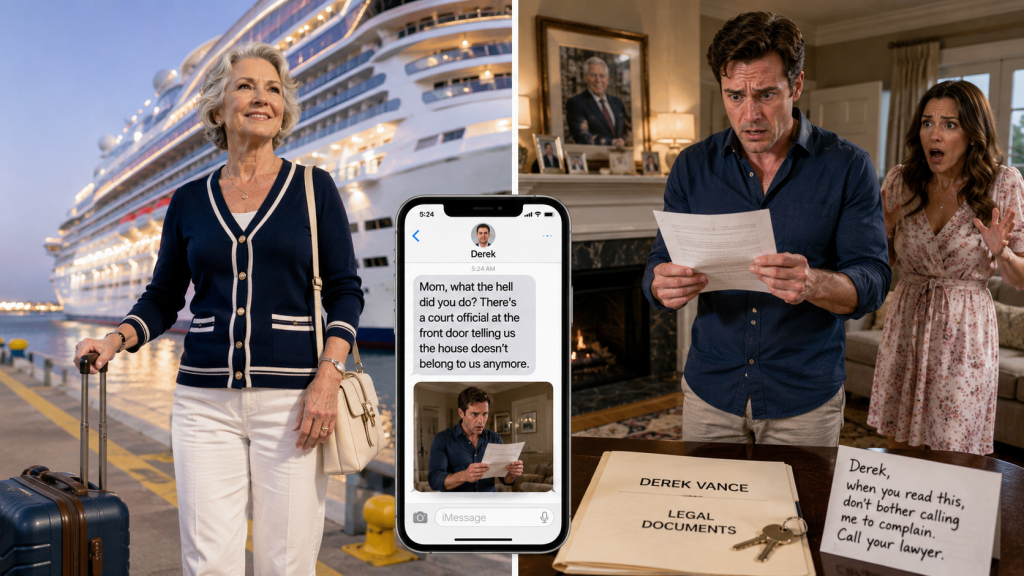
I buried my husband, and nobody knew that that very exact week, I purchased a ticket for a year-long cruise. When my son dumped three cages in my living room as though I were his personal maid, I knew my grieving period was over. My daughter-in-law didn’t even bother to say hello. She just shoved the cages onto my carpet and said, “Here are your instructions.” I just smiled. By dawn, when the ship set sail from San Diego, my absence was going to completely shatter their lives.
The picture came through a bit blurry, but I could easily make out Derek’s face.
Ghost-white. His jaw completely unhinged. Clutching my note in his left hand and that second manila folder in his right—the one I had centered on the coffee table with bold, black Sharpie: “DEREK.”
Behind him, Megan was staring down the hallway, as if she genuinely expected the parakeets, the rabbit, and the cat to magically appear. I was sure she had ripped open every door, peered under the sofa, and shrieked my name like someone summoning a maid who was dawdling.
She found absolutely nothing. No animals. No kibble. No mother.
My cell phone began buzzing again. Derek. Megan. Derek. Megan.
Then Marcus, my oldest son, who had been living out in Denver for years and only ever called on Christmas or when he needed to double-check what size sweater his father wore.
I ignored them all.
Before me, the cruise liner glowed like a floating white metropolis ready to launch into the sky. The Port of San Diego smelled of ocean salt, diesel exhaust, roasting coffee, and the break of dawn. In the distance, the silhouette of the Coronado Bridge arched darkly against the harbor, like a silent witness that had watched warships, pleasure cruisers, promises, and farewells come and go.
I was saying my own farewell, too. But not to my deceased husband. To my chains.
I marched up the boarding ramp with my navy suitcase in one hand and my passport in the other. A young crew member in a crisp uniform beamed at me.
“Welcome aboard, Mrs. Evelyn.”
That word—“welcome”—cut right through my chest. It had been years since anyone had offered me a welcome without demanding a favor immediately afterward.
Stepping into my stateroom, I parked the luggage by the bed and swept back the heavy curtains. Through the porthole window, I could see the docks, the massive harbor cranes, the streetlights illuminating the Gaslamp Quarter, and a handful of cabs idling like glowing yellow fireflies. I thought of Arthur, of his favorite linen shirt, of his frail hands during those grueling last months.
“Forgive me for running off so soon,” I murmured to the glass.
But I felt zero guilt. I felt, deep down, that wherever he was, he was grinning.
The screen lit up again. A voice memo from Derek. I had no desire to press play. Then one from Megan. Hard pass. Finally, a text popped up from my son:
“Mom, what the hell is this? What does this lawsuit mean? Why does the paperwork say we have to vacate? Where are my pets?”
My pets. He didn’t ask if I was okay. He didn’t ask if I was safe. He only cared about his own inconveniences.
Sitting on the edge of the mattress, I unzipped my tote bag and withdrew my own copy of the exact legal folder he was currently holding. I had compiled it alongside Eleanor Vance, a silver-haired estate lawyer with a soothing voice who had known Arthur since they were teenagers.
Eleanor was the one who ripped the blinders off my eyes. Not through gentle advice, but through hard paper trails.
Three months prior to Arthur’s passing, Derek had driven his dad to the bank “to help him sort out some signatures.” Arthur was frail, highly medicated, and easily confused, but his mind grasped far more than the kids gave him credit for. That evening, when he returned, he squeezed my fingers and whispered:
“Evelyn, do not sign the house over to him. Not as long as you have breath in your lungs.”
I chalked it up to feverish rambling. It wasn’t a fever. It was a dire warning.
After the burial, when Derek brought up the real estate while still tracking cemetery mud onto my rugs, I dug into Arthur’s filing cabinet. Buried in the back, I discovered copies of forged promissory notes, a rejected power of attorney form, sketchy personal loans taken out in my husband’s name, and a mortgage application trying to leverage our home as collateral for Derek’s mounting debt.
My son didn’t genuinely care what my plans were for the property. He just needed to know how quickly he could liquidate it.
Eleanor reviewed the whole mess at her downtown firm, right near the waterfront, where you can hear street musicians playing acoustic guitars in the afternoon and baristas rush by carrying iced oat lattes like they’re precious cargo.
“Evelyn,” she informed me softly, “your husband made sure you were protected.”
Arthur had quietly updated his living trust a year ago. The deed was transferred entirely to me, free and clear, with zero loopholes. He had also inserted an ironclad clause: for the duration of my life, nobody could reside in, sell, lease, or borrow against the property without my notarized, written consent.
And Derek had already tried to bypass it. Not once, but three separate times.
The first folder, the one I had placed beside the spare keys, contained the official notice from Eleanor: a civil suit for forged signatures, the immediate revocation of any assumed power of attorney, and a restraining injunction legally barring Derek from setting foot on my property uninvited.
The second folder was much more brutal. That one held a decade’s worth of printed wire transfers, Venmo receipts, text screenshots, and a meticulous spreadsheet of every single dime I had bailed him out with. Not because I intended to sue him for the money. Mothers don’t keep ledgers to put a price tag on love.
But the second a son treats his grieving mother like the hired help while dumping pet cages on her floor, those ledgers transform into a bulletproof vest.
Derek’s name flashed on the screen again. This time, I swiped to accept. I didn’t offer a greeting. I just listened to him breathe.
“What the hell did you do?” he bellowed. “Where are you hiding?”
In the background, I could hear Megan screeching hysterically about the cat, the bunny, and the birds.
“Good morning to you too, Derek.”
“Don’t you use that tone with me! There’s a process server standing in the kitchen. She says we have to pack up and get out. She’s threatening to call the cops if we don’t leave!”
“That sounds accurate.”
“This is my house!”
I gazed out the porthole. The sky above the Pacific was shifting into a pale, bruised purple.
“No, Derek. It is my house.”
Complete silence followed. It wasn’t the silence of a guilty conscience. It was the silence of rapid calculation.
“Mom, you’re acting completely hysterical. You literally just became a widow. Megan and I are terrified for your mental state. Just tell us where you are, and we’ll come get you.”
A laugh nearly bubbled up my throat.
“I am precisely where I should have parked myself a decade ago.”
“What is that supposed to mean?”
Right on cue, the cruise director’s voice echoed over the PA system, announcing our imminent casting off. I watched passengers strolling the outer decks holding paper coffee cups, wearing oversized sun hats, radiating the pure, unfiltered joy of people who still believe life can be generous.
I inhaled deeply.
“It means I am officially retired from managing your pets, your bad credit, your rocky marriage, your appetite, and your fragile ego.”
“Mom, please…”
“The animals are perfectly safe. Mrs. Higgins drove them over to her nephew’s no-kill rescue shelter. I sent them along with all their food, paid for their shots, and left a hefty cash donation. That poor cat is finally out of that suffocating plastic crate.”
I heard a scuffle, and Megan snatched the receiver. “You spiteful old hag! That purebred cat cost us a fortune!”
Hearing her venom, a lock finally tumbled open in my chest. I didn’t shed a tear over the insult. I shed a tear mourning the fact that, for so long, I had let toothless people chew me up.
“Megan,” I said smoothly, “I left a special little folder for you, too. It’s tucked inside the hallway console drawer.”
Dead air. “What folder?”
“The one filled with printed screenshots of your text threads. The ones where you bragged that as soon as I ‘started slipping,’ you were going to shove me into a state-run nursing facility so you two could flip the property. Eleanor already filed copies.”
Megan gasped sharply, like she had just inhaled a mouthful of broken glass. Derek scrambled back onto the line.
“Mom, stop. Please don’t do this to us. We’re family.”
Family. It’s a magic word some people deploy to drain your blood when they won’t even offer you a sip of water.
“That is exactly why I pulled the trigger on this,” I told him. “Because, at the end of the day, you are my child, and I refused to stick around until I actively despised you.”
I ended the call.
The ship’s horn erupted into a massive, earth-shaking blast. I felt the bass vibrate right through the soles of my shoes. Slowly, the San Diego skyline began to slide backward beyond the glass—or maybe it was me who was finally moving forward.
I wandered up to the Lido deck. The crisp Pacific breeze whipped across my cheeks. The harbor promenade slipped past, with its towering palm trees, naval monuments, and morning joggers hitting the pavement. Miles inland, I pictured the local breakfast diners flipping their open signs, the espresso machines hissing to life, kicking off that distinct West Coast morning rush where the coffee flows like dark, bitter fuel.
I hadn’t even eaten breakfast yet. Oddly, for the first time in my adult life, I didn’t care. I wasn’t required to pour anyone’s coffee.
A woman roughly my age was leaning against the teak railing a few feet away. She was sporting a massive straw sun hat and a bold slash of cherry-red lipstick.
“First time cruising?”
“First time escaping,” the words tumbled out before I could catch them.
She studied my face for a heartbeat and grinned. “Well, I can certainly toast to that.”
She extended a polished steel thermos toward me. “Dark roast with a heavy dash of cinnamon. I’m from Phoenix. A smart woman never leaves port without her own decent brew.”
I took a grateful sip. It was scalding, sweet, and aggressively strong.
“I’m Barbara, by the way,” she offered.
“Evelyn.”
“Sailing solo?”
I stared out at the sprawling blue water. “For the very first time, yes.”
I didn’t elaborate. She didn’t pry. Certain women just inherently understand when a simple answer is carrying decades of invisible baggage.
The cruise liner crept out of the San Diego bay. The California coastline slowly receded, solid and shadowy, steeped in years of marine layers and memory. I realized that I, too, had operated like a fortress—but the sort of fortress where people only ever came to dump their emotional baggage, never pausing to ask if the load-bearing walls were cracking.
My phone vibrated in my pocket again. This time, the caller ID read Marcus. I answered it because, unlike Derek, Marcus wasn’t a screamer. His weapon of choice was simply disappearing.
“Mom,” he said cautiously. “Derek just called me in a panic. He claims you’ve completely lost your mind.”
“Of course he does.”
“Is it true about the house and the lawsuit?”
“Every word.”
He let out a heavy sigh. “And you’re really on a cruise ship?”
“That part is true, too.”
The line went quiet for a long moment. “Why didn’t you just talk to me about this?”
I stared down at my hands. They were dotted with sunspots, mapped with raised blue veins, the fingernails filed short from endless dishwashing, endless cooking, endless caretaking. These were the same hands that had rocked Marcus through childhood fevers, patched torn baseball uniforms, wrestled with Arthur’s wheelchair, and painstakingly sliced prescription pills into perfect, tiny halves.
“Because when your father took a turn for the worse, I called you three separate times begging for help, and you never showed,” I told him flatly. “Because when I was drowning, you told me your schedule was just too packed. Because I am done asking my children for permission to exist.”
Marcus had no rebuttal. Eventually, he whispered:
“I am so sorry, Mom.”
The apology stung. Not because it fixed anything, but because it had arrived about five years too late.
“Save your apologies,” I advised him. “Keep them in your pocket for when I get back, assuming you actually want to know me as a human being and not just as a default parent.”
“Are you even coming back?”
The Pacific Ocean yawned wide open in front of the bow, impossibly vast.
“In twelve months.”
“A whole year?”
“A whole year.”
In my mind’s eye, I could see him collapsing into a chair, frantically doing the math on things he had always taken for granted: birthdays without my custom cakes, Thanksgiving without my famous stuffing, flu seasons without my chicken noodle soup, and most importantly, his own guilt without my polite silence to absorb it.
“But… what if there’s an emergency? What if something happens?”
“Call an adult,” I said mildly. “You are all adults now.”
I ended the call gently. Not out of spite. Just out of a clean, weightless exhaustion.
I killed the first morning just doing laps around the promenade deck. Tourists were snapping selfies, toddlers were sprinting in circles, and a stressed couple was bickering over a misplaced piece of luggage. I strolled into the grand dining hall and loaded a plate with fresh fruit, buttery toast, scrambled eggs, and a cup of drip coffee that couldn’t rival the cafes back home—but it tasted exactly like freedom.
As I lifted my fork, I froze. For forty uninterrupted years, I had always eaten last. First Arthur was served, then the boys, then the grandkids, then the houseguests, and finally, I’d wash the serving pans. My own plate was always left waiting, lukewarm and sad, right next to the kitchen sink.
This morning, my breakfast was piping hot.
And I cried. Not a hysterical sob. Just enough to let it out.
Around noon, another text dinged from Derek. “Mom, let’s all just take a breath and calm down. Megan hasn’t stopped crying. The baby keeps asking where you are. Please don’t do this to our family.”
The baby. My sweet granddaughter, Sophie. At the mention of her name, my heart physically ached. Sophie carried zero blame for her parents’ staggering selfishness. I spent hours baking her favorite sugar cookies simply because she would wrap her little arms around my neck without ever asking for a transaction. God, I would miss that little girl.
I opened the messaging app connected to my granddaughter’s iPad, which she occasionally used to send me choppy little voice memos. There was an unplayed audio file.
“Grandma Evie, Daddy told me you ran away because you don’t love us anymore. Are you really gone?”
I sank onto a wooden deck bench. The ocean wind whipped wildly through my hair. I hit the record button.
“My precious girl, Grandma loves you to the moon and back. I promise. But loving your family doesn’t mean you have to let them treat you like garbage. As soon as I get a good signal, I will call you. And I am going to mail you beautiful postcards from every single country I visit. This big adventure is to teach you a very important lesson, my sweet bug: absolutely no woman on this earth was born to be a doormat.”
I hit send. Then, I went into my settings and blocked Derek and Megan’s numbers for the next twelve hours. Not permanently. Just long enough for me to breathe.
Later that afternoon, as the ship pushed deep into Pacific waters, I wandered down to the observation lounge where they were hosting a mixer for long-term cruisers. The room was packed with fellow widows, eccentric retirees, and adventurous couples. I met a retired middle-school teacher from Seattle, a lively guy from Portland who claimed he was drafting his memoirs, and an adorable couple from Chicago celebrating their golden anniversary.
Out of all of them, I was the only one who still looked like she was hauling a casket on her back.
Barbara slid into the armchair next to me. “You have the thousand-yard stare of a woman who left a warzone back on the mainland.”
“I left my greedy son standing in my living room holding a very hostile legal folder.”
“Ah. So you didn’t leave a war, you left a live grenade.”
I couldn’t help but smile. She nailed it. But the grenade wasn’t lobbed out of sheer malice. It was thrown to blast open a prison door that had been welded shut by decades of financial and emotional abuse.
Once the sun set, the ocean transformed into a sheet of gleaming, pitch-black glass. Up on the pool deck, a live jazz band struck up a set to officially bid farewell to the California coast. A young crooner was belting out an old Sinatra standard, and a dozen couples drifted onto the dance floor. I thought of Arthur, who had two left feet and zero rhythm, but who would stubbornly drag me onto the floor at every block party and wedding reception anyway.
“I have no idea how to dance by myself,” I whispered to no one.
Barbara caught it. “Nobody dances by themselves on this ship, Evelyn.”
She grabbed my hand and yanked me right into the center of the crowd.
I danced terribly. I danced feeling utterly ridiculous. I danced while weeping and belly-laughing simultaneously. I danced for Arthur, for the carefree twenty-something I used to be, and for the suffocated woman who had spent half a century buried alive beneath stained aprons, mortgage payments, and orange pill bottles. I danced until my arthritis flared in my knees and my lungs opened wide to let the sea air in.
By the time I stumbled back to my cabin, I decided to unblock my phone. Thirty missed notifications instantly flooded the screen. I ignored the family and only tapped the email from Eleanor, my attorney.
“The extraction is complete. Derek threw a massive tantrum but eventually surrendered the keys. The deputy on site recorded the entire eviction on bodycam. Megan tried to call animal control to file abandonment charges; I quickly shut that down by faxing over the shelter intake logs, your vet receipts, and the surrender authorizations. We have officially secured a court date for the forgery charges. Enjoy your vacation, Evelyn.”
Enjoy. The concept felt incredibly heavy, yet wonderful.
Right beneath Eleanor’s email was a text from Mrs. Higgins. “The birds won’t stop chirping, the bunny is happily chewing on Timothy hay, and the cat managed to scratch my nephew’s arm, but he insists that means the cat is coming out of its shell. Sleep well, my dear friend. Arthur would be on his feet giving you a standing ovation right about now.”
I let out a loud, ugly laugh in the empty room. Then I dissolved into tears all over again.
I could easily picture Arthur sitting at our kitchen island with his black coffee, chuckling that the mean cat had character and noting that Derek had desperately needed to learn how to wash his own damn dishes since 1998.
Of course, the motherly guilt tried to worm its way back in around 3:00 AM. Guilt always knows how to exploit the cracks in the foundation. I jolted awake, agonizing over my dark, empty house, Arthur’s memorial portrait sitting alone, the blown-out candles. I thought about Derek as a little boy, sweating out a terrible flu while glued to my chest. I thought about Megan calling me an old hag. I thought about little Sophie.
For one frantic heartbeat, I wanted to demand they turn the ship around so I could get off. But there was no land left. Only the deep ocean.
Lying there in the dark, I finally realized that sometimes, a woman deliberately burns the bridge behind her just to guarantee she won’t betray herself by running back.
Fast forward to day three at sea, an email popped into my inbox from Derek. I still had his number blocked, so he bypassed it using an ancient Yahoo account.
“Mom, I know I completely messed up. But you can’t leave me out to dry like this. I’m your son.”
I stared at the screen for a long time. Then my thumbs started typing:
“Yes, you are my son. That is exactly why I handed you a thousand second chances. Today, I am finally handing you a consequence. Direct all your questions to Eleanor. Update your resume and find a job. Pay down your own debts. Step up and be a father to your daughter. And when the day comes that you can have a conversation with me without expecting me to open my wallet or solve your problems, maybe we can try again.”
It took him nearly an hour to write back. “And what if I can’t do all that?”
I looked out at the unbroken blue horizon. “Then you better learn.”
That same afternoon, the cruise director hosted a little workshop where passengers wrote letters to their future selves. They passed around thick cardstock and wax-sealed envelopes. Some folks scribbled down travel bucket lists. Others listed prayers for their grandkids. I wrote a solemn vow to myself.
“Evelyn: When you finally go home, do not shrink yourself to fit their needs. Never again unlock your door for people who only show up to dump their dirty cages on your carpet. Remember the Port of San Diego, the stinging wind, and the California coast fading into the fog. Never forget how amazing it felt to eat your food while it was still hot. Remember that your grieving finally ended the very second you refused to bury yourself in the ground next to Arthur.”
I sealed the envelope and buried it at the bottom of my navy suitcase.
Months down the line, there would be dozens of exotic ports. There would be Cabo San Lucas, the distant cliffs of Puerto Vallarta, hidden coves with crystal-clear turquoise water, lavish dinners shared with eccentric strangers, and quiet mornings where the sun seemed to break over the water just for my benefit. There would inevitably be days of crushing sadness, and long, dark nights where I would ache for Arthur’s voice the same way one mourns a childhood home that burnt to the ground. There would be FaceTime calls with Sophie, who would sound a little happier each time, updating me that her daddy was currently burning scrambled eggs for breakfast, and her mommy had finally figured out how to scoop a litter box.
There would also be an ugly court hearing back home. Derek, his voice breaking on the stand, would be forced to confess that he forged those documents out of sheer desperation, driven by underwater credit cards and the toxic, arrogant assumption that anything belonging to me was automatically his. Eleanor would email me the grim transcript without sugarcoating a single detail. I wouldn’t pop champagne over it. No mother celebrates watching her own child hit rock bottom.
But I also wouldn’t throw my own body on the pavement to cushion his fall anymore.
But on that first night at sea, none of that future mess existed yet. There was only me. My quiet stateroom. The rhythmic, soothing crash of the waves against the hull.
And a brand-new notification from little Sophie:
“Grandma Evie, send me a picture of your big boat. I love you. You are definitely not a doormat.”
I slapped a hand over my mouth to muffle a violent sob. I snapped a gorgeous picture of the silver moonlight reflecting off the Pacific water and hit send. Then, I powered down my phone completely.
I spritzed on the expensive perfume Arthur had bought me, cranked the porthole wide open, and let the briny ocean air tangle my hair into a mess.
Thousands of miles behind me lay three empty pet cages. A freshly vacuumed living room. A sharpie note. A brutal legal folder. And an entitled son who was finally going to have to learn how to survive without bleeding his mother dry.
Stretched out endlessly in front of me was the black water—vast, terrifying, and entirely free.
And for the very first time since I watched them lower my husband into the dirt, I didn’t just feel like a grieving widow. I felt fiercely, unapologetically alive.
THE END! THANKS FOR READING!