At seventy-one, I won $89 million and kept my mouth shut. Then my son looked at me and said, “Mom, when are you finally moving out?” I didn’t argue. I just walked away—and by 7:30 the next morning, I was buying their dream house under a name they hadn’t bothered to remember.
But every ordinary noise had an empty place under it. Lucas noticed. At least I thought he did.
“Mom, you shouldn’t live alone,” he said after the funeral. Chloe stood beside him in a cream dress, holding a casserole dish somebody from church had brought over.
“For a little while,” Lucas added.
That phrase did a lot of work. It made the decision sound temporary. It made the sacrifice sound practical. It made my grief sound like something the family could manage if I would just cooperate.
So I sold the house Thomas and I had owned for thirty-four years in Santa Fe. I sold the yellow kitchen where he had measured coffee with the same bent spoon every morning. I sold the rosebushes Thomas trimmed badly but proudly. I sold the porch where he drank tea at sunrise and waved at neighbors he never remembered by name but always greeted like cousins.
I told myself this was what families did. They adjusted. They made room. They held each other up.
Lucas’s house in Austin looked like a magazine nobody was allowed to touch. White cabinets. Black fixtures. A covered pool. Three garage doors. A refrigerator full of almond milk, string cheese, and routines that had no place for me.
Chloe called the spare bedroom “the guest room.” She corrected me the first week when I called it my room. “It just photographs better as a guest room,” she said, straightening a chair nobody ever sat in.
That should have told me something. But loneliness makes people fluent in excuses. I told myself Chloe was particular. I told myself Lucas was busy. I told myself the children were growing and all teenagers drifted in and out of rooms like smoke.
And I made myself useful.
I folded towels. I packed lunches. I signed permission slips when Lucas forgot. I drove my grandson to soccer and my granddaughter to piano. I learned which pan Chloe liked for eggs. I learned which mug Lucas wanted left clean beside the coffee maker. I learned not to leave my crossword book on the counter.
I learned that in their house, helpfulness was welcome until it looked like belonging.
That was the trust signal I gave them. Access. Labor. Silence. The softest parts of myself. They used all of it.
At first, the slights were small enough to doubt. A brunch invitation that did not include me. A family photo where Chloe said, “Let’s get one of just us first,” and then forgot the second one. A conversation that stopped when I entered the kitchen.
Then one Sunday, they left a note beside the coffee maker. Gone to brunch. Back later. No invitation. No apology. No “Do you need anything?” Just a sticky note and an empty kitchen.
Another afternoon, I walked past their bedroom and heard Chloe’s voice behind the door. “She eats our food, uses our utilities, and contributes what exactly?”
There are sentences you hear with your ears. There are others you hear with your whole body. I waited for Lucas to correct her. I waited for him to say, “That’s my mother.” I waited for the man I had raised to remember who had paid for his braces, sat through his fevers, packed his dorm room, and cried in the driveway the day he moved out.
He said nothing. Not once.
In February, I bought a lottery ticket at a gas station after a Medicare appointment. It was not a grand moment. There was no sign from heaven. The clerk smelled like cigarette smoke and cinnamon gum. A man in a baseball cap argued with the pump outside because his receipt would not print. I bought the ticket because Thomas used to say luck sometimes wore dirty shoes.
The ticket stayed in my handbag for four days.
On Monday morning at 9:42, while the house was empty and my coffee had gone lukewarm, I checked the numbers. I checked them once. Then again. Then I sat very still at the kitchen island while the refrigerator hummed behind me.
$89 million.
It is strange what the body does when something impossible becomes real. I did not scream. I did not call Lucas. I did not run through the house laughing like people do on television.
I folded that ticket and slid it into my Bible between Psalms and the church bulletin Thomas had saved. Then I washed my coffee cup.
Money does not always make you louder. Sometimes it makes you careful. Sometimes it gives you the one thing nobody can take back. Options.
By March, the money had not changed how Lucas saw me. It had changed how I saw Lucas. I noticed every little performance. Chloe’s sigh when I opened the pantry. Lucas’s silence when she complained about the water bill. The way they spoke about “downsizing” me without using the word. The way they treated my presence like a subscription they were tired of paying for.
And then came the dinner. The chicken. The garlic green beans. The cracking ice. My son’s chair scraping back.
“Mom, when are you finally going to move out?”
My grandson stopped scrolling. My granddaughter’s fork hovered above her potatoes. Chloe stared at her plate, but her mouth tightened like she had helped rehearse the question.
The table froze. Forks paused halfway to mouths. The candle on the sideboard kept burning like it had not noticed the room had gone cruel.
For one ugly heartbeat, I wanted to tell them. I wanted to say, “Your mother has $89 million, Lucas.” I wanted to watch Chloe’s face rearrange itself. I wanted to see whether love would appear once money entered the room.
But dignity is not the same as revenge. And I had spent too many years teaching Lucas that tantrums did not win arguments to throw one myself at seventy-one.
So I set the basket down. I folded my napkin once. Then again.
“Excuse me,” I said.
Outside, the Texas evening smelled like chlorine, dry dirt, and somebody’s expensive candle burning through an open slider. The patio chair scratched the stone when I sat down. Behind me, nobody followed.
At 2:13 a.m., I opened the notepad in my nightstand and wrote five lines. Keep silent. Hire attorney. Claim privately. Separate assets. Find a home.
Not a room. A home.
The next morning before dawn, I showered and put on my gray church blazer. It was the one Thomas liked because he said it made me look like I could fire a banker. I sat at the same kitchen table where my son had erased me.
By 7:30 a.m., I had three estate attorneys booked under my maiden name.
Chloe came downstairs in heels. Her perfume arrived before her voice. She saw my laptop, my blazer, my steady hands on the keyboard. She had expected tears. She got typing.
My attorney, Sylvia Vance, was sharp-eyed and calm enough to make panic feel unnecessary. Her office smelled like dust, old paper, and decisive action.
She asked one question before she touched any paperwork. “Have you told anyone?” “No.” “Good,” she said. “Keep it that way.”
Within days, the architecture of my escape was drawn in ink and law. The trust existed. The private claim was handled. The account authorizations were surgically separated. Every paper Lucas thought he could someday touch had a wall around it. I signed each page under my maiden name with the calm precision of a woman who had seen too many families confuse blood with ownership.
I kept living in Lucas’s house. I kept folding towels. I kept driving the kids when asked. But something inside me had stopped waiting for permission.
Then I saw the house.
Four bedrooms. East-facing sunroom. Real yard. Quiet street. Shade trees. A porch wide enough for morning tea. It was exactly the kind of house Lucas and Chloe had always described when they talked about their “next chapter.” More charm. Better neighborhood. More room for entertaining. More status.
I toured it alone at 10:05 a.m. The front hall smelled faintly of cedar and lemon oil. Sun warmed the old floorboards. A brass house key lay on the counter for the showing. I touched it with two fingers and remembered who I was before grief taught me to ask permission.
The next morning, I made a full-price cash offer through the trust. Clean close. No Lucas. No Chloe. No explanation.
When the offer was accepted, I sat in my car in the driveway of a grocery store and laughed so hard I had to press a napkin under my eyes. Not because I had beaten them. Because for the first time in two years, I could picture a morning that belonged to me.
By the end of that week, breakfast appeared before I asked. Chloe smiled too warmly. Lucas asked if I needed anything from Target. My grandchildren were told to spend more time with Grandma.
Kindness that arrives too suddenly usually has paperwork behind it. I did not know what they had found, but I knew they had found something.
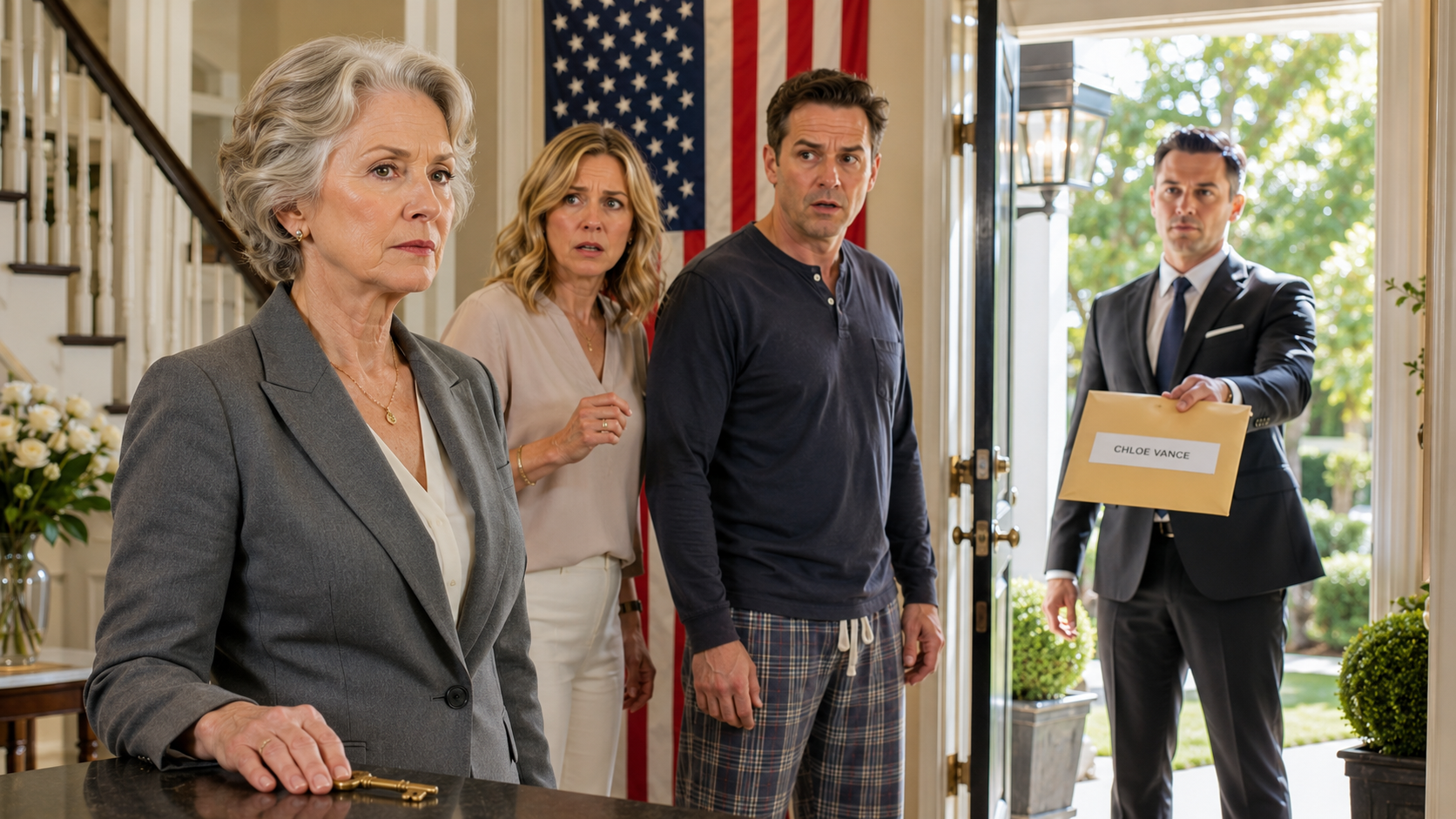
Saturday at 8:11 a.m., Chloe walked into my room without knocking. She shut the door. Her eyes dropped to the envelope on my dresser. The brass key was half visible beneath my Bible.
“You bought a house?” she asked.
I placed one hand over the key. Then the doorbell rang.
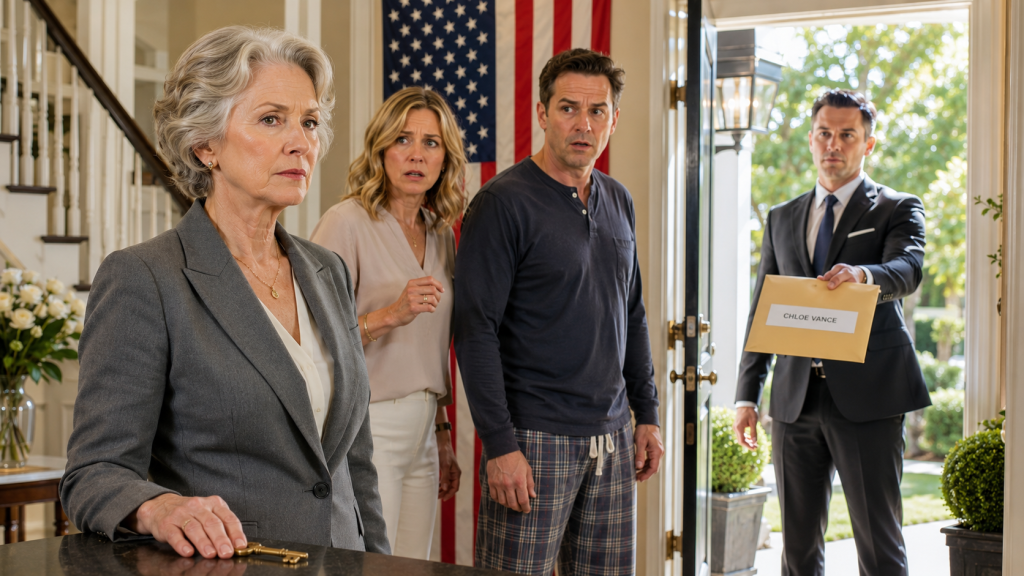
On the porch stood a man in a dark suit with a leather folder that had Chloe’s name on it. Lucas came down the stairs barefoot. Chloe stopped breathing through her nose.
The man lifted the folder. The first thing I saw was not the letterhead. It was Chloe’s name typed across the front in clean black ink.
“Mrs. Hayes?” he asked.
Both of us answered with our eyes. That was when I understood Sylvia Vance had done exactly what I paid her to do. Quietly. Properly. With every signature where it belonged.
The man opened the folder and showed only the top page. There was my maiden name on one line, the trust name on another, and beneath that, a delivery confirmation stamped 8:11 a.m.
Then Chloe saw the second page. Her lips parted. Her fingers went flat against the wall as if the room had tilted. “Lucas,” she whispered, but his name came out thin and useless.
My granddaughter appeared behind him in her pajama shirt. My grandson stood in the hallway, his face going pale as he looked from his mother to me.
Lucas came down the last two steps. “Mom,” he said carefully, “what is this?”
I picked up the brass key from beneath my Bible. My hand did not shake.
The man turned the page toward Chloe, and she read the first line. That was the line that made her knees soften.
Lucas looked from the folder to the key, and his voice dropped. “Mom, whose house did you buy?”
I stood slowly. The room went quiet in a way I had been waiting two years to hear. Not the quiet of people deciding I was old and inconvenient. This was the quiet of people realizing the person they had dismissed had been making decisions while they were busy underestimating her.
“The one you wanted,” I said.
Chloe’s face drained. Lucas blinked once. “The Cedar Ridge house?” he asked.
I did not correct the neighborhood name. I did not need to. He knew the house. They had talked about it at dinner. Chloe had once stood in the kitchen holding a glass of wine and said, “Can you imagine Thanksgiving there?” I had been rinsing plates when she said it. She had not looked at me. Now she could not stop looking.
“You bought our house?” she whispered. “No,” I said. “I bought my house.”
The man in the suit lowered his folder. Lucas swallowed. “Mom, we can talk about this.”
That sentence almost made me smile. Talk had been available for two years. But people who benefit from your silence usually discover conversation after you stop being useful. “I already talked,” I said. “You just weren’t listening.”
Chloe grabbed the folder then. Her eyes moved quickly over the page, searching for a mistake, a loophole. There was none. The trust owned the house. Sylvia had included a letter confirming that no other family member had authority over the property, the funds, or the trust.
Lucas took the page from her and read it himself. Then he read it again. “Where did you get the money?” he asked.
There it was. Not “Are you okay?” Not “Why didn’t you tell me you were hurting?” Not “Mom, I’m sorry.” Where did you get the money?
My grandson flinched. My granddaughter looked down. I think, in that moment, they heard their father more clearly than he heard himself.
I walked to the dresser and picked up my Bible. The brass key lay warm beneath my palm. “I was always going to leave,” I said. “I just decided not to leave empty-handed from my own life.”
Lucas rubbed both hands over his face. “Mom, come on. Chloe didn’t mean—” “Yes, she did.” Chloe looked up sharply. I kept my voice even. “And you did too.”
That was the part he could not meet. He could argue details. He could blame stress, bills, teenagers, work, marriage. But he could not argue the silence. Silence leaves records too. In children. In rooms. In the way a mother stops asking to be defended.
I moved out three days later.
Not with drama. Not with shouting. I packed methodically. Boxes stacked like quiet promises.
They did try, of course. Lucas knocked on my bedroom door that evening and asked if I wanted tea. Chloe made soup the next day and told me she had always admired my independence.
My grandson carried boxes without being asked. My granddaughter waited until I was checking the trunk, then slipped a folded note into my purse. The paper was thin. The ink was smudged from hurried fingers: I’m sorry we didn’t say anything.
That note broke me more than Lucas’s question had. Children notice the rooms adults teach them to survive. I kept the note.
At the new house, the movers placed my old tea kettle in the kitchen first. The first morning, I woke before sunrise and made tea. The east-facing sunroom filled slowly with light. I set Thomas’s cup across from mine because grief is allowed to keep a place without asking anyone’s permission. The house was quiet. Not empty. Quiet. There is a difference.
Lucas came by a week later. He stood on the porch with a paper coffee cup in one hand and shame in the other. Chloe did not come. For once, that was wise.
“Mom,” he said, “I messed up.”
I let him stand there long enough to understand that this porch belonged to me. Then I opened the door. We talked for forty-three minutes. He apologized. He cried when he talked about Thomas. He cried when he admitted that letting Chloe speak for both of them had been easier than defending me.
I listened. Then I told him the truth. “I love you,” I said. “But you will never again be in charge of where I sleep.” His face folded inward. He nodded. That was the beginning of something. Not forgiveness. Not yet. A beginning.
Chloe sent flowers two days later. White roses. I placed them on the porch for three hours, then gave them to my neighbor, who said they looked expensive. “They were,” I told her. We both understood I was not talking about flowers.
In the months that followed, I learned how to live in a house that did not require me to be useful before I was welcome. I bought a porch swing. I planted roses that Thomas would have trimmed badly. I invited my grandchildren for dinner every other Sunday. No guilt. No performances.
They came quieter at first. Then warmer. One evening, my granddaughter stood beside me at the sink and said, “Grandma, did Dad know you were sad?”
I looked out the window at the porch. “I think he knew,” I said. “I don’t think he wanted to know what it meant.” She nodded like that made sense in a way children should not have to understand.
Years do not arrive with fanfare. They accumulate like dust on the windowsill. The $89 million changed my accounts, my address, and the way people smiled when they learned I had options. But the real change happened at 6:18 p.m. at a polished table with cooling chicken and garlic green beans.
That was the moment my son taught me what my silence had been costing me. And that was the moment I stopped paying.
I still love Lucas. Love is a gravity; it pulls, it outlasts arguments. But I had learned that love without self-respect becomes a room someone else can rename. For two years, Chloe called mine the guest room. Now I have a home.
Lucas calls on Sundays now. Short. Clean. He asks about the roses. He doesn’t ask for favors. That is the shape of a repaired boundary. Chloe sends a card on my birthday. I keep it in a drawer. I know what it cost her to write, and that is enough.
Every morning, I set Thomas’s cup on the windowsill. I pour tea into it. I don’t drink it. Care is not what people say when they want something. Care is what they do when they think you have nothing left to give. Thomas never argued for my worth; he simply lived it beside me.
I still turn the brass key in the lock. It catches sometimes. The mechanism is old. I do not replace it. I adjust my wrist. I learn the angle. Some things are not meant to slide open effortlessly. They are meant to be met with attention, with the quiet understanding that what you secure is only as strong as the hand that turns it.
Silence is only heavy when it’s keeping secrets from yourself. When it’s protecting your own name? It’s just peace.
THE END! THANKS FOR READING!