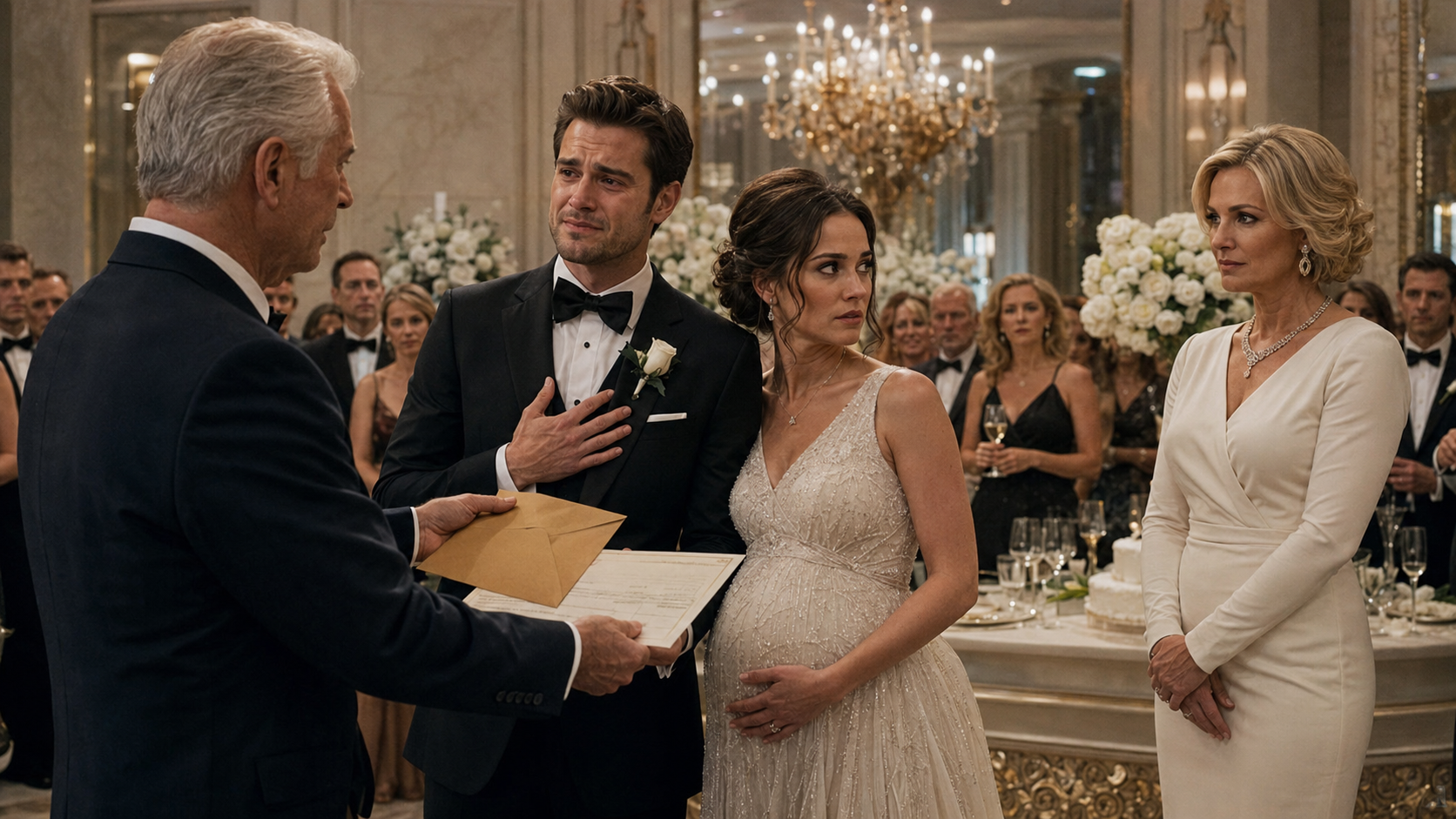
Three hours before my son’s wedding, I overheard his fiancée smearing industrial-strength glue on my sick wife’s chair. My own son was acting as the lookout by the door, laughing. I didn’t scream. I didn’t cancel the event. I just swapped the place cards… and waited for the bride to try and stand up in front of two hundred guests.
“Harry…” Chloe whispered, her lips barely moving. “Help me.” Harrison leaned toward her, confused at first, then absolutely furious when he realized what was happening. “What the hell did you do?” he hissed through gritted teeth.
Chloe’s eyes went wide with panic. “What did I do? You’re the one who told me to put more on!” The emcee’s microphone was still live on the podium. And that sentence echoed clearly across the room.
Entire. Cruel. It rolled through the ballroom like a crystal wine glass shattering in slow motion. The applause died instantly. The jazz orchestra stopped playing mid-note. Two hundred guests stood completely frozen, watching the bride physically glued to a chair, her pristine white gown trapped by the exact same poison she had set for my wife.
Martha squeezed my hand. “Tom… what’s happening?”
I didn’t answer her right away. Because Harrison was staring at me. No longer looking at me like a son, but like an accused man standing before a judge.
Chloe pulled again, desperate. The delicate French lace tore with a dry, sickening rip. Several women in the front row covered their mouths in shock. Someone let out a nervous laugh at a back table, but no one dared to join in.
“Get me up, you idiot,” Chloe hissed at him.
Harrison tried to grab her arm. “Stop making a scene.”
“I’m stuck!”
The microphone picked it up again. Everyone heard it. Mrs. Sterling, Chloe’s mother, stood up abruptly, her expensive pearl necklace rattling against her chest. “What kind of sick joke is this?”
I stood up slowly. Not because I needed the theatrical drama, but because at my age, when your soul breaks, your body demands care.
“It’s the sick joke your daughter prepared for my wife.”
Martha turned to me, her eyes wide. “For me?” Her voice was small. Too small for a woman who, for forty years, had held my entire world together with hands of steel and a heart of pure gold.
Harrison took a step toward me. “Dad, don’t start.”
I looked at him. And for the very first time in his life, I didn’t see my little boy. I saw a man who had learned to use my last name as a shield, and his mother’s tenderness as a doormat.
“I didn’t start this, Harrison. I just swapped the place cards.”
A massive, collective gasp filled the hall. Chloe started to cry, but they weren’t tears of remorse. They were tears of utter humiliation. Of rage. The tears of a woman who couldn’t stand that her own trap had been violently sprung on her.
“He did it!” she screamed, pointing a manicured finger at me. “Mr. Gallagher did this to me!”
I nodded calmly. “Yes. I put your name in the exact seat where you spread the industrial glue.”
Martha put a trembling hand over her chest. “Glue?”
Harrison took another step toward me, his face flushed. “Dad, shut the hell up. There are guests here.”
“That is exactly why I’m going to speak.” I picked up the crystal champagne flute in front of me and set it firmly back on the tablecloth. I didn’t want to toast. I wanted to remember.
“Thirty-five years ago, your mother pawned her grandmother’s earrings to pay for your tuition at that elite private academy you wanted so badly. Twenty-eight years ago, she went without buying herself a single new piece of clothing for a year just to buy you your first computer. Twelve years ago, when you crashed your car while drunk and begged her not to tell me, she was the one who quietly paid to fix the other guy’s bumper.”
Harrison turned pale. “That has nothing to do with this.”
“It has everything to do with this. Because the woman you wanted to see glued to a chair tonight—humiliated, wetting herself from sheer terror, or lying helpless on the floor—is the exact same woman who carried you when you had a 103-degree fever and told me, ‘Don’t yell at him, Tom, he’s just a little boy.’”
Martha began to weep in silence. I looked at her, and I felt something officially snap inside my chest. She shouldn’t have had to find out like this. But monsters choose their own time to emerge from the dark. And sometimes, you just have to decide whether you let them bite, or whether you flip on the floodlights.
Mrs. Sterling rushed to Chloe’s side, frantically pulling at the dress. “Get scissors! Get acetone! Somebody do something!”
A hotel manager ran over. Chloe tried to hide her face in her hands. “Mom, do something.”
Mrs. Sterling turned her fury on me. “You are an absolute savage! Ruining your own son’s wedding!”
“No, ma’am. Your daughter ruined it the second she decided my wife was an ‘aesthetic obstacle.’”
She opened her mouth but couldn’t find a single word.
The Evidence
Then, a voice spoke up from among the stunned guests. “I recorded it.”
Everyone turned. It was a young woman, Chloe’s cousin Madison, holding her iPhone up, her face pale but determined. “I’m sorry, Chloe… but since before the ceremony even started, you were bragging that Martha was going to be ‘a total joke.’ I thought it was just cruel banter, but I recorded it because it gave me a sick feeling.”
Chloe glared at her with pure venom. “Madison, put that down right now.”
“No.”
Harrison shouted, “Put the damn phone down!”
That ended any lingering doubt in the room. An innocent man doesn’t scream at a witness. Madison was physically shaking, but she kept the phone held high.
“I also recorded it when Harrison said that after the wedding, you were going to convince Mr. Gallagher to put the construction firm in Chloe’s name because ‘the old lady was practically dead anyway and he was going to be lonely soon.’”
The ballroom turned into a graveyard. Martha let go of my hand. Not quickly. Slowly. As if she had just touched a burning stove.
“Did you actually say that?” she asked.
Harrison turned toward her, his voice cracking. “Mom, no. It wasn’t like that.” But he didn’t dare step closer. Chloe’s chair, cemented to her own malice, acted as a border no one could cross without getting stained.
I pulled out my phone. “Marcus.”
My driver appeared from the back doors, steady and stoic as always. “Yes, Mr. Gallagher?”
“Bring the black folder from the SUV.”
Harrison looked at me with genuine fear. Finally. Not the fear of losing his mother’s love. Not the fear of having broken my heart. The fear of paperwork. Spoiled children are never afraid of the pain they cause; they are only afraid of the consequences that cost them money.
Marcus returned with a thick black leather folder. The exact same one my corporate lawyer had handed me two days earlier, after months of lingering doubts, financial suspicions, and silences I hadn’t wanted to confront. I opened it right there on the head table.
“I came prepared for something else tonight, Harrison. Not for this. I intended to give you a wedding gift.”
Chloe stopped struggling. Harrison swallowed hard. “Dad…”
“I intended to officially hand you the directorship of the firm’s residential development wing. I intended to sign over 15% of my voting shares. I intended to secure your entire future.”
Martha looked at me, utterly confused. I lowered my voice. “I also intended to ask you, in front of all these people, to just come back home and eat dinner with your mother once a week. A silly old man’s wish, I suppose.”
Harrison’s eyes filled with tears. But I no longer knew if I could trust them. I pulled out the first legal document. “This was the trust fund transfer.”
I tore it right down the middle. A collective gasp echoed through the ballroom.
Harrison took a step forward. “You can’t do that!”
I pulled out the second document and tore it. “This was the directorship appointment.”
“Dad!”
I pulled out the third. “And this was the deed authorization for you and your wife to occupy the summer estate in Lake Geneva for the first five years of your marriage.”
Chloe screamed from the chair: “Harry, do something!”
I looked at her dead in the eye. “He’s done quite enough.”
Mrs. Sterling began to sob theatrically. “My daughter made a mistake! A stupid prank! You can’t destroy two families over a chair.”
Martha lifted her head. Her tears were still falling, but her voice was like iron. “It wasn’t just a chair.”
The entire room went dead silent. My Martha, in her sky-blue dress and with her wrinkled, beautiful hands, stood up carefully from her seat. I instinctively reached out to help her, but she gave me a gentle wave off. She wanted to stand on her own two feet. And she did.
“It wasn’t just a chair,” she repeated, her voice echoing perfectly. “It was me. My shattered hip. My frail body. My absolute shame. My deepest fear. You weren’t just trying to ruin a dress tonight. You wanted to ruin me physically, just so my son would stop feeling guilty for despising me.”
Harrison began to cry for real. Or so it seemed. “Mom, please forgive me. I got carried away.”
Martha looked at him the exact way a homeowner looks at a door they painted, cared for, and defended for decades, only to realize it’s been entirely hollowed out by termites from the inside.
“I don’t know if I can.”
Those six words hurt him more than a physical blow. Chloe, acting purely out of desperation, pulled up as hard as she could. The designer dress tore violently from her hip all the way down to her thigh. Several guests looked away in discomfort. Not out of modesty, but out of the sheer discomfort of seeing justice exposed so brutally.
Two hotel engineers finally arrived with a heavy-duty industrial solvent. One of them, inspecting the adhesive, shook his head grimly. “This doesn’t just wipe off, man. We have to literally cut the fabric away from the chair cushion and peel it back layer by layer. If an older person had sat in this and tried to pull up, it could have ripped their skin clean off.”
Martha closed her eyes. Harrison buried his face in his hands. I felt physically nauseous. Because assuming the worst was one thing; hearing a complete stranger confirm how close my wife had come to being maimed by her own son was another entirely.
The Legal Reality
At that exact moment, my attorney walked through the ballroom doors. Vance. Silver-haired, fiercely serious, with the face of a man who is never, ever late by accident.
“Mr. Gallagher,” he said smoothly, adjusting his suit jacket. “I received your text.”
Harrison’s head snapped up. “You called the corporate lawyer? Tonight?”
“Not before the ceremony,” Vance replied coldly. “After hearing what you were planning, yes.”
Vance stepped up to the table. “There is internal CCTV footage from the hotel lobby and ballroom. Security is already securing the hard drives. There are dozens of witnesses and clear, premeditated intent to cause severe bodily harm to a vulnerable senior citizen.”
Chloe shrieked, “I’m not a criminal!”
Vance looked down at her over his glasses. “A judge will decide that, ma’am.”
“I’m not even anyone’s legal wife yet!” she yelled hysterically.
And that single sentence left Harrison nailed to the floorboards. Not “we didn’t do anything.” Not “please forgive me.” Not “what have I done?” The very first thing she tried to protect was the legal title. The liability. Her entry into the Gallagher family bank accounts.
Martha turned to our son. “Did you sign the marriage license yet?”
Harrison couldn’t answer. Neither did Chloe. Vance opened a sleek gray folder. “The religious ceremony has concluded. However, the civil signing was scheduled for after the reception, at 8:00 PM in the bridal suite.”
I felt a wave of relief so massive it almost shamed me. My son wasn’t legally bound to this woman. There was still an exit door. A small, incredibly damaged door, but a door nonetheless.
Harrison looked at me, begging. “Dad, please. Don’t do this. We’re all just upset and drinking. Chloe made a stupid mistake. I did, too. But we’re family.”
“Family?” I asked. “Three hours ago, you literally said your mother looked like old furniture.”
Martha shuddered. Harrison frantically shook his head. “I wasn’t thinking clearly!”
“No, you were thinking perfectly clearly. What you didn’t think about was that someone might actually overhear you.”
He fell to his knees. Right in front of his mother. Not in front of me. “Mom, please forgive me. I let myself get carried away. Chloe was stressed about the photos. I didn’t want to…”
Martha took a slow step backward. “Don’t use that woman to hide your own mouth. The words came from you, Harrison.”
Chloe, sitting with half her dress violently cut off while two engineers tried to peel her away from the upholstery, let out a bitter, ugly laugh.
“How perfectly convenient. Now it’s all my fault. He’s the one who told me his mom was suffocating him! That you were faking being sicker than you are to manipulate him! That his dad would leave him with absolutely nothing if he didn’t lock down a marriage soon!”
Harrison turned to her in absolute horror. “Shut your mouth.”
But Chloe no longer had any desire to sink alone. “No, honey. If I’m staying stuck here, you’re staying right here with me.”
The entire ballroom held its breath. Chloe looked directly at me. “Do you want to know the actual truth, Mr. Gallagher? Your son doesn’t love me. And I sure as hell don’t love him. This was a business agreement.”
Martha put a trembling hand to her mouth. I felt the blood pounding in my ears like a drum. “What agreement?”
Harrison shouted, “Chloe, stop!”
She smiled with eyes completely blackened by running mascara. “Your precious Harry needed to get married before you finalized changes to your will. My mom needed me to marry into a family with a trust fund before the bank foreclosed on our house. We all won.”
Mrs. Sterling lunged at her own daughter. “Shut up, you stupid girl!”
Too late. Vance was recording it on a dictaphone. Madison was still recording on her iPhone. And perhaps half the room was, too.
I looked down at my son. “Did you know the contents of my will?”
Harrison remained completely silent. Vance frowned deeply. “Mr. Gallagher, only three people on this earth knew that specific clause: you, me, and the notary public.”
A cold, creeping sensation ran down my spine. Chloe let out a broken, hysterical laugh. “Oh, well, I guess someone else knew. Because Harry had a photocopy of it.”
Harrison turned pale in a way I had never witnessed before. Vance approached him, his lawyer demeanor shifting to something much more dangerous. “Where exactly did you get a copy of a sealed legal document?”
My son didn’t answer. But his terrified eyes darted toward someone among the crowd of guests. A table near the back. Table Twelve.
Sitting there was my brother, Arthur. My own younger brother. With his scotch glass untouched, his tailored suit impeccable, and the terrified face of a man who had just watched a load-bearing wall collapse—a wall that he himself had secretly weakened.
I understood the entire puzzle before Harrison even spoke. Arthur had worked with me for thirty years. Arthur had full access to my corporate offices. Arthur knew exactly where Vance kept copies when he came over to sign contracts. And Arthur, ever since I made the decision to leave the vast majority of my assets to Martha while I was still alive rather than directly to Harrison, had completely stopped visiting me on Sundays.
“Uncle Arthur,” Harrison whispered.
The name alone was enough. My brother slowly set his scotch glass down on the tablecloth. “Tom, don’t jump to any wild conclusions here.”
Martha grabbed my arm. Now she was the one physically holding me up. I looked at Arthur. At Harrison. At Chloe, permanently stuck to her own trap. At Mrs. Sterling, feigning a dramatic fainting spell. At the two hundred guests who no longer knew if they were attending a wedding reception or a criminal trial.
And I realized in that moment that the glued chair wasn’t just an isolated prank. It was the rusted tip of a rebar poking out of the concrete. Underneath it, there was a completely rotten structure. My family. My blood. My legacy. All of it full of fatal cracks.
Vance leaned in close to my ear. “Mr. Gallagher, we must leave this premises immediately and secure all of your corporate documents tonight.”
I nodded slowly. But before we moved toward the exit, Martha let go of my arm and walked straight toward Harrison. Every person in the room thought she was going to bend down and hug him. I did, too. Because a mother always terrifies us with her infinite capacity to forgive.
But Martha just reached up, unclasped the fake pearl brooch she wore on her lapel, and placed it gently into our weeping son’s palm.
“I was going to give this to you when your first child was born,” she said softly. “It originally belonged to my mother. Today I’m giving it to you so you can always remember that the only thing fake at this table wasn’t the pearls.”
Harrison began to sob uncontrollably. Martha returned to my side. “Take me home, Tom.”
I took her arm. We walked past Chloe, who had been partially freed by the engineers, leaving half of her beautiful dress stuck to the chair cushion like a layer of skin peeled away from a lie.
As we reached the grand exit doors, Arthur jogged up to catch me. “Brother, wait a second. You’re making a massive mistake.”
I stopped. “No, Arthur. The mistake was believing that blood doesn’t require a structural inspection.”
His face hardened into a scowl. “You don’t know everything.”
“Then speak.”
He looked at Martha. Then at Vance. Then at Harrison, who was still weeping on his knees. “Your will wasn’t the only document I made a copy of.”
Vance tensed instantly. “What else do you have in your possession?”
Arthur smiled slightly. A sad, totally rotten smile. “The letter Dad left behind before he died.”
I felt all the oxygen leave the room. Our father had died forty years ago. And he had never left a letter. Or, at least, that’s what I was always told. Arthur reached into his suit jacket and pulled out a yellowed, aged envelope. My name was written right on the front. Thomas. In my father’s unmistakable handwriting.
Martha whispered, “Tom…”
Arthur held up the envelope like a trophy. “If you try to destroy me today, Tom, you’re also going to destroy the grand myth you’ve told everyone about how you built your precious company… and about who really paid for that first plot of land on the South Side.”
My hand closed tightly over Martha’s cane. The ruined wedding no longer existed to me. The chair, the glue, the humiliation, and the torn lace dress had unexpectedly opened a much older, darker door. And standing behind that door was my brother, holding a secret that had been sitting silently at our family table for four decades.
The Hidden Foundation
Arthur held the envelope as if it were a loaded gun.
And it was. Not the kind that fires lead bullets, but the kind that shatters your entire reality. For forty years, I had proudly repeated the exact same origin story: that my father died leaving me nothing but a rusted Ford truck, two toolboxes, a mountain of debt, and a phrase: “Concrete doesn’t forgive the lazy.” With that, I built Gallagher Construction. With that, I raised my son. With that, I became a ruthless businessman when I had to be, and a humble man when I could.
But inside that envelope was my name, written by the hand of a dead man. And the dead, when they finally speak up late, do not come to offer comfort. They come to collect a debt.
“Give it to me,” I demanded.
Arthur held the envelope just a little higher. “Not out here.”
I laughed—a dry, raspy sound that scraped my throat. “Are you suddenly worried about having an audience? Ten minutes ago, you were perfectly willing to sit back and watch my wife be publicly humiliated in front of two hundred people.”
“I had absolutely nothing to do with the chair prank.”
“But you had everything to do with the rest of it.”
He didn’t answer. Martha gripped my arm tighter. Her hand was ice-cold. “Tom, please let’s just go.”
“Yes,” I said. “But we are leaving with the envelope.”
Arthur pressed his lips together in a thin line. Harrison slowly stood up from the floor behind us. His face was swollen, his eyes bloodshot, his custom suit heavily wrinkled. For a split second, he looked exactly like the little boy who would break a vase in the living room and pray his mother would blame it on the wind.
“Dad, just listen to him,” Harrison pleaded. “Uncle Arthur didn’t want to hurt you.”
I looked at him with disgust. “And what about you?”
He looked down at his shoes. That was all the answer I needed.
Vance stepped forward, all business. “Mr. Gallagher, if that document rightfully belongs to Thomas, you are legally obligated to hand it over. If it was stolen from a private residence or used to manipulate corporate financial decisions, this is going to become a federal issue very quickly.”
Arthur smirked. “Always so self-righteous, Vance. It’s funny you weren’t quite so righteous when you helped Tom write Harrison completely out of the company.”
“I didn’t leave anyone out,” I fired back. “Your nephew wrote himself out the exact moment he confused hard-earned inheritance with divine right.”
Chloe, currently half-covered by a borrowed linen tablecloth and her ruined dress, screamed from the back of the room: “Well, of course he had to secure a marriage! You were going to leave everything to your sick wife!”
Martha closed her eyes. Not out of physical weakness, but out of sheer exhaustion—that ancient, bone-deep exhaustion of women who constantly hear others discuss them as if they were just plots of land, bank accounts, or antique furniture.
“I am not the spoils of war,” she said. Her voice wasn’t loud, but it cut through the massive room. Chloe instantly fell silent. Mrs. Sterling did, too.
Arthur looked me dead in the eyes. His arrogant confidence was peeling off his face, layer by layer. He had fully expected to see me terrified. He expected the mention of “Dad” to fold me, that the old letter would act as a trump card to make me forget the chair, the glue, the humiliation, and the betrayal. But a lifetime in commercial construction taught me one crucial thing: when a load-bearing column is cracked, you don’t just slap a fresh coat of paint over it. You take a sledgehammer to it, inspect the rebar, and decide if it can be salvaged or if the whole thing needs to be torn down to the dirt.
“This is the last time I’m asking,” I told him. “Give me the envelope.”
Arthur looked down at the aged paper. For an instant, I honestly thought he was going to rip it up. Vance thought so, too, and immediately stepped forward. But the person who moved first was Madison—Chloe’s cousin, the girl with the iPhone. She approached, physically trembling, but with a raw courage I hadn’t seen in many grown men in boardrooms.
“Mr. Arthur,” she said, her voice shaking. “It’s all being recorded. If you destroy that, that will be recorded as evidence, too.”
Arthur glared at her. “Shut up, little girl.”
“No,” she replied, barely above a whisper. “I’m so incredibly tired of staying silent in this toxic family.”
I didn’t even know the girl’s last name, but in that moment, I respected her deeply. There are certain people who are born into families filled with constant noise, yet they still manage to listen to their own moral conscience.
Arthur let out a bitter laugh and threw the yellowed envelope at my chest. I caught it. It weighed practically nothing in my hands. But it hurt a great deal. I didn’t open it. Not yet.
“Vance,” I said, “we’re leaving.”
“Mr. Gallagher, it’s best if we exit through the service doors. Hotel security already has the camera footage isolated and the list of key witnesses.”
Harrison tried to approach Martha one last time. “Mom, please. Don’t leave like this.”
Martha looked at him. My wife could be as sweet as fresh bakery bread, but today, her tenderness had run completely out of sugar. “Leave like what, Harrison?”
He couldn’t answer.
“With my dignity? With my skin still intact? Without giving you the satisfaction of explaining exactly why you wanted to sit back and watch me suffer?”
Harrison openly wept. “I swear I didn’t want you to suffer.”
Martha shook her head slowly. “No, son. You wanted me to suffer just a little bit. Just enough to be a punchline. Just enough so I would remember my place. But you conveniently forgot that I was the woman who taught you how to walk. I knew exactly where my place was long before you ever learned how to stand up.”
He completely crumbled. And I felt a brief pang of pity. Yes, pity. Because no matter how much a son dirties himself in the mud, you still remember holding them when they were a clean, innocent baby. But pity is not the same thing as forgiveness. And today, I finally learned that a father can also love his child from a distance, just so he doesn’t keep raising a forty-year-old monster.
We walked out of the ballroom amid hushed whispers. Nobody applauded. Nobody dared. At the side service exit, Marcus was waiting with the SUV idling. I opened the heavy door for Martha. She climbed in slowly, painfully. Vance took the front passenger seat. I stood outside for just a moment, the envelope tight in my hand. From the main lobby entrance, I could hear muffled screaming: Chloe yelling at her mother, Mrs. Sterling blaming Harrison, Harrison crying out for me, Arthur demanding someone listen to him. All those wealthy people who had put on expensive suits to celebrate a wedding were now frantically fighting not to drown in the truth.
I got in the back seat. “Take us home, Marcus,” I said.
The Truth in Ink
Nobody spoke a word during the drive. Martha stared blankly out the tinted window. Her tears were no longer falling, but they were still there, trapped in her eyes like rain that can’t find a way to fall. I looked down at the envelope. Thomas. My father’s handwriting. Firm. Slanted aggressively to the right. As if he were still in a rush.
We arrived at the house as dusk was settling over the suburbs. Marcus tried to help Martha up the steps, but she insisted on doing it herself. She was quietly picking up the shattered pieces of herself, and every painful movement was her way of saying: I am still here.
We went inside. The house was perfectly intact. The leather sofas, the framed photos, the portrait of Harrison as a young child sitting on the grand piano. Martha stopped in front of that specific photo. He was six years old in it. Smiling, missing a front tooth, proudly wearing a youth soccer medal around his neck. She reached out and gently touched the glass frame.
“I did something wrong,” she whispered into the quiet room.
I felt a sharp pain in my chest. “No, Marty. You didn’t.”
“Yes,” she said firmly. “I did something horribly wrong. Because my own son was able to look at his mother and see nothing but a burden.”
I walked over to her. “Martha, there are children who take unconditional love and turn it into a blank check to destroy things. That is absolutely not the fault of the one who provided the love.”
She looked at me, her eyes searching mine. “And what if we just pampered him too much?”
I thought of all the “let it go” moments over the years. The “poor kid, he’s just stressed from finals.” The times Harrison broke curfew or wrecked a car and we rushed to fix it with a checkbook. The countless doors we opened for him before he ever learned how to knock. I didn’t want to lie to her tonight.
“Maybe,” I admitted softly. “But pampering a child is not the same thing as teaching them cruelty. He chose to be cruel on his own.”
Martha sat down heavily on the sofa. I sat directly across from her. Vance remained standing near the entryway, respectfully giving us silence. I placed the yellowed envelope onto the glass coffee table. No one touched it for a full minute. Then, Martha took a deep, shaky breath.
“Open it, Tom.”
My fingers actually shook as I broke the old adhesive flap. Inside were three items: a handwritten letter, a faded bank receipt, and a black-and-white photograph. The photo slipped out first. It was my father, young, holding his fedora. Standing next to him was my mother. And standing behind them both was a woman I recognized instantly by her kind eyes: Martha’s mother, Eleanor. In the photo, my father was holding a manila folder. Eleanor had her hand resting on it, looking exactly like someone officially handing over something of great importance.
Martha leaned forward. “That’s my mom.” Her voice cracked instantly.
I picked up the letter. My father’s handwriting hit me like a brick from the very first line: “Thomas, if you are reading this, it is because I was a coward and didn’t have the guts to tell you the truth while I was still breathing.”
I had to stop reading. Martha reached across and took my free hand. I swallowed hard and continued.
My father explained that when I was twenty-two, dreaming of buying my very first commercial plot of land to start the business, he didn’t have a dime to his name. The rusted truck wasn’t worth anything; his tools were already pawned; the massive debt to the local bank was literally days away from taking our childhood home.
Then, Eleanor stepped in. She had life savings—it wasn’t much to the wealthy elite, but to her, it was her entire life’s work: cash from tailoring dresses, from weekend bake sales, from decades of saving pennies and dimes in metal coffee tins under her bed. She gave every last cent of that money to my father on one strict condition: that it go directly to me and Martha. Not to him. Not to Arthur. Not to bail out the Gallagher family debt. It was specifically so I could start a legitimate business and ensure Martha would never go hungry a day in her life.
My father accepted the cash. But he bought the commercial land in his name because “it was simpler for the paperwork.” Then he grandly handed the deed to me, claiming it was the ultimate fruit of his lifelong sacrifice. He never once mentioned Eleanor. He never mentioned Martha. He never mentioned that the very first foundation stone of my massive empire had been paid for by the calloused, pricked fingers of my mother-in-law.
I felt my chest completely cave in. Gallagher Construction. My ultimate pride. My legacy. My arrogant speech at every single company anniversary gala. It had all started with a humble woman who I only remembered serving me black coffee in chipped ceramic mugs. A woman who never once asked for a brass plaque. Or a framed photo in the lobby. Or an executive office with her name on the door.
Martha was openly weeping now, no longer trying to hide it. “My mom never breathed a word to me.”
I kept reading the page. My father wrote that he deeply regretted the lie. He wanted to fix it, but his pride and shame just became a comfortable habit. Arthur had stumbled upon the bank receipt one afternoon and aggressively demanded a massive cut of the company, arguing that if the financial help had come into the family, he deserved his fair share as a son. My father refused him. That was the exact moment Arthur’s lifelong resentment was born. Not because something was unfairly taken from him, but because he discovered that not everything I had came from the grit of the Gallagher men. It came from a poor, working-class woman. A mother.
The final line made me close my eyes in shame: “If you are half the man I pretend you are, Thomas, you will put the correct name where I selfishly put mine.”
I dropped the letter onto the table. Nobody spoke. The silence in the living room was no longer the shocked silence of a ruined wedding; it was the heavy silence of standing over an open grave.
Vance stepped forward and picked up the faded receipt very carefully. “This has immense historical value, Tom, and perhaps legal weight as well. But far more importantly, Mr. Gallagher… it completely changes the entire narrative of your corporate assets. Your mother-in-law provided the initial seed capital. If there are corresponding bank records from that era, we could officially document it.”
I looked at Martha. My entire adult life, I had walked around saying, “my company.” She never once corrected me. She never demanded an accounting of the finances. She never once said, “Without my mother, you would have been a broke laborer.” On the contrary. She would wake up at 4:00 AM when I had early pours. She would wait up for me with a hot dinner. She would help me pick out holiday bonuses for my foremen. She would sit quietly and listen to me brag about landing million-dollar contracts. And she would just smile.
My God. How many countless times does a woman stay silent in the shadows—not because she lacks the truth, but simply because she doesn’t want to strip the pride away from the man she loves?
I slid off the sofa and knelt directly before her on the rug. At my age, my knees scream in protest. Today, I didn’t care. “Forgive me, Marty.”
She frantically shook her head. “You didn’t know, Tom.”
“But I happily enjoyed an incomplete history. And I never once stopped to ask how much of your blood was poured into my dreams.”
She reached out and touched my weathered face. “I put my whole life into it, Tom. And I don’t regret a single second of it. But today, I no longer want my life to be completely invisible.”
I kissed her palm. “It won’t be. I promise you.”
Vance cleared his throat respectfully. “Mr. Gallagher, we must act swiftly before Arthur moves any capital. If he had unrestricted access to these types of documents, he could have easily made copies of other things—perhaps even initiated unauthorized transactions.”
I stood back up. The broken old man from the ballroom had stayed behind at the hotel. The CEO standing in my living room no longer wanted blind punishment out of anger. He wanted surgical order.
“First thing tomorrow morning, we go straight to the corporate office,” I commanded. “We will change every digital access code, audit the files, formally revoke Arthur’s powers of attorney, and call an emergency board meeting.”
Vance nodded sharply. “And Harrison?”
I looked over at the photo of my son on the piano. That innocent child no longer existed. But I still did. And I had to make a decision as a father, and as the man responsible for thousands of employees who depended on the firm to feed their families.
“Harrison is permanently stripped of any decision-making power, executive position, signature authority, company benefits, or trust payouts until he answers for this legally and truly seeks professional help. If he ever wants to sit at my table again, it won’t be because we share the same blood. It will be because of his actions.”
Martha closed her eyes. It physically hurt her. It hurt me, too. But there are certain pains in life that act like surgery—they cut you open just to save you.
Arthur called my cell phone seventeen times that night. Harrison called thirty-four times. Chloe sent a vicious text from an unknown number: “All of this is going to sink your reputation, too.”
I read it once and deleted it. Not out of fear. Out of basic hygiene.
Rebuilding the Foundation
The following morning, I arrived at the corporate headquarters with Martha by my side. I had never once brought her to executive board meetings. I always used to say she’d get bored by the numbers. The ugly truth was, I had intentionally built a world where she only appeared at holiday parties as a prop, not in the boardroom making decisions. That world was officially over.
The lobby staff and executives were stunned to see her walk through the glass doors holding my arm. Some greeted her with genuine warmth. Others offered that awkward, stiff courtesy of people who know a scandal just happened but don’t know how much they are allowed to ask. Waiting in the main boardroom were the regional directors, Vance, the chief accountant, the corporate notary, and Arthur.
Yes, Arthur had arrived early. He was sitting right in my chair at the head of the table. My chair.
When I walked in, he didn’t even bother to stand up. “How incredibly theatrical,” he sneered. “Bringing Martha in here to elicit sympathy from the board.”
Martha stepped forward before I could even open my mouth. She calmly set her leather purse on the mahogany table and stared him down. “Arthur, pity is stealing credit from the dead just to pressure the living.”
Several directors awkwardly looked down at their legal pads. Arthur turned bright red. “You don’t understand the first thing about this business, Martha.”
“I understand foundations perfectly,” she replied without missing a beat. “Because my mother paid for your first one.”
The entire boardroom went dead still. Vance began distributing photocopies of the letter, the bank receipt, and several alarming documents we had uncovered early that morning: logs of unauthorized server access, copies of deeds taken from the notary’s private files, and confidential emails blindly forwarded to Arthur’s personal account. The chief accountant was visibly sweating.
“Mr. Gallagher, there are several large transactions we need to audit immediately. Some invoices from our steel suppliers—suppliers directly linked to Arthur—show massively inflated pricing margins.”
Arthur slammed his fist on the table. “Those are lies!”
Vance looked at him over his glasses. “Then I assume you won’t have a single problem submitting to a forensic audit.”
That was the exact moment my brother finally realized the yellowed envelope wasn’t his ultimate weapon. It was his written confession. He stood up abruptly. “I helped you build this empire, Tom!”
“Yes,” I said calmly. “And you were highly compensated for it. With a massive executive salary, minority shares, six-figure bonuses, company cars, luxury trips, and a hell of a lot of my patience. What you weren’t paid for was the right to rot my family from the inside out.”
“Dad always preferred me!” he spat out.
It actually hurt to hear that. Not for me. For him. Forty years later, a grown millionaire was still fighting a dead ghost for affection.
“Then go to the cemetery and collect your affection from his grave,” I told him coldly. “But leave my wife alone.”
The notary formalized Arthur’s immediate, temporary removal from all operational access pending the results of the forensic audit. Vance filed injunctions regarding the stolen corporate documents. The accountant handed over the server backups. The directors quietly signed strict non-disclosure agreements.
And then I did what I should have done three decades ago. I stood at the head of the table before all of them.
“As of today, the true moral founder of this corporation will be formally recognized by her name: Eleanor Hayes. Without her initial capital contribution, this building would not exist. And my wife, Martha Hayes Gallagher, will step in as the active President of the newly formed Family Heritage Council.”
Martha looked at me as if I had just thrown open a window in a dusty room where she had been taking shallow breaths for decades.
“Tom…”
“No,” I said softly, so only she could hear. “This isn’t a gift, Marty. It’s just a correction.”
The Epilogue
Three months later, the company officially launched a massive scholarship fund for the children of our laborers and employees: The Eleanor Hayes Grant. Martha insisted that the kids be allowed to study whatever they actually wanted: civil engineering, nursing, culinary arts, accounting, music.
“Not everyone is born to pour concrete and build skyscrapers,” she told the board. “Some people are meant to build lives.”
On the day of the inauguration ceremony, she cut the red ribbon. I stayed off to the side, clapping from the crowd. For the first time in my life, I didn’t want to be the center of attention. I discovered that real pride can also be felt simply by standing in the shadows and watching the right person finally receive the light.
Harrison wasn’t there. After the disastrous, canceled wedding, he fell off the map for two weeks. Then he showed up at our driveway gate in the middle of the night, heavily intoxicated, sobbing into the intercom. We didn’t buzz him in. Martha cried quietly behind the living room curtains. I did, too. But we didn’t open the iron gate.
The next morning, I sent him a single text message: “I love you. But I am not going to rescue you from the consequences of your own cruelty. When you are completely sober, and when you want to repair the damage without demanding our forgiveness, call Vance.”
Months dragged on. He had to sell his sports car. Chloe officially dumped him the second she realized there would be no immediate trust fund payouts, no Lake Geneva estate, and no useful billionaire last name attached to him. Mrs. Sterling attempted to file frivolous lawsuits against the banquet hall, The Drake Hotel, me, and even the manufacturer of the dining chair. None of it prospered. Madison testified against them. Other cell phone videos magically appeared online. The truth, when it finally loses its fear, tends to multiply.
Arthur fell much deeper. The forensic audit found small embezzlements at first, which quickly led to massive ones. Inflated supplier invoices. Rigged local contracts. Kickbacks. Forged signatures. I didn’t press criminal charges to have him destroyed and jailed. It wasn’t necessary. The SEC stepped in, and his own reckless ambition had left muddy footprints all over the ledgers.
One afternoon, he asked to meet me. I accepted. Not at my home, and not in the boardroom. On a public park bench outside the corporate tower. He arrived looking ten years older. Or perhaps, for the first time in my life, I was just seeing him without the “loyal little brother” costume on.
“Are you going to send me to federal prison?” he asked, staring at the pavement.
“That doesn’t depend solely on me anymore, Arthur.”
“We are blood, Tom.”
I looked down at my rough hands. The hands of a laborer. The hands that signed million-dollar contracts. The hands that had also blindly signed away trust without reading deep enough into people’s character.
“Blood is not concrete, Arthur. It doesn’t magically hold together a foundation that is rotten. Sometimes, it only stains.”
He laughed without a trace of humor. “Dad left everything to you.”
“No. Dad left me a massive lie. You weaponized it. I blindly believed it. And Martha paid the price for it.”
He didn’t say anything else. He just stood up and walked away. I haven’t spoken to him since.
With Harrison, it was a different story. Because a son never truly leaves your heart for good. A full year after that horrific wedding, Vance called my private line. “Mr. Gallagher, Harrison came to my office today.”
I went downtown with Martha. Harrison was sitting quietly in the reception area. He was much thinner. He had shaved his beard. He was wearing a simple cotton shirt. No Rolex watch. No expensive “CEO-in-training” cologne. He stood up respectfully when he saw us step off the elevator. He didn’t run to us. He didn’t immediately burst into manipulative tears. That alone made me willing to listen.
“Mom,” he said softly. “Dad.”
Martha squeezed my hand tight. He pulled a folded sheet of notebook paper from his pocket. “I didn’t come here to ask for money. Or a job at the firm. Or for you to drop the restrictions. I just came to read this.”
It was a letter. Not nearly as old or yellowed as my father’s, but just as heavy. Harrison read it aloud in the lobby. He asked for genuine forgiveness. Not “I’m sorry if you felt bad.” Not “I’m sorry if I exaggerated.” Not “I’m sorry for what happened.” He explicitly asked for forgiveness for having despised his mother, for having actively planned to financially take advantage of me, for having happily allowed Chloe to prepare a physically cruel humiliation, and for having confused parental love with a blank check.
Then he looked directly at Martha. “I’m not asking you to hug me right now. I’m not asking you to ever trust me again. I just wanted to look you in the eye and tell you that I’m in intensive therapy, that I’m working the register at a local hardware store for an owner who doesn’t know who I used to be, and that for the very first time in my entire life, I’m paying my own apartment rent with my own money. It scares the hell out of me. But I think I desperately needed it.”
Martha was weeping. I was, too. Harrison left the handwritten letter on the glass coffee table.
“I’m going to keep coming to check in with Mr. Vance every single month to prove that I’m staying on track. If one day you want to see me for ten minutes at a coffee shop, I’ll be there. If not, I will completely respect that, too.”
He turned around and walked to the elevator. Martha didn’t call out to stop him. But she didn’t tear up the letter, either. She carefully folded it and put it in her purse. That night, I saw her sitting by the window, reading it three separate times. She didn’t ask me what we should do, because a mother inherently knows that forgiveness, when it finally arrives, doesn’t obey schedules or orders. It arrives limping. Or it doesn’t arrive at all.
Six months later, we agreed to meet him at a small diner. Ten minutes turned into fifteen. Then a full half-hour. He didn’t return to our house for a very long time after that. And when he finally did return, he didn’t swagger through the front door like an owner. He rang the doorbell. He waited on the porch. He brought a bouquet of daisies for Martha and a metal toolbox for me.
“To fix the squeaky garden gate,” he said sheepishly. “If you’ll let me.”
I let him. We worked on it in total silence. I explained how to properly align the heavy iron hinge. He actually listened. Without interrupting. Without rolling his eyes and saying, “I already know, Dad.”
When we finished the job, Martha brought out a pitcher of iced tea. We sat on the back patio. It wasn’t a perfect, cinematic scene. There was no sweeping music. No tearful, grand promises that everything was fixed. Just three flawed people sitting around a wrought-iron table, slowly learning how not to use love as a weapon. Sometimes, that quiet peace is more of a miracle than any grand wedding.
That hotel ballroom at The Drake closed months later for extensive renovations. Not because of the scandal, although the high-society rumors certainly claimed that. I had Marcus drive me past the hotel one morning and I saw union workers hauling out the old banquet chairs into a dumpster. Perhaps that specific one was among them. The chair. The trap. The one that didn’t manage to catch Martha, but rather caught everyone who believed that publicly humiliating an older woman was just a funny joke. I thought about parking and staying to watch them throw it away. I didn’t. I just told Marcus to keep driving.
Martha was sitting by my side. She was wearing a beautiful yellow sundress. Her silver hair was pulled back elegantly. She no longer wore the fake pearl brooch; Harrison had quietly returned it to her months ago. Not as a petty claim, but in a small velvet box. “I still don’t deserve to hold onto this yet,” he had said. Martha kept it. Not as a bitter punishment. As a memory of when things started to change.
That Sunday, we formally inaugurated the Eleanor Hayes Foundation’s community dining hall. Martha specifically wanted it built right next to a massive project where Gallagher Construction was developing low-income family housing. She told the board that you can’t proudly build a roof over someone’s head if the people underneath it are starving.
There were children running everywhere. Dozens of them. Their sneakers squeaked loudly against the freshly polished floors. Their innocent laughter bounced off the brightly painted walls. Martha watched them all with a brilliant smile that easily erased ten years from her face.
Harrison arrived a little late, carrying two heavy cardboard boxes of fresh fruit for the kitchen. He was sweating. No private driver. No Italian suit. Just a guy in a t-shirt. He walked up to his mother. “Sorry, Mom, there was a wreck on the expressway.”
She looked at him warmly. “The important thing is that you arrived carrying something to offer that wasn’t just an excuse.”
He smiled faintly. I did, too.
On the main brick wall of the dining hall, there was a gleaming bronze plaque: “Eleanor Hayes. The first stone was hers.”
Martha reached up and touched the cool metal with her fingertips. “My mom would have absolutely insisted that this wasn’t necessary.”
“That’s exactly why it was necessary,” I replied.
She leaned her head against my shoulder. “Do you ever think about the wedding?”
I looked out over the crowded room. I saw Harrison handing out apples to the kids. I saw Madison, who had driven down from college and was now studying corporate law on a Foundation scholarship. I saw Vance chatting with Marcus by the buffet line. And I saw my wife standing tall—not as a quiet ornament for any man’s ego, but as the visible, unbreakable foundation of everything good in my life.
“Yes,” I said. “I remember it.”
“Me too,” she whispered. “But it doesn’t hurt the same way anymore.”
I took her hand. “How does it hurt now?”
She thought about it for a moment, watching the kids play. “Like an old surgical scar. It doesn’t actively bleed anymore, but it’s always there to remind me exactly where I learned not to let people force me into a seat I didn’t choose.”
I gently squeezed her hand. At that exact moment, a little boy ran backward into my legs and almost knocked over a plastic pitcher of water.
“Sorry, Mister!” he chirped.
“Run carefully, buddy,” I told him with a chuckle. The boy ran off laughing. Martha followed him with her gaze.
The children were running freely. And this time, no one had to stop out of fear of breaking a rule. The music played happily from a portable speaker. There was more than enough food. The chairs were clean and safe. No one was hiding poison under any of them. No one was whispering about inheritances in the corners. No one felt the sick need to humiliate a woman just to feel important.
And I finally understood, late in my life but at long last, that a family isn’t saved just by forcing all its names to sit at the exact same table. It is saved by actively removing the seats where lies, abuse, and greed try to sit.
Sometimes, a gap remains at the table. Sometimes, it physically hurts to look at that empty space. But then, eventually, someone arrives carrying fresh fruit. Someone arrives with a genuine apology that doesn’t selfishly demand an immediate hug. Someone arrives carrying a bronze plaque for a woman no one ever bothered to thank. Someone arrives with children who just want to run and laugh.
And suddenly, the hole stops looking like a tragic loss. It starts to look like space. Space to breathe. Space to rebuild properly. Space to finally put the correct name on the first stone.
Martha looked up at me and smiled brightly. “Let’s go eat, Tom. But this time, you’re serving my plate.”
I laughed out loud. “Yes, Madame President. Right away.”
I walked over and took two plates from the stack. I served her first. Not out of polite courtesy. Out of overdue justice. And as I watched my wife receive her meal, her rightful place, and her complete, unbroken history, I knew that disastrous wedding hadn’t taken away a son, a brother, or a legacy. It had simply given us back something much more difficult to handle: the raw truth.
And with the truth, even if it hurts like hell at first, you can finally build something that lasts.
THE END! THANKS FOR READING!