
Marcus kicked the door open. And the world seemed to stop entirely. The television in the corner continued flashing blue light across the room, illuminating the scene in broken, unnatural pulses.
Sarah Miller lay on the floor beside the bed, barely conscious. Her wrists were bound with the cord from a bedside lamp, and a strip of torn fabric had been tied loosely across her mouth. Her face was swollen, and one side of her blouse had been ripped at the shoulder. A heavy dresser had been dragged against the window, blocking any possible escape.
David stood over her, breathing hard, his shirt soaked with sweat and alcohol. Vince Carter was near the doorway to the adjoining bathroom, one hand clutching a half-empty bottle and the other raised as though he had been interrupted in the middle of something terrible.
For one frozen second, nobody moved. Then Jessica shouted, “Police! Show me your hands!” Vince dropped the bottle. It shattered against the hardwood floor.
David spun around, his eyes wild and unfocused. “You don’t understand,” he slurred. “This is my house.” “Get on the floor!” Marcus ordered. Instead, David reached toward the nightstand.
Jessica saw the movement first.
“Hands!”
David ignored her.
Marcus lunged forward and knocked his arm away just as David’s fingers closed around the handle of a small revolver hidden beneath a folded newspaper.
The gun struck the floor and slid beneath the bed.
David swung at Marcus with surprising strength. Marcus blocked the punch, twisted David’s arm behind his back, and drove him carefully but forcefully onto the carpet.
Vince tried to run through the bathroom.
Jessica caught him before he reached the window. He slipped on the wet tile, fell against the sink, and began shouting that he had done nothing.
Within seconds, both men were handcuffed.
Sarah remained motionless.
Jessica dropped to her knees beside her.
“Sarah? My name is Officer Hayes. You’re safe now.”
Sarah’s eyelids fluttered, but she did not answer.
Jessica removed the cloth from her mouth and checked her breathing.
It was shallow.
Too shallow.
She pressed her radio.
“Two adult males in custody. One female victim, unconscious but breathing. Send medical upstairs immediately. We also have two children somewhere inside the residence.”
At the mention of the children, Sarah’s eyes opened.
“Chloe,” she whispered.
“Your daughter called us,” Jessica said. “She’s alive. We’re finding her now.”
Sarah’s face crumpled with relief.
“Eli,” she gasped. “My son.”
“We’ll find him too.”
Paramedics rushed into the room moments later. They placed an oxygen mask over Sarah’s face, cut the cord from her wrists, and began assessing her injuries.
Marcus pulled David upright.
The man’s expression changed when he saw the paramedics surrounding his wife.
For one brief moment, the anger drained from his face.
“What happened to her?” he asked.
Jessica stared at him.
“You happened to her.”
David blinked as if the words made no sense.
“I didn’t mean—”
“Save it,” Marcus said.
As the officers led David and Vince toward the staircase, a small sound came from farther down the hallway.
Three gentle knocks.
Then silence.
Jessica followed the sound to a closed bedroom door.
“Chloe?” she called softly. “It’s Officer Jessica. The police are here.”
No answer.
She tried the handle.
Locked.
“Chloe, your father and his friend are in handcuffs. They cannot hurt you.”
A little voice finally answered.
“Is my mom alive?”
Jessica swallowed the tightness in her throat.
“She’s alive, sweetheart. The ambulance workers are helping her.”
The lock clicked.
The bedroom door opened no more than two inches.
One terrified brown eye appeared in the gap.
Jessica holstered her weapon and crouched down.
“It’s okay,” she said.
The door opened slowly.
Chloe stood barefoot in pink pajamas, holding the phone tightly against her chest. Her dark hair was tangled, and tear tracks shone on both cheeks.
Behind her, the closet door was blocked by a small desk chair.
“My brother is inside,” Chloe whispered. “I told him monsters couldn’t open doors if we stayed quiet.”
Jessica moved the chair aside and opened the closet.
Six-year-old Eli sat beneath a heavy blanket, hugging a stuffed dinosaur. His entire body trembled.
When he saw Jessica’s uniform, he covered his face.
“No,” he cried. “Don’t take Mommy away.”
Jessica sat on the floor.
“I’m not taking her away. We’re taking her somewhere doctors can help her feel better.”
Chloe stepped closer.
“Did I wait too long to call?”
The question struck Jessica harder than anything she had seen in the bedroom.
“No,” she said firmly. “You called at exactly the right time.”
“But I heard them earlier.”
“You are nine years old. None of this was your responsibility.”
Chloe’s chin trembled.
“Mom told me never to call unless she stopped answering me.”
Jessica looked toward the hallway.
“Did she stop answering tonight?”
Chloe nodded.
“She told us to go upstairs. Then Dad started shouting. Mr. Vince laughed. Mom screamed once, and then everything got quiet. I called her name through the vent, but she didn’t answer.”
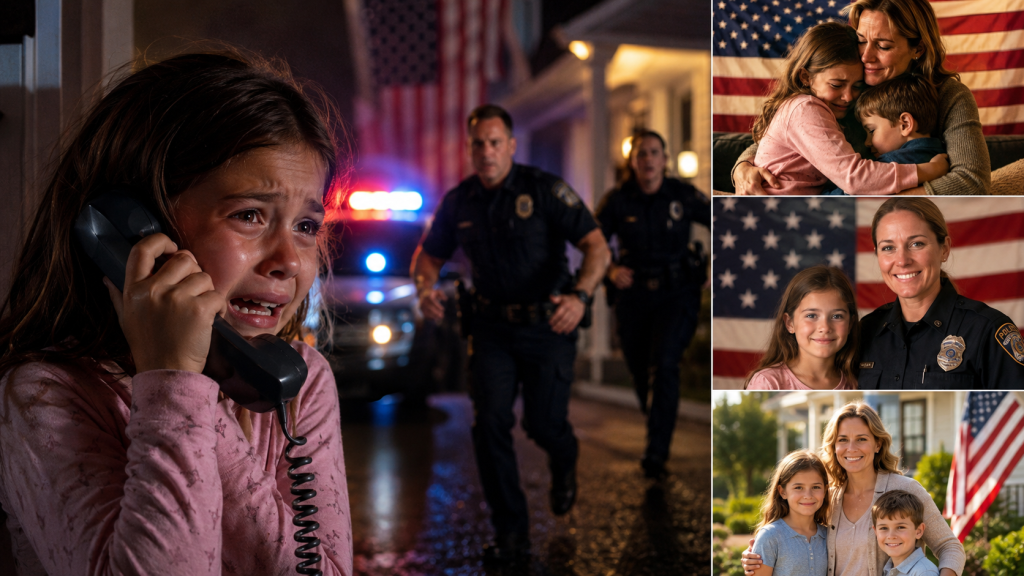
Jessica held out her hand.
“Come with me. Both of you.”
Chloe took her hand, while Eli clung to his sister’s pajama sleeve.
As they stepped into the hallway, paramedics wheeled Sarah toward the stairs.
Her head was secured, and an oxygen mask covered her face.
Chloe froze.
“Mommy!”
Sarah lifted one shaking hand.
The paramedic stopped the stretcher for a moment.
Chloe ran forward but hesitated before touching her.
Sarah reached for her daughter’s fingers.
“You did good,” she whispered beneath the mask.
Chloe burst into tears.
“I’m sorry.”
“No,” Sarah said. “Never be sorry.”
Eli appeared beside his sister.
“Are you going to die?”
Sarah’s eyes filled.
“Not tonight.”
The children were taken to a neighbor’s home while officers secured the house and detectives began documenting the crime scene.
Across the street, porch lights flickered on one by one.
Curtains moved.
Neighbors stood in doorways, shocked by the sight of police cars, an ambulance, and two handcuffed men being placed in separate vehicles.
Some of those neighbors had heard shouting before.
Some had noticed Sarah wearing long sleeves during warm weather.
One woman had seen a bruise along Sarah’s jaw two months earlier and accepted her explanation that she had walked into a cabinet door.
Another remembered Chloe waiting alone at the school bus stop in the rain because no adult had come outside.
They had all noticed pieces.
None had allowed themselves to see the whole picture.
At the hospital, Sarah was taken immediately into emergency care.
She had a concussion, two fractured ribs, severe bruising, and injuries around her wrists. Doctors found no life-threatening internal bleeding, but they kept her under observation because she had lost consciousness and was struggling to breathe.
Chloe and Eli sat in a family waiting room with Officer Jessica, wrapped in donated blankets.
A social worker named Denise arrived shortly after midnight.
She brought juice, crackers, clean socks, and two small stuffed animals.
Eli accepted a stuffed bear but refused to let go of his dinosaur.
Chloe did not touch the food.
She stared at the clock.
Every minute seemed to frighten her.
“Is Mom awake?” she asked repeatedly.
“Not yet,” Denise replied each time. “But the doctors are with her.”
At 2:15 in the morning, a physician entered the room.
His expression was serious but calm.
“Your mother is stable,” he said. “She has some injuries that will take time to heal, but she is going to survive.”
Chloe covered her face and sobbed.
Eli climbed into her lap, though he was almost too big.
Jessica looked away for a moment, pretending to study the vending machine so the children would not see her tears.
The next few hours passed slowly.
Detectives interviewed Chloe only after a child specialist arrived. They asked simple questions and avoided making her repeat details unnecessarily.
Chloe explained that her father had started drinking heavily after losing his job.
At first, he slept late and shouted at the television.
Then he blamed Sarah for everything: the bills, the children’s noise, the broken washing machine, the weather.
When he was sober, he sometimes apologized.
He bought flowers.
He promised to attend meetings.
He cried and said he was ashamed.
But the promises never lasted.
Vince made everything worse.
He encouraged David to drink, mocked Sarah, and called the children weak.
Sometimes he stayed for days.
Sarah had tried to leave twice.
The first time, David emptied their bank account and threatened to report the car stolen.
The second time, he found Sarah and the children at a motel and begged her to come home.
He promised he had changed.
Three weeks later, the violence returned.
“Why didn’t your mother call the police?” the interviewer asked gently.
Chloe looked down.
“Dad said they would take us away forever. He said Mom would go to jail because she let it happen.”
The child specialist nodded.
“That wasn’t true.”
“I know now,” Chloe whispered.
By sunrise, David and Vince had been booked into the county jail.
David faced multiple charges, including domestic assault, unlawful restraint, child endangerment, and illegal possession of a firearm.
Vince faced assault and related charges.
Both men denied responsibility.
David claimed the situation had been a misunderstanding caused by alcohol.
Vince insisted he had only been trying to calm things down.
The physical evidence told a different story.
So did Chloe’s 911 call.
So did Sarah’s injuries.
So did the revolver beneath the bed.
Three days later, Sarah woke fully.
The first thing she asked was whether her children were safe.
The second thing she asked was whether David was still in custody.
When the nurse said yes, Sarah closed her eyes and whispered, “Thank God.”
Chloe and Eli were allowed into the room that afternoon.
Sarah looked smaller in the hospital bed.
One side of her face was bruised, and her arm was supported by a sling.
But when her children entered, she smiled.
Eli ran to her immediately.
Chloe stayed near the door.
Sarah noticed.
“Come here, sweetheart.”
Chloe shook her head.
“I should have called sooner.”
Sarah’s smile disappeared.
“Chloe, look at me.”
The girl slowly raised her eyes.
“This was never your fault.”
“But I knew Dad was hurting you.”
“You are a child.”
“I could have saved you before.”
Sarah began crying.
“You saved me that night. But you should never have needed to save me. I was supposed to protect you.”
Chloe stepped forward.
“You did protect us.”
“Not enough.”
“You put us upstairs. You gave me the phone. You taught me our address. You told me what to say.”
Sarah remembered the afternoon months earlier when she had quietly shown Chloe how to make an emergency call.
At the time, she had called it a safety lesson.
Deep inside, she had known it was preparation.
“I’m sorry,” Sarah whispered.
Chloe climbed carefully onto the edge of the bed.
“No more sorry,” she said. “That’s what you told me.”
Sarah pulled both children close.
They remained that way until the nurse gently reminded them that Sarah needed rest.
Because the house was still a crime scene and Sarah had nowhere safe to go, Denise arranged temporary housing through a domestic violence support organization.
The shelter was located in a converted apartment building with locked entrances, private family rooms, a shared kitchen, and staff available day and night.
Sarah resisted at first.
She felt embarrassed.
She imagined strangers judging her.
She worried the children would hate the unfamiliar room.
But Chloe looked around at the clean beds and secure windows and said, “It’s quiet here.”
That single sentence ended Sarah’s hesitation.
Quiet had once meant danger in their house.
At the shelter, quiet meant safety.
The first night, Chloe placed a chair beneath the doorknob.
Sarah noticed but said nothing.
The second night, Eli woke screaming because he dreamed someone was coming up the stairs.
The third night, Sarah heard Chloe whispering into a toy phone, repeating her address and begging someone to hurry.
Healing did not begin with relief.
It began with fear finally having enough room to reveal itself.
The shelter arranged counseling for all three of them.
Sarah’s counselor, Maribel, helped her understand the cycle she had been trapped inside.
The abuse had not started with bruises.
It had started with control.
David criticized her friends.
He monitored her spending.
He complained when she visited her sister.
He made jokes about her intelligence.
When she objected, he accused her of being oversensitive.
Then came the shouting.
Then the threats.
Then the violence.
Afterward, he apologized so completely that Sarah sometimes believed the man she had married had returned.
Maribel explained that remorse without change was not safety.
Sarah listened, sometimes crying, sometimes arguing, sometimes sitting in silence.
She had loved David once.
That truth did not excuse what he had done, but it complicated her grief.
She mourned the husband he used to be.
She mourned the family photographs.
She mourned the version of the future she had promised her children.
Then, slowly, she began mourning the years she had spent waiting for a man who no longer existed.
Chloe’s therapist used drawings rather than direct questions.
In her first picture, Chloe drew a small house surrounded by black rain.
A tiny girl stood upstairs, holding a phone.
In the second picture, she drew two police cars.
In the third, she drew her mother standing beside a red front door, holding the children’s hands.
“What is behind the door?” the therapist asked.
Chloe thought for a long time.
“A new place,” she said.
“Is your father there?”
“No.”
“Is anyone angry?”
“No.”
“Are you afraid?”
Chloe studied the picture.
“Not all the time.”
That answer was considered progress.
The legal process moved slowly.
David remained in custody because the judge considered him a danger to Sarah and the children.
At the preliminary hearing, Sarah saw him for the first time since the attack.
He wore a jail uniform and looked exhausted.
When their eyes met, he began crying.
Sarah felt her body react before her mind did.
Her hands went cold.
Her breathing shortened.
For one terrible second, she wanted to comfort him.
Then she remembered Chloe hiding in the closet.
She remembered Eli asking if she was going to die.
She remembered the cord around her wrists.
She looked away.
David’s attorney suggested that alcohol had changed his behavior.
The prosecutor answered that intoxication did not erase choice.
Evidence showed that David had blocked the bedroom window, hidden a weapon, and threatened Sarah when she tried to leave.
Those were not accidents.
They were decisions.
Vince eventually accepted a plea agreement and agreed to testify against David.
His testimony revealed something Sarah had not known.
On the night of the attack, David had told Vince that he planned to frighten Sarah so badly she would never attempt to leave again.
Vince claimed he had not believed David would go as far as he did.
The prosecutor asked why he had helped restrain her.
Vince lowered his head.
“I was drunk.”
The courtroom was silent.
Being drunk had become the answer both men used for everything.
The jury did not accept it.
Before the trial concluded, Sarah gave a statement.
She stood behind the podium with trembling hands.
David watched from the defense table.
“For years,” she began, “I believed surviving each night meant I was protecting my children. I thought staying quiet kept things from becoming worse. I thought if I worked harder, spoke softer, and avoided every mistake, I could restore the man my husband used to be.”
She paused.
“But my silence did not protect my children. It taught them to live around fear. My daughter learned to identify footsteps. My son learned to cry without making noise. My children should have been learning multiplication and bedtime stories. Instead, they were learning survival.”
David lowered his eyes.
Sarah continued.
“I do not say this because I hate him. I say it because truth matters more than the story we tell ourselves about people we once loved. He chose violence. He chose control. He chose to make his family afraid of him. Alcohol did not make those choices. It only made it easier for him to stop hiding them.”
She looked directly at David.
“My daughter called for help because the adults around her had failed. I will spend the rest of my life making sure she never has to be that brave again.”
David was convicted.
The judge imposed a lengthy prison sentence, along with a permanent protective order forbidding him from contacting Sarah or the children.
When the sentence was announced, Sarah felt no victory.
Only exhaustion.
Justice could prevent David from reaching them.
It could not return the years they had lost.
Recovery would require something different.
Months passed.
Sarah found a small apartment near Chloe’s school.
It had two bedrooms, pale yellow walls, and a balcony overlooking a community garden.
The locks were strong.
The neighbors were kind.
The first evening, Sarah let the children choose where to place the furniture.
Eli positioned his bed beneath the window.
Chloe chose the room closest to her mother’s.
They ate pizza on the floor because they did not yet own a table.
For dessert, they shared a grocery-store cake with the words “NEW HOME” written in blue icing.
Eli got frosting on his nose.
Chloe laughed.
Sarah realized she had not heard that laugh in a very long time.
The next morning, Chloe opened every curtain.
Sunlight filled the apartment.
Sarah stood in the kitchen and cried quietly.
Not from sadness.
From the shock of feeling safe.
She found work at a medical billing office and began rebuilding her finances.
The shelter helped her open a separate bank account, replace important documents, and apply for assistance.
She attended support groups with other survivors.
At first, she hated the word survivor.
It sounded like a label attached to the worst thing that had happened to her.
Later, she understood that surviving was not the end of her identity.
It was the beginning of reclaiming it.
Chloe returned to school.
Her teacher noticed she startled less often when someone dropped a book.
She began joining her classmates at lunch instead of sitting near the exit.
She wrote a short essay titled “The Bravest Phone Call.”
Her teacher asked whether she wanted to share it with the class.
Chloe said no.
The story was still hers.
She did, however, agree to visit the emergency dispatch center with her mother.
The dispatcher who had answered her call was named Linda Morrison.
When Chloe entered the room, Linda immediately recognized her voice.
Neither of them spoke at first.
Then Linda knelt and opened her arms.
Chloe hugged her.
“You stayed with me,” Chloe said.
“I promised I would.”
“I thought they would hear me.”
“You were very quiet.”
“I was scared.”
Linda pulled back and looked into her eyes.
“Being brave does not mean you weren’t scared. It means you did what you needed to do while you were scared.”
Chloe nodded.
“Did you hear everything?”
“I heard enough.”
“Did I sound like a baby?”
“No,” Linda said. “You sounded like someone trying to protect the people she loved.”
Sarah stood nearby, crying.
Linda showed Chloe the room where emergency calls were received.
Rows of screens glowed beneath soft fluorescent lights.
Voices murmured through headsets.
Every person in that room was waiting for someone’s worst moment.
Linda let Chloe sit at an unused station.
“This is where your call came in,” she said.
Chloe touched the edge of the desk.
“Do children call often?”
“Sometimes.”
“Do they know what to say?”
“Not always.”
Chloe thought for a moment.
“Could schools teach them?”
Linda smiled.
“That is a very good idea.”
The visit inspired something unexpected.
With Sarah’s permission, Chloe helped create a simple safety presentation for children at her school.
A counselor delivered most of it, but Chloe recorded one sentence that was played at the end:
“If something feels dangerous, you are allowed to ask for help. You are not betraying your family by trying to keep them alive.”
The school later shared the program with other districts.
No one used Chloe’s full name.
She did not want attention.
She only wanted other children to know what she had not known soon enough.
A year after the night of the call, Officer Jessica visited the family.
She brought a small gift: the cleaned and restored family portrait that had been lying shattered in the hallway.
Sarah stared at it.
David’s hand rested on her shoulder.
Everyone was smiling.
“I thought you might want this,” Jessica said. “Or you might want to throw it away. Either choice is yours.”
Sarah held the frame for a long time.
Then she removed the photograph.
She took scissors from a kitchen drawer and carefully cut David from the picture.
She placed the remaining image—herself, Chloe, and Eli—into a new frame.
“This is our family,” she said.
Jessica smiled.
Chloe looked at the picture.
“We looked happy.”
Sarah nodded.
“Sometimes people smile in pictures because they want the picture to become true.”
“Are we happy now?”
Sarah considered the question.
“We are becoming happy.”
Eli, now seven, looked up from the floor.
“I’m happy when we have pancakes.”
Everyone laughed.
On the anniversary of the attack, rain fell over Portland again.
Not as violently as before, but steadily enough to make Chloe stand at the window.
Sarah approached quietly.
“Are you okay?”
Chloe nodded.
“I remember the sound.”
“So do I.”
“Do you ever think Dad will become good again?”
Sarah sat beside her.
“I think people can change, but change requires truth, responsibility, and years of work. We cannot build our lives around waiting for someone else to become safe.”
“Do you still love him?”
Sarah took a long breath.
“I love who I believed he was. I also know what he became. Both things can be true.”
Chloe leaned against her.
“Am I bad for missing him sometimes?”
“No.”
“Even after what he did?”
“Missing someone does not mean you want them back in your life.”
Outside, the rain tapped softly against the glass.
Chloe no longer heard footsteps in every storm.
She no longer slept with the phone beneath her pillow.
She still checked the front door twice before bed, but her therapist said healing was not about becoming fearless.
It was about fear no longer controlling every decision.
Two years later, Sarah spoke at a community event for domestic violence awareness.
She stood before police officers, social workers, teachers, nurses, and families.
Chloe sat in the front row beside Eli.
Sarah told them that abuse often hides behind ordinary curtains.
It lives in respectable houses.
It belongs to people who wave at neighbors, volunteer at school, and apologize convincingly afterward.
She asked everyone to notice more.
To ask questions.
To believe frightened children.
To understand that leaving is often dangerous, complicated, and financially terrifying.
Then she told them about the call.
“My daughter was nine years old,” she said. “She whispered because she believed her voice could get us killed. But her voice saved our lives.”
The audience stood in applause.
Chloe’s cheeks turned pink.
Afterward, a woman approached Sarah with two young children.
She spoke so quietly that Sarah had to lean closer.
“Your story helped me realize I need to leave,” the woman said.
Sarah did not tell her what to do.
She did not say leaving would be easy.
She simply took her hand and introduced her to Maribel, who was standing nearby.
Later, Chloe asked, “Do you think she’ll be okay?”
“I think she took the first step.”
“Like calling 911?”
“Yes.”
They walked to the parking lot beneath a clear evening sky.
No rain.
No shouting.
No broken glass.
Just Sarah holding one child’s hand while Chloe walked close beside her.
Before getting into the car, Chloe looked back at the building where people were still talking, exchanging phone numbers, and offering help.
“Mom?”
“Yes?”
“That night, when the police came into the house, did you know I called?”
“Not until Officer Jessica told me.”
“Were you angry?”
Sarah looked horrified.
“Never.”
“I thought maybe you would be. Dad always said family problems had to stay inside the house.”
Sarah knelt so they were eye to eye.
“That is how dangerous people protect themselves. They convince everyone else that silence is loyalty.”
Chloe absorbed the words.
“Then what is loyalty?”
“Protecting people, even when the truth is painful.”
Chloe smiled faintly.
“Then I was loyal to you.”
“You were.”
“And you’re loyal to us now?”
“Every day for the rest of my life.”
Eli leaned out of the car window.
“Can we get pancakes?”
Sarah laughed.
“It’s dinnertime.”
“Pancakes can be dinner.”
Chloe opened the passenger door.
“He has a point.”
They drove to a small diner near their apartment.
Sarah ordered coffee.
Chloe ordered chocolate-chip pancakes.
Eli ordered the same and poured too much syrup over everything.
As they ate, Sarah looked around the booth.
There were still difficult days.
There were nightmares.
There were legal bills.
There were questions she could not answer.
There were memories that arrived without warning.
But there was also laughter.
There was safety.
There was a front door nobody was afraid to open.
There were mornings without apologies and nights without footsteps.
At 11:47 p.m. two years earlier, Chloe Miller had whispered into a phone because whispering was the only power she believed she had.
She had been a terrified child hiding in a closet, holding the fate of her family in trembling hands.
But the dispatcher listened.
The officers came.
The truth entered the house.
And once the truth was inside, the silence that had protected David for so long finally shattered.
Not everything broken that night could be repaired.
But Sarah, Chloe, and Eli learned that a broken life could still be rebuilt.
Not exactly as it was.
Not without scars.
But stronger, safer, and finally free.
💬THE END! THANK YOU FOR READING!