
It was not the moment my son removed me from the family group chat that hurt the most. It was the phrase that came after. Spoken with that cold calmness children only use when they stop seeing you as a mother and start seeing you as a burden.
“Mom, it was for working adults. You don’t understand anything we talk about.” I am seventy-six years old. I have been a widow for eleven years. And that sentence stayed stuck inside me like a thorn under my ribs, because they were not just leaving me out of a conversation.
They were erasing me. Little by little. From my own family. My name is Barbara Whitaker. For forty-eight years, I was married to Joseph Whitaker, though everyone called him Joe. Joe and I were not rich people.
We built our farm with blistered hands, unpaid weekends, farmer’s markets, and savings kept in glass jars behind flour bags. Every tree on that land had a story. Every roof tile had a year attached to it. Every fence post had been repaired by Joe at least twice, because he believed nothing was truly broken if a person still had patience.
The farmhouse was not fancy.
It had creaking floors, a wide porch, a red barn, lemon trees behind the kitchen, and a long gravel driveway that turned muddy every spring.
But to me, it was beautiful.
It was the place where my children learned to walk.
Where we measured their heights on the pantry door.
Where Joe taught them how to plant tomatoes.
Where I baked pies before sunrise for the Saturday market.
Where every Christmas, every birthday, every reunion, every family photograph seemed to say the same thing:
We belong here.
At least, that was what I believed.
Over time, my children stopped seeing the farm as a home.
It became a convenience.
A place to arrive with friends, kids, coolers, meat to grill, speakers, extra towels, and expectations.
A free weekend resort with an old woman in the background who cooked, cleaned, smiled, and asked no questions.
Charlie, my eldest, was the one who removed me from the family group chat.
I only found out because my phone had gone silent for nearly two weeks.
No photos of the grandchildren.
No updates about school plays.
No messages about birthdays or plans.
At first, I thought my phone was broken.
I took it to the little repair shop in town, and the young man behind the counter checked it kindly.
“No, Mrs. Whitaker,” he said. “Your phone is fine. Maybe they started a new chat.”
I smiled like that did not hurt.
Then I called Charlie.
He sounded distracted, like I had interrupted something more important.
“Charlie, did something happen to the family group?”
There was a pause.
Then he sighed.
“Oh. That.”
“Yes. I’m not seeing any messages.”
“Mom, we made another group.”
“Without me?”
“It was just easier.”
“Easier for what?”
Another sigh.
Then the sentence came.
“Mom, it was for working adults. You don’t understand anything we talk about.”
Working adults.
As if I had not worked every day since I was fifteen.
As if raising children, running a farm, keeping accounts, dealing with buyers, repairing leaks, planting orchards, caring for a dying husband, and surviving widowhood did not count.
I sat at my kitchen table with the phone pressed to my ear and looked out at the lemon trees Joe planted the year Charlie was born.
“I see,” I said.
Charlie’s voice softened slightly, but not with guilt.
With impatience.
“Don’t take it personally.”
That was another phrase people use when they have done something personal and want you to carry the shame quietly.
I ended the call.
For the rest of the afternoon, I moved through the house slowly.
I washed one cup.
Folded one towel.
Put one spoon back in the drawer.
Then I sat down again.
The worst part was not being removed.
It was realizing that nobody else had objected.
Not Lauren, my daughter-in-law.
Not David, my younger son.
Not my daughter, Melissa.
Not any of the grandchildren old enough to wonder where Grandma had gone.
They had all stepped around my absence as if it were furniture.
A week later, Lauren sent me a private message.
Not a phone call.
Not an apology.
Not even a question.
Barbara, leave the keys in the usual spot. We’re coming Friday with the kids.
No please.
No thank you.
No how are you.
That was how I found out they had planned an entire weekend at my farm without telling me.
Twelve people.
Twelve.
Charlie and Lauren.
Their three kids.
David and his girlfriend.
Melissa and her husband.
Two teenage grandchildren.
And one of Charlie’s business friends with his wife.
As if the owner of the house did not exist.
As if I were just another piece of furniture.
For years, I had left the key under the big clay flowerpot near the porch steps.
Everyone knew that.
Too many people knew that.
They would arrive while I was at church or the doctor or buying feed.
They would open the door, fill the refrigerator, rearrange the rooms, turn up the music, and say, “Surprise, Mom!” as if surprise were the same as permission.
I used to tell myself it meant they still wanted to be near me.
I used to bake extra bread.
Make preserves.
Put away clean sheets.
Stock the pantry with the snacks the grandchildren liked.
That was my mistake.
I confused being used with being needed.
After Lauren’s message, I did not respond.
Instead, I packed a small overnight bag, called John, the caretaker, and drove to the farm a day early.
John had worked for us for fourteen years.
He was quiet, kind, and practical.
He lived in the little cottage beyond the barn and knew more about the farm than any of my children had bothered to learn.
When he saw my face, he did not ask unnecessary questions.
He simply took my bag from the car and said, “Tea?”
“Yes,” I said. “Strong.”
Inside the farmhouse, the afternoon sun lay across the wooden floor in long golden strips.
Dust floated near the windows.
The kitchen smelled faintly of lemon oil and old memories.
On the table sat the brown leather notebook.
Joe had sewn the cover himself years ago after I complained that store-bought books fell apart too quickly.
On those pages, we had written everything.
How much the well cost.
When we replaced the roof.
How many lemon trees we planted.
What each market day earned.
Which buyers paid late.
How much was left after seed, fuel, feed, repairs, and taxes.
But the notebook was more than records.
It was our history.
Our labor.
Our proof.
It was almost a will without saying it was one.
I opened it and ran my fingers over Joe’s handwriting.
March 14. Barbara says the north field can handle lavender. I think she’s right. She usually is.
I laughed once.
Then cried before I could stop myself.
John placed tea beside me and quietly left the room.
Charlie arrived first the next afternoon.
He walked in without knocking.
That was the first thing I noticed.
He did not use the key under the pot because I was home.
He simply opened the door and stepped inside like the farm already belonged to him.
He wore sunglasses pushed onto his head, a polo shirt, and the expression of a man annoyed to find reality standing in his way.
“Mom,” he said. “You’re here.”
Not hello.
Not how are you.
You’re here.
As if I had ruined his plans by existing in my own house.
“Yes,” I said. “I live here.”
He ignored that and looked around.
“Where’s everyone else?”
“Not here yet.”
“Good. We need to get the grill started before dark.”
I remained seated at the kitchen table.
“Charlie, why was I removed from the family group chat?”
He rubbed his forehead.
“Mom, not this again.”
“Yes. This again.”
“It wasn’t a big deal.”
“It was to me.”
He gave me that patient look.
The one that humiliates more than shouting.
“We didn’t want to bother you with adult things.”
I stared at him.
“Adult things like planning to use my farm without asking me?”
He frowned.
“Mom, it’s family property.”
“No. It is my property.”
He let out a short laugh.
“You know what I mean.”
“I’m beginning to.”
His eyes fell to the brown notebook on the table.
“What’s that?”
“Your father’s notebook.”
He picked it up casually and flipped through the pages.
For one foolish second, I thought he might soften.
I thought he might see Joe’s handwriting and remember the man who taught him to ride a tractor.
Instead, he smirked.
“These things just gather dust, Mom.”
Then he tossed it into the trash beside the kitchen island.
“You’d better tidy up a bit before the others arrive.”
I looked at the trash can.
The corner of the notebook stuck out beneath a paper towel.
Something inside me went quiet.
Very quiet.
I did not cry in front of Charlie.
I did not shout.
I did not tell him that his father had carried that notebook through rainstorms and market days.
I simply stood, walked to the sink, and rinsed my teacup.
Charlie took that for surrender.
People like him usually do.
From my bedroom window later that afternoon, I watched the others arrive.
Suitcases.
Coolers.
Bags.
Laughter.
One of the grandchildren carried a speaker.
Lauren had a grocery tote in one hand and her phone in the other.
David’s girlfriend wore white sneakers too clean for a farm.
Melissa looked around like she was inspecting a rental property.
Nobody came upstairs to greet me.
Nobody knocked on my door.
Outside, they were on vacation.
Inside, I sat in a house full of memories turned into a place where my presence no longer fit.
That night, after everyone went to sleep, I went downstairs.
The kitchen was a mess.
Crumbs on the counter.
Wine glasses in the sink.
Mud near the back door.
The trash can smelled of barbecue wrappers and disrespect.
I reached inside and pulled out Joe’s notebook.
The leather cover was smudged.
I wiped it clean with a damp cloth.
Then I opened it.
And remembered something my children had never taken the trouble to ask.
The truly important things were never left out on the table.
Under the floorboards of my bedroom, where Joe and I had hidden what we could not afford to lose, the only thing capable of changing everything was still safe.
I went upstairs and moved the braided rug beside my bed.
The board beneath it lifted with a little pressure from the old butter knife I kept in my sewing basket.
Inside was a metal box.
Joe had made the hiding place after a neighbor’s house was robbed twenty years earlier.
In the box were the real deed, updated trust documents, bank papers, a letter from Joe, and the amendment I had signed three months earlier after a conversation with my lawyer, Mr. Callahan.
Charlie did not know about it.
None of them did.
They still believed the farm would pass to the children equally after I died.
That had been the old plan.
Before the jokes about me being forgetful.
Before Lauren told guests, “Barbara gets confused with schedules.”
Before David suggested I move into assisted living so the farm could “be put to better use.”
Before Melissa asked whether it made sense for “one old woman” to occupy so much land.
Before the group chat.
Before the notebook hit the trash.
Three months earlier, I changed everything.
I had placed the farm into a protected trust.
Not for my children.
For agricultural students, widows needing housing, and caretakers who understood land was not an inheritance prize.
John was named lifetime caretaker.
The farmhouse would remain mine as long as I lived.
After that, it would become the Whitaker Agricultural Fellowship House.
My children would receive personal keepsakes, a small cash amount, and nothing else from the farm itself.
At first, signing those papers felt cruel.
That night, holding Joe’s notebook, it felt merciful.
I did not sleep crying.
I slept thinking.
The next morning, when all twelve of them appeared in the kitchen expecting breakfast, coffee, clean towels, and my usual quiet obedience, they found the table empty except for Joe’s brown notebook and one folded paper.
Charlie laughed first.
“What’s this, Mom? Another diary?”
I looked at him calmly.
“No. It’s an invoice.”
Lauren frowned.
David picked up the paper.
He read aloud, “Weekend lodging for twelve guests. Cleaning fees. Utilities. Food storage. Property use. Barbecue area. Pool maintenance. Linen service.”
His voice faded.
“Mom, this is ridiculous.”
“No,” I said. “Ridiculous was removing me from my own family conversation, then treating my farm like a free resort.”
Melissa crossed her arms.
“We’re your children.”
“Yes,” I said. “That used to mean you asked before entering my home.”
Charlie’s face hardened.
“We’re family.”
I opened the notebook to the page where Joe had written in his careful handwriting:
This farm belongs to Barbara first. If the children forget respect, remind them that inheritance is not a right.
The room went silent.
Even the teenagers looked up from their phones.
Charlie’s jaw tightened.
“Dad wrote that?”
“Yes.”
“He was probably joking.”
I looked at him.
“Your father rarely joked in ink.”
Lauren sighed sharply.
“Barbara, this is all very dramatic. Nobody meant to hurt your feelings.”
“My feelings are not the issue.”
“Then what is?”
I placed the real deed on the table.
Then the trust documents.
Then the amendment.
“This is.”
Charlie picked up the pages.
At first, he scanned them with irritation.
Then confusion.
Then panic.
“What is this?”
“The farm is no longer passing to you.”
David grabbed the documents from him.
“What do you mean no longer?”
“I mean I changed the estate plan.”
Melissa stepped forward.
“You can’t do that.”
“I can. I did.”
Charlie’s face reddened.
“You changed Dad’s farm?”
“No,” I said. “I protected my farm.”
He slammed his palm on the table.
“You’re doing this because of a group chat?”
“No, Charlie. I’m doing this because the group chat finally made me stop pretending I didn’t know what had happened to my family.”
Lauren laughed nervously.
“Come on. This is emotional manipulation.”
I turned to her.
“You sent me a message telling me to leave keys for twelve people without asking whether I was home, well, lonely, tired, or even willing.”
“We assumed—”
“Yes. That is the whole problem.”
John appeared in the doorway then.
He did not enter.
He simply stood there, steady and quiet.
Charlie saw him and scoffed.
“What is he doing here?”
“John lives here,” I said. “And unlike you, he knocks.”
David tossed the documents back onto the table.
“So what? You’re giving our inheritance to strangers?”
“To people who will care for the land.”
“We’re your blood.”
“Blood does not weed fields. Blood does not fix roofs. Blood does not give permission to disrespect the woman who kept this place alive.”
Melissa’s eyes filled with tears.
For a moment, I almost softened.
Then she said, “What are we supposed to tell people?”
And I knew her tears were not for me.
They were for the embarrassment.
“You can tell them the truth,” I said. “You came to my home without invitation, and I closed the gate.”
The grandchildren shifted awkwardly.
One of them, Emma, Charlie’s oldest, looked at me with something like shame.
“Grandma,” she said softly. “I didn’t know you weren’t in the chat.”
Charlie turned on her.
“Emma, stay out of this.”
“No,” I said. “Let her speak.”
Emma looked down.
“Dad said you didn’t like texting.”
The room changed.
Just slightly.
But enough.
I looked at Charlie.
“You told them that?”
He avoided my eyes.
“It was easier than explaining.”
“Explaining that you removed me?”
He said nothing.
Lauren picked up her purse.
“This is insane. We should leave.”
“Yes,” I said. “You should.”
Charlie looked stunned.
“You’re kicking us out?”
“I am ending an uninvited visit.”
“We drove three hours.”
“You had one week to call and ask.”
David muttered, “This is unbelievable.”
“No,” I said. “What’s unbelievable is that I had to write an invoice for my children to remember I am a person.”
The silence that followed was not grief.
It was calculation.
They were thinking about the farm.
The trust.
The lost holidays.
The lost free weekends.
The lost inheritance.
Not one of them apologized first.
That told me everything.
By afternoon, suitcases were repacked.
Coolers were carried back to cars.
The speaker went silent.
Lauren cried in the driveway, but only when she realized the trip was really over.
David cursed under his breath.
Melissa called someone and said, “Mom’s having some kind of episode.”
I heard her.
I opened the porch door.
“Melissa.”
She froze.
“If you say that again, Mr. Callahan will send you a copy of the medical evaluation I completed last month proving I am fully competent. I planned ahead because I know my children.”
Her face went pale.
Good.
Charlie was the last to leave.
He stood at the bottom of the porch steps, looking smaller than he had in years.
“Mom,” he said, “you’re going to regret this.”
I looked at the boy I had once rocked through fever, the man who now thought threatening regret was the same as love.
“No,” I said. “I regret not doing it sooner.”
He drove away without saying goodbye.
That evening, I closed the front gate.
Not just with the latch.
With a chain.
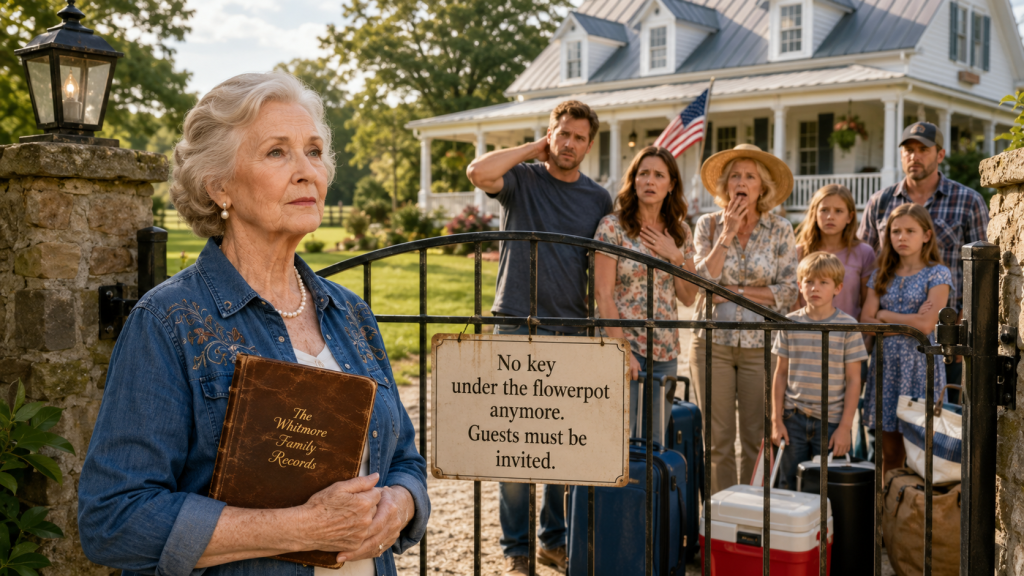
John helped me hang the sign.
No key under the flowerpot anymore. Guests must be invited.
Beneath it, on a small wooden stand, I placed a photocopy of one page from Joe’s notebook.
The page Charlie had thrown away.
Under Joe’s words, I added one final line of my own.
You called me too old to understand adult things. So I handled this like an adult.
For three days, my phone did not stop ringing.
Charlie called fourteen times.
Lauren sent messages saying I was hurting the grandchildren.
David accused me of being influenced by John.
Melissa suggested I might be lonely and confused.
That one made me laugh.
Not because it was funny.
Because loneliness had become less painful than their company.
Mr. Callahan handled the formal responses.
He sent copies of the trust documents, the competence evaluation, and a letter making it clear that any attempt to enter the property without permission would be treated as trespassing.
That word shocked them.
Trespassing.
People who had treated my home like a hotel were suddenly offended to learn it had boundaries.
The first apology came from Emma.
Not Charlie.
Not Lauren.
Emma.
She called me herself two weeks later.
“Grandma,” she said, crying. “I’m sorry. I should have noticed.”
“Oh, sweetheart,” I said. “You’re seventeen. This was not yours to carry.”
“Dad said you were being mean.”
“I know.”
“But I read the sign.”
I smiled sadly.
“And?”
“I think he was wrong.”
She came to visit the following month.
Alone.
She knocked.
I cried when I heard that knock.
Not because it was dramatic.
Because it was respect.
We made lemon cake.
I showed her the notebook.
Not the deed.
Not the legal papers.
The real notebook.
Joe’s pages.
The market records.
The tree planting dates.
The notes about rain.
The little sentences he wrote about me when he thought I would never notice.
Emma read them with care.
“He loved you a lot,” she said.
“Yes,” I replied. “He did.”
She touched the page gently.
“I don’t think Dad understands this place.”
“No,” I said. “He remembers growing up here. That is not the same as understanding what it cost.”
Over the next year, the farm changed.
Not in appearance.
In spirit.
The gate stayed closed unless I opened it.
The key under the flowerpot disappeared for good.
John repaired the west fence and painted the barn.
I started inviting local students from the agricultural college to spend Saturdays learning about small orchards and soil health.
Widows from my church came for tea on the porch.
One woman, Martha, stayed for three weeks after her son sold her house without asking.
That was when I knew the trust had been right.
The farm was never meant to become a trophy for people who did not value it.
It was meant to shelter those who needed a place to stand.
Charlie did not speak to me for eight months.
Then he came one Sunday morning.
Alone.
He stopped at the gate and called.
“I’m outside,” he said.
“I know.”
“Can I come in?”
It was the first time in years he had asked.
I looked through the kitchen window at the road.
He stood by the gate, hands in his jacket pockets.
No cooler.
No suitcase.
No Lauren.
Just my son.
I pressed the button that opened the gate.
He walked up the drive slowly.
At the porch, he hesitated.
Then knocked.
I opened the door.
He looked older.
Tired.
“I’m sorry,” he said.
I waited.
He swallowed.
“For the group chat. For the farm. For the notebook. For treating you like you were just… there.”
Just there.
That was the closest he had come to honesty.
I stepped aside and let him in.
Not because everything was fixed.
Because a knock deserves an answer.
We sat at the kitchen table.
The same table where he had thrown his father’s notebook away.
He looked at it now with shame.
“I don’t know when I became like that,” he said.
“Entitlement grows quietly.”
He nodded.
“Lauren and I separated.”
I was not surprised.
“She said I let you humiliate us.”
“And what do you think?”
He looked out at the lemon trees.
“I think you stopped letting us humiliate you.”
That sentence mattered.
Not enough to undo years.
Enough to begin.
He asked about the trust.
I explained it again.
This time, he listened.
He did not argue.
When I finished, he said, “Dad would have liked the student housing.”
“Yes,” I said. “He would.”
His eyes filled.
“I miss him.”
“So do I.”
For the first time in many years, my son cried at my kitchen table without asking me to fix the consequences first.
That mattered too.
I did not change the trust back.
He did not ask me to.
That mattered most of all.
Now, two years have passed since the night I pulled Joe’s notebook from the trash.
The family group chat still exists, I suppose.
I am not in it.
But there is another chat now.
Emma started it.
She named it Grandma’s Farm Days.
Only people who ask before coming are allowed.
It is smaller.
Kinder.
Mostly photos of lemon harvests, recipes, weather, and occasional updates from the students staying in the old guest rooms.
Charlie messages sometimes.
Melissa rarely does.
David not at all.
That used to hurt.
Now it simply tells me where people have chosen to stand.
The notebook is no longer left on the kitchen table.
It sits in a glass case in the hallway near a framed photograph of Joe standing beside the first lemon tree.
Under it is a small plaque Emma helped me order.
Respect is also an inheritance.
Every time I pass it, I touch the frame.
Not because I am sentimental.
Because I remember.
I remember the woman who thought love meant leaving keys under flowerpots.
I remember the mother who believed being useful was the same as being valued.
I remember the widow who let laughter fill her house even when the laughter forgot to include her.
And I remember the night she finally stopped asking for permission.
My children thought I was too old to understand adult things.
They were wrong.
I understood money.
Documents.
Property.
Silence.
Entitlement.
And the difference between family and access.
Most of all, I understood Joe’s notebook.
They saw old pages.
Dust.
Numbers.
A useless relic.
I saw proof.
Proof that love worked.
Proof that land remembers.
Proof that the life Joe and I built was never meant to be handed to people who could not even knock.
The key is not under the flowerpot anymore.
It never will be again.
The gate opens when I choose.
The porch light shines for those who arrive with respect.
And the farm, at last, feels like mine again.
THE END! THANKS FOR READING!