
Six months after I buried my husband and my children, I learned that grief doesn’t stay still. It changes shape. It follows you into grocery stores, into meetings, into silence at night when your house is too quiet and your mind remembers sounds your life no longer has.
The first time I saw the article, I thought it was a mistake. A photograph of me standing outside the courthouse. My face pale, eyes hollow, hands folded tightly like I was trying to hold myself together.
The headline read:
“WIDOW SEEKS JUSTICE AFTER DRUNK DRIVER CLAIMS ENTIRE FAMILY.”
I didn’t remember being photographed that day.
I didn’t remember agreeing to anything.
But I remembered everything that came before it.
The trial had taken months to begin. Delays, paperwork, insurance investigations, legal arguments that reduced my husband and children into case files and timestamps. Every time I was forced to repeat what happened, it felt like tearing open a wound that refused to close.
And then suddenly, people noticed me.
Not because of the loss.
Because it became public.
That was when my parents called.
Again.
Again.
And again.
I didn’t answer at first. I didn’t want their version of grief. I already knew what it looked like when it was inconvenient.
But they didn’t stop.
So one afternoon, I picked up.
My mother’s voice came soft, careful, rehearsed.
“Sarah… sweetheart… we saw the news.”
Of course they had.
“I didn’t know it was this bad,” she continued.
I almost laughed.
“You didn’t know?” I said quietly. “Mom, I called you from the hospital.”
Silence.
Then she exhaled.
“We were overwhelmed,” she said. “Jessica was in tears that whole week. You know how sensitive she is.”
Even now.
Even then.
Jessica.
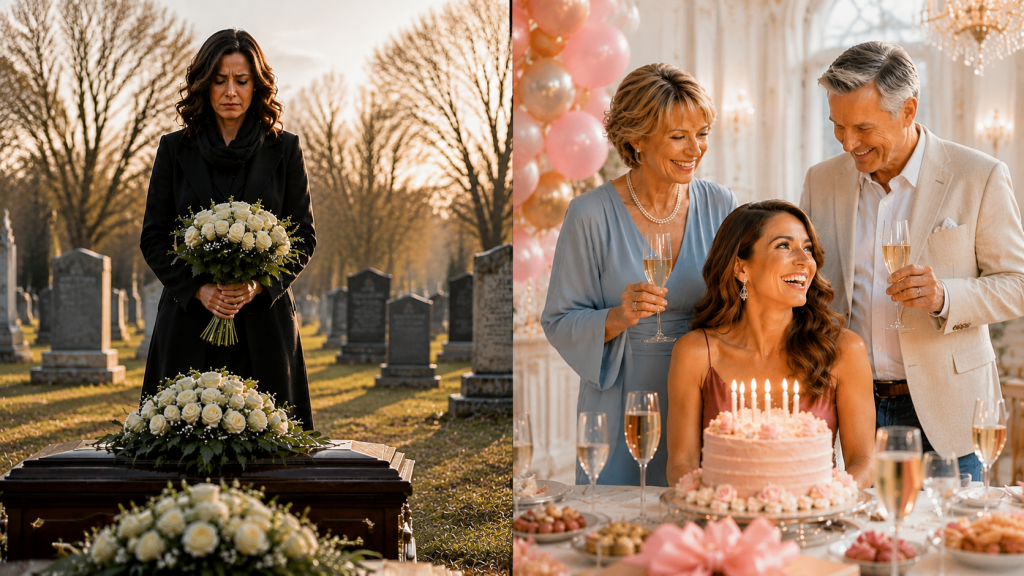
Always Jessica.
My father took the phone.
“Sarah,” he said, like he was addressing a business problem, “we want to help now.”
“Now?” I repeated.
“Yes. Whatever you need. Financial support. Lawyers. We can come over this weekend.”
I stared at the wall of my apartment.
The same wall where I used to hang family photos that I had since taken down.
“I buried them alone,” I said.
Another pause.
“We didn’t realize—”
“You did realize,” I interrupted. My voice didn’t rise. It didn’t need to. “I told you. I begged you. You chose not to come.”
His tone hardened slightly.
“That was a very important event for your sister.”
That sentence broke something clean inside me.
Not loudly.
Not dramatically.
Just finally.
“I don’t want anything from you,” I said.
And I hung up.
Two days later, Jessica showed up at my apartment.
She didn’t knock at first.
She texted:
Open the door. We need to talk.
I didn’t.
So she knocked harder.
When I finally opened it, she stood there in designer clothes that cost more than my monthly rent, holding a coffee like this was a casual visit.
Her eyes scanned me first.
Not with concern.
With judgment.
“You look worse than the photos,” she said.
I didn’t invite her in.
She stepped in anyway.
“I don’t understand why you’re still punishing everyone,” she continued. “It’s been months.”
I leaned against the doorframe.
“Punishing?” I repeated.
“Yes. Posting your story everywhere. Talking to journalists. Making it bigger than it needs to be.”
I stared at her for a long moment.
“I didn’t make anything bigger,” I said. “I just stopped hiding it.”
She sighed like I was exhausting.
“Mom and Dad feel terrible,” she added. “You should call them back.”
“I buried my husband and children alone,” I said again. “At their country club birthday party.”
Her jaw tightened.
“You’re obsessed with that.”
“No,” I replied. “I just finally remember it clearly.”
She looked away for a second, then back at me.
“You always did this,” she said. “Turn everything into something dramatic. That’s why people distance themselves from you.”
That sentence should have hurt.
It didn’t anymore.
Instead, it clarified everything.
“I didn’t ask for distance,” I said. “You all chose it.”
She placed her coffee on my counter like she still belonged here.
“You should consider what forgiveness looks like,” she said.
For a moment, I almost asked her what she thought loss looked like.
Instead, I said nothing.
And she left.
But not before saying one last thing.
“Don’t expect us to keep showing up if you stay like this.”
The door closed behind her.
And for the first time, I understood something important.
They were not going to change.
Not because they couldn’t.
Because they didn’t have to.
The trial began two weeks later.
The drunk driver sat across the courtroom with his head down most days, his lawyer speaking in polished sentences about regret and mistakes and alcohol dependency as if those words could undo anything.
They couldn’t.
I listened to testimony about speed, impact, survival time.
I listened to experts explain how quickly life ends when physics decides it should.
I listened to everything except what I actually wanted anyone to say.
“I’m sorry your family is gone.”
But no one says that in court.
Not really.
Outside the courtroom, reporters asked me questions I didn’t want to answer.
“How does it feel to face him?”
“Do you forgive him?”
“Are you seeking maximum damages?”
I stopped answering after the third week.
Instead, I focused on something else.
The settlement.
The accountability.
The structure of what remained when life was gone.
And somewhere in that process, I met someone who didn’t belong to my past.
Her name was Claire.
She was a court-appointed advocate for victims’ families.
She didn’t ask me to be strong.
She didn’t tell me I would heal.
She just showed up.
Every hearing.
Every delay.
Every moment I thought I might not make it through the next hour.
She sat beside me.
Quiet.
Steady.
Present.
One day, after a particularly long session, I asked her why she did this job.
She looked at me for a moment before answering.
“Because someone should stay,” she said simply.
No speeches.
No pity.
Just that.
And something inside me shifted again.
Not toward happiness.
Not yet.
But away from isolation.
Months passed.
The driver was sentenced.
Not enough, people said.
Never enough.
But sentences don’t rebuild houses.
They don’t refill chairs at dinner tables.
They don’t give back voices that used to call your name in the morning.
After the trial ended, I thought the silence would return.
Instead, something unexpected happened.
The newspaper article stayed online.
People began sharing it.
Messages started appearing.
Strangers telling me about their own losses.
About drunk drivers.
About families broken and never repaired.
About parents who didn’t show up.
At first, I ignored them.
Then one message stayed with me.
A woman wrote:
“I read your story. My parents also didn’t come when my daughter died. I thought I was alone.”
That night, I didn’t sleep.
Not because I was sadder.
But because I wasn’t.
For the first time, I understood something that had nothing to do with my family.
I was not the only one who had been abandoned in the middle of something unbearable.
And that realization didn’t fix anything.
But it made the world feel less empty.
Two months later, I was invited to speak at a support group.
I almost didn’t go.
I stood outside the building for twenty minutes, watching people walk in who looked like they were carrying invisible weights.
Finally, I entered.
I didn’t have a speech prepared.
I didn’t have closure.
I had only the truth.
So I told them about dinosaur pancakes.
About violin notes in a living room.
About a morning that still felt too bright to have ended in darkness.
About a hospital call that changed everything.
About a birthday party I wasn’t invited to grieve at.
When I finished, no one clapped.
They just nodded.
Some cried.
Some didn’t.
And that was enough.
Afterward, Claire found me outside.
“You did well,” she said.
I shook my head.
“I just talked.”
“That’s the hardest part,” she replied.
We stood there for a while.
Then she asked, “Are you going back to your parents?”
I thought about it.
About Jessica.
About my mother’s voice.
About my father’s priorities.
“No,” I said.
“Not yet?”
“No,” I repeated. “Not ever like before.”
And I meant it.
Because something had changed.
Not my grief.
That stayed.
But my boundaries.
My understanding of what love is supposed to look like when it is real.
It does not ask you to wait.
It does not rank your pain.
It does not schedule your devastation around convenience.
It shows up.
Or it doesn’t.
One year after the crash, I visited the cemetery alone.
No cameras.
No reporters.
Just me.
Three stones.
Michael.
Emma.
Noah.
I brought no flowers that day.
Just silence.
I sat there for a long time and told them everything that had happened since.
Not because I expected answers.
But because I didn’t want to stop speaking their names.
When I left, I noticed something behind me.
A small group of people had gathered near the entrance.
Support group members.
People I recognized.
Claire was there too.
They didn’t approach me.
They just stood there.
As if saying without words:
You are not alone in this part anymore.
And for the first time since that morning in the kitchen with dinosaur pancakes, I believed that life could exist beside loss without pretending it wasn’t there.
Not the same life.
Not a healed one.
But one I could still walk through.
One step at a time.
THE END! THANK YOU FOR READING!