
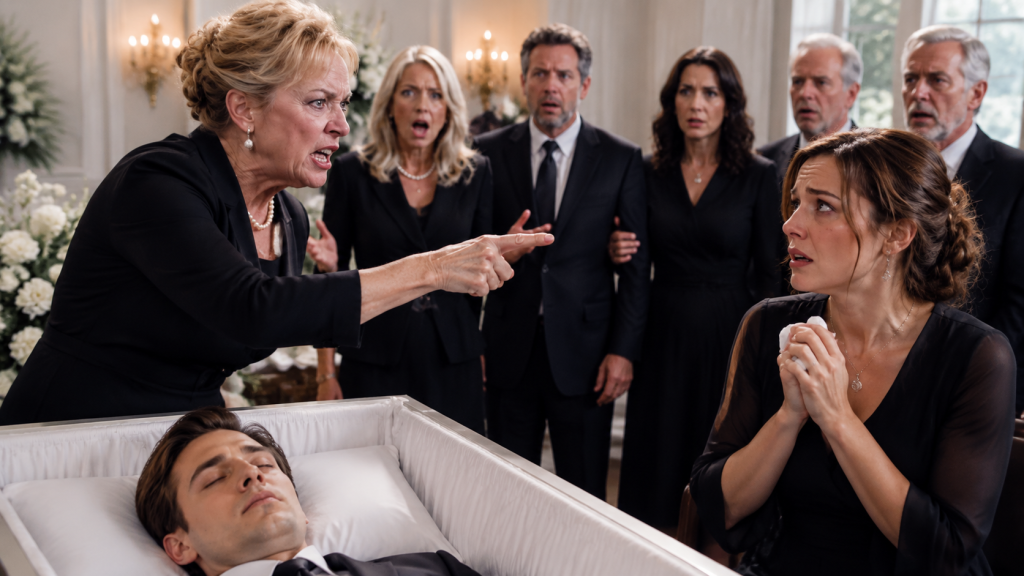
I didn’t move when Daniel’s hand pushed the coffin lid higher. Not at first.The chapel had already become something unreal—air too thin, silence too sharp, every eye locked on the impossible sight of a man who was supposed to be dead.
Margaret Vale froze mid-step. Her face didn’t just change—it emptied, like someone had pulled the foundation out from under her expression.
“No,” she whispered, barely audible. “No, that’s not possible.”
Daniel sat up fully now, slowly, as if waking from a long and carefully controlled sleep. The funeral makeup cracked at the corners of his face, revealing the faint bruising of medical sedation rather than death. His gaze lifted—not to me first—but to the side of the chapel where Victor and the board members sat.
“Still talking about me like I’m not here?” he said quietly.
That was when the doors behind the chapel burst open again.
But this time, it wasn’t silence that entered.
It was authority. Police officers moved in with measured precision, not rushing, not reacting emotionally, but as if they had been waiting for this exact moment for a very long time. One of them raised a hand, and the side exits sealed shut. Another signaled toward the balcony where hidden security cameras had already been recording for the past forty minutes.
Margaret finally turned fully toward Daniel, her composure breaking in uneven layers.
“You’re supposed to be dead,” she said.
Daniel looked at her the way someone looks at a report they’ve already finished reading.
“So were my financial records,” he replied. “Until someone looked twice.”
That was when I understood what the tapping fingers had really meant.
It wasn’t just a signal for me.
It was the final confirmation that every system we had built—legal, digital, forensic—was already active.
Margaret took a step back. “This is insane. He faked his death—he—”
“No,” I interrupted quietly.
Every head turned toward me.
For the first time that day, I spoke clearly.
“He didn’t fake his death,” I said. “He faked your certainty.”
The chapel seemed to tighten around those words.
I stepped forward, slowly placing the white rose on the edge of the coffin.
“You spent three years stripping him of control,” I continued. “You removed him from his company, isolated him from the board, moved assets through three offshore foundations, and used family trust clauses to lock him out of his own patents.”
Victor scoffed, trying to recover ground. “She’s just—”
“Be quiet,” Daniel said.
Not loudly.
But enough that Victor obeyed.
Daniel swung his legs out of the coffin and stood fully, steadying himself for just a moment before straightening his suit jacket. He looked almost ordinary again, except for the fact that every person in that room now understood they had been wrong about him in every possible way.
“I didn’t disappear because I was weak,” he said. “I disappeared because I needed every one of you to believe you had already won.”
Margaret’s voice sharpened again, desperation creeping in. “You think this changes anything? You think the board will accept—”
“The board has been dissolved for forty-eight hours,” I said.
That silence hit harder than anything before it.
Daniel finally looked at me.
A small nod.
Not gratitude. Not surprise. Just confirmation that the final piece had fallen into place.
“I think it’s time,” he said.
The officers moved.
Margaret turned suddenly, trying to reach for her brother, but it was already too late. Handcuffs clicked around her wrists with a sound that echoed far too loudly in the chapel. Victor tried to protest, but another officer was already reading charges—financial fraud, coercion, obstruction of a federal investigation spanning multiple jurisdictions.
The words didn’t feel real to anyone except the people being named.
Margaret looked at me over her shoulder as she was led forward.
“You planned this,” she hissed. “You stood there and let me—”
“No,” I said again, softer this time. “You planned it for yourself. I just stopped interfering.”
Her face twisted—not in anger now, but in something closer to disbelief.
The kind that comes when a story you’ve told yourself for years suddenly stops working.
As she was taken past the pews, whispers turned into silence. Relatives who had nodded earlier now avoided eye contact. Phones lowered. The performance was over, and no one wanted to be part of the record anymore.
Daniel stepped down from the platform and walked toward me.
For a second, neither of us spoke.
Then he said, “You didn’t hesitate.”
“I almost did,” I admitted.
He gave a faint, tired smile. “That’s why it worked.”
Behind us, the chapel doors remained open. Outside, flashing lights reflected faintly across the stained glass windows, turning saints and angels into shifting fragments of color.
But inside, everything felt strangely still.
As if the room itself was exhaling after holding its breath for months.
I finally looked at Daniel properly.
“You really went through with it,” I said.
“I had to,” he replied. “They wouldn’t have confessed otherwise.”
There was something heavier underneath his voice, something not entirely about strategy or law enforcement. Something about betrayal that couldn’t be processed in spreadsheets or case files.
I understood that part without him explaining it.
Because I had seen it too many times in my work.
People rarely collapsed because of one action.
They collapsed because the illusion holding them together finally stopped being believable.
Daniel turned slightly toward the coffin, still open, still absurd in its emptiness.
“That was the hardest part,” he said quietly. “Letting them think I was already gone.”
I followed his gaze.
“Did it feel like dying?” I asked.
He paused.
“Not dying,” he said. “Disappearing.”
The officers began clearing the chapel row by row. Relatives were escorted out. Some protested. Some stayed silent. No one resisted for long. The story they had built no longer had authority.
When the room finally emptied, only three of us remained: Daniel, me, and the quiet echo of everything that had just collapsed.
Daniel walked toward the front pew and sat down for the first time like a human being again, not a strategy or a target or a missing person.
“You were right,” he said after a while.
“About what?”
“That they’d expose themselves if given enough rope.”
I sat beside him.
“They always do,” I said.
Outside, a door closed sharply. Then another.
Silence settled deeper now, not the tense silence of before, but something final.
Daniel leaned back slightly, exhaling.
“It’s over,” he said.
I didn’t answer immediately.
Because in my experience, “over” was a dangerous word.
It usually meant the beginning of paperwork, courtrooms, retaliation, or the slow unraveling of everything that still hadn’t been found.
But for the first time, I allowed myself to consider it anyway.
“It’s not over,” I said finally.
He looked at me.
“It’s just no longer theirs.”
A faint sound of distant sirens passed outside again, fading as quickly as it arrived.
Daniel nodded slowly, as if accepting a conclusion he had already reached days ago but needed me to confirm.
“I couldn’t have done this without you,” he said.
I almost laughed.
“You already did,” I replied. “I just made sure they didn’t rewrite it.”
He stood again, this time more steadily.
The coffin remained between us for a moment, absurd in its symbolism now that its purpose had been exposed.
Then Daniel closed it himself.
Not gently. Not violently.
Just finally.
The sound echoed through the chapel like the end of a sentence no one would argue with anymore.
We walked out together as the last of the police secured the perimeter. Outside, daylight hit harder than expected—too bright after the enclosed darkness of the chapel.
Margaret was being placed into a vehicle at the far end of the driveway. She saw us briefly through the window.
This time, she didn’t speak.
She just stared.
As if trying, at the very last moment, to understand where her control had gone wrong.
The doors closed. The vehicle pulled away.
And for the first time in a very long time, Daniel didn’t look behind him.
He looked forward.
THE END! THANK YOU FOR READING!