
It was not the moment my son removed me from the family group chat that hurt me the most.It was the sentence that came after. “Mom, it was for working adults. You don’t understand what we talk about.” My name is Benita Morales.
I am seventy-six years old. I have been a widow for eleven years. And that sentence stayed inside me like a thorn under my ribs, because they were not only leaving me out of a conversation. They were slowly erasing me from my own family.
I was not a rich woman. My husband, José, and I built our farm through hard work, after years of market days, glass jars filled with savings, and long Sundays spent beneath the sun.
Every tree carried a memory.
Every roof tile had a story.
Every fence post had been placed by hands that knew hunger, tiredness, and hope.
But to my children, the farm had slowly stopped being a home.
It became a convenience.
A place to arrive with suitcases, coolers, meat for grilling, children, speakers, and friends I had never met.
A free weekend house.
A hotel with an old woman in the background who cooked, cleaned, and never complained.
The worst part was that I still believed it was love.
I believed leaving the key under the large clay flowerpot meant I was being useful.
I believed washing sheets before they arrived meant I was still needed.
I believed making preserves, filling the refrigerator, and keeping the spare rooms ready meant my children still saw me as their mother.
Then Carlos removed me from the family chat.
My own son.
The boy I once carried on my hip while watering tomatoes.
The boy José taught to drive the tractor before his feet could even reach the pedals.
I called him when I noticed the group was gone from my phone.
“Carlos,” I asked, “why am I not in the family chat anymore?”
He sighed.
Not angrily.
Worse.
Impatiently.
“Mom, it was for working adults. You don’t understand what we talk about.”
For a moment, I could not speak.
Working adults.
As if I had not worked before he was born.
As if I had not raised three children, buried a husband, managed land, paid taxes, fixed fences, sold fruit, and survived storms that would have made him cry.
“I see,” I said quietly.
He did not notice the crack in my voice.
“Don’t take it personally.”
That is what people say when they want permission to hurt you without consequences.
A week later, my daughter-in-law, Laura, sent me a private message.
Benita, leave the keys where they always are. We’re coming Friday with the kids.
No please.
No thank you.
No how are you.
That was how I found out they had already planned an entire weekend at my farm without even telling me.
Twelve people.
Carlos, Laura, their children, my daughter Ana, her husband Diego, their children, and two cousins who only remembered me when there was roasted meat.
Twelve people arriving at my home as if the owner did not exist.
I went to the farm one day early.
Juan, the caretaker, was repairing a section of fence near the lemon trees when I arrived.
He knew immediately something was wrong.
Juan had worked with José for years.
After my husband died, he stayed, not because the pay was generous, but because he respected what we built.
He looked at my face and did not ask foolish questions.
He simply made tea and left me alone in the living room.
There, on the wooden table, sat José’s brown leather notebook.
He had sewn the cover himself years ago, using scraps of leather from an old saddle.
Inside, we had written everything.
How much the well cost.
When we changed the roof.
How many lemon trees we planted.
How much we earned at the market.
How much debt we paid.
Which storm broke the south fence.
Which year the mango trees finally gave good fruit.
It was not only a notebook.
It was proof that the farm had been built by sacrifice.
It was the memory of José’s hands.
Carlos arrived first that afternoon.
He came in without knocking.
He did not kiss my cheek.
He did not ask how I was feeling.
He only frowned when he saw me sitting in the living room.
“Mom? What are you doing here already?”
I looked at him.
“This is my house, Carlos.”
He gave a small laugh, as if I had made a joke.
“I know, but we were coming tomorrow. Laura thought you’d stay in town until evening.”
“No one told me you were coming.”
He waved his hand.
“We didn’t want to bother you with details.”
“Because I don’t understand adult things?”
His face tightened.
“Mom, don’t start.”
“I am not starting anything. I am asking why your wife told me to leave the keys under the flowerpot like I am staff.”
He sighed again.
That sigh had become his favorite weapon.
“Everyone is busy. We planned it in the group.”
“The group you removed me from.”
“It was so we wouldn’t bother you.”
“No,” I said. “It was so I wouldn’t have a say.”
He looked away.
Then his eyes fell on the notebook.
“What is this old thing?”
He picked it up and flipped through the pages without care.
My heart tightened when I saw his thumb bend the corner of a page José had written on.
“Your father’s notebook,” I said.
Carlos barely listened.
“These things only collect dust, Mom. You should clean up before everyone else gets here.”
Then he tossed the notebook into the trash bin beside the cabinet.
As if it were an old flyer.
As if José had not written those pages beneath lamplight after working fifteen hours.
As if my life belonged in the garbage because my son found it inconvenient.
I did not cry in front of him.
But something inside me stopped asking for permission in that exact moment.
That evening, the rest of them arrived.
Suitcases rolled across the porch.
Children shouted.
Coolers thudded against the kitchen floor.
Laura walked down the hallway without greeting me.
Diego asked if there was ice.
Ana kissed my cheek quickly, already looking at her phone.
The cousins opened the refrigerator before they even said hello.
Outside, they seemed to be on vacation.
Inside, I was looking at a house full of people who had forgotten I was a person.
They grilled meat.
They played music.
They let the children run through the garden, breaking two young tomato plants Juan had carefully tied that morning.
When I asked them to lower the music after ten, Carlos said, “Mom, relax. We came to enjoy ourselves.”
I looked at him and realized he truly believed my discomfort was an interruption.
Not a fact.
An interruption.
That night, after everyone finally went to sleep, I took the notebook out of the trash.
I cleaned the cover with a soft cloth.
I sat at the kitchen table and opened it.
José’s handwriting leaned slightly to the right.
Strong.
Patient.
Alive in every line.
I turned the pages slowly.
Then I remembered something my children had never cared enough to ask.
The truly important things had never been left out in the open.
Under the floorboard in my bedroom, where José and I used to hide the things we could not afford to lose, there was still a metal box.
At two in the morning, I moved the rug, lifted the loose board, and pulled it out.
Inside were papers wrapped in cloth.
The trust documents.
The deed.
Letters from José.
Receipts.
A signed agreement from years earlier placing the farm in my name alone, protected from any sale, loan, or family use without written permission.
José had insisted on it after Carlos once joked, at twenty-five, that land should never sit under “old people’s control.”
I had forgotten the exact words of the document.
But José had not.
My husband had protected me even before I knew I would need protection.
I did not sleep that night.
I did not fall asleep crying.
I fell asleep thinking.
Before sunrise, I woke Juan.
“I need your help,” I said.
He looked at my face and nodded.
By seven, everyone was still asleep.
By eight, Juan had changed the chain on the front gate.
By nine, I had removed the spare key from under the flowerpot.
By ten, I had taped a copy of the legal notice inside a plastic sheet and placed José’s notebook beneath it on a small wooden stand by the locked gate.
Then I left the house through the back lane and went to town with Juan.
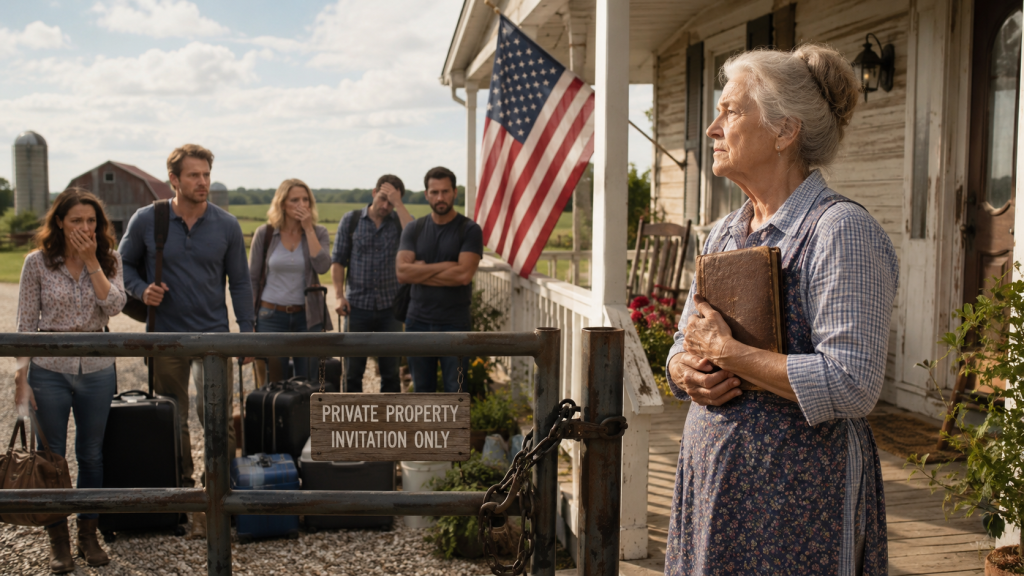
When all twelve of them finally loaded their cars that afternoon, ready to return from the market with more meat, drinks, and guests they had not asked permission to invite, they found the gate locked for the first time in their lives.
Carlos rattled the chain.
At first, he laughed.
Then he grew angry.
“Mom!” he shouted. “Where’s the key?”
Beside the gate hung the wooden sign I had painted before sunrise.
This farm is not a hotel. Entry by invitation only.
Under it sat José’s notebook, sealed inside a clear plastic cover.
Carlos opened it carelessly.
I watched from the porch, standing beside Juan.
Laura crossed her arms.
Ana looked confused.
Diego muttered something about me being dramatic.
Then Carlos reached the last pages.
His face changed.
Inside were copies of the deed, the trust rules, the maintenance costs, the taxes I had paid, and every contribution José and I had made.
There was also a new page in my handwriting.
For eleven years, I left the key under the flowerpot because I wanted to feel loved. Today, I removed it because I finally remembered I am the owner of my own home.
Carlos looked up.
“Mom, open the gate.”
“No.”
“You’re embarrassing everyone.”
“You did that when you arrived at my house without asking.”
Laura stepped forward.
“Benita, the kids are tired.”
“They can rest at your house.”
Ana’s eyes filled with tears.
“Mom, please. We didn’t mean to hurt you.”
I looked at my daughter.
“Then why did none of you ask if I wanted twelve people here?”
She lowered her eyes.
Diego scoffed.
“It’s family property.”
Juan took one step forward.
“No,” he said calmly. “It is Mrs. Benita’s property.”
Carlos glared at him.
“This is family business.”
I lifted the legal notice.
“Working adults should understand legal notice.”
The words landed exactly where I wanted them to.
Carlos went pale.
“Mom, I didn’t mean it like that.”
“Yes, you did.”
Silence spread across the group.
Even the children stopped whining.
I looked at the coolers, the suitcases, the bags, and the people who had forgotten to ask whether I was alive before asking for my keys.
“Go home,” I said. “This weekend, I am resting.”
Carlos lowered his voice.
“Mom, we can talk.”
“We could have talked before you removed me from the family chat.”
Laura wiped her eyes, angry now.
“So you’re punishing everyone?”
“No,” I said. “I am teaching you the difference between family and access.”
They stood there for nearly twenty minutes.
Calling.
Texting.
Arguing among themselves.
But the gate stayed locked.
At last, Carlos picked up his cooler.
One by one, they loaded their cars.
Ana came to the gate before leaving.
“I’m sorry,” she whispered.
I nodded.
“I hope you are.”
Then she left too.
When the last car disappeared down the road, the farm became quiet.
Not empty.
Quiet.
There is a difference.
Juan looked at me.
“Tea?”
I smiled.
“Yes.”
That evening, I sat on the porch with José’s notebook on my lap.
The sun lowered over the lemon trees.
The air smelled of soil and leaves.
For the first time in eleven years, there were no dirty dishes waiting for me.
No beds to strip.
No strangers drinking under my roof.
No children breaking plants while adults laughed.
Only the farm.
Only memory.
Only peace.
My phone buzzed all night.
Carlos called fourteen times.
Laura sent long messages.
Ana apologized twice.
Diego wrote that I had gone too far.
I answered none of them.
The next morning, I created a new group chat.
I named it: Benita’s Farm Rules.
I added my children, their spouses, and Juan.
Then I wrote one message.
From today forward, visits are by invitation only. No key will be left outside. No one enters without asking. Anyone who disrespects the land, the house, Juan, or me will leave. If this is hard to understand, read your father’s notebook.
Carlos replied first.
Mom, this is unnecessary.
I wrote back:
No, son. It is eleven years late.
After that, no one answered.
For two months, no one came.
At first, the silence hurt.
Then it healed.
I planted new herbs.
Juan repaired the old bench under the mango tree.
I spent mornings reading José’s notebook and afternoons making preserves because I wanted to, not because twelve people expected breakfast.
Then one Sunday, Ana came alone.
She knocked at the gate.
She did not honk.
She did not call me dramatic.
She held a small bag of bread and said, “May I come in?”
That question nearly made me cry.
I opened the gate.
We sat on the porch for two hours.
She apologized without excuses.
That mattered.
Carlos took longer.
Pride is a heavy thing for sons who realize their mothers are not as weak as they believed.
When he finally came, he brought no suitcase.
No cooler.
No wife speaking for him.
He stood at the gate with José’s notebook in his hands.
“I read it,” he said.
I waited.
His eyes were wet.
“I didn’t know Dad wrote all that.”
“You never asked.”
He nodded.
“I’m sorry I threw it away.”
“That notebook was your father’s voice.”
“I know that now.”
I opened the gate, but only halfway.
“Come in for coffee,” I said. “Not for the weekend.”
He almost smiled.
“Coffee is enough.”
It was not fixed.
Families do not repair in one afternoon.
But something had shifted.
They no longer arrived as owners.
They arrived as guests.
And guests knock.
Now the key is no longer under the flowerpot.
It hangs on a hook inside my kitchen.
Beside it is José’s notebook.
Sometimes my grandchildren ask about it, and I tell them stories.
Real stories.
About their grandfather, about the well, about the lemon trees, about the year we almost lost everything and kept going anyway.
They listen.
Maybe because they are young.
Maybe because children understand respect when adults stop teaching them entitlement.
I am still seventy-six.
I am still a widow.
I still miss José every morning.
But I am no longer furniture in my own family.
I am no longer the old woman in the background of their weekend plans.
I am Benita.
This is my farm.
My home.
My peace.
And peace, I learned, begins the moment you stop leaving the key out for people who forgot how to knock.
THE END! THANKS FOR READING!