
I will never forget the morning I held the plane ticket in my hands. My heart was beating so fast it felt like something was trying to escape my chest. Twelve years.Exactly twelve years since my only daughter, Mary Lou, left America after marrying a Korean man named Kang Jun.
She was twenty-one then.Young, stubborn, beautiful, and convinced that love could survive any distance. I was against the marriage at first. Not because Kang Jun was Korean.Not because he came from another country.
But because he was nearly twenty years older than her, and because he wanted to take her across the world before I had even learned how to let her go.
“Mom,” she said at the time, holding both my hands, “I know what I’m doing.”
But children say that when they are young. And mothers remember those words for the rest of their lives. The wedding was small.
Too fast.
Within a month, she was gone.
At the airport, Mary Lou hugged me so tightly I could barely breathe.
She cried into my shoulder like a child.
I tried to be strong.
I tried not to beg.
I told myself she would come back in a year.
Then one year became two.
Two became five.
Five became twelve.
She never came home.
But every year, exactly eighty thousand dollars arrived.
Not one cent less.
Always with the same short message.
Mom, always take care of yourself. I’m doing well.
People in town envied me.
“How lucky you are, Theresa,” they said. “Your daughter married well. She never forgets you.”
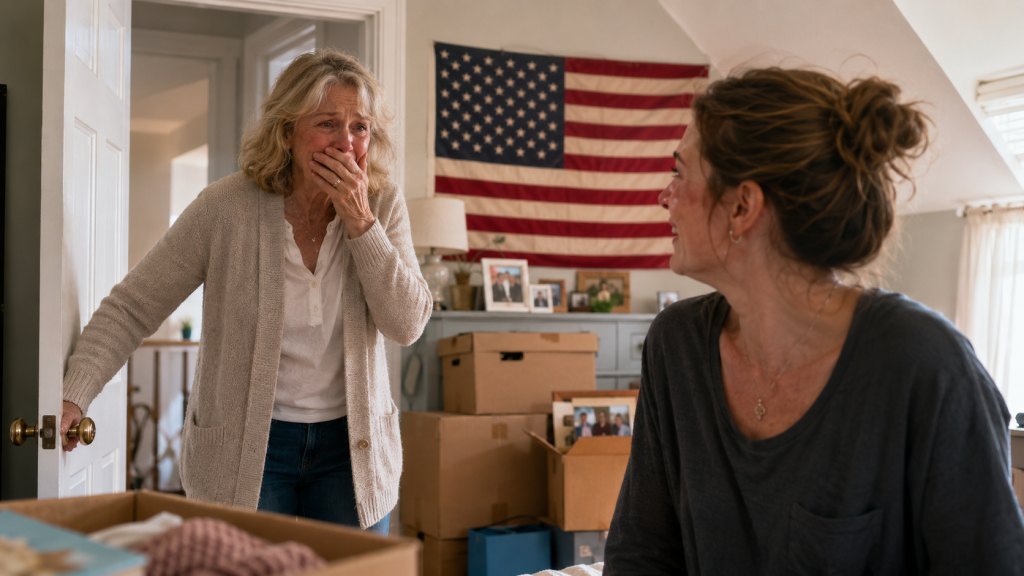
I would smile because explaining a mother’s loneliness to people counting money is useless.
Yes, my house improved.
The leaking roof was fixed.
The old car was replaced.
Medical bills were paid.
But every Christmas, I still set one extra plate at the table.
Every Christmas, I made Mary Lou’s favorite beef stew.
Every Christmas, the chair stayed empty.
Money can fill a bank account.
It cannot hold your hand.
It cannot laugh in your kitchen.
It cannot call you Mom in a tired voice at the end of the day.
During our rare video calls, Mary Lou always looked beautiful.
Too beautiful.
Her hair was neat.
Her makeup perfect.
The background behind her always plain, like she was careful about what I could see.
But her eyes were different.
Hurried.
Distant.
Afraid of something she never named.
“Why don’t you come home?” I asked once.
She went silent.
Then she smiled.
“I’m very busy with work, Mom.”
After that, I stopped asking.
Sometimes mothers become cowards because they fear the truth will hurt more than silence.
But at sixty-three years old, I became tired of being afraid.
That Christmas, I decided to go to her.
I did not tell anyone except my neighbor, Mrs. Alvarez, who helped me buy the ticket, prepare my documents, and write Mary Lou’s address in both English and Korean on a folded piece of paper.
I had never flown across the world before.
I had never left the country.
On the plane, my hands gripped the armrests until my fingers ached.
When we landed in Seoul, the airport felt enormous and bright.
People moved quickly around me.
Signs glowed in a language I could not read.
I felt small, foolish, and old.
But I had crossed an ocean for my daughter.
So I kept walking.
A taxi driver looked at the address, nodded, and drove me through streets full of lights, tall buildings, bridges, and winter trees.
Eventually, the city thinned into a quieter neighborhood.
The taxi stopped in front of a two-story house behind a black gate.
The garden was tidy.
Too tidy.
No toys.
No shoes.
No bicycle.
No sound of a television.
No smell of food.
I rang the bell.
No one answered.
I waited, heart pounding.
Then I noticed the gate was not locked.
“Mary?” I called softly.
No answer.
I pushed the gate open and walked to the front door.
My hand trembled as I touched the handle.
It opened.
That was when I froze.
The living room was spacious, clean, and lifeless.
Everything was perfectly arranged.
A pale sofa.
A glass table.
Plastic flowers in a vase.
White walls with no family photographs.
No stray shoes by the door.
No jacket on a chair.
No coffee cup.
No sign that anyone truly lived there.
“Mary Lou?” I called.
My voice sounded strange in that silent house.
No answer.
I stepped inside.
The kitchen was even cleaner than the living room.
No grease on the stove.
No dishes drying near the sink.
The refrigerator held only bottles of water, a small container of rice, and some withered fruit.
A terrible feeling began to form in my stomach.
I went upstairs.
There were three doors.
The first room had one bed, perfectly made.
The closet was full of women’s clothes.
Not a single man’s shirt.
No tie.
No shoes.
Nothing belonging to Kang Jun.
The second room looked like an office, but the desk seemed unused.
No photos.
No personal items.
No trace of a husband.
Then I opened the third door.
My knees went weak.
The room was full of boxes.
Some were sealed.
Some were open.
Inside were stacks of cash.
Dollars.
Not Korean money.
American dollars, bundled tightly with rubber bands.
I touched one stack with shaking fingers.
“What is this?” I whispered.
For twelve years, Mary Lou had sent me eighty thousand dollars every year.
But this room held far more than that.
Where had it come from?
Why was it hidden?
And where was Kang Jun?
At that moment, I heard a door open downstairs.
My body went cold.
Footsteps moved through the house.
Slow.
Careful.
Then someone called in Korean.
A man’s voice.
I did not understand the words, but I understood the danger in them.
I backed away from the boxes.
The footsteps came up the stairs.
Then my daughter appeared in the doorway.
For one second, neither of us moved.
Mary Lou was thinner than in the video calls.
Her face was pale.
Her eyes widened with terror when she saw me.
“Mom?” she whispered.
I almost collapsed at the sound of her voice.
Then she rushed forward and grabbed me.
Not like a happy daughter greeting her mother.
Like someone trying to save me from a fire.
“What are you doing here?” she breathed. “Why didn’t you tell me?”
“I came to see you,” I said, my voice breaking. “I’m your mother.”
Her eyes darted toward the stairs.
“You should not have come alone.”
I pointed at the boxes.
“What is this? Where is your husband?”
Mary Lou’s lips trembled.
“Kang Jun died nine years ago.”
The room spun.
I gripped the edge of a box.
“Died?”
She nodded, tears filling her eyes.
“A car accident. At least that’s what they called it.”
“Then who has been sending the money?”
“Me.”
I stared at her.
“All of it?”
“Yes.”
“But why? Why lie to me?”
“Because if I told you he was dead, you would come. And if you came, they would know about you.”
Before I could ask who she meant, the man’s voice came again from downstairs.
Mary Lou’s face went white.
She pulled me behind the door and whispered, “Don’t speak.”
A man appeared in the hallway.
He was older, wearing a black coat and polished shoes.
His eyes moved from Mary Lou’s face to the open room behind her.
Then to me.
He smiled, but it was not kind.
He spoke English with a heavy accent.
“This must be your mother.”
Mary Lou stepped in front of me.
“Mr. Park, she came without warning. She knows nothing.”
His smile deepened.
“That is unfortunate.”
My daughter’s hand tightened around mine.
For the first time in twelve years, I understood.
Mary Lou had not stayed away because she forgot me.
She had stayed away because she was trapped.
Mr. Park looked at the boxes of money.
“You were supposed to move these today.”
“I know,” Mary Lou said.
“And now your mother has seen them.”
“She won’t say anything.”
He looked at me.
“Will you?”
My mouth went dry, but I forced myself to stand straighter.
“I don’t even know what I’m seeing.”
Mr. Park laughed softly.
“That is best.”
He turned to Mary Lou.
“You have until tonight. Then both of you come with me.”
When he left, Mary Lou shut the door and locked it.
Then she turned and hugged me so tightly I felt her whole body shaking.
“Mom,” she sobbed. “I’m so sorry.”
I held her face in my hands.
“Tell me everything.”
She pulled documents from a drawer hidden beneath the floorboard.
Passports.
Bank papers.
Photos of women I did not know.
Some looked young.
Some looked frightened.
“Kang Jun was not who I thought he was,” she said. “He married women from overseas. He promised them love, homes, work, protection. Then he took their documents and used their names to move money through shell companies.”
My blood turned cold.
“When I discovered it, I wanted to leave. But by then he had already used my name too. Accounts. Transfers. Documents. If I ran, they said I would go to prison. If I called you, they said they would find you.”
I could barely breathe.
“And after he died?”
“His partners came. Mr. Park was one of them. They needed someone to keep moving the money without drawing attention. I knew English. I knew the American accounts. They forced me to help.”
She wiped her tears with shaking hands.
“The money I sent you every year was clean before it left Korea. I made sure. I told myself if I could not come home, at least I could keep you safe.”
I grabbed her shoulders.
“Mary Lou, money never mattered more than you.”
She broke then.
My beautiful daughter, who had carried twelve years of fear alone, collapsed into my arms like the twenty-one-year-old girl I lost at the airport.
For a few minutes, we just cried.
Then I remembered Mr. Park’s words.
“You said they would follow me if you left.”
Mary Lou nodded.
“They watch the house. They watch my accounts. They know when I call people.”
“Then we don’t call from here.”
She looked at me.
“Mom?”
I pulled out the little folded paper Mrs. Alvarez had given me before I left.
On the back, she had written a phone number.
The United States embassy.
“She said if anything went wrong, call this.”
Mary Lou stared at it like it was a miracle.
We left the house through the back while the winter sky turned dark.
Mary Lou took only the documents, the USB drive, and one small bag.
We walked two streets over to a convenience store.
The young clerk stared when I pushed the embassy number toward him and begged, “Please. Phone.”
Maybe he did not understand everything.
But he understood fear.
He let us use the phone.
Mary Lou spoke first.
Then I did.
Within an hour, we were inside a police station with an embassy official, a translator, and two investigators who listened while Mary Lou finally told the truth.
The boxes of money were seized that night.
Mr. Park was arrested two days later.
Others followed.
The investigation became larger than either of us understood.
There were financial crimes, fake companies, forged immigration papers, and women who had disappeared into marriages that were never truly marriages.
Mary Lou was questioned for weeks.
But the documents she saved proved she had been forced, threatened, and used.
For the first time in twelve years, someone believed her.
I stayed beside her through every interview.
When she cried, I held her hand.
When she froze, I answered simple questions.
When she apologized for the hundredth time, I finally said, “If you say sorry again, I’ll scold you like when you were little.”
She laughed through tears.
It was the first real laugh I had heard from her since she was twenty-one.
Months passed before we were able to return to America.
Mary Lou came with me.
She brought one suitcase, a folder of legal papers, and the photograph from her old passport.
At the airport, she stopped before boarding.
For a moment, fear crossed her face.
“What if I don’t remember how to be home?” she whispered.
I took her hand.
“Then we learn together.”
When we arrived, Mrs. Alvarez was waiting with flowers.
My house looked the same, but everything felt different because Mary Lou was finally inside it.
That first Christmas back, I set the table for two.
Then three, because Mrs. Alvarez insisted she was family now.
I made beef stew.
Mary Lou helped cut the carrots.
At one point, she looked around the kitchen and started crying.
“I dreamed of this,” she said. “For years.”
I placed a bowl in front of her.
“Then eat before it gets cold.”
She laughed again.
The money she had sent me remained mostly untouched in a separate account.
After the investigation ended, Mary Lou used part of it to help other women who had been trapped the way she had been.
She said she wanted the money to become something that saved people instead of something that silenced her.
People in town asked why she had stayed away so long.
Some whispered, as people always do.
I stopped caring.
The truth belonged to Mary Lou, and she would tell it only when she was ready.
As for me, I learned something no mother should ever have to learn.
Sometimes a child sends money not because she is living well, but because money is the only safe way she can say, “I’m still alive.”
For twelve years, I thought my daughter had chosen a life without me.
But when I opened the door to that cold, silent house in Korea, I found the truth.
Mary Lou had not forgotten me.
She had been protecting me.
And when I finally brought her home, the eighty thousand dollars no longer mattered.
The only thing that mattered was hearing her voice in my kitchen again.
“Mom,” she said one night, standing in the doorway with a blanket around her shoulders, “can I stay here for a while?”
I looked at my daughter, my only child, finally safe beneath my roof.
I smiled through tears.
“Mary Lou,” I said, “you never stopped belonging here.”
THE END! THANKS FOR READING!