
The second my divorce became final, I canceled my ex-mother-in-law’s credit card. Not her card, technically. Mine.For five years, Margaret Hawthorne had carried a black titanium card linked to my private account and treated it like a family inheritance.She bought designer suits for charity luncheons she never donated to.She booked spa weekends under the excuse of “stress.
” She sent luxury handbags to women who smiled at her in country club bathrooms.And every month, when the bill arrived, my husband Brandon would kiss my cheek and say, “You know how Mom is. Just let it go.”So I let it go. Again. And again.
Until the divorce judge signed the final order, and the marriage that had drained me of patience, dignity, and half my sleep was legally over.
At 3:17 p.m., I walked out of court.
At 3:42, I called the bank.
At 3:49, Margaret Hawthorne’s card was canceled.
By 4:11, Brandon called me screaming.
“What the hell did you do, Olivia?”
I stood in my penthouse kitchen, calmly drinking espresso from a white porcelain cup, surrounded by the first real silence I had owned in years.
My name is Olivia Vale.At thirty-eight, I was a senior partner at Sterling Point Capital, a venture firm where people did not survive by being emotional.
Brandon had always hated that.
He liked my money.
He liked my reputation.
He liked introducing me at galas as “my brilliant wife.”
But he hated that I could sit across from powerful men and not blink.
He hated that when he shouted, I grew quieter.
He hated that my calm made his anger look childish.
“Your mother is no longer authorized on my account,” I said.
“She was just humiliated in front of two hundred people!” Brandon roared. “Her card declined on a fifty-thousand-dollar Cartier necklace at the charity auction!”
I almost laughed.
Not because it was funny.
Because it was so perfectly Margaret.
She had tried to buy a necklace at a charity auction with money that had never belonged to her, and still somehow believed she was the victim.
“If your name isn’t on the account, Brandon, you don’t get to use the plastic,” I said.
“You humiliated her!”
“No,” I replied. “Her entitlement did that.”
“You always hated my mother.”
“I funded your mother.”
“That’s what family does.”
“That was never family. That was access.”
He went silent for half a breath.
Then his voice dropped into the tone he used when shouting failed.
“Olivia, don’t be petty. Turn the card back on. Mom is crying.”
For five years, that sentence would have worked.
Not because I loved Margaret.
Because I loved peace.
I loved the hope that if I gave enough, they would stop taking.
I loved the illusion that my marriage could still become something kind.
But the divorce had made one thing beautifully clear.
I did not have to buy peace from people who enjoyed disturbing mine.
“The card is dead,” I said. “And so is this conversation.”
Then I hung up.
And blocked him.
For the first time in months, I slept deeply.
At least, I thought I did.
At exactly 6:42 the next morning, I woke to a sound that did not belong in any home.
Not knocking.
Not shouting.
A drill.
A shrill, metallic grinding sound that tore through my hallway like an animal chewing bone.
I sat upright in bed.
For one second, my mind could not understand what my ears were hearing.
Then the deadbolt screamed.
I grabbed my phone from the nightstand and opened the security camera feed.
There they were.
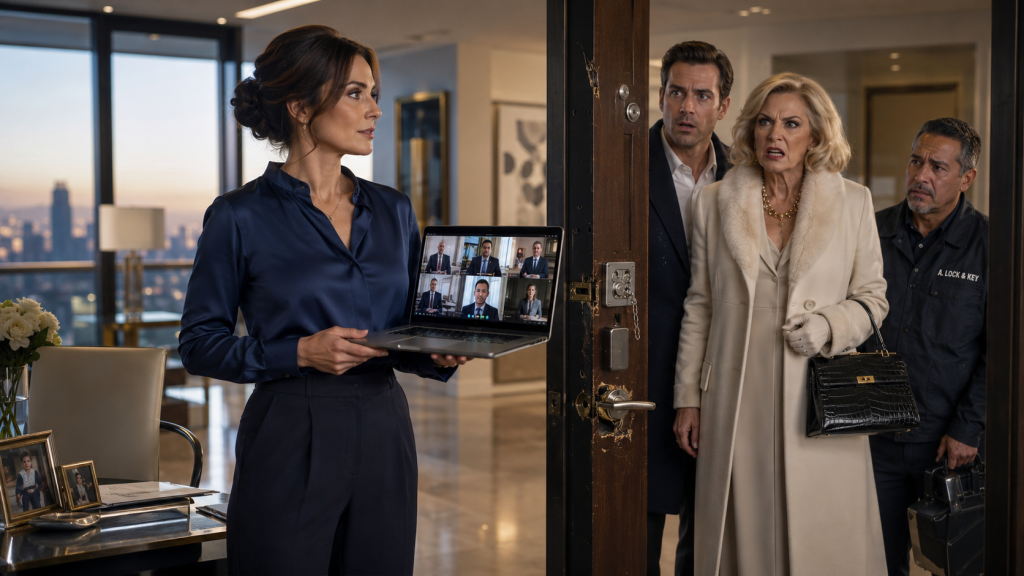
Margaret Hawthorne stood outside my penthouse door in a cream coat, her hair perfect, her mouth twisted with poisonous rage.
Beside her stood Brandon, speaking urgently to a locksmith.
The locksmith looked uncomfortable, holding a heavy-duty drill against my lock.
“Just drill it!” Brandon said, loud enough for the camera microphone to catch every word. “My wife is having a severe psychiatric episode because of the divorce. She locked herself inside. We have to get in before she hurts herself.”
My blood turned to ice.
Ex-wife.
He knew that.
The divorce had become final less than twenty-four hours earlier.
But Brandon was standing in my hallway, inventing a mental health emergency to force an illegal entry into my home.
Margaret clutched her handbag and added, “She’s unstable. She cut off my card in a rage yesterday. We’re family. We know her.”
The locksmith hesitated.
“Sir, I usually need proof of residence or authorization.”
Brandon pulled out his old driver’s license.
The one with my penthouse address on it from before he moved out during the separation.
“This is my home,” he lied. “Please. We don’t have time.”
I stared at the camera feed.
My hands did not shake.
That surprised me.
Maybe because a part of me had been waiting for Brandon to do something like this.
Not exactly this.
But something.
Men like him do not accept closed doors easily when they have spent years believing every door should open.
He thought I was still in bed.
Weak.
Alone.
Disoriented.
He had no idea I had been awake since six.
I was fully dressed in a navy silk blouse and tailored trousers, seated at my home office desk, preparing for a live board meeting with eight senior partners from Sterling Point Capital.
The call had started ten minutes earlier.
My laptop was open.
My camera was on.
The chairman was speaking about a distressed acquisition.
I looked at the faces on screen.
Eight executives.
Two legal advisors.
One outside compliance officer.
All watching me notice the sound.
“Olivia?” my CEO, David Mercer, asked. “Is everything all right?”
The drill shrieked again.
The deadbolt cracked.
I did not panic.
I simply picked up my laptop, turned it toward the entry hallway, and said, “Apparently, my ex-husband is attempting to break into my home during this meeting.”
No one spoke.
On the screen, I saw David lean forward.
The outside counsel removed her glasses.
One partner whispered, “Is this live?”
“Yes,” I said.
The deadbolt gave way with a violent snap.
My front door swung inward.
Brandon stepped inside first.
Margaret followed with the confidence of a woman entering property she still believed she controlled.
The locksmith remained at the threshold, suddenly realizing he had made a terrible mistake.
Brandon stopped when he saw me.
I was not crying.
I was not hiding.
I was standing in my hallway holding an open laptop, with twelve corporate witnesses staring directly at him.
His face changed.
“What are you doing?” he demanded.
I smiled.
“Working.”
Margaret’s eyes moved to the screen.
Her mouth tightened.
“Turn that off.”
“No.”
Brandon took one step forward.
“Olivia, this is a private family matter.”
Behind him, the locksmith lowered his drill.
“It sounded like a psychiatric emergency,” the locksmith muttered.
“It was a lie,” I said. “And you are on camera.”
Margaret snapped, “Don’t you dare speak to him that way. You forced this by humiliating me yesterday.”
I looked at her.
“You tried to buy a necklace with my money after my divorce from your son became final.”
Her nostrils flared.
“That card was promised.”
“No, Margaret. It was tolerated.”
Brandon’s eyes flicked to my laptop again.
He was calculating.
He always calculated when cornered.
Then he lifted his hands, trying to become reasonable.
“Everyone needs to calm down. Olivia has been under a lot of stress. We were worried.”
My CEO’s voice came from the laptop speakers, cold and clear.
“Mr. Hawthorne, this meeting is being recorded on a corporate server.”
Brandon froze.
David continued, “Sterling Point Capital will preserve the full video and audio record of your entry.”
Margaret’s face drained.
At that exact moment, my private security alarm finally connected to the emergency line.
Sirens sounded faintly from the street below.
The locksmith backed into the hallway.
“I didn’t know,” he said quickly. “He told me she was his wife and—”
“Ex-wife,” I corrected.
Brandon glared at me.
“You’re enjoying this.”
“No,” I said. “I’m documenting it.”
The police arrived six minutes later.
Six minutes can feel like an hour when two people who hate your independence are standing inside your home.
But I stayed where I was.
The laptop stayed open.
The partners stayed on the call.
No one disconnected.
That mattered more than I can explain.
For years, Brandon had made me feel alone in rooms full of people.
That morning, he finally stood in my space and realized I had witnesses.
Two officers entered cautiously.
One asked who lived there.
I answered first.
“I do. Alone. The divorce was finalized yesterday. My ex-husband no longer has permission to enter. His mother never did. He hired this locksmith by claiming I was having a psychiatric breakdown.”
Brandon spoke over me.
“She’s twisting this. We were worried about her safety.”
The older officer looked at the broken deadbolt on the floor.
Then at the laptop.
Then at the visible security camera above the hallway table.
“Is there footage?”
I said, “All of it.”
Margaret sat on my white sofa without being invited, as if claiming a cushion could restore her authority.
“This is ridiculous,” she said. “She owes me that card.”
The younger officer paused.
“Owes you what card?”
Margaret realized too late that she had answered the wrong question.
Brandon closed his eyes.
I almost pitied him.
Almost.
Twenty minutes later, my attorney called.
Her name was Celeste Ward, and she had handled my divorce with the surgical calm of a woman who enjoyed turning arrogance into paperwork.
“Olivia,” she said, “do not speak to Brandon. Do not speak to Margaret. The recording is enough.”
I stood near the entry table while officers questioned Brandon.
“Enough for what?” I asked.
“Illegal entry. False emergency claims. Harassment. Defamation. Possibly conspiracy, depending on what the locksmith says and whether Brandon knowingly used outdated identification to gain access.”
Across the room, Brandon heard the word conspiracy.
His face went pale.
Margaret stood sharply.
“This is absurd! She is being dramatic because I used one card!”
Celeste’s voice came through the phone.
“Is Margaret speaking?”
“Yes.”
“Wonderful. Let her continue.”
I almost smiled.
One of the board partners was still visible on my laptop screen.
Then David Mercer leaned toward his camera.
“Olivia, we are prepared to provide the full meeting recording and witness statements from everyone present.”
Brandon turned toward the laptop as if it had betrayed him.
But the laptop had done nothing.
It had only shown the truth.
That was enough.
This was not my word against his.
It was his lie against eight senior executives, three security cameras, two police officers, a locksmith trying to save his license, and a corporate server.
I walked to the entry table and picked up the ruined deadbolt.
The metal was warm from the drill.
One officer handed me a plastic evidence bag.
I placed the broken lock inside.
Then I looked at Brandon.
“The divorce ended yesterday,” I said softly. “Today, the consequences begin.”
For the first time since I married him, Brandon had nothing left to take from me.
He was not arrested in handcuffs that morning.
Life is rarely that cinematic.
Instead, the officers issued a report, collected statements, reviewed footage, and warned both Brandon and Margaret that remaining on the property would lead to removal.
Margaret refused to leave at first.
“This sofa cost more than your salary,” she snapped at one officer.
The officer looked at her calmly.
“Then you should stand up carefully.”
She did.
Brandon tried one last time at the door.
“Olivia, don’t do this. You’ll make things worse.”
I stood behind the threshold.
“No, Brandon. Worse was waking up to a drill in my lock. This is what comes after.”
The door closed.
Or rather, what was left of it did.
Security replaced the lock within the hour.
By noon, Celeste had filed for an emergency protective order.
By two, Sterling Point’s legal department had preserved the meeting recording.
By four, the locksmith company called me directly.
The owner apologized three times and confirmed Brandon had represented himself as my current husband and legal resident.
By six, Margaret called from an unknown number.
I answered only because Celeste told me to record.
“You heartless little climber,” Margaret hissed. “You married into this family and now you think you can throw us away?”
“No,” I said. “I divorced out of it.”
“You humiliated me.”
“You tried to spend fifty thousand dollars of my money.”
“You had plenty.”
That sentence told the whole story.
Not you offered.
Not you agreed.
Not thank you.
Only you had plenty.
To the Hawthornes, my abundance had justified their entitlement.
“I also have boundaries now,” I said.
She laughed bitterly.
“Boundaries? You mean lawyers.”
“Yes,” I said. “Those too.”
The protective order hearing happened three days later.
Brandon arrived in a charcoal suit with the exhausted expression of a man prepared to perform victimhood.
Margaret wore navy and pearls.
She carried a handkerchief she never used.
Their attorney argued that Brandon acted out of concern.
Celeste played the hallway audio.
My wife is having a severe psychiatric break.
Then she played the living room video.
This is a private family matter.
Then the clip where Margaret said, She owes me that card.
The judge watched without expression.
When the recording from my board meeting began, Brandon looked down at the table.
The humiliation he had accused me of causing finally found him.
But this time, it had been earned.
The judge granted the protective order.
Brandon was barred from my home, my office, and direct contact.
Margaret was included after she interrupted the judge to say, “This would never have happened if Olivia understood her place.”
The judge looked over her glasses and said, “Mrs. Hawthorne, that statement just made my decision easier.”
I treasured that sentence more than I should have.
After court, Brandon waited near the elevator.
Celeste immediately stepped between us.
He looked past her at me.
“You didn’t have to go this far.”
I stared at the man I had once loved.
The man I once believed was charming, ambitious, and misunderstood by his impossible mother.
Now I saw him clearly.
A man raised to believe women were resources.
A man who mistook access for love.
A man who lied about my sanity because a locked door offended him.
“You drilled through my deadbolt,” I said.
His jaw tightened.
“I was worried.”
“No. You were locked out.”
He had no answer.
That was the closest he ever came to honesty.
The next month was ugly.
Brandon tried to paint himself as a concerned ex-husband.
Margaret told mutual friends I had become unstable after the divorce.
Someone leaked a twisted version of the Cartier story to a society gossip page.
That lasted exactly one afternoon.
Sterling Point’s communications team did not release the private footage, but they issued a careful statement confirming that a “former spouse attempted unauthorized entry during a recorded corporate meeting under false pretenses.”
The gossip died quickly.
Rich people adore scandal until lawyers arrive with timestamps.
I changed everything after that.
Locks.
Elevator access.
Parking permissions.
Digital passwords.
Emergency contacts.
My therapist told me it was normal to feel violated even though Brandon had not touched me.
“Your home was breached,” she said. “Your sense of safety was attacked.”
She was right.
For weeks, every hum in the walls sounded like a drill.
Every footstep in the hallway made my chest tighten.
I stopped drinking espresso in the kitchen.
I worked from my office with the door open.
I hated that they had made my beautiful penthouse feel like a crime scene.
Then, slowly, I took it back.
I replaced the white sofa Margaret had sat on.
Not because she ruined it.
Because I wanted no memory of her comfort in my home.
I hung new art in the hallway.
I bought a heavier door.
I hosted a dinner for six women I trusted, and when they laughed too loudly over wine, the penthouse began to sound like mine again.
Brandon eventually accepted a settlement tied to the protective order violations and property damage.
The locksmith company cooperated fully.
Margaret never got her Cartier necklace.
That fact still gives me a small, petty joy.
Six months later, I attended a charity auction alone.
Same hotel.
Same kind of crowd.
Different woman.
I wore black silk.
No wedding ring.
No Hawthorne name attached to mine.
At some point in the evening, I passed the Cartier display.
A diamond necklace glittered under glass.
For one second, I thought about Margaret, standing in front of her friends while her stolen access declined.
Then I thought about the drill.
The deadbolt.
The lie.
My laptop turned toward the hallway.
The room full of witnesses.
And I smiled.
Not because revenge had made me happy.
Because freedom had made me whole.
I did not bid on the necklace.
I donated fifty thousand dollars directly to the women’s legal defense fund hosting the auction.
The director nearly cried.
I simply said, “Use it for someone changing her locks.”
A year after the divorce, people still asked if I regretted canceling the card so abruptly.
I always gave the same answer.
“No. I regret not canceling it sooner.”
Because it was never just a card.
It was a leash disguised as generosity.
As long as Margaret could swipe, Brandon could call.
As long as Brandon could call, he could demand.
As long as they could demand, part of me still belonged to the marriage.
Canceling the card was the first clean cut.
The drill was their answer.
The court order was mine.
Now my penthouse is quiet again.
But not empty quiet.
Peaceful quiet.
Chosen quiet.
There is a difference.
I still drink espresso in the mornings.
I still sit at the kitchen island.
Sometimes sunlight hits the new lock in the hallway and the metal shines.
When it does, I remember the sound of the old deadbolt breaking.
Then I remember something louder.
My own voice, calm and clear, saying no.
No to the card.
No to the lie.
No to the family that called taking love.
No to the man who thought divorce was only paperwork and not a locked door.
The second my divorce became final, I canceled my ex-mother-in-law’s card.
She was humiliated in public.
Brandon tried to punish me in private.
But he forgot one thing.
I had spent years learning how to stay composed in rooms full of powerful people.
So when he broke into my home, I did not scream.
I did not hide.
I turned the camera.
And I let the whole room watch him become exactly what he was.
THE END! THANKS FOR READING!