
I found my mother’s life insurance policy in her attic.Five hundred thousand dollars.Beneficiary: me.Updated in 2018.For ten minutes, I just sat there on the attic floor, holding the folder against my chest while dust floated in the thin beam of afternoon light coming through the small window.I had not gone into the attic looking for money.I was looking for old family photos…..More article below👇
Mom had been having more bad days than good ones, and the doctor said familiar pictures might help her memory.She was seventy-nine now.Dementia had taken the sharpest parts of her first.Dates.Names.Recipes.Then it started taking softer things.The way she used to hum when she watered plants.
The way she always remembered which neighbor liked lemon pie.
The way she called me every Sunday at 7 p.m., even if we had just spoken that morning.
Now she lived in the front bedroom downstairs because stairs had become dangerous.
Some mornings, she knew me.
Some mornings, she called me by my father’s name.
And some mornings, she stared at me with the terrified eyes of a woman waking up in a life she did not recognize.
My name is Elena Torres.
My mother, Rose Torres, raised me and my brother Gerald alone after my father died.She worked at a dental office for thirty-six years.She packed our lunches, paid every bill on time, and kept every document in labeled folders.That was why I was not surprised to find the first insurance policy.Mom had always been organized.The folder was marked:
LIFE POLICY — ELENA — DO NOT THROW AWAY.
My hands trembled when I opened it.
Policy amount: $500,000.
Beneficiary: Elena Torres.
Last updated: August 2018.
I remembered that year.
Mom had hip surgery.
She called me into the kitchen one night and said, “If anything happens to me, you handle everything. Gerald gets angry when grief arrives. You get quiet and practical.”
I laughed then.
“Mom, nothing is happening to you.”
She tapped the table with one finger.
“Promise me.”
So I promised.
I thought that was the end of it.
Then, behind the first folder, I found a second one.
Same insurance company.
Same amount.
Same kind of paperwork.
But this one looked newer.
The folder was not labeled in Mom’s handwriting.
It had a printed sticker.
POLICY REPLACEMENT — GERALD TORRES.
My stomach tightened.
I opened it slowly.
Policy amount: $500,000.
Beneficiary: Gerald Torres.
Updated three weeks ago.
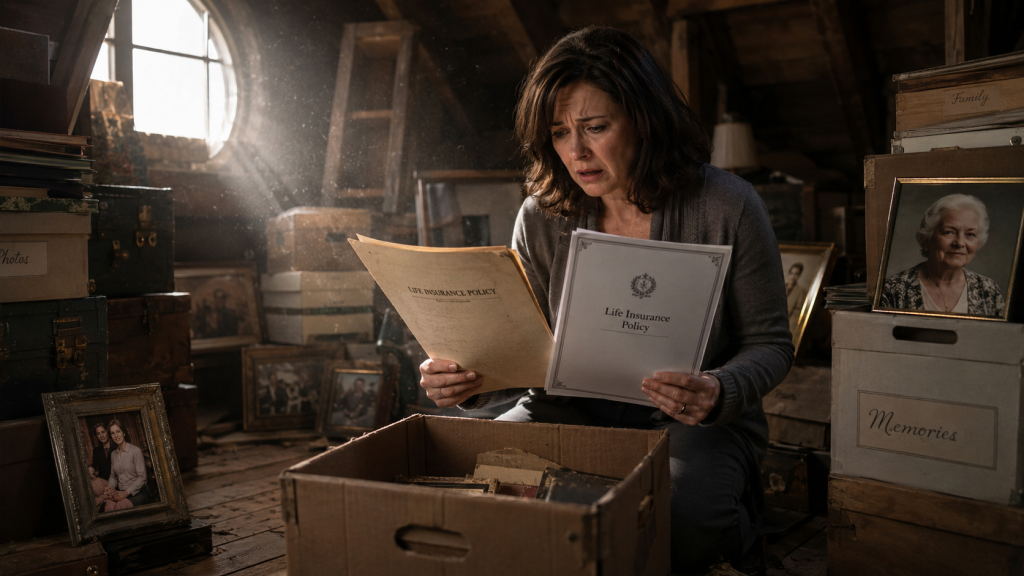
Three weeks ago, my mother could not remember how to sign her own birthday card.
Three weeks ago, she asked me why my father had not come home from work, even though he had been dead for twenty-one years.
Three weeks ago, she tried to put her shoes in the microwave because she thought it was the hallway closet.
And somehow, according to the document in my hand, she had walked into an insurance office and authorized a policy change worth half a million dollars.
I called the insurance company from the attic floor.
The agent placed me on hold twice.
When she came back, her voice was cautious.
“Ms. Torres, your mother’s original policy was cancelled. The new one names Gerald Torres as beneficiary.”
“My brother cancelled mine?”
“I can’t characterize it that way.”
“Then characterize it correctly.”
There was silence.
“The change was authorized in person by the policyholder.”
“My mother has dementia.”
“I understand your concern.”
“No,” I said. “You don’t. She can barely hold a pen.”
The agent lowered her voice.
“The paperwork indicates she signed voluntarily.”
I looked down at the signature.
Rose Torres.
Except it did not look like my mother’s signature.
Mom’s R always curled wide at the top.
Her T crossed heavily, almost angrily.
This signature was thin.
Shaky in the wrong way.
Careful, as if copied.
“Who processed it?” I asked.
“I’m not able to disclose internal employee details.”
That answer told me enough.
My brother’s wife, Diane, worked at that company.
She was not an agent.
Not officially.
She worked in policy support, which meant she had access to files most families never thought about until it was too late.
I hung up and drove straight to Mom’s house.
She was sitting in her recliner with a blanket over her knees, watching an old cooking show with the volume too loud.
“Hi, Mom,” I said.
She smiled.
For one beautiful second, I thought she knew me.
Then she said, “You look like my cousin Linda.”
I knelt beside her.
“Mom, did Gerald take you to the insurance office recently?”
She blinked.
“Gerald was little this morning. He had mud on his shoes.”
My throat tightened.
“He’s grown now, Mom.”
“Oh.”
She looked at her hands.
The fingers were bent with arthritis.
Her right hand trembled even at rest.
I took out a pen and paper.
“Can you write your name for me?”
She frowned with concentration.
It took her almost a full minute to grip the pen.
The letters came out uneven, drifting downward across the page.
Rose.
She stopped before writing Torres.
“I’m tired,” she whispered.
I looked at the insurance signature again.
It was not hers.
Not even close.
I called a lawyer that afternoon.
Her name was Patricia Vale, and she had a reputation for sounding bored while destroying people.
She listened without interrupting.
Then she said, “You have thirty days to contest a beneficiary change before it becomes extremely difficult to reverse.”
My hand tightened around the phone.
“How many days do I have left?”
“When was the change processed?”
“Three weeks ago.”
Patricia paused.
“Then you have about twenty-two days. We move now.”
The next morning, I sat in her office with every document I had found.
The old policy.
The new policy.
Mom’s medical records.
A note from her neurologist.
Recent videos showing her confusion.
A copy of her signature from 2018.
And the new signature that looked like someone had rehearsed it under pressure.
Patricia laid everything side by side.
Her expression did not change.
But her pen stopped moving.
“This is ugly,” she said.
“Can we stop it?”
“We can contest it. But if your brother’s wife works at the company, we need the internal chain. Who processed it? Who approved it? Was there a notary? Was capacity assessed? Was undue influence documented? Most companies have safeguards for elderly policyholders, especially with a known cognitive diagnosis.”
“She knew,” I said.
“Who?”
“Diane. My sister-in-law. She knew Mom had dementia. Everyone knows.”
Patricia leaned back.
“Then this may go beyond a family dispute.”
She called the company while I sat across from her.
She used words like preservation notice, litigation hold, suspected elder financial abuse, and regulatory complaint.
Suddenly, the insurance company became more cooperative.
An hour later, Patricia received the processing chain by email.
She read it silently.
Then looked up at me.
“Your brother’s wife initiated the change.”
I nodded, though my stomach had already sunk.
“And her supervisor who approved it is Martin Hale.”
The name struck me like cold water.
Martin Hale.
Gerald’s best friend from college.
The man who had attended Gerald’s wedding.
The man who came to Mom’s seventy-fifth birthday party and ate two plates of barbecue in our backyard.
The man I had seen in the background of a photo Gerald posted three weeks ago with the caption:
Helping Mom get things organized.
My voice came out flat.
“Martin was at my mother’s house the day the policy changed.”
Patricia’s eyes sharpened.
“Can you prove that?”
“I think so.”
I drove straight to Mom’s nursing aide service and asked for the visitor logs.
The receptionist hesitated until I mentioned legal fraud and elder exploitation.
Then she slid the clipboard across the desk with a look that said she already regretted working that shift.
Three weeks ago, at 11:20 a.m., Gerald signed Mom out.
At 11:22, Diane signed as accompanying family.
At 11:25, Martin Hale signed as “family friend.”
They returned at 1:43 p.m.
No one had told me.
No one had asked me.
No one had mentioned taking my confused mother anywhere.
I took photos of the log and drove home shaking.
That evening, I asked Mom again.
“Do you remember Gerald taking you somewhere?”
Mom stared out the window for a long time.
Then she whispered, “The bank with blue chairs.”
I froze.
The insurance office had blue chairs in the lobby.
I had seen them in photos online.
“What happened there, Mom?”
She rubbed her thumb against her fingers.
A nervous habit she had since I was a child.
“They told me to be good,” she said.
My skin went cold.
“Who told you?”
“The woman with red nails.”
Diane.
My sister-in-law always wore red nails.
“What did she tell you to do?”
Mom looked at me suddenly, her eyes filling with fear.
“Did I do wrong?”
I grabbed her hand.
“No, Mom. You didn’t do anything wrong.”
Her chin trembled.
“She said Gerald would lose the house if I didn’t help.”
I closed my eyes.
Gerald did not own Mom’s house.
Mom owned it outright.
Or I thought she did.
The next morning, Patricia filed the contest.
By lunch, Gerald called.
I let it ring twice before answering.
He did not say hello.
“You’re trying to steal from me!”
His voice was loud enough that I held the phone away from my ear.
“Interesting,” I said. “Because I thought I was trying to protect Mom.”
“You found one old policy and got greedy.”
“The old policy was active until your wife replaced it.”
He went quiet for half a second.
Then, “Diane didn’t do anything wrong.”
“She processed a policy change for her cognitively impaired mother-in-law.”
“Mom knew what she wanted.”
“Mom thinks Dad is still alive.”
“That’s not fair.”
“No, Gerald. What’s not fair is taking a seventy-nine-year-old woman with dementia to an insurance office and pretending her signature means consent.”
“You always thought you were better than me.”
“No. I always knew you were angry. I didn’t know you were this desperate.”
He cursed.
I asked one question.
“Why did Mom need three people to help her sign one document?”
Silence.
Then a rustling sound.
Diane grabbed the phone.
“You should have stayed out of the attic,” she hissed.
That was when I knew the insurance policy was not the only thing they had changed.
I hung up and called Patricia.
“Check the house,” I said.
“What house?”
“My mother’s house.”
Within two hours, Patricia pulled county records.
My mother’s house, the house she had paid off after thirty years of dental office work, had been placed into a transfer-on-death deed.
Beneficiary: Gerald Torres.
Updated the same day as the insurance policy.
My name had been removed.
Again.
The notary?
Martin Hale’s cousin.
The witness?
Diane Torres.
I sat in Patricia’s office staring at the screen.
The betrayal was no longer a single act.
It was a plan.
A coordinated plan.
Insurance.
House.
Power.
Access.
And probably more we had not found yet.
“Bank accounts,” I whispered.
Patricia nodded.
“We’ll subpoena records if necessary. But first we need emergency protection.”
“For Mom?”
“For Mom, and for the assets.”
The next day, we filed for temporary conservatorship review and an emergency injunction preventing any transfer of Mom’s property, insurance rights, or financial accounts until capacity and undue influence could be investigated.
Gerald exploded.
He called relatives.
He told them I was stealing from a sick woman.
He said I was punishing him because Mom loved him more.
Diane posted vague messages online about “money bringing out people’s true colors.”
I did not respond.
Patricia told me silence was not weakness when lawyers were building the trap.
Three days later, the first hearing took place.
Gerald arrived in a navy suit he probably bought for court.
Diane wore pearls and a wounded expression.
Martin Hale appeared as a company representative, which was the stupidest thing he could have done.
Patricia smiled when he entered.
Not kindly.
The judge listened while Gerald’s lawyer claimed Mom had wanted to “simplify her estate.”
Then Patricia played a video.
It was from the week before the policy change.
Mom sitting at her kitchen table, trying to sign a birthday card for her neighbor.
She could not write Torres.
She forgot the neighbor’s name.
She asked me why my father had not come home.
The courtroom went quiet.
Then Patricia placed the insurance signature beside Mom’s attempted signature.
Even from ten feet away, the difference was obvious.
The judge leaned forward.
“Who witnessed the insurance change?”
Martin cleared his throat.
“The paperwork was processed according to company procedure.”
“That was not my question,” the judge said.
Diane looked down.
Gerald’s jaw tightened.
Patricia spoke.
“Your Honor, we have reason to believe Mrs. Torres was taken from her home by Gerald Torres, Diane Torres, and Martin Hale, brought to the insurance office, pressured into signing documents she did not understand, and then also taken to execute a property transfer.”
Gerald stood.
“That’s a lie!”
The judge looked at him once.
He sat down.
Patricia continued.
“We are requesting temporary suspension of all recent beneficiary changes, a freeze on property transfer, independent capacity evaluation, and referral to Adult Protective Services.”
Diane’s face went pale.
Martin shifted in his seat.
The judge granted all of it.
Afterward, Gerald followed me into the courthouse hallway.
“You’re ruining my life,” he said.
I looked at him.
“No. I’m interrupting what you tried to do to Mom.”
His eyes filled with rage.
“You don’t know what it’s like. I have debt. Diane’s job is unstable. Mom promised to help.”
“Mom can’t promise half a million dollars when she doesn’t know what day it is.”
“She’s my mother too.”
“Then act like her son.”
He flinched.
For one second, I saw the little boy he used to be.
The one Mom packed extra sandwiches for because he was always hungry.
The one who cried when Dad died but refused to let anyone see.
Then Diane grabbed his arm.
“Don’t talk to her.”
Gerald let her pull him away.
That hurt more than I expected.
Not because he left.
Because he had already chosen his side.
The investigation moved faster after that.
The insurance company placed Diane on administrative leave.
Martin Hale was suspended pending internal review.
The notary admitted she never saw Mom sign the property deed in person.
She had stamped it because Martin told her it was “family business.”
Family business.
That phrase has covered more crimes than strangers ever could.
Adult Protective Services interviewed Mom.
She could not explain the insurance policy.
She did not know what a beneficiary was.
When asked who she wanted to inherit her house, she said, “The children can share. But Elena knows where the water shutoff is.”
I cried when Patricia told me.
It was such a Mom answer.
Practical even through the fog.
The insurance company eventually reversed the new policy and reinstated the 2018 beneficiary designation pending final legal review.
The property transfer was voided.
Mom’s accounts were frozen under court supervision.
I was appointed temporary conservator after an independent doctor confirmed what we already knew: Mom could not understand complex financial documents and had not been able to for months.
Gerald did not speak to me for six weeks.
Then one evening, he came to Mom’s house while I was cleaning out the pantry.
I saw him through the kitchen window.
He looked older.
Thinner.
Diane was not with him.
I opened the door but did not invite him in.
“What do you want?”
He looked past me into the house.
“Is Mom here?”
“She’s sleeping.”
He nodded.
Then he said, “Diane left.”
I said nothing.
“She said I ruined everything.”
I stared at him.
“Did she make you do it?”
His mouth trembled.
“I wanted to believe it was okay.”
That was the closest thing to honesty I had heard from him in months.
“She said Mom would never know the difference,” he whispered.
“And you listened?”
He looked down.
“I’m in debt, Elena.”
“So you sold your soul?”
His eyes filled.
“I thought I could fix it before anyone found out.”
“Fix what? You were waiting for Mom to die.”
The words hit him hard.
He actually staggered back.
“I wasn’t—”
“Yes,” I said. “You were. You changed her insurance and her house. You didn’t borrow money. You bet on her death.”
He covered his face with both hands.
For a moment, I thought he would cry.
Then Mom’s voice came from behind me.
“Gerald?”
I turned.
She stood in the hallway in her robe, small and confused.
Gerald looked at her.
His face broke.
“Hi, Mom.”
She smiled faintly.
“You’re late for school.”
He made a sound like a sob.
“Yeah,” he whispered. “I know.”
She shuffled toward him.
I wanted to stop her.
I wanted to protect her from him.
But dementia is cruel in strange ways.
She did not remember the theft.
She did not remember the signatures.
She remembered her son as a boy with messy hair and untied shoes.
Gerald knelt in front of her.
She touched his cheek.
“Did you eat?”
That was Mom.
Always asking if the person hurting was fed.
Gerald cried then.
Really cried.
Not because he was forgiven.
Because she did not know what he had done.
And somehow, that was worse.
He agreed to a settlement two weeks later.
He surrendered all claims to the policy and the house.
He cooperated with the investigation.
Diane was terminated from the insurance company.
Martin lost his license approval authority and faced civil penalties.
The notary was referred to the state commission.
No one went to prison.
People always expect justice to look dramatic.
Sometimes justice looks like documents corrected, access revoked, signatures invalidated, and guilty people forced to live with who they became.
Gerald and I did not become close again.
This is not that kind of story.
There are betrayals that do not disappear just because someone cries in the kitchen.
But he visits Mom twice a month now.
Supervised.
He brings groceries.
He fixes little things around the house.
He does not discuss money.
The first time he tried, Mom patted his hand and said, “Ask Elena. She remembers things.”
He looked at me then.
Not angry.
Ashamed.
I am still learning what to do with that.
Mom’s attic is clean now.
The folders are organized in fireproof boxes.
The insurance policy is safe.
The house is protected.
Her medical care is funded.
Her favorite chair is still by the window.
On good days, she calls me Elena.
On bad days, Linda.
On very bad days, she looks at me with fear, and I sit beside her until it passes.
Sometimes she asks about Gerald.
Sometimes she asks about Dad.
Sometimes she asks if the children will be all right.
I always tell her yes.
Because that is what she needs to hear.
And because, now, I can make sure it is true.
Last week, I found one more folder in the attic.
It was tucked behind a box of Christmas ornaments.
My name and Gerald’s were written across the front in Mom’s handwriting.
Inside was a letter.
Not legal.
Not official.
Just Mom.
My children,
If you are reading this, I am probably forgetting things.
I hope I remembered to tell you both that I love you.
Money is only paper unless it becomes care.
Do not let it make you cruel.
Do not let fear make you greedy.
Do not let grief make you strangers.
Elena, you always carry too much.
Gerald, you always hide when you are scared.
Please find your way back to each other if you can.
If you cannot, at least do not destroy what love built.
Mom.
I sat on the attic floor and cried.
Not because the letter fixed anything.
It did not.
But because she had seen us clearly before the fog came.
She knew me.
She knew Gerald.
She knew what fear could do.
And she tried, in her quiet way, to protect us from ourselves.
I made a copy of the letter and mailed it to Gerald.
He did not call.
But the next time he visited Mom, he brought lemon pie.
Not store-bought.
Homemade.
It was terrible.
Too sour.
The crust was burned.
Mom ate two bites and said, “Needs sugar.”
Gerald laughed.
I laughed too.
For one small moment, we were not enemies.
We were just two tired children sitting with the mother who had loved us before money turned love into paperwork.
I found a life insurance policy in my mother’s attic.
Five hundred thousand dollars.
Beneficiary: me.
Then I found another one.
Same amount.
Beneficiary: my brother.
Updated three weeks before.
I thought I had uncovered greed.
I did.
But I also uncovered fear.
Corruption.
Pressure.
Shame.
And the terrifying truth that elderly people can be robbed without anyone breaking a window.
Sometimes all it takes is a pen placed in a trembling hand.
A lie spoken gently.
A witness willing to look away.
A family member who thinks need excuses betrayal.
My mother cannot protect herself anymore.
So I will protect her.
Not because of the money.
Not because of the house.
Because once, when I was small and afraid of the dark, she sat beside my bed every night until I slept.
Now it is my turn to sit beside her.
My turn to remember.
My turn to keep the light on.
And if anyone tries to steal from her again, they will learn what Gerald learned too late.
Dementia may have taken my mother’s memory.
But it did not take her daughter.
THE END! THANKS FOR READING!