
My mother spent seven years praying to my dead sister.Every night, before she went to bed, she lit one white candle beside Valeria’s photograph.She would sit in that little room at the end of the hallway, holding a rosary between trembling fingers, whispering the same words over and over.“Come to me in a dream, my baby. Just once. Let me know you are at peace.”
I used to stand outside the door and listen.Sometimes she cried softly.Sometimes she talked to Valeria like she was still alive.And sometimes, on the worst nights, she begged God to take her too.My sister’s room had become a shrine.
The bed remained perfectly made with the lavender blanket Valeria loved.
Her school trophies still stood on the shelf.
Her books were lined up in the exact order she had left them.
A silver hairbrush sat on the dressing table beside a bottle of perfume that had gone stale years ago.
And on the wall hung the photograph from her seventeenth birthday.
Valeria smiling.
Valeria alive.
Valeria before everything disappeared.According to the police, she died seven years ago.One night, she left the house after dinner.She never came back.My father said she had been upset.He told the police she had been rebellious for weeks. He told neighbors she had been seeing dangerous people. He told my mother that grief would destroy us if we kept asking questions.
Months later, human remains were found buried in a rural field outside the city.
The investigation moved quickly after that.
Too quickly.
The police told us the tests matched.
They handed us an urn.
They gave us a sealed report.
There was a funeral.
There were flowers.
There were prayers.
There were people crying in black clothing, telling us Valeria was in a better place.
My mother nearly collapsed beside the coffin.
I remember my father holding her by the shoulders and whispering, “Let her rest.”
That became his favorite sentence.
Let her rest.
Whenever I asked about the report, he said, “Let her rest.”
Whenever my mother wondered why Valeria would leave without her phone, he said, “Let her rest.”
Whenever an old classmate called and said Valeria had been scared of someone before she vanished, he said, “Let her rest.”
And eventually, silence swallowed our house.
But my mother never accepted silence.
Not truly.
She kept Valeria’s room untouched.
She kept the candle burning.
She kept waiting.
For seven years, she waited for a miracle.
And yesterday, the miracle appeared on national television.
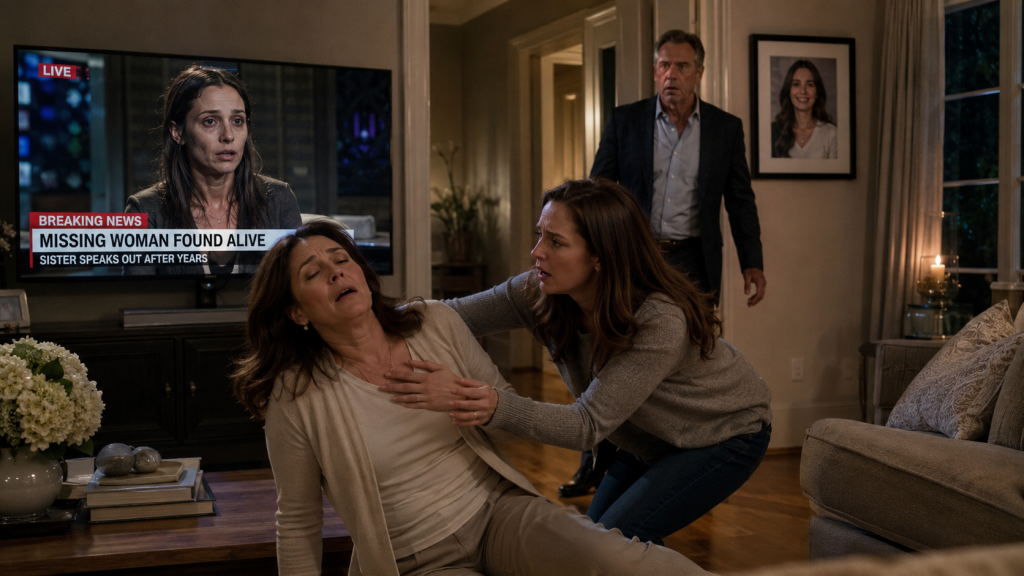
I was eating dinner alone in the living room when the news report interrupted the program.
The anchor’s face was serious.
A woman had escaped after being held against her will for years.
The case was being called one of the most shocking crimes in the country.
I barely listened at first.
Then they showed the victim.
My fork slipped from my hand.
The plate shattered against the floor.
The woman on the screen was thin.
Her cheeks were hollow.
Her hair was shorter.
Her eyes looked older than they should have.
But I knew her.
I knew the small scar near her eyebrow.
I knew the way her mouth trembled when she tried not to cry.
I knew my sister.
“Valeria,” I whispered.
My mother came running from the kitchen.
“What happened?”
I couldn’t answer.
I only pointed at the television.
She turned.
For one second, she did not move.
Then she screamed so loudly that the sound seemed to crack the walls.
Because the dead do not appear on television.
The dead do not sit under studio lights.
The dead do not speak into microphones with tears in their eyes.
But Valeria did.
My mother reached toward the screen like she could touch her.
“My baby,” she sobbed. “My baby is alive.”
The journalist asked Valeria how she had survived.
Valeria looked down at her hands.
“I was hidden,” she said. “Moved from place to place. I was told my family believed I was dead. I was told if I tried to escape, my mother would suffer.”
My mother covered her mouth.
I felt the room tilt beneath me.
Then the journalist asked, “Who was responsible?”
Valeria lifted her eyes.
Her face changed.
Fear passed through it first.
Then rage.
“The man everyone believes is a good person,” she said.
The screen changed.
A photograph appeared beside her.
The alleged suspect.
My mother collapsed before I could catch her.
Because the man in the photograph was my father.
The same man who had stood beside us at the funeral.
The same man who carried the urn into the church.
The same man who told my mother to stop asking questions.
I dropped to my knees beside her and grabbed my phone to call an ambulance.
Before I could dial, the phone vibrated.
Unknown number.
I answered with shaking hands.
At first, there was only breathing.
Ragged.
Panicked.
Then a voice whispered, “Marina?”
My heart stopped.
Only one person in the world called me that way.
“Valeria?”
She began to cry.
“I don’t have time.”
“Where are you?” I whispered. “Where are you?”
“Listen to me. Dad already knows I spoke out.”
Behind me, the front door opened.
My father stepped inside.
Rain dripped from his coat.
His eyes went first to my unconscious mother, then to me, then to the phone in my hand.
“Who are you talking to?” he asked.
His voice was calm.
Too calm.
Valeria whispered quickly, “Old Miller Road. The abandoned chapel behind the cemetery. Go now.”
“What is there?”
“The truth,” she said. “And proof.”
My father took one step toward me.
“Give me the phone, Marina.”
Valeria’s voice broke.
“If he gets there before you, you will never know who really died at my funeral.”
The line went dead.
My father held out his hand.
“Give it to me.”
I stared at him.
For seven years, I had wanted to believe he was only cold because grief had changed him.
But grief does not make a man look at his daughter like a locked door he is ready to break.
“What did you do to her?” I asked.
His face hardened.
“Your sister was sick. She ruined this family.”
“She was alive.”
He stepped closer.
“She should have stayed dead.”
The words turned my blood to ice.
I ran.
I did not grab my coat.
I did not grab shoes.
I slipped through the kitchen, out the back door, and into the rain.
My mother’s car keys were still in my pocket from earlier that day.
I jumped into her car and drove barefoot through the storm, sobbing so hard the road blurred.
Behind me, headlights appeared.
My father was following.
Old Miller Road twisted through woods and fields, ending near an abandoned cemetery no one visited anymore.
The chapel stood behind it, leaning and gray, with broken windows and ivy crawling over the walls.
I parked behind a row of trees and ran inside.
The chapel smelled of damp wood and old dust.
Candles burned near the altar.
Fresh candles.
Someone had been there.
At the center of the room sat a wooden box.
On top of it was an envelope.
My name was written across the front.
Marina.
My hands shook as I opened it.
Inside were photographs.
Documents.
Birth records.
Police reports.
And one picture that made my knees weaken.
Valeria standing beside a young woman who looked almost exactly like her.
Same dark hair.
Same build.
Same age.
On the back of the photograph, someone had written one name.
Lucia.
A voice came from the shadows.
“That was the girl they buried as me.”
I turned.
Valeria stood near the broken window.
For a moment, neither of us moved.
Then I ran to her.
She felt real in my arms.
Thin.
Shaking.
Alive.
I held her so tightly she gasped.
“I thought you were gone,” I cried.
“I know,” she whispered. “He made sure everyone thought that.”
“What happened?”
Valeria pulled away and looked toward the door.
“We don’t have long.”
She opened the wooden box.
Inside were more files, an old phone, a necklace, and a small recorder.
“Dad was involved with people who moved girls across state lines,” she said. “I found out by accident. I saw names. Payments. Photos. I told him I was going to the police.”
My stomach twisted.
“He kidnapped you?”
“He said he was protecting the family. He locked me in a cabin first. Then he handed me to a man who owed him money. They kept moving me whenever I caused trouble.”
“And Lucia?”
Valeria’s eyes filled with tears.
“She was another girl they took. She tried to escape. She died before I could help her.”
I covered my mouth.
“They used her body?”
Valeria nodded.
“She had no family looking for her. Dad arranged everything. He paid someone to falsify the test. He gave you ashes and called it closure.”
My father’s voice suddenly echoed through the chapel.
“Very touching.”
We turned.
He stood in the doorway, soaked from rain, holding a flashlight.
His face was no longer the face of a grieving father.
It was the face of a man whose secrets had finally caught fire.
Valeria stepped behind me.
“You should have stayed hidden,” he said.
“You buried another girl in my name,” she replied.
He sighed as if she had disappointed him.
“You never understood what I built. What I protected.”
“You destroyed us,” I said.
He looked at me with disgust.
“I kept this family alive.”
“No,” I said. “You kept yourself safe.”
He moved closer.
I backed toward the altar.
My fingers touched the small recorder inside the box.
I pressed the button.
A red light blinked.
My father did not notice.
He looked only at Valeria.
“You were always like your mother,” he said. “Weak. Emotional. Dangerous with the truth.”
Valeria lifted her chin.
“The truth is already out.”
He laughed.
“A television interview is not proof. By morning, my lawyers will call you unstable. They will say trauma confused you. They will say you are inventing memories.”
“Not after this,” I said.
He turned to me.
I held up the recorder.
His smile vanished.
From outside, sirens wailed.
Red and blue lights flashed through the broken chapel windows.
My father froze.
Valeria exhaled like she had been holding her breath for seven years.
I heard footsteps.
Officers rushed through the door.
My father raised both hands, suddenly calm again, suddenly innocent.
“This is a misunderstanding,” he said.
But the box was open.
The files were visible.
The recorder was running.
And Valeria was standing alive in the middle of the chapel.
They arrested him beneath the cross.
He did not look at Valeria as they took him away.
He looked at me.
As if I had betrayed him.
But I knew the truth now.
He had betrayed us first.
My mother woke in the hospital hours later.
The first thing she asked was, “Was it a dream?”
I took her hand.
“No, Mom.”
Valeria stepped into the room.
My mother made a sound I had never heard before.
Not quite a cry.
Not quite a prayer.
Something deeper.
Something broken becoming whole.
Valeria rushed into her arms.
They held each other while the machines beeped softly around them.
My mother touched Valeria’s face again and again, as if counting every bone, every tear, every breath.
“I lit a candle for you every night,” she sobbed.
“I saw them,” Valeria whispered.
My mother pulled back.
“What?”
Valeria smiled through tears.
“The chapel had a window facing the road. Sometimes, from one of the houses they kept me in, I could see the candle in our window from far away. I knew you still loved me.”
My mother broke down again.
For seven years, she had thought she was praying to the dead.
But somewhere in the dark, her living daughter had been praying back.
The investigation lasted months.
Names came out.
Officers were suspended.
Doctors questioned.
Records reopened.
Lucia finally got her real name back.
Her remains were returned to the aunt who had never stopped searching for her.
My father never confessed.
Not fully.
Men like him rarely do.
Even in court, he called himself a protector.
A victim.
A father who had made difficult choices.
But the jury heard the recorder.
They saw the documents.
They listened to Valeria.
And when the verdict came, my mother did not cry.
She only closed her eyes and whispered, “Now let her rest.”
This time, she was not talking about Valeria.
She was talking about Lucia.
Today, my sister’s room is no longer a shrine.
The bed is unmade sometimes.
The window is open.
Her trophies are dusty.
Her photograph still hangs on the wall, but now it is surrounded by new ones.
Valeria smiling with my mother.
Valeria sitting in sunlight.
Valeria alive.
Some nights, my mother still lights a candle.
But not because she is waiting for a miracle anymore.
She lights it for the girl who was buried under the wrong name.
She lights it for the years stolen from us.
She lights it because darkness can live inside a house for a long time when everyone is taught to call it grief.
And sometimes, when the flame flickers, Valeria sits beside her.
Neither of them says much.
They do not have to.
My mother spent seven years praying to my dead sister.
But my sister was never dead.
She was hidden.
She was silenced.
She was erased.
And the man who erased her sat at our dinner table every night, pretending to mourn.
Now his chair is empty.
The room at the end of the hallway is open.
And for the first time in seven years, our house finally feels like a place where the living can breathe.
THE END! THANKS FOR READING!