
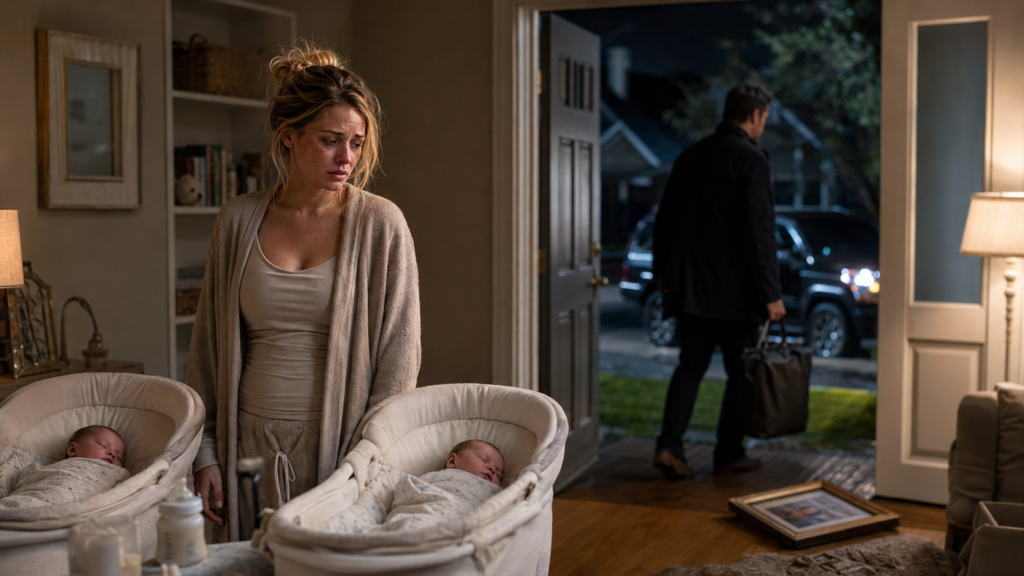
My husband, Daniel Whitmore, shouted those words in the middle of our living room while our one-month-old twins screamed from their bassinets.He had a suitcase in his hand.I had spit-up on my shirt, stitches that still burned when I walked, and a body that felt like it had been broken open and stitched back together too quickly.Lily had finally stopped crying after forty minutes of rocking, only for Noah to wake up hungry again.
I had slept maybe two hours in three days.My hair was greasy.My hands shook when I lifted a bottle.My eyes felt gritty from crying silently in the bathroom at dawn so Daniel would not accuse me of “making everything worse.”“Daniel, please,” I whispered, holding Noah against my chest. “I can’t do this alone.”
He laughed.
Not because anything was funny.
Because he was angry that I had dared to need him.
“Women have babies every day, Claire. You’ll survive.”
His phone buzzed in his pocket.
Outside, someone honked.
Then laughter rose from the driveway.
His friends.A black SUV waited in front of our small house in Portland, engine running, music thumping faintly through the closed windows.For three seconds, I did not understand.Then I saw the suitcase.The good one.The black hard-shell suitcase he used for international trips.
“You’re seriously leaving?” I asked.
Daniel avoided my eyes.
“I paid for it months ago.”
“We have newborn twins.”
“And I have a life too.”
The sentence hit harder than if he had yelled.
I stared at the man I married three years earlier, the man who cried when the ultrasound showed two heartbeats, the man who promised he would take night shifts, change diapers, and “protect my recovery like a guard dog.”
Now he stood in front of me acting like fatherhood was a noisy inconvenience interrupting his vacation.
“You never told me the trip was still happening,” I said.
His jaw tightened.
“I knew you’d react like this.”
“Like what?”
“Emotional. Controlling. Making everything about you.”
Noah started crying harder.
Lily stirred in her bassinet and began wailing too.
Daniel covered his ears for one dramatic second.
“This,” he snapped. “This is exactly what I’m talking about. I can’t breathe in this house.”
I looked down at Noah’s tiny face, red and furious and innocent.
“They are one month old, Daniel.”
“I know how old they are.”
“Then act like it.”
His face changed.
For a moment, I thought he might shout again.
Instead, he rolled his suitcase toward the door.
“Don’t start. I need space.”
I followed him as far as the hallway, one baby in my arms, the other crying behind me.
“Please,” I said again, and hated how small my voice sounded. “Please don’t leave me like this.”
He opened the door.
Cold air rushed in.
One of his friends called, “Come on, man! We’re going to miss check-in!”
Daniel looked back at me.
Not with guilt.
Not with love.
With annoyance.
“You’ll survive.”
Then he walked out.
The front door slammed so hard the framed photo from our wedding fell off the wall and cracked against the floor.
For a long time, I stood there with Noah crying against my shoulder, staring at the broken glass around our smiling faces.
That night, I sat on the nursery floor between two crying babies and cried with them.
I fed one.
Then the other.
Changed one.
Then the other.
Rocked Lily until Noah screamed.
Rocked Noah until Lily hiccupped herself awake.
By morning, I could not remember whether I had eaten.
By the second day, I forgot to take my pain medicine on time and ended up curled on the bathroom floor, breathing through the ache while Lily screamed from her crib.
Daniel posted his first photo from Paris that afternoon.
He stood beneath the Eiffel Tower with three friends, sunglasses on, beer in hand.
His caption read:
Finally breathing again.
I stared at the screen until the words blurred.
Finally breathing.
While I sat in a dark nursery, trying to keep two newborns alive with a body that had not healed and a mind that felt like it was coming apart thread by thread.
He did not call.
Not that day.
Not the next.
He sent one text on the fourth day.
Hope you’re calmer now.
I did not answer.
I wanted to write back, Hope you remember you have children.
Instead, I put down the phone and changed Noah’s diaper with shaking hands.
The first week nearly broke me.
There is no poetic way to say it.
I smelled like milk and sweat.
My stitches pulled when I bent.
My breasts hurt.
My back ached.
I cried when both babies cried because there was only one of me and two of them.
Neighbors dropped off casseroles, but I forgot to eat them until they spoiled.
My mother lived across the country and had her own health issues.
My father was gone.
Daniel’s mother, Elise Whitmore, called twice.
The first time, I did not answer.
The second time, I picked up because I thought maybe she would help.
“Claire,” she said gently. “How are the babies?”
That question undid me.
I started crying before I could stop myself.
There was silence on her end.
Then she asked, “Where is Daniel?”
I could have lied.
A wife protects her husband.
That was what people taught us.
Smooth the edges.
Make excuses.
Say he is tired.
Say he is working.
Say new fatherhood is hard.
But I looked at Lily and Noah lying beside each other on the changing pad, their tiny fists waving in the air, and I realized protecting Daniel meant abandoning them.
“He went to Europe,” I whispered.
The silence on the phone changed.
“What?”
“With his friends. For a month.”
Elise did not speak for several seconds.
When she did, her voice had become colder than I had ever heard it.
“When did he leave?”
“Last week.”
“Did he arrange help for you?”
“No.”
“Are you alone?”
“Yes.”
Another pause.
Then she said, “Claire, I am getting on a plane.”
“No,” I said quickly. “It’s okay. I don’t want drama.”
“Drama?” Her voice sharpened. “My son left his postpartum wife alone with one-month-old twins and flew to Europe. Drama has already happened.”
But Elise was in Florida visiting her sister and could not arrive until the next evening.
I told her not to come.
She ignored me.
Still, by the eighth day, before Elise arrived, something inside me went quiet.
Not healed.
Not strong.
Quiet.
The kind of quiet that comes after you stop waiting for a door to open.
I sat on the nursery floor at 3:12 a.m., feeding Lily while Noah slept against my thigh, and looked at Daniel’s latest photo.
Rome.
A rooftop restaurant.
A woman I did not know leaning too close beside him.
His arm around the back of her chair.
The caption was one word:
Freedom.
I turned off my phone.
Then I turned it back on and called my older sister, Marianne.
She answered groggily.
“Claire?”
“I need help.”
That was all I said.
She was silent for half a second.
Then fully awake.
“I’m coming.”
Marianne lived in Seattle.
She drove through the night.
When she arrived at 8:40 the next morning, she found me sitting on the couch, pale and half-asleep, with Noah in my arms and Lily crying in the bassinet.
She did not ask why the living room was messy.
She did not ask why I smelled like milk.
She did not tell me I looked terrible.
She walked in, took Noah gently from my arms, and said, “Go shower. I’ve got them.”
I tried to argue.
She pointed toward the hallway.
“Claire. Shower.”
Under the hot water, I cried so hard I had to sit down.
When I came out wearing clean pajamas, Marianne had changed both babies, started laundry, ordered groceries, washed bottles, and put soup on the stove.
She handed me a bowl.
“Eat.”
I ate three spoonfuls and started crying again.
Marianne sat across from me.
“Now tell me everything.”
So I did.
Daniel leaving.
The SUV.
The posts.
The silence.
The women in the photos.
The bills arriving.
The ignored calls.
The way he made me feel as if asking for help was selfish.
By the time I finished, Marianne’s face was unreadable.
That was never a good sign.
My sister was a high school principal.
She had mastered the expression adults wore right before consequences entered the room.
“Do you want to stay married to him?” she asked.
The question stunned me.
Not because I had not thought about it.
Because no one had asked what I wanted in weeks.
I looked toward the nursery.
“I don’t know.”
“That’s fair.”
“I just know I can’t live like this.”
“That’s also fair.”
By noon, Marianne had created a folder on my laptop.
Daniel travel photos.
Messages.
Bank withdrawals.
Credit card charges.
Unpaid utility notice.
Mortgage reminder.
My medical discharge papers.
The pediatrician appointments he missed.
The call log showing every time I reached out.
Every message he ignored.
She took screenshots of his public posts before he could delete them.
Paris.
Rome.
Barcelona.
Ibiza.
Him laughing on a boat.
Him drinking wine.
Him dancing in a club.
Him kissing a woman with dark hair beneath blue lights.
I saw that photo and stopped breathing.
Marianne’s hand landed on my shoulder.
“Save it,” she said softly.
“I don’t want to look at it.”
“You won’t have to for long. But save it.”
I did.
That evening, Elise arrived from Florida.
She came through the door with two suitcases, red eyes, and a face carved from fury.
When she saw me, her expression broke.
“Oh, Claire.”
I stood awkwardly, unsure if she was there as my mother-in-law or as Daniel’s mother.
Then she hugged me.
Carefully.
Gently.
Like someone who knew I had been cracked in half.
“I am so sorry,” she whispered.
I started crying again, but this time I did not feel ashamed.
She went to the bassinets and looked at the twins.
Lily blinked up at her.
Noah yawned.
Elise covered her mouth.
“My grandchildren,” she whispered.
Then she turned toward the wall where the wedding photo had fallen.
The cracked frame still sat on the entry table.
Her face hardened.
“Where is my son right now?”
“I think Barcelona,” Marianne said.
Elise pulled out her phone.
I stopped her.
“Please don’t call him.”
She looked at me.
“I am not asking him to come home. A man who needs to be begged back to his newborns is not useful.”
That sentence stayed with me.
A man who needs to be begged back is not useful.
The next day, Marianne called a family lawyer named Victor Hayes.
He was calm, direct, and had the exhausted patience of someone who had watched too many people confuse marriage with permission to neglect.
I sat on the couch with a burp cloth over my shoulder while Victor spoke through the laptop.
“Claire, I need to be clear. Leaving you alone postpartum with one-month-old twins while he travels internationally may be relevant to custody, support, and financial conduct. His social media posts help establish timeline and priorities. The photo with the woman may matter in property negotiations depending on spending.”
I nodded numbly.
“I don’t want to punish him,” I said.
Victor’s eyes softened.
“Protecting yourself and your children is not punishment.”
By the second week, I opened a separate bank account.
Not because I wanted to hide money.
Because Daniel had been spending freely abroad while bills at home waited.
Marianne helped me move my freelance income there.
Elise insisted on paying for a night nurse three nights a week.
At first, I refused.
She looked at me sharply.
“Do not deny my grandchildren care because my son failed to provide it.”
I accepted.
The first night the nurse came, I slept four straight hours.
When I woke, I cried from the shock of feeling human.
By the third week, Victor filed for legal separation and emergency temporary custody.
The petition stated the truth plainly.
Daniel had voluntarily left the marital home for a month-long international vacation.
Daniel had not arranged care for his postpartum wife or newborn twins.
Daniel had ignored calls and messages.
Daniel had used marital funds for travel and entertainment while household bills remained unpaid.
Daniel had publicly posted intimate images with another woman.
Words look different in legal documents.
Cleaner.
Sharper.
Less emotional.
Somehow, that made them more devastating.
I read the filing twice, then closed the laptop.
“That’s my marriage?” I whispered.
Marianne sat beside me.
“That’s his behavior.”
By the fourth week, Daniel’s name was removed from the nursery savings account my parents had funded before their deaths.
That account had been meant for the twins.
Not airfare.
Not wine.
Not hotels.
Not whatever life Daniel thought he deserved separate from the family he had abandoned.
Elise went with me to the bank.
When the manager asked if Daniel should be notified, Elise said, “My son will be notified by his consequences.”
Even Marianne looked impressed.
During Daniel’s final week abroad, he called once.
Not to apologize.
Not to ask how Lily and Noah were.
He called because his credit card declined at a hotel in Ibiza.
“What did you do to the account?” he demanded.
I was sitting in the nursery with Lily asleep on my chest.
Noah was curled beside Marianne on the rocking chair.
Elise was folding tiny onesies at the dresser.
For the first time in a month, I did not feel alone.
“I protected the babies’ money,” I said.
He laughed harshly.
“Don’t start acting insane because I took a trip.”
“A trip?”
“I needed space.”
“You needed space from one-month-old twins?”
“I needed space from you acting like motherhood made you helpless.”
Elise froze.
Marianne’s face darkened.
I closed my eyes.
There it was again.
The cruelty dressed as honesty.
“I’m hanging up now,” I said.
“Claire, don’t you dare—”
I ended the call.
My hand shook afterward, but not from fear.
From the body remembering fear while the mind had already chosen differently.
On the morning Daniel came home, I was not in the house.
Neither were the babies.
We had moved two days earlier into Marianne’s rental townhouse across town.
It was small, clean, and quiet.
The twins’ bassinets were by the window.
My clothes were folded in a dresser that did not smell like Daniel’s cologne.
A security camera app showed our old front entry.
Victor had arranged for Daniel to be served at the house.
Elise had asked to be present.
Not inside.
Nearby.
She wanted to see the truth land.
At 11:18 a.m., Daniel’s rideshare pulled into the driveway.
He got out tanned, rested, wearing sunglasses and a linen shirt I had never seen before.
He looked like a man returning from a life that had not cost anyone else anything.
He rolled his suitcase to the door and tried his key.
It worked.
I had not changed the locks.
I wanted him to open the door.
I wanted him to see exactly what abandonment looked like when it stopped waiting.
The camera showed him stepping inside.
Then stopping.
The living room was empty.
The couch remained, but the family photos were gone.
The twins’ bassinets were gone.
The diaper cart was gone.
The framed ultrasound was gone.
The wedding photos were gone.
On the kitchen counter lay three things.
Divorce papers.
A court summons.
And a printed photo of him kissing the woman in Ibiza.
Daniel walked slowly toward the counter.
He picked up the photo first.
His face changed.
Then he picked up the summons.
His mouth opened.
“No,” he whispered.
He turned toward the nursery.
Empty.
He ran down the hallway.
Opened the bedroom.
The closet.
The bathroom.
Then back to the nursery.
“No. No way. This can’t be happening.”
His phone rang.
I knew because Elise called him from the driveway.
He answered on camera, voice sharp with panic.
“Mom? Where is Claire?”
Elise’s voice came through my speaker.
“Safe. With the babies. Which is more than you bothered to make sure of for a month.”
Daniel’s face twisted.
“This is ridiculous. She’s being dramatic.”
“Do not use that word,” Elise said.
“She took my kids.”
“She removed them from a home you voluntarily abandoned.”
“I didn’t abandon anyone. I took a vacation.”
“From your newborn children?”
“I needed a break.”
There was a silence.
Then Elise said, “Claire needed stitches to heal. Sleep. Food. Help. You gave yourself champagne in Barcelona.”
Daniel looked toward the camera suddenly, as if sensing I was watching.
“Claire?” he called.
I did not answer.
The doorbell rang.
Daniel jerked around.
Victor Hayes stood outside with a process server.
Daniel opened the door halfway.
“Mr. Whitmore,” Victor said. “You’ve been served.”
Daniel looked down at the papers, then back at Victor.
“What the hell is this?”
“A petition for legal separation, emergency custody orders, and financial restraint pending hearing.”
Daniel’s voice rose.
“I just got home.”
Victor’s expression did not change.
“Yes. That timing was intentional.”
Daniel threw the papers onto the table.
“You people are insane.”
Then my voice came through the hallway speaker.
I had activated it from Marianne’s house.
“No, Daniel. We are awake.”
He spun toward the speaker.
“Claire?”
I sat on Marianne’s couch with Lily sleeping against my chest and Noah tucked safely beside my sister.
My voice was steady.
Steadier than I felt.
“You came home to exactly what you left behind.”
He swallowed.
“Where are my children?”
“Our children are safe.”
“Bring them home.”
“No.”
“This is my house too.”
“Yes. And the court will decide what happens next.”
He laughed once, panicked and ugly.
“You can’t just leave me.”
I looked at the camera feed.
At the empty nursery.
At the man who had walked away when I begged.
“You left first.”
“That was different.”
“Because you wanted it?”
He dragged a hand through his hair.
“I was overwhelmed.”
“So was I.”
“You had the babies.”
I almost laughed.
As if the babies were a vacation package he had generously left for me to enjoy.
“Yes,” I said. “I had the babies. Alone. Bleeding. Exhausted. Afraid. While you posted about freedom.”
He looked at the printed Ibiza photo.
“That meant nothing.”
“Leaving meant everything.”
For once, he had no answer.
Then he tried the voice.
The soft one.
The husband voice.
“Claire, come home. We can fix this.”
I looked down at Lily’s tiny hand curled against my shirt.
“No, Daniel. We are not coming home to a man who needs a court order to remember he is a father.”
His eyes filled, but I did not know whether it was sorrow or fear.
Maybe both.
“I’m their dad.”
“Then you should have acted like it when they needed you most.”
Elise arrived twenty minutes later.
She walked into the house without knocking because Daniel had left the door open.
He turned toward her like a drowning man seeing a boat.
“Mom, talk to her.”
Elise looked around the empty living room.
Then at the divorce papers.
Then at her son.
“I am.”
“What?”
“I’m talking to her attorney. I’m talking to the court if asked. And I’m talking to you now.”
His face went pale.
“You’re taking her side?”
Elise’s eyes flashed.
“I am taking my grandchildren’s side. Sadly, that is not yours.”
Daniel looked genuinely stunned.
That was when I realized he had expected everyone to orbit his discomfort forever.
Even his mother.
Especially his mother.
Elise walked past him into the garage and returned carrying the family heirloom cradle.
It was old, polished wood, carved by Daniel’s grandfather.
She had loaned it to us when the twins were born, though they were too small and medically delicate to sleep in it safely yet.
“This belongs with my grandchildren,” she said.
Daniel stepped forward.
“You can’t take that.”
Elise looked at him.
“Watch me.”
Victor’s process server, still near the door, suddenly looked very interested in the floor.
Elise carried the cradle out herself.
Daniel did not stop her.
For the first time, there were no friends laughing outside.
No SUV waiting.
No plane ticket.
No hotel bar.
No escape.
Only consequences.
The emergency custody hearing happened four days later.
Daniel arrived in a navy suit, clean-shaven, wearing the solemn expression of a man who had been coached to look remorseful.
His attorney argued that he had made a “poor judgment call” but loved his children.
Victor presented the timeline.
Departure date.
Messages.
Ignored calls.
Travel receipts.
Credit card charges.
Photos.
My medical records showing postpartum complications.
Pediatrician records listing me as the only attending parent.
Witness statements from Marianne, Elise, and the night nurse.
Then came Daniel’s own posts.
Finally breathing again.
Freedom.
The judge read those captions silently.
Then looked at Daniel.
“Mr. Whitmore, did you post these while your children were one month old?”
Daniel shifted.
“Yes, Your Honor, but social media lacks context.”
The judge looked over her glasses.
“Your wife’s medical records provide context.”
Temporary primary custody was granted to me.
Daniel received supervised visitation at first, with parenting classes required before expanded time.
He also received temporary support orders and a financial restraint.
He looked furious when the decision came down.
Not broken.
Furious.
That mattered.
People reveal themselves when consequence arrives.
Daniel revealed that he was not sorry he left.
He was sorry leaving no longer benefited him.
The months after that were not easy.
I wish I could say I became instantly strong, moved into a perfect apartment, and never cried again.
That would be a lie.
I cried often.
Sometimes from exhaustion.
Sometimes from grief.
Sometimes because I would see a father holding a baby at the grocery store and feel rage so sudden I had to leave the aisle.
But I was not alone anymore.
Marianne stayed for six weeks.
Elise came every weekend.
The night nurse taught me how to feed both babies at once.
Victor handled legal messages so I did not have to read Daniel’s accusations at midnight.
I went to therapy.
At first, I said I was there because of the divorce.
My therapist gently said, “You are also recovering from abandonment during a medical vulnerability.”
That sentence made me cry harder than I expected.
Abandonment.
Not a fight.
Not a misunderstanding.
Not a husband needing space.
Abandonment.
Naming things matters.
Daniel struggled with supervised visits.
He wanted photo opportunities.
The twins wanted routine.
He wanted them calm.
They cried.
He wanted credit for showing up.
The supervisor wrote everything down.
At one visit, he complained that Noah “always screamed with him.”
The supervisor asked, “How often did Noah hear your voice during his first two months?”
Daniel did not answer.
Eventually, he improved.
Not because he suddenly became noble.
Because court made effort non-negotiable.
He learned how to hold them.
How to change diapers.
How to prepare bottles.
How to tell the difference between Lily’s hungry cry and Noah’s tired cry.
He attended parenting classes with other fathers who looked equally humbled.
One day, after a visit, he said to me in the parking lot, “I didn’t know it was this hard.”
I looked at him.
“I told you.”
He lowered his eyes.
“I thought you were exaggerating.”
“I know.”
That was all I said.
Because what else was there?
The divorce took nearly a year.
The Ibiza woman disappeared from Daniel’s life after the custody hearing made the news in his social circle.
Apparently, romantic vacation stories lose sparkle when paired with court documents about abandoned newborns.
His friends stopped posting pictures with him.
Some apologized to me through social media messages.
I ignored most of them.
They had honked outside while I begged for help.
Their regret was not my responsibility.
Elise never excused Daniel.
That surprised me most.
She loved him.
I saw it.
She cried privately sometimes.
But she never used her love for him as a weapon against me.
At the twins’ first birthday, she stood in Marianne’s backyard holding Lily while Noah smashed cake into his hair.
Daniel attended for one hour under the temporary agreement.
He brought gifts.
He looked awkward.
When he left, Elise watched him walk to his car.
“I raised him better,” she said quietly.
I stood beside her.
“Maybe you did. Maybe he chose worse.”
She wiped a tear quickly.
“Thank you for letting me know them.”
I looked at her.
“You showed up.”
Her face softened.
“So did you.”
By then, I had learned that showing up is love when words are not enough.
The divorce finalized three months later.
I kept primary custody.
Daniel received gradually expanded visitation tied to compliance, therapy, and consistent support.
The house was sold.
I used my share to buy a small townhouse near Marianne, with a sunny nursery and a kitchen window overlooking a maple tree.
The twins learned to crawl there.
Then walk.
Lily said “Mama” first.
Noah said “up.”
Daniel missed both.
Not because I kept him away.
Because milestones do not wait for convenient weekends.
When the twins were eighteen months old, Daniel asked if we could talk after pickup.
We stood on the sidewalk between our cars.
He looked older.
Tired.
Less polished.
“I’ve been trying to write an apology,” he said.
I waited.
“I keep making it about how overwhelmed I was.”
“That is what you always did.”
He nodded.
“I know.”
For once, he did not defend himself.
Then he said, “I left because I believed your suffering was your job and my discomfort was an emergency.”
I felt those words settle between us.
They were the first honest ones.
“I can’t undo it,” he said.
“No.”
“But I am sorry.”
I looked at him for a long time.
The apology did not heal the month he was gone.
It did not erase the nursery floor.
It did not give me back the early newborn days I spent surviving instead of bonding peacefully.
But it was real.
Real enough to acknowledge.
“Thank you for saying it correctly,” I said.
His eyes filled.
I did not hug him.
I did not soften the moment for him.
I simply got into my car and drove home to my children.
Years have passed now.
Lily and Noah are loud, funny, stubborn little people.
Lily collects rocks and gives them names.
Noah hates peas with theatrical conviction.
They know their father.
They love him.
He is more responsible now.
I am grateful for that.
But I do not rewrite history to make adulthood easier for him.
One day, when they are old enough, they will know a careful version of the truth.
Not to poison them.
To teach them.
Love is not proven by who returns when consequences arrive.
Love is proven by who stays when things are hard.
Daniel sees them every other weekend and one evening a week.
He has never missed a support payment.
He keeps diapers at his place now.
He knows Lily needs the blue cup and Noah hates loud hand dryers.
Progress is still progress, even when it arrives late.
But late progress is not the same as repair.
Repair belonged to me.
To Marianne.
To Elise.
To the women who came into my house when Daniel left and helped me remember that needing help was not failure.
Sometimes I think about that day he came home.
The empty house.
The papers on the counter.
The photo from Ibiza.
The camera catching his face as he realized I had stopped waiting.
People sometimes say it was cruel.
I do not think so.
Cruelty was leaving.
What I did was evidence.
I gave him the silence he created.
I gave him the empty room his absence had earned.
I gave him the truth, printed and waiting.
The first month of my twins’ lives was not what I dreamed.
There were no peaceful family mornings.
No tender photos of Daniel rocking a baby in soft light.
No shared night shifts.
No whispered laughter over tiny socks.
There was me.
Bleeding.
Exhausted.
Begging.
Then surviving.
Then choosing.
And maybe that is its own kind of birth.
Because the twins were born in a hospital.
But I was reborn on the nursery floor, the night I stopped waiting for the man who left and called the people who would come.
Daniel once shouted that the crying of our babies was driving him crazy.
Now, when Lily and Noah laugh so loudly the walls shake, I think of that sentence.
He heard noise.
I hear life.
He needed space.
I needed support.
He flew to Europe.
I built a home.
And when he finally opened the front door and found nothing waiting for him, he froze in horror.
But I was not horrified anymore.
I was free.
THE END! THANKS FOR READING!